
How Wardah Harharah Got a Google Knowledge Panel
A UAE-based leadership author and executive coach had a published book, a strong career, and a professional website — but no Google Knowledge Panel. A competitor had one. Here is exactly what I did, and why it worked.
A Published Author With No Google Identity
Wardah Harharah is a globally recognised leadership practitioner and executive coach based in Dubai, UAE. With over two decades of experience across Etihad Airways, Airbnb, and Louis Vuitton — and a published book, And So We Lead — she had all the credentials of someone Google should recognise.
Yet when searching her name, Google showed only a collection of social profiles and website links. No Knowledge Panel. A comparable author in her space had one — with photos, credentials, and a book listing prominently displayed. The gap was not about credibility. It was about how Google understood her identity.
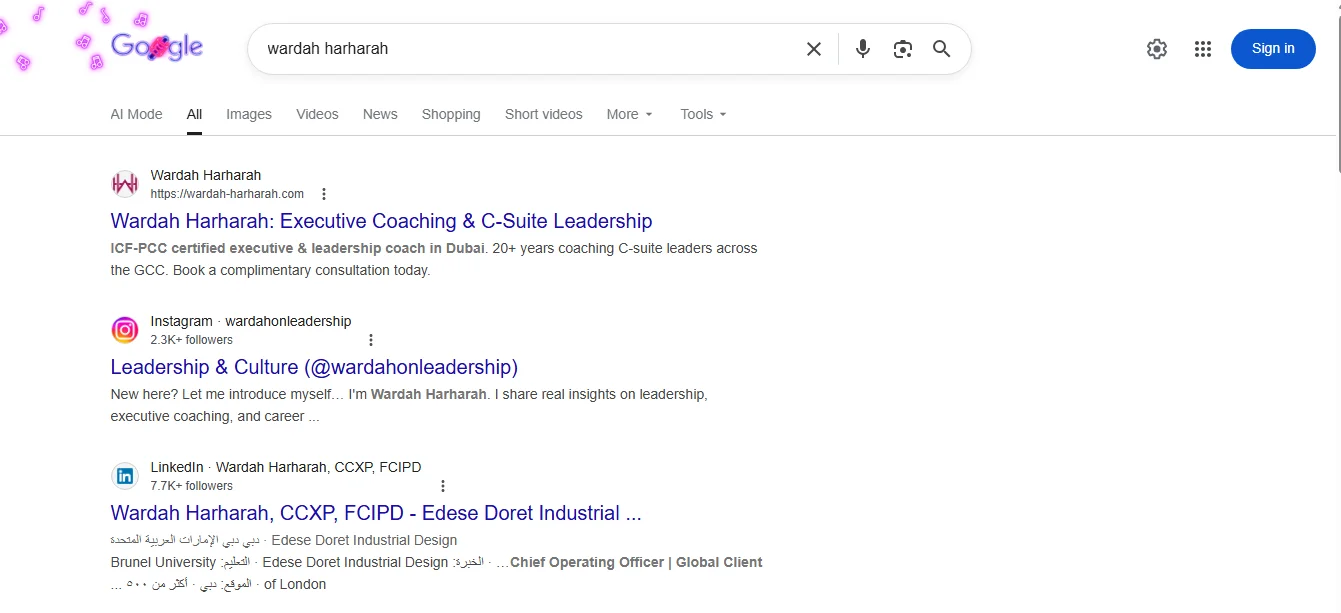
Before: Searching “Wardah Harharah” returned only standard results — no Knowledge Panel
Google had no verified, structured record linking her name to her book, credentials, and profession.
Despite being published and listed on Amazon, the book had never been submitted to Google Books — the primary trigger for author Knowledge Panels.
The book was absent from Open Library, LibraryThing, BookBrainz and other structured databases Google cross-references to verify authors.
Neither the author nor the book existed as structured entities in Wikidata — one of Google’s most trusted Knowledge Graph sources.
Why the Panel Was Not Appearing
Google’s Knowledge Panel is not triggered by fame or follower count. It is triggered by entity confidence — Google’s ability to cross-reference consistent, structured information about a person across multiple trusted sources.
My audit revealed a clear pattern: Wardah had strong individual profiles but they were not connected. Google could see a website, a LinkedIn profile, and an Amazon listing — but could not confidently link them all to the same person as a verified, notable author.
The audit identified three specific gaps: structured entity records (Wikidata), book platform distribution (Google Books and library databases), and cross-platform consistency of name, credentials and descriptions.
Three Pillars of Entity SEO — Working Together
Knowledge Panels are not triggered by a single action. The strategy required all three pillars working simultaneously — each one reinforcing the others and giving Google the cross-referenced evidence it needed to build confidence in the entity.
Entity Building — Wikidata and Structured Data
Structured entity records were created for both the author and the book in Wikidata — the global knowledge database that directly feeds Google’s Knowledge Graph.
Each entry was populated with verified facts: credentials, occupation, location, notable work, ISBN, publication date, and cross-links between the two entries. Schema markup was also audited on the author’s website.
Book Distribution — Google Books and Library Databases
The book was submitted to the Google Books Partner Program and listed across 10+ trusted book platforms. Each platform creates a new trusted signal that Google can cross-reference.
Consistency of title, author name, ISBN, and description was maintained precisely across every platform — no variations, no discrepancies.
Cross-Platform Consistency — The Entity Footprint
Existing profiles on Amazon Author Central, Goodreads, and the author’s website were audited and aligned. The same name, description, credentials, and book details were used across every platform.
This consistency is what gives Google the confidence to build a Knowledge Panel. A single discrepancy can slow the process significantly.
10+ Platforms. One Consistent Identity.
Over three months, the book was listed and the author’s entity was established across every major platform Google trusts for author and book verification. Every listing used identical core information — no variations in name, credentials, or book details.
Each platform serves a different purpose in Google’s entity verification process. Some (Wikidata, Open Library) are structural databases Google reads directly. Others (Google Books, Goodreads) are high-trust consumer platforms. Together they create a web of cross-referenced signals that Google uses to build confidence in an entity.
The Knowledge Panel Appeared.
After three months of consistent entity building work, the Knowledge Panel appeared on Google search results for “Wardah Harharah”.
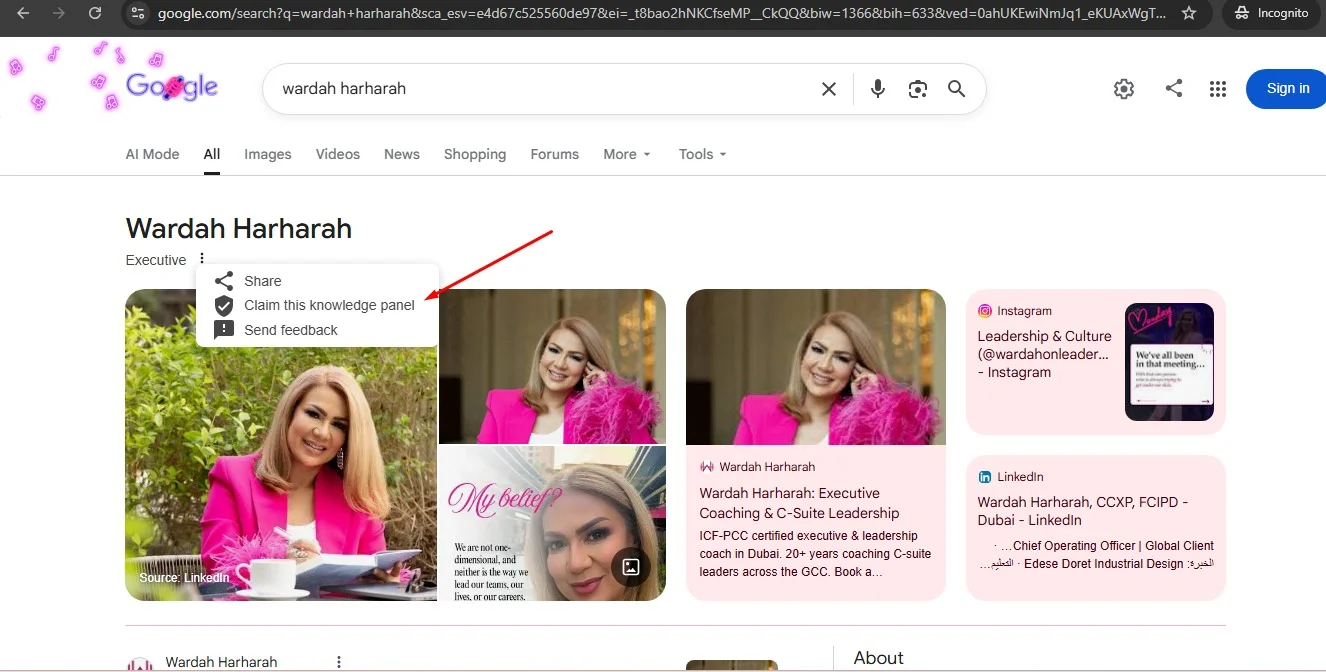
After: The Google Knowledge Panel now appears when searching “Wardah Harharah”
📊 What the Knowledge Panel Shows
The panel pulled information directly from the structured entity data built across multiple trusted platforms.
What This Case Study Proves
There is no button to press. Google builds a panel when it has sufficient structured evidence across trusted sources. The work is in building that evidence consistently.
Rankings are about keywords. Knowledge Panels are about identity. The signals Google needs for a panel are completely different from those that drive keyword rankings.
A published book on Google Books is one of the strongest triggers for an author Knowledge Panel. Without it, even a well-known author may not have a panel.
Every platform must show the same name, description, credentials and book details. A single discrepancy can slow Google’s entity confidence and delay the panel.
The same structured entity signals that trigger a Knowledge Panel also make a person more likely to be cited by AI tools like ChatGPT, Perplexity and Google AI Overviews.
Three months of sustained, methodical work across 10+ platforms. Not a quick fix. A structured process that requires knowing which signals matter and executing them precisely.
Need a Google Knowledge Panel for Yourself or a Client?
Every Knowledge Panel project starts with a free 30-minute strategy call where I review the current entity footprint and tell you exactly what needs to be done. No pitch. No pressure.
✅ Free 30-min call ✅ No commitment ✅ Response within 24 hours