
Most sites that struggle with SEO have done keyword research. They know which keywords matter. What they have not done is the step that turns a list of keywords into a functioning content strategy: keyword mapping.
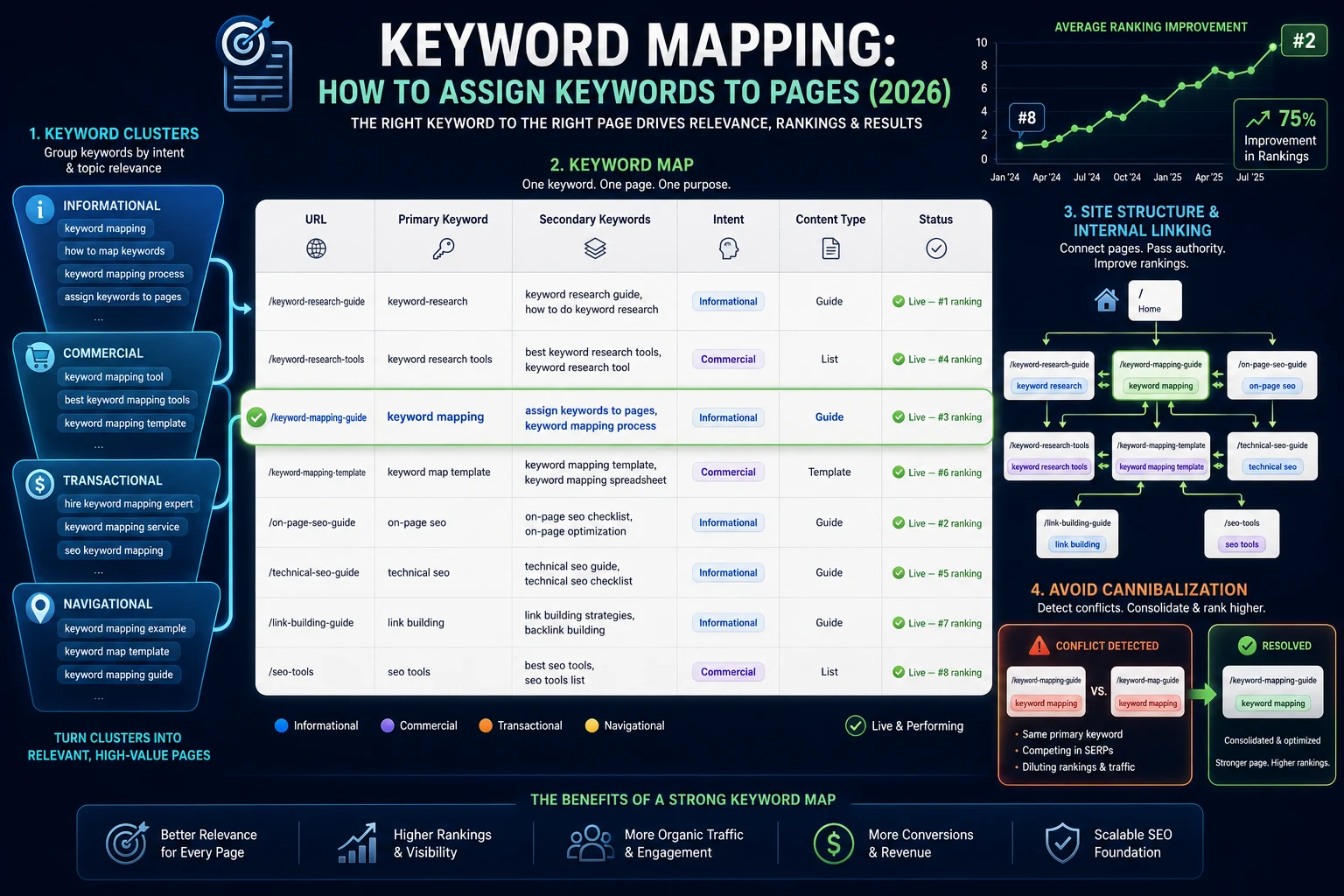
Keyword mapping is the process of assigning specific keyword clusters to specific pages, creating a one-to-one relationship between each target keyword group and a single URL on your site. It is the bridge between keyword research and content execution, and without it, even the best keyword research produces a chaotic content strategy where pages compete against each other, coverage gaps go unnoticed, and no single page owns its topic clearly enough to rank.
This guide explains what keyword mapping is, why it matters, how to build a keyword map from scratch, and how to maintain it as your site grows.
What is Keyword Mapping?
Keyword mapping — the process of assigning targeted keyword clusters to specific URLs on a website, documenting which page is responsible for ranking for which queries, and ensuring that every page has a clearly defined search purpose.
The output is a keyword map: a structured document (typically a spreadsheet) that records the relationship between every important keyword on your target list and the page designated to rank for it.
A keyword map does four things simultaneously:
It prevents keyword cannibalistion by making explicit which page owns each keyword. When every team member can see at a glance which page targets which cluster, accidental duplication is prevented before publication rather than diagnosed after the fact.
It reveals content gaps by making visible which keyword clusters in your research do not yet have a corresponding page. These gaps become your content creation priority list.
It guides on-page optimisation by specifying exactly which keywords should appear in each page’s title tag, H1, meta description, URL, and body content.
It supports internal linking strategy by making it clear how pages in the same topic area relate to each other, which pages should link to which, and where authority should flow within the site structure.
Keyword Mapping vs Keyword Research
Keyword research and keyword mapping are sequential steps in the same workflow, not interchangeable terms.
Keyword research is the discovery phase: finding, evaluating, and prioritising keywords based on volume, difficulty, intent, and business relevance.
Keyword mapping is the assignment phase: connecting the output of research to specific pages on your site, creating the structural plan that content production executes against.
You cannot map keywords before researching them, and researching keywords without mapping them to pages produces intelligence with no operational plan behind it. The two steps always work in sequence.
What Goes in a Keyword Map?
A keyword map is a document, most practically a spreadsheet, with one row per page and columns recording the key information about each page’s keyword assignment. At minimum, each row should capture:
URL — the full page address, or a slug for planned pages not yet published.
Page title — the intended title of the page, incorporating the primary keyword.
Primary keyword — the single most important keyword the page is designed to rank for. Every page has exactly one primary keyword.
Secondary keywords — related keywords sharing the same intent and topic that the page should naturally rank for as secondary targets. Typically three to ten per page.
Search intent — the dominant intent of the primary keyword (informational, commercial, transactional, navigational).
Content type — the format the page should take based on SERP analysis (guide, listicle, product page, comparison, landing page).
Target word count — the approximate depth required based on what the SERP shows.
Status — whether the page is live, planned, needs updating, or identified as a cannibalistion conflict.
Current ranking position — for live pages, the current position for the primary keyword, updated regularly.
Internal links in — which other pages on the site link to this page.
Internal links out — which other pages this page should link to.
This structure creates a functional operational document, not just an inventory. When the keyword map is maintained properly, it serves as the single source of truth for the entire content and SEO strategy.
How to Build a Keyword Map: Step by Step
Step 1: Audit Existing Pages
Before mapping keywords to pages, you need a complete inventory of what already exists on your site.
List every significant URL on your site. For each URL, record:
- What the page is about (its current topic focus)
- What keyword it appears to be targeting (if any)
- Current organic traffic (from Google Analytics)
- Current primary keyword impression data (from Google Search Console)
- Whether the page is performing well, underperforming, or not indexed
This audit serves two purposes. It reveals which existing pages are already well-positioned for a keyword cluster and simply need the mapping formalised. It also reveals which pages are competing for the same keyword (cannibalistion), which pages are targeting keywords that do not match the site’s current topical focus, and which have no clear keyword purpose at all.
For a new site with no existing content, skip this step and proceed directly to Step 2.
Step 2: Organise Keyword Research by Cluster
Take the prioritised, clustered keyword list from your keyword research and group related keywords together. Each cluster represents a topic that will be addressed by a single page.
If your keyword research is already clustered (grouped by topic and intent), this step is straightforward: each cluster becomes a row in the keyword map with the highest-volume, best-fit keyword in the cluster designated as the primary keyword and the remaining keywords designated as secondary targets.
If keywords are not yet clustered, cluster them now. Keywords belong in the same cluster when they share the same dominant intent and the same SERP result pages appear in the top ten for all of them (indicating Google treats them as the same topic).
Step 3: Match Clusters to Pages
This is the core mapping decision: for each keyword cluster, which page should own it?
Three scenarios arise:
Scenario 1: Perfect match. An existing page already covers this topic with the right intent and content type. Assign the cluster to that page. The page may need minor optimisation (updating the title tag, adding secondary keywords, improving depth) but the primary assignment is straightforward.
Scenario 2: Imperfect match. An existing page covers a related topic but with the wrong intent, format, or angle for the cluster. For example, an informational guide page exists for a keyword cluster where the SERP clearly wants a comparison article. Options here are: significantly restructure the existing page to match the correct format, or create a new page and resolve any cannibalistion between the two.
Scenario 3: No match. No existing page covers this keyword cluster. It is a content gap. Record it in the keyword map with a status of “planned” and a priority ranking based on the five-dimensional evaluation from the keyword research process.
Work through every cluster systematically, assigning it to one of these three scenarios. When complete, the keyword map now reflects the full relationship between every target keyword and either an existing or planned page.
Step 4: Resolve Cannibalistion Conflicts
During the mapping process, you may discover that multiple existing pages have been inadvertently targeting the same keyword. This is keyword cannibalistion, and it must be resolved before the map is finalised.
For each cannibalistion conflict, choose one of four resolutions:
Consolidate. Merge the competing pages into a single, more comprehensive page and redirect the others to it. The strongest resolution when the pages are covering genuinely similar ground.
Differentiate. If the pages can be clearly distinguished by intent or subtopic, restructure each to clearly own its distinct keyword cluster without overlap.
Redirect. If one page is clearly stronger (better content, more backlinks, higher traffic), redirect the weaker page to the stronger one.
Noindex. For very thin or duplicate pages with no backlinks, a noindex tag removes them from search results without redirecting. Use with care as this is a more drastic option.
Document all cannibalistion decisions and their resolutions in the keyword map with a status note.
Step 5: Apply Keyword Assignments to On-Page Elements
Once each cluster is assigned to its page, the keyword map drives on-page optimisation decisions for that page.
The primary keyword should appear in:
- The title tag (ideally within the first 60 characters)
- The H1 tag (which should closely match or mirror the title tag)
- The page URL (the slug should include the primary keyword or a close variant)
- The meta description (naturally, not forcibly)
- The opening paragraph of the body content
- At least one H2 or H3 subheading where relevant
Secondary keywords should appear naturally throughout the body content, in subheadings where they fit logically, and in image alt text where relevant.
The principle throughout is natural integration. Content written for readers, covering the topic comprehensively, will naturally incorporate the relevant keyword vocabulary. Forcing keyword placement at the expense of readability is counterproductive in 2026’s semantic search environment.
URLs that include the target keyword see approximately 45% higher click-through rates than URLs without keyword relevance. This is one of the most straightforward optimisation wins that keyword mapping enables: ensuring every page’s URL reflects its primary keyword.
Step 6: Plan Internal Links
The keyword map’s record of which pages exist and what they cover creates a natural framework for internal linking.
For each page in the map, identify:
- Which other pages in the map cover related subtopics that this page should link to
- Which higher-authority pages (pillar pages, high-traffic existing pages) should link to this page to distribute authority toward it
- Which pages cover the same broad topic and form a content cluster together
Document the planned internal link structure in the keyword map. When new content is published, the map tells writers which existing pages to link from and which new pages to link to.
Strong internal linking, planned through the keyword map, has a compounding effect on topical authority. Search engines follow these links to understand the relationships between pages and the structure of your topic coverage. A well-linked cluster signals much stronger topical authority than the same pages with no internal links between them.
Keyword Mapping for New vs Established Sites
The keyword mapping process is the same in principle for new and established sites, but the emphasis differs considerably.
New Site: Keyword Mapping as Planning
For a new site with no existing content, keyword mapping is a forward-looking planning exercise. There are no cannibalistion conflicts to resolve and no existing page inventory to audit. The map is built entirely from the keyword research output.
The primary task is:
- Take the full prioritised keyword cluster list from research
- Create one planned URL for each cluster
- Sequence them by priority (starting with lowest-difficulty, most-foundational topics)
- Assign content type, target word count, and intended internal links for each
This becomes the content calendar and production roadmap. The map grows as content is published, with status updated from “planned” to “live” and ranking data added as pages are indexed.
For a new site, the keyword map is the most important strategic document in the entire SEO operation. Every content decision flows from it.
Established Site: Keyword Mapping as Audit and Optimisation
For an established site, keyword mapping begins with the existing content audit and works outward to identify gaps, conflicts, and optimisation opportunities.
The most valuable output for an established site is often not the mapping of new content but the identification of:
Quick wins: Pages ranking in positions 5 to 20 for their primary keyword, where the mapping reveals that a title tag update, content expansion, or additional internal links could push the page into the top three.
Cannibalisation fixes: Pages that were published without a keyword map, resulting in multiple pages competing for the same cluster. Resolving these conflicts often produces immediate ranking improvements for the surviving, consolidated page.
Coverage gaps: Topics that competitors rank for and that the site’s keyword research has identified as priorities, but which have no page assigned.
For an established site, completing a keyword map often produces more immediate SEO value than publishing new content, because it organises the authority that already exists into a more effective structure.
Maintaining the Keyword Map
A keyword map built once and never updated quickly becomes irrelevant. The map is a living operational document that requires ongoing maintenance.
Update rankings monthly. Record current position for each page’s primary keyword at least monthly. Tracking position trends identifies which pages are climbing (validate and support the approach), which are declining (diagnose why), and which are stagnant (identify the limiting factor).
Add new content before publishing. Every piece of new content should be entered into the keyword map before it is published, confirming there is no cannibalistion conflict and that the URL and on-page elements align with the keyword assignment.
Conduct a full audit quarterly. Review the entire map for: pages that have drifted from their keyword assignment (content updates have changed the topic focus), new cannibalistion risks, and clusters that now have a better page than the one originally assigned.
Refresh keyword data annually. Search volume, competition levels, and intent can shift over time. An annual review of the keyword research underlying the map ensures the assignments remain based on current data rather than potentially outdated estimates.
Keyword Mapping and AI Search
In 2026, keyword mapping has an additional dimension: optimising for AI Overview citation potential alongside traditional ranking targets.
AI Overviews synthesise answers from multiple pages based on topical authority and content structure. A well-maintained keyword map contributes to AI citation potential in several ways.
Clear page ownership of specific topics means each page is the unambiguous, well-structured authority on its cluster. AI systems extracting information for a specific query find a clean, focused, authoritative source rather than multiple competing pages with overlapping coverage.
Strong internal linking from the keyword map creates a navigable, clearly structured topic architecture that AI crawlers can follow to understand the full scope of your site’s expertise on each subject.
Explicit keyword-to-page assignment ensures that the most relevant page for any given query is clearly identifiable from its URL, title tag, and opening content, making it easier for AI systems to select the right page as a citation source.
Common Keyword Mapping Mistakes
Assigning too many primary keywords to one page. Each page has one primary keyword. Assigning multiple primary keywords creates an unfocused page that ranks weakly for everything rather than strongly for one thing. Secondary keywords support the primary but never replace the single-focus clarity of one primary keyword per page.
Mapping keywords before completing SERP analysis. A keyword cluster assigned to the wrong content type based on tool data alone, without SERP analysis, is a mapping error that no amount of on-page optimisation can fix. SERP analysis must precede every mapping decision.
Treating the keyword map as a one-time task. A static keyword map becomes outdated quickly. Sites that build a map once and ignore it lose the cannibalistion prevention, gap identification, and internal linking benefits that require ongoing maintenance.
Ignoring existing content in the audit. Mapping keywords to new pages when an existing page already covers the topic results in instant cannibalistion. The audit of existing content must be the first step for any established site.
Mapping by topic alone without considering intent. Two pages can cover the same topic with different intents. “What is keyword mapping” (informational) and “keyword mapping tool” (commercial) are different intent clusters requiring different pages, even though both relate to keyword mapping. Mapping decisions must always be intent-driven, not just topic-driven.
❓ Frequently Asked Questions
How detailed should a keyword map be?
As detailed as needed to prevent ambiguity. At minimum: URL, primary keyword, secondary keywords, intent, content type, and status. For larger sites with multiple content producers, adding target word count, responsible writer, publication date, and internal link targets makes the map more operationally useful.
Can one page rank for multiple keywords?
Yes, and this is expected. A well-written, comprehensive page naturally ranks for dozens or hundreds of keyword variations beyond its primary keyword. The keyword map records the primary and secondary keywords intentionally targeted. Ranking for additional related terms beyond those is a positive outcome, not a concern.
What tool should I use to build a keyword map?
Google Sheets or Microsoft Excel work well for most sites. For large sites with hundreds of pages, specialised tools like Ahrefs, Semrush, or dedicated keyword mapping platforms offer additional automation and integration with rank tracking data. Start with a spreadsheet and move to dedicated tooling when the scale justifies it.
How do I handle a site with 500+ pages?
Prioritise. Map the highest-traffic and highest-priority pages first. Focus initial mapping and optimisation effort on the pages most likely to deliver ranking improvements with the smallest amount of work. Work outward from high-priority, high-traffic pages to lower-priority pages over time.
Is keyword mapping different for e-commerce sites?
The process is the same but the scale and page types differ. E-commerce keyword maps typically include category pages (targeting commercial intent cluster keywords), product pages (targeting transactional keywords), and blog or guide content (targeting informational keywords). Category page mapping is often the highest-value activity for e-commerce SEO because these pages aggregate authority across many product pages.
Summary
Keyword mapping is the critical step between keyword research and content execution. Without it, keyword research produces intelligence with no operational plan, and content is published without clear SEO purpose.
The process: audit existing pages, organise keywords into clusters, match clusters to pages across three scenarios (perfect match, imperfect match, content gap), resolve cannibalistion conflicts, apply keyword assignments to on-page elements, and plan internal links.
The most important principles:
- One primary keyword per page. No exceptions.
- Every mapping decision is intent-driven, not just topic-driven.
- SERP analysis precedes every mapping assignment.
- The keyword map is a living document, not a one-time task.
- For new sites, the keyword map is the content calendar. For established sites, it is the audit tool that reveals the fastest ranking improvement opportunities.
A well-built and consistently maintained keyword map is the structural foundation that allows every other SEO investment, from content creation to link building, to deliver its maximum return.