
There is a phrase that captures the most important shift in search engine history: Google moved from strings to things.
For most of its early history, Google was a string-matching machine. It looked at the words on your page, looked at the words in a search query, and matched them. The more your page contained the exact strings of text the searcher used, the more likely it was to rank.
That approach has been obsolete for years. In 2026, Google reads your content the way a knowledgeable human would. It understands meaning, context, and the relationships between ideas. It recognises that “affordable smartphone” and “cheap mobile phone” refer to the same thing. It knows that a page about keyword research that never mentions search volume, keyword difficulty, or search intent is probably not comprehensive on the topic. It identifies entities, the people, places, products, and concepts referenced in your content, and maps them to a knowledge structure spanning hundreds of billions of facts.
Semantic SEO is the discipline of optimising content for this modern understanding of search. It is the most important conceptual shift any practitioner can make, because it changes how you think about content, keywords, and what it means to be relevant.
What is Semantic SEO?
Semantic SEO — the practice of optimising content based on meaning, context, and the relationships between topics rather than isolated keyword repetition.
Where traditional SEO asked “how often does this page contain the target keyword,” semantic SEO asks “how completely and accurately does this page represent its topic, and how clearly do search engines understand what it is about?”
The practical difference is significant. A page optimised for traditional SEO might repeat its target keyword eight to twelve times across a 1,000-word article. A page optimised for semantic SEO might rank for the same keyword and dozens of related queries while using the exact keyword phrase only twice, because it covers the topic comprehensively using natural language that includes all the conceptually related terms a genuine expert would use.
How Google Understands Meaning: The Technical Foundation
To practice semantic SEO effectively, understanding the technology behind semantic search is important even at a conceptual level.
Natural Language Processing (NLP)
Natural Language Processing — the branch of artificial intelligence concerned with enabling computers to read, understand, and generate human language.
Google’s search system is built on advanced NLP models including BERT, Neural Matching, and AI systems powered by Google’s Gemini. These models do not read content word by word looking for keyword matches. They analyse the full context of a sentence, a paragraph, and an entire document, understanding the meaning and intent of the content as a whole.
BERT, introduced in 2019 and still core to Google’s ranking pipeline under the name DeepRank, reads text bidirectionally. It considers both the words before and after each word simultaneously, giving it the ability to understand context in ways that earlier, left-to-right reading models could not. The result is that Google understands nuance, ambiguity, and contextual meaning in language rather than just pattern-matching words.
Vector Embeddings
Vector embeddings are the mathematical mechanism that makes semantic search possible.
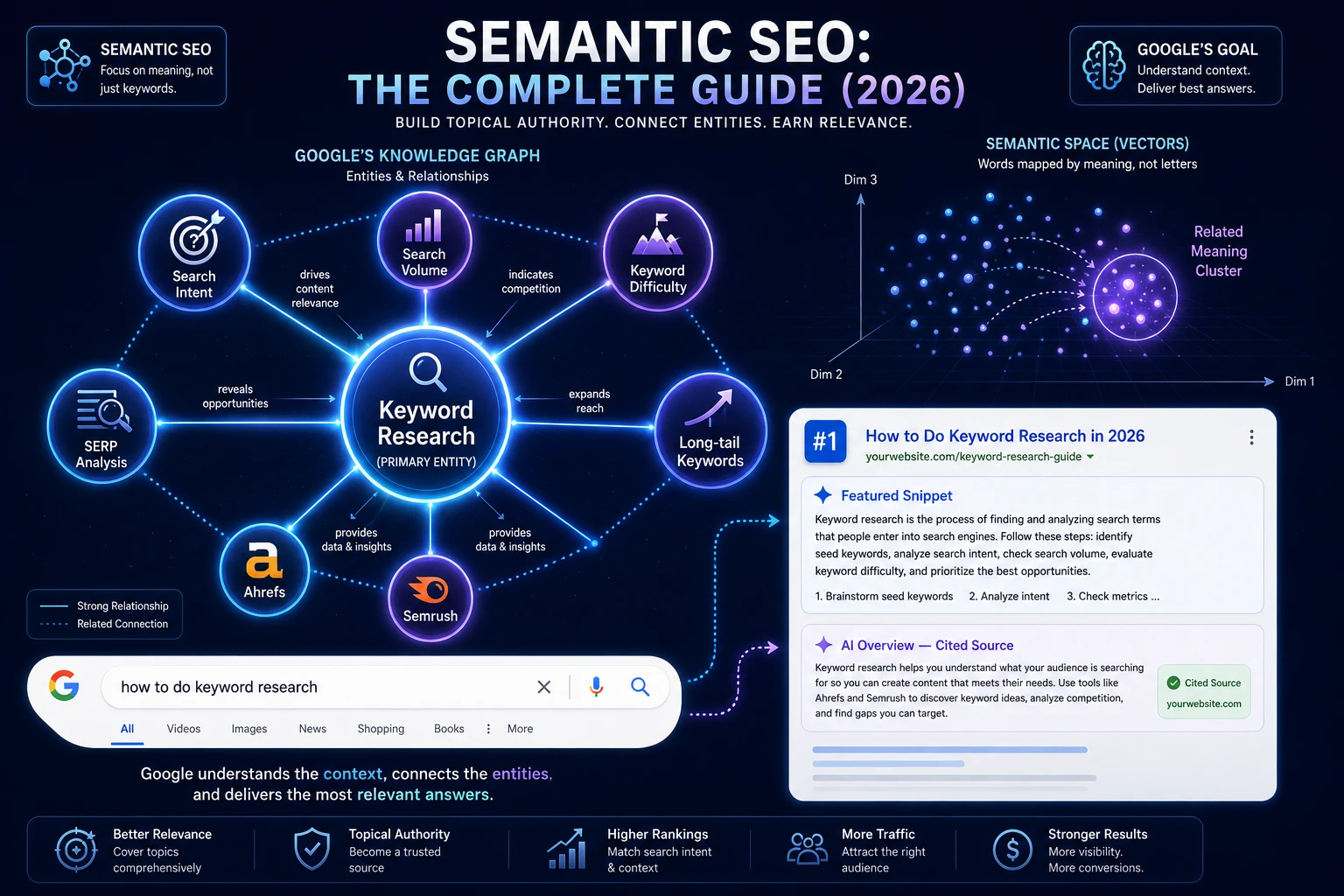
When Google processes a web page or a search query, it converts the text into a numerical vector, a mathematical representation of the content’s meaning encoded as a point in a very high-dimensional space. Pages covering similar topics end up with vectors that are close together in this space, even if they do not share a single keyword.
This is the technology that made exact-match keyword optimisation redundant. Google does not need to find your exact keywords to understand that your page is about a topic. It converts your content into its semantic representation and evaluates how closely it matches the semantic representation of what the user is looking for.
The practical implication is significant: a page can rank for a query without containing a single word from that query, if its semantic content is sufficiently relevant. And conversely, a page that contains the exact query phrase repeatedly but lacks the conceptual depth expected for that topic will rank poorly.
AI Overviews and AI Mode use the same vector embedding approach to select citation sources. Content that covers multiple related concepts, entities, and subtopics produces richer semantic embeddings that match a wider range of query formulations. Semantic completeness shows the strongest correlation with AI Overview citation frequency of any content quality signal measured in 2026.
Entities
Entities are the people, places, organisations, products, concepts, and events that a piece of content references. They are the “things” that Google maps and tracks in its Knowledge Graph.
An entity in SEO is not just a keyword. It is a real-world object or concept with a stable identity that Google can identify, verify, and connect to related entities. “Apple” is a different entity from “apple” (the fruit). “Keyword research” is an entity representing a specific concept within SEO. “Ahrefs” is an entity representing a specific software company.
When Google processes your content, it identifies the entities present, evaluates their salience (how central they are to the content), and maps them to its existing knowledge of those entities and their relationships.
Entity salience — a measure of how central or prominent an entity is within a piece of content, assessed by how much of the content is related to that entity and how directly the entity is addressed.
A page targeting “keyword research” that never mentions search volume, keyword difficulty, seed keywords, long-tail keywords, or SERP analysis has critically low entity salience for the relevant entity cluster. It signals to Google’s NLP systems that the content does not genuinely and comprehensively address the topic it claims to cover.
Semantic SEO vs Traditional SEO
The contrast between traditional and semantic SEO is not just a philosophical difference. It produces measurably different content and outcomes.
Traditional SEO approach:
- Identify a target keyword
- Include the keyword at a specific density (title, headings, body, meta)
- Build links to the page
- Repeat for next keyword
Semantic SEO approach:
- Identify a topic and its full entity and concept landscape
- Create content that comprehensively covers the topic, including all related entities, questions, subtopics, and conceptual connections
- Build authority across the full topic cluster, not just individual pages
- Optimise the site structure to make topic relationships explicit
The semantic approach produces content that ranks for many more queries than the single keyword targeted. A semantically comprehensive guide on keyword research naturally ranks for dozens of related searches: “how to do keyword research,” “keyword research tools,” “keyword difficulty explained,” “what is search volume,” and many more, without requiring separate pages for each variant.
The Core Principles of Semantic SEO
1. Topic Completeness Over Keyword Density
The fundamental measure of semantic optimisation is not how often you use the primary keyword. It is how completely your content covers the topic and its conceptual landscape.
Every significant topic has a set of related concepts, entities, subtopics, and questions that genuinely expert content addresses. For “keyword research,” that landscape includes: seed keywords, search volume, keyword difficulty, long-tail keywords, search intent, SERP analysis, keyword clustering, keyword mapping, and tools like Ahrefs and Semrush.
Content that covers this landscape comprehensively is semantically rich. Content that focuses narrowly on repeating the phrase “keyword research” while ignoring half of the conceptual territory is semantically thin, even if it is long.
Practical test: if you removed all instances of the primary keyword phrase from your content, would a knowledgeable reader still know exactly what the page is about from the surrounding context and concepts? If yes, the content is semantically rich. If no, the content relies too heavily on keyword repetition and lacks conceptual depth.
2. Entity Coverage and Relationships
Identify the key entities your content should reference and ensure they are covered with appropriate depth and accuracy.
For any piece of content, the entity landscape includes:
Primary entities — the main subjects of the content. A page about keyword research has “keyword research” as its primary entity.
Supporting entities — the related concepts, tools, people, and organisations that a complete treatment of the topic references. For keyword research: Ahrefs, Semrush, Google Keyword Planner, search volume, keyword difficulty, seed keywords.
Contextual entities — broader subject area entities that place the primary topic in context. For keyword research: SEO, search engines, Google, content strategy.
Ensuring these entities are clearly present, accurately described, and naturally interconnected in your content strengthens the semantic signal Google receives about what the page is genuinely about.
3. Co-Occurrence Terms
Co-occurrence — the tendency of specific words and phrases to appear together in documents about the same topic, which search engines use as a signal of topical relevance.
When Google processes large amounts of content about keyword research, it develops a statistical model of which terms consistently appear together in expert discussions of that topic. Pages that naturally include these co-occurring terms signal genuine expertise in the topic. Pages that include the primary keyword but lack the expected co-occurrence pattern signal surface-level coverage.
The way to identify co-occurrence terms for any topic is to read the top-ranking content for your target keyword and note the vocabulary those pages consistently use. What terms appear across multiple top-ranking pages that your content does not include? Adding these terms naturally and accurately improves semantic alignment.
4. Topic Clusters and Pillar Architecture
Semantic SEO extends beyond individual pages to site structure. The pillar-cluster model is the architectural expression of semantic SEO at a site level.
A pillar page covers a core topic broadly and comprehensively, linking to cluster pages that address specific subtopics in depth. The cluster pages link back to the pillar and to each other where relevant. This structure makes the topic relationships explicit to search engines and demonstrates that the site has built genuine, multi-level authority on the subject.
For Google’s semantic understanding, a site with a well-structured topic cluster on keyword research, where the pillar links to dedicated pages on search volume, keyword difficulty, keyword clustering, keyword mapping, and long-tail keywords, sends a much stronger topical authority signal than a site with the same number of pages but no structured relationships between them.
5. Search Intent Alignment
Semantic SEO is inherently intent-driven. The semantic meaning Google seeks to match is not just the words of a query but the intent behind it.
A page can be semantically rich on the topic of “keyword research tools” but still fail to rank for the query if it is written as an informational guide when the SERP clearly shows the intent is a comparison and review format. Semantic completeness and intent alignment must work together.
Practical Semantic SEO Techniques
Build a Topic Map Before Writing
Before creating content, map the full conceptual landscape of the topic. List:
- The primary entity and its definition
- All related entities that should appear in the content
- The questions a reader would naturally have after understanding the primary topic
- The subtopics that form the natural scope of comprehensive coverage
- Related pages on your site that this content should link to and from
This map becomes the content outline. Each element on it that is absent from the final content is a semantic gap.
Use Natural Language Naturally
The most important instruction for semantic content writing is to write like a genuine expert addressing a knowledgeable audience. Experts discussing a topic naturally use the full vocabulary of that topic, not just the primary keyword.
A genuine expert writing about keyword research will naturally mention search volume, keyword difficulty, long-tail keywords, search intent, SERP analysis, and tools by name. They will not artificially repeat the phrase “keyword research” beyond where it is naturally appropriate. The full vocabulary of the expert discussion is the semantic signal.
Answer the Full Question Scope
Every significant search query has a broader question scope than the surface query implies. Someone searching “how to do keyword research” is also likely to want to know: what tools to use, how to evaluate keywords, how to prioritise targets, how to avoid cannibalistion, and how to map keywords to content.
Semantically rich content addresses not just the primary question but the natural follow-up questions a reader would have. This is what Google means by “comprehensive” content and what the Helpful Content System evaluates. Content that answers one question and leaves the reader needing to search again for the follow-up questions is semantically incomplete by this measure.
Use Google’s Natural Language API for Content Evaluation
Google provides a free Natural Language API tool (cloud.google.com/natural-language) that demonstrates how Google’s NLP system reads and categorises content.
Paste any piece of content into the tool and check three outputs:
Entities: Which entities does Google identify in your content, and what salience scores does it assign? High salience for your primary entities confirms strong semantic alignment. Missing expected entities reveal gaps.
Categories: How does Google classify the overall topic of your content? If the content category does not match your intended topic, there is a semantic alignment problem. A page about keyword research tools that Google categorises under “Business Operations” rather than “Internet & Telecom > Web Services > Search Engine Optimisation” has a semantic focus issue.
Sentiment: Less relevant to most SEO contexts, but useful for content where tone matters (reviews, comparisons).
This tool gives direct insight into how Google’s NLP systems actually read your content, making it the most actionable semantic SEO diagnostic available.
Implement Structured Data for Entity Clarity
Structured data and schema markup provide an explicit layer of semantic communication above the natural language content of a page. Where NLP infers entity relationships from content patterns, schema markup states them explicitly.
For semantic SEO, the most impactful schema types are:
Article schema with author details (linking to a Person schema with verifiable credentials) explicitly signals E-E-A-T and entity relationships.
Organisation schema with sameAs properties linking to verified profiles (Wikipedia, Wikidata, LinkedIn, Crunchbase) helps Google accurately identify your brand entity in the Knowledge Graph.
FAQ schema makes question-and-answer content explicitly extractable by both traditional rich results and AI Overview systems.
Entity-specific schemas (Product, Recipe, LocalBusiness, Event) provide structured entity data that supplements NLP interpretation.
In 2026, structured data that explicitly identifies entities and their relationships to other known entities is a direct input to Knowledge Graph recognition and AI Overview citation eligibility.
Semantic SEO and AI Search
The relationship between semantic SEO and AI search in 2026 is direct and important.
AI Overviews and AI Mode do not retrieve results by keyword matching. They use vector embedding similarity to find pages whose semantic content best matches the query. A page that is semantically rich, well-structured, and covers a topic comprehensively produces embeddings that match a wider range of query formulations, giving it more opportunities to be selected as a citation source.
Semantic completeness, the degree to which a page covers all the expected entities, concepts, and subtopics of its primary topic, is the content quality signal most strongly correlated with AI Overview citation frequency.
This means that semantic SEO is not just a strategy for ranking in traditional search. It is the strategy for appearing in AI-generated answers. The two objectives, traditional organic ranking and AI citation, are served by the same practices.
Measuring Semantic SEO Performance
Traditional SEO measurement focuses on keyword rankings. Semantic SEO requires a broader measurement framework.
Keyword spread. A semantically optimised page should rank for many more queries than its primary keyword alone. Use Google Search Console to track the total number of queries each page appears for. A well-executed semantic page on keyword research should appear in Search Console data for dozens to hundreds of related queries.
Entity recognition in Google NLP API. Test content before and after semantic optimisation to verify that entity salience scores for primary entities have improved and that expected entities are now present in the entity extraction.
Featured snippet and People Also Ask appearance. Semantically comprehensive content that directly answers questions earns these SERP features at higher rates. Tracking featured snippet and PAA appearances is a leading indicator of semantic quality.
AI Overview citation tracking. Monitor whether your brand and specific pages appear as cited sources in AI Overviews for your target topics. This is an emerging measurement category that increasingly important SEO tools are building features to track.
Common Semantic SEO Mistakes
Confusing semantic SEO with keyword synonyms. Adding synonyms and keyword variations is not semantic SEO. It is just extended keyword targeting. Semantic SEO is about conceptual completeness, entity coverage, and topic depth, not lexical variation.
Treating semantic SEO as a content length prescription. “Write longer content” is not semantic SEO advice. A 5,000-word article that is semantically thin (repetitive, poorly structured, entity-sparse) is worse than a 1,500-word article that is semantically complete. Depth of coverage, not length, is the measure.
Ignoring site structure. Semantic SEO at the page level without the supporting topic cluster architecture at the site level underperforms. The relationship between pages matters as much as the semantic quality of individual pages.
Overfocusing on technical implementation and underfocusing on content quality. Structured data, NLP tools, and entity analysis are useful diagnostics and signals. But the foundation of semantic SEO is genuinely expert, comprehensive content. No amount of schema markup compensates for thin content.
❓ Frequently Asked Questions
Is semantic SEO replacing traditional SEO?
It is not replacing traditional SEO so much as evolving it. The foundational elements of SEO, technical health, backlink authority, user experience, and intent alignment, all remain essential. Semantic SEO changes how content is created and structured within that foundation. The two work together rather than one replacing the other.
Do keywords still matter in semantic SEO?
Yes, but their role has changed. Keywords are still the bridge between what users search and what content addresses. The difference is that semantic SEO uses keywords as topic indicators and intent signals rather than as strings to repeat at specific densities. Keyword research remains foundational. Keyword stuffing is counterproductive.
How do I know if my content is semantically rich enough?
Run it through Google’s Natural Language API and check entity salience and topic categorisation. Compare it to top-ranking content for your target keyword: what entities, concepts, and subtopics do those pages cover that yours does not? The gaps revealed by this comparison are the semantic gaps to address.
How long does semantic SEO take to show results?
Semantic improvements to existing content typically show ranking results within four to twelve weeks as Googlebot recrawls and reindexes the updated pages. Structural changes to topic cluster architecture take longer to produce compounding authority effects, typically three to six months.
Summary
Semantic SEO is the practice of optimising content based on meaning, context, and topic completeness rather than keyword repetition. It is built on Google’s ability to convert text into mathematical semantic representations (vector embeddings), identify and map entities using NLP, and evaluate topical completeness against the expected conceptual landscape of a topic.
The core principles:
- Topic completeness matters more than keyword density
- Entities must be identified, covered accurately, and appropriately salient in content
- Co-occurrence vocabulary, the terms that naturally appear alongside your primary topic in expert discussions, should be present in your content
- Topic cluster architecture at the site level amplifies semantic authority beyond what individual page optimisation achieves
- AI search systems use the same semantic evaluation mechanisms as traditional ranking, making semantic SEO the unified strategy for both
The phrase that captures what semantic SEO requires of content creators: write like a genuine expert for a knowledgeable audience, covering the full scope of the topic. Google’s semantic systems are sophisticated enough to know when that standard has been met and when it has not.
Advanced Semantic SEO: Entity Optimisation and the Knowledge Graph
For practitioners ready to go beyond the foundational principles, entity optimisation and Knowledge Graph recognition represent the next level of semantic SEO.
Understanding the Knowledge Graph
Google’s Knowledge Graph is a database of entities and the relationships between them. It contains billions of facts about the world: that Ahrefs is an SEO software company, that its founder is Dmitry Gerasimenko, that it competes with Semrush, that it is headquartered in Singapore. These are not stored as web pages. They are stored as structured data relationships between entities.
When Google processes content, it does not just read text. It maps the entities it finds to this existing Knowledge Graph structure. Content that references clearly identified, verifiable entities in accurate, contextually appropriate ways aligns with Google’s existing knowledge structure. This alignment strengthens the semantic signal.
Appearing in the Knowledge Graph as an entity (rather than just referencing entities) is the highest form of semantic authority for a brand. Knowledge Graph entities receive knowledge panel displays in search results, are cited in AI Overviews as named sources, and are recognised across multiple search surfaces including voice search and Google Discover.
How to Build Knowledge Graph Recognition
For a brand or author to become a recognised entity in Google’s Knowledge Graph, several signals contribute:
Wikidata and Wikipedia presence. These are Google’s highest-trust entity sources. A Wikidata entity record with accurate, verifiable information about your brand or an author establishes a stable entity anchor that Google can confidently map to.
Consistent structured data across the site. Organisation schema with sameAs properties linking to LinkedIn, Crunchbase, Twitter/X, and other authoritative profiles creates a web of consistent entity signals that Google can verify.
Third-party mentions and citations. Being referenced by name in authoritative publications, particularly those that already have strong Knowledge Graph recognition, transfers entity recognition signal. Digital PR that earns coverage in established publications is entity-building activity as much as it is link-building.
Consistent brand information across platforms. The same name, logo, description, and foundational facts appearing consistently across your website, Google Business Profile, LinkedIn, Crunchbase, and industry directories reduces entity disambiguation uncertainty.
SERP Overlap as a Semantic Clustering Signal
One of the most technically accurate ways to determine whether keywords belong on the same page or separate pages is SERP overlap analysis.
Two keywords belong in the same content cluster if the top ten search results for each keyword significantly overlap, meaning many of the same pages appear in both sets of results. This overlap tells you that Google treats both keywords as the same topic, even if the phrasing is different.
When overlap is low, Google distinguishes the two queries as separate topics requiring separate pages.
Research combining SERP overlap clustering with vector-based keyword similarity has shown 90% coherence in cluster accuracy compared to 70% with keyword similarity alone. Using SERP overlap, either manually or through tools like Ahrefs or Semrush that compare SERP results across keywords, produces more reliable clustering decisions than using keyword similarity metrics alone.
Semantic SEO Checklist
Before publishing any piece of content optimised for semantic SEO, verify:
Topic completeness
- Have all expected entities for this topic been identified and covered accurately?
- Do all key subtopics within the scope of this query receive adequate coverage?
- Are the follow-up questions a reader would naturally have after the main content addressed?
- Does the content use the natural vocabulary of genuine expertise on this topic?
Entity clarity
- Is the primary entity of the page clearly identified and consistently referenced?
- Does the content include supporting entities with appropriate accuracy and depth?
- Have contextual entities that place the primary entity in its broader topic landscape been included?
Structural signals
- Is the heading structure logical and does it reflect the full topic scope?
- Is relevant structured data implemented (Article, FAQ, Organisation schema)?
- Does the content link to related cluster pages on the same site?
Semantic verification
- Has the content been tested in Google’s Natural Language API to verify entity salience and category classification?
- Does the entity and category output match the intended topic?
AI citation readiness
- Are direct, concise answers provided near the beginning of relevant sections?
- Is factual information accurate and consistent with other authoritative sources?
- Does the content cover the topic at sufficient depth to be selected as a source for multiple sub-questions about the topic?