
Keyword cannibalistion is one of the most common and most misunderstood SEO problems on established websites. It happens silently, grows over time, and produces symptoms that are frustratingly easy to mistake for something else: rankings that plateau, traffic that stagnates, pages that should rank well but never break onto the first page.
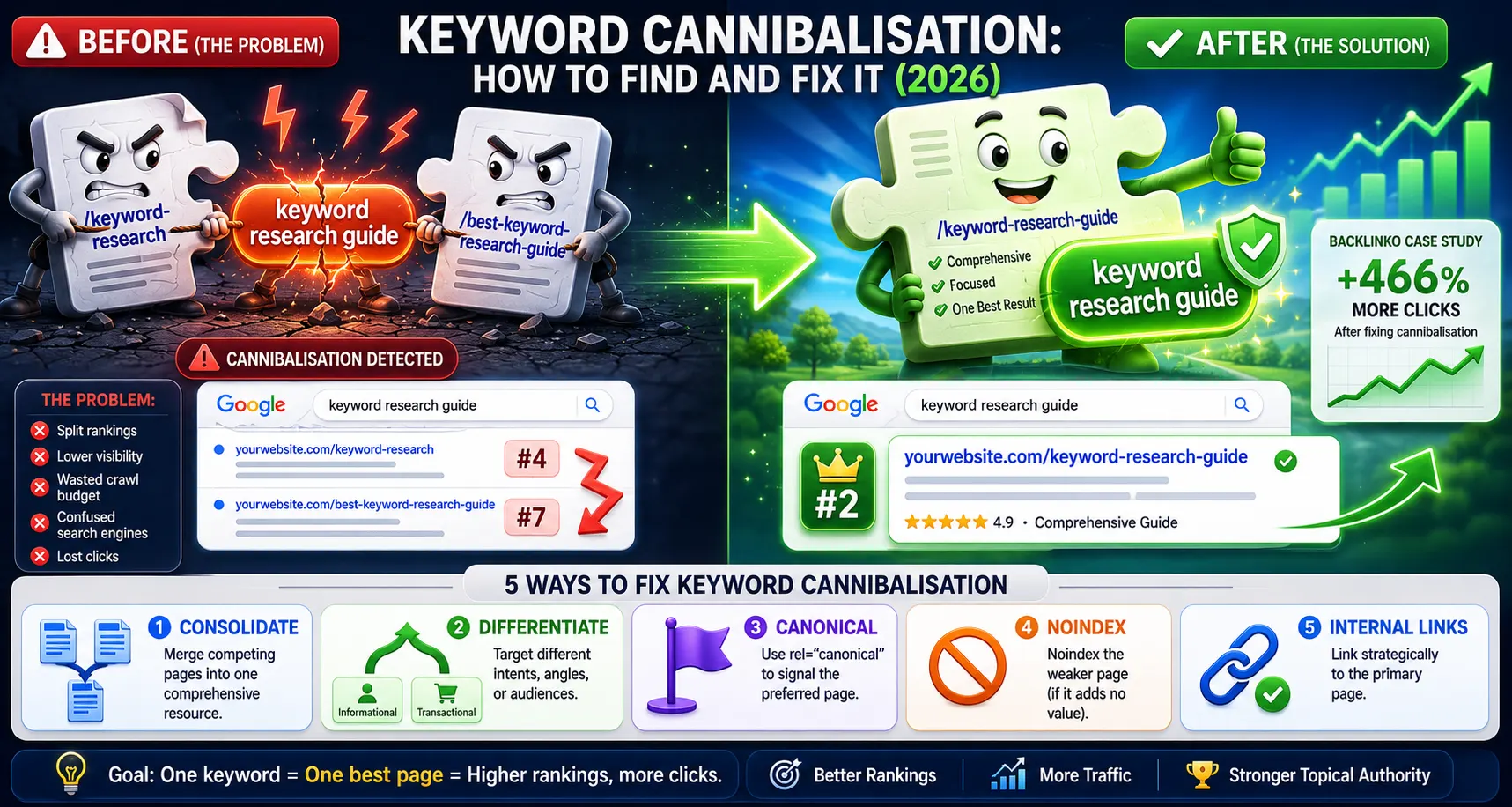
When Backlinko discovered that two of their articles were cannibalising each other, they consolidated them with a 301 redirect. The result was a 466% increase in clicks year over year. That outcome is not unusual. Fixing cannibalistion is one of the highest-ROI activities in SEO because it unlocks ranking potential from pages that already have authority and backlinks, without requiring new content or link building.
This guide explains exactly what keyword cannibalistion is, how to diagnose it correctly, how to choose the right fix, and how to prevent it from returning.
What is Keyword Cannibalistion?
Keyword cannibalistion — an SEO issue that occurs when two or more pages on the same website target the same keyword and serve the same or very similar search intent, causing them to compete against each other in search results, split ranking signals, and weaken both pages.
The practical effect: instead of one strong page ranking well for a keyword, you have two weaker pages dividing the link equity, authority, and click signals that would otherwise concentrate on a single page. Google cannot confidently identify which page is the most relevant result, so it ranks neither as high as the stronger consolidated page would rank.
How Keyword Cannibalistion Damages Rankings
Understanding the mechanism helps explain why the problem matters and why it is often worse than it appears.
Link equity is divided. When multiple pages target the same keyword, any backlinks pointing to each page split their authority between them. A single page with 20 backlinks pointing to it is significantly stronger than two pages each receiving 10 of those links.
Google is uncertain which page to rank. When Google’s algorithm identifies multiple pages from the same domain as relevant to a query, it must choose between them. It may rank the wrong page (one without the best content or backlinks), rotate between them inconsistently, or rank both at lower positions than either would achieve alone.
Ranking oscillation occurs. A clear symptom of cannibalistion in historical ranking data is two competing pages alternating in position for the same keyword, one appearing in the top five one week and the other appearing a few positions lower the next, with neither consistently maintaining a strong ranking.
Conversion rates suffer. Even when cannibalistion causes the right page to rank, the wrong page may rank instead, sending users to a page that does not match the conversion goal. A classic example: a product category page should rank for a transactional keyword but an old blog post outranks it instead. Traffic arrives but nobody converts because the blog post does not facilitate a purchase.
User experience degrades. Multiple pages on the same site answering the same question fragment the user experience and create redundant content that serves neither search engines nor readers well.
True Cannibalistion vs False Positives
Before diagnosing fixes, understanding what is and is not genuine cannibalistion prevents unnecessary action that could actually harm rankings.
True cannibalistion exists when: two or more pages target the same keyword AND serve the same or very similar intent. Both pages address the same question, for the same type of user, in the same format. Google is genuinely uncertain which one to prefer.
False positives occur when: two pages target the same keyword but with different intent, or when one page ranks for a keyword as a secondary variant rather than a primary target. A pillar page ranking for “keyword research” and a cluster page ranking for “keyword research tools” is not cannibalistion. The pages serve different intents and the secondary ranking reinforces topical authority.
The critical test is intent alignment, not keyword overlap. Two pages using the same keyword phrase are only cannibalising if they are both trying to serve the same searcher goal with the same type of content. If the SERP analysis confirms the pages serve different intents, they are not genuinely competing.
Many SEO tools flag keyword overlap as cannibalistion without intent analysis. Treat these flags as leads to investigate, not automatic confirmation of a problem.
Common Causes of Keyword Cannibalistion
Publishing similar content over time without coordination. The most common cause. A site publishes a guide on “keyword research” in 2022, then publishes another guide on “how to do keyword research” in 2024 without checking whether a page already covers that topic. Both pages target the same intent and compete.
Publishing new versions without retiring old ones. An article is updated and republished under a new URL without redirecting the old URL. Both the 2022 version and the 2024 version remain live, competing for the same keyword.
Over-optimising multiple pages for the same keyword. A site has a product page, a category page, and a blog post all aggressively optimised for the same keyword phrase. The blog post ranks when the product page should.
Poorly structured site architecture. Category pages, tag pages, and archive pages can generate hundreds of thin, overlapping URLs that compete with each other and with primary content pages for the same keyword territory.
E-commerce product and category overlap. Product pages optimised for the same keyword as their parent category pages frequently cannibalise each other, particularly when product descriptions closely mirror category page copy.
How to Find Keyword Cannibalistion
Method 1: Google Search Console
Google Search Console is the most reliable free tool for identifying cannibalistion.
In Search Console, navigate to Performance and click on a keyword that you believe may have a cannibalistion issue. Apply the query filter and then switch to the Pages tab. If two or more different URLs from your site appear in the data for the same query, investigate whether those pages are targeting the same intent.
Check the date range across several months and observe whether different pages have been appearing for the same query at different times. Fluctuating between two URLs for the same keyword is a strong cannibalistion signal.
Method 2: Google site: Search
Type the following into Google: site:yourdomain.com “target keyword phrase”
Google will return all pages on your domain that are relevant to that phrase. If multiple pages appear and you suspect they serve the same intent, click through each result and assess whether they are genuinely targeting the same audience goal or whether their content distinguishes them clearly.
This method is quick and requires no tools. For large sites, it is most useful as a spot-check on specific suspected keywords rather than a comprehensive audit.
Method 3: Ahrefs or Semrush Organic Keywords Report
Enter your domain into Ahrefs Site Explorer or Semrush Domain Overview and go to the Organic Keywords report. Filter or search for a specific keyword. The ranking history view in Ahrefs is particularly useful: if multiple URLs from your domain have appeared in the top twenty for the same keyword over recent months, alternating in position, that is a clear cannibalistion indicator.
Both tools also have dedicated cannibalistion audit features that scan your entire domain and flag keywords where multiple pages are ranking simultaneously. Use these reports as a starting point for investigation, then apply the intent test to filter out false positives.
Method 4: Historical Ranking Oscillation
In any rank tracking tool (Ahrefs, Semrush, or dedicated rank trackers), look at the historical ranking data for your most important keywords. If you see two different URLs from your domain appearing alternately in the ranking chart for the same keyword, this oscillation is a diagnostic signal that Google is uncertain which page to prefer.
How to Fix Keyword Cannibalistion
Once genuine cannibalistion is confirmed, the fix depends on the specific situation. There are five possible resolutions, and choosing the right one matters.
Fix 1: Consolidate and Redirect (Most Common)
When two pages cover the same topic with the same intent and neither has substantially superior backlinks or traffic, merging them into a single, stronger page is the most effective resolution.
The process: identify which page is stronger (more backlinks, more traffic, better content, preferred URL structure). Incorporate the best content from both pages into the stronger page. Permanently redirect (301 redirect) the weaker page to the stronger one. Update internal links to point to the consolidated page.
The consolidated page inherits the link equity and traffic signals from both original pages, and a single focused page almost always outperforms two divided ones.
The Backlinko case study is the clearest documented example: consolidating two cannibalising articles with a 301 redirect produced a 466% year-over-year click increase. The authority and signals that were divided between two pages concentrated on one.
Fix 2: Differentiate and Reoptimise
When two pages cover the same topic but can be meaningfully differentiated by intent or audience, restructuring each page to clearly serve a distinct goal is the right approach.
This fix applies when the pages target the same keyword but should legitimately serve different searcher needs. One page might be reoptimised to serve informational intent (what is keyword research) while the other is reoptimised for commercial intent (best keyword research tools). If the SERP analysis supports two distinct content types for related keywords, differentiation rather than consolidation is appropriate.
The key: the differentiation must be genuine and substantial. Cosmetic changes (a different title with the same content) do not resolve the underlying cannibalistion. The pages must genuinely serve different intents to compete as separate entities rather than against each other.
Fix 3: Apply a Canonical Tag
When two pages must both exist (for example, a product page and a printer-friendly version, or multiple pagination URLs covering the same content) but one is clearly the preferred ranking target, the canonical tag tells Google which URL to treat as the authoritative version.
The canonical tag does not remove the non-canonical page from the index. It tells Google to attribute all ranking signals to the canonical URL. Use this for technical duplication situations rather than content cannibalistion, where consolidation or differentiation is usually more effective.
Fix 4: Noindex the Weaker Page
When a page exists for a legitimate operational reason but should not rank in search results (for example, a legacy URL structure kept for internal references, or a thin category page that cannot be improved), applying a noindex meta tag removes it from Google’s index without requiring a redirect.
Use noindex with care. It is a one-way door in that once a page is noindexed, any ranking signals it had accumulated are not automatically transferred to another page. Consolidation with a redirect is usually preferable to noindex for pages with any meaningful authority.
Fix 5: Strengthen Internal Linking
When one page is clearly preferred but a competing page continues to intercept rankings, strengthening internal links to the preferred page helps signal to Google which URL should be prioritised.
Ensure that all relevant internal links across the site point to the intended ranking page, not the competing one. This is often a supporting action used alongside other fixes rather than a standalone solution, but for mild cases where the cannibalistion is primarily a link signal issue, it can be sufficient.
Choosing the Right Fix: Decision Framework
| Situation | Recommended Fix |
|---|---|
| Both pages cover same topic, same intent | Consolidate and 301 redirect the weaker to the stronger |
| Pages can be meaningfully distinguished by intent | Differentiate and reoptimise each for distinct intent |
| Technical duplication (same content, different URLs) | Canonical tag on duplicate, primary page as canonical |
| Page exists for non-SEO reasons but should not rank | Noindex the page |
| Preferred page exists but wrong page keeps ranking | Strengthen internal links to preferred page first, then assess |
How to Prevent Keyword Cannibalistion Going Forward
Fixing existing cannibalistion is a reactive measure. Prevention is far more efficient and starts with two practices.
Maintain a keyword map. The single most effective prevention tool is a keyword map that assigns one primary keyword cluster to one URL before any content is published. Before commissioning or publishing any new piece of content, check the map to confirm no existing page already covers that intent. If one does, either build on the existing page or deliberately differentiate the new content enough to serve a genuinely distinct intent.
Run a SERP overlap check before publishing. Before finalising any new content, search the target keyword in an incognito window. If your own site already appears for that query with a different URL, investigate before publishing additional content. Google telling you that an existing page is already relevant to that query is a strong signal that a new page on the same topic will cannibalise it.
Review cannibalistion quarterly. For active sites with regular content publication, a quarterly cannibalistion audit using Search Console and your primary SEO tool prevents small issues from compounding into significant ranking problems. New content added over the previous quarter is the primary risk area to review.
❓ Frequently Asked Questions
Is all multi-URL ranking for the same keyword a problem?
No. Sometimes Google ranks two pages from your site for the same keyword in positions five and eight, for example. If one is a pillar page and the other is a closely related cluster page, and both serve distinct aspects of the user’s need, this can be a sign of strong topical authority rather than cannibalistion. The issue arises when pages compete for the same position and neither can hold it consistently, not when multiple pages appear for a broad keyword with legitimately different angles.
Can I prevent cannibalistion without a keyword map?
You can reduce the risk by doing a site: search before publishing new content, but a keyword map is the most reliable prevention mechanism for sites producing content at scale. Without it, cannibalistion accumulates silently and requires periodic reactive audits to address.
Does fixing cannibalistion always improve rankings?
Not immediately and not always dramatically, but it almost always improves the situation over time. After consolidating pages and implementing redirects, expect three to twelve weeks for Google to recrawl, reindex, and reflect the consolidation in rankings. Sites with significant cannibalistion problems often see meaningful ranking improvements after systematic fixes, as the Backlinko 466% example demonstrates.
Should I worry about cannibalistion on a new site?
Less so. A new site with a small content library and a keyword map from the start is unlikely to develop significant cannibalistion. The problem accumulates on sites that have published content for years without a systematic keyword assignment process. A new site using a keyword map from day one is effectively preventing the problem before it starts.
What happens to the SEO value of a redirected page?
A 301 redirect passes the majority of link equity (typically estimated at 90% or more) from the redirected page to the destination URL. The redirected page’s backlinks, authority, and historical ranking signals consolidate on the surviving page. This is why consolidation with a redirect almost always produces better rankings than two separate pages competing with each other.
Summary
Keyword cannibalistion occurs when multiple pages on the same site target the same keyword and intent, dividing authority, confusing Google’s ranking decisions, and weakening both pages. It is one of the most common causes of ranking plateaus on established sites and one of the highest-ROI problems to fix.
The key principles:
- True cannibalistion requires both keyword overlap AND intent overlap. Keyword overlap alone is not sufficient.
- Ranking oscillation (two URLs alternating in position for the same keyword) is the clearest diagnostic signal.
- The right fix depends on the situation: consolidate and redirect (most common), differentiate and reoptimise, apply canonical tags, noindex, or strengthen internal links.
- Fixing cannibalistion unlocks existing authority rather than requiring new content or link building. The returns can be dramatic.
- Prevention is more efficient than remediation. A keyword map that assigns one primary keyword per page eliminates the primary cause of cannibalistion before it develops.
Cannibalistion in Specific Site Types
The problem manifests differently across different types of websites, and the diagnostic approach should reflect the site structure.
E-commerce Sites
E-commerce sites face some of the most complex cannibalistion challenges due to the layered structure of product pages, category pages, subcategory pages, and filtered views.
The most common e-commerce cannibalistion patterns:
Product page vs category page conflict. A product page optimised for “running shoes” cannibalises the category page targeting the same keyword. The fix is usually to focus the category page on the broader keyword and redirect product-level optimisation to more specific long-tail variants (for example, “Nike Air Zoom Pegasus 40”).
Faceted navigation URL proliferation. Filter and sort parameters on e-commerce category pages generate hundreds of near-duplicate URLs (for example, /running-shoes?colour=blue, /running-shoes?size=10) that cannibalise both the base category page and each other. The standard fix is to use canonical tags pointing all parameter variants to the base category URL, or to noindex faceted parameter URLs entirely.
Thin product variant pages. Multiple product pages differing only in colour or size often target the same keyword. These should typically be served as variants on a single product page rather than separate indexed URLs.
Blog-Heavy Sites
Content-first sites and blogs accumulate cannibalistion naturally over time as writers address related topics across multiple posts without tracking keyword assignments.
The most common blog cannibalistion pattern is temporal: an article published in 2022 is still indexed and ranking while a 2024 update of the same topic has been published under a different URL. Neither is strong enough to consistently hold the top positions.
The systematic fix for blog cannibalistion is a content audit that identifies all posts in the same topic area, assesses which is strongest (most backlinks, most traffic, best content), and consolidates others into the primary post with 301 redirects.
Sites with Tag and Archive Pages
WordPress and similar CMS platforms generate tag pages, category archive pages, and date archive pages that can multiply URL count dramatically without adding unique content. These pages often cannibalise primary content pages by ranking for the same keyword terms while offering no additional value.
The standard approach: noindex tag pages and date archive pages unless they serve a genuine user need. Category archive pages can be retained and optimised if they can be made substantively useful (with an introductory description, curated featured posts, and distinct content beyond just a list of posts). Those that cannot be made genuinely useful should be noindexed.