

Let me be straight with you. For years, “ranking” meant one thing: getting to the top of Google. You optimized your title tags, built backlinks, chased featured snippets. That was the game.
But in 2026, a growing number of people are not opening Google at all. They type their question into ChatGPT and take the answer at face value. No scrolling, no comparing ten links. Just an answer. And if your brand or content is not inside that answer, you are invisible to them.
That is not a future problem. It is happening today.
Understanding how to rank in ChatGPT answers is now a core part of any serious content and SEO strategy. I have spent a lot of time digging into how ChatGPT decides what to cite, testing different content structures, and tracking what actually changes citation behavior versus what is just noise. This guide is everything I have learned, organized into things you can actually act on.
First, Understand What “Ranking in ChatGPT Answers” Actually Means
People throw around the phrase “ranking in ChatGPT” loosely. Let me clarify what it actually means because the goal shapes the strategy entirely.
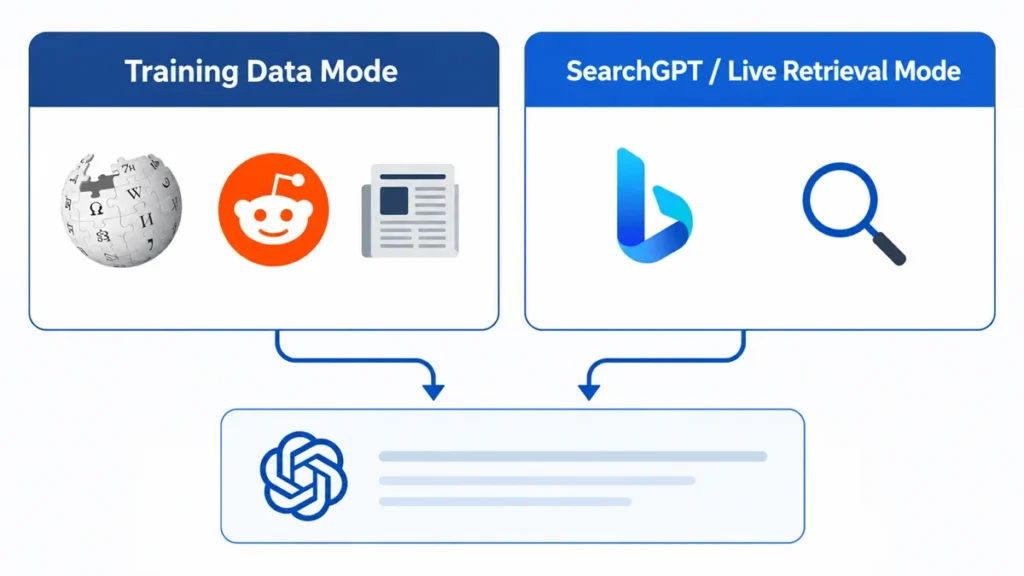
ChatGPT operates in two distinct modes, and they pull citations differently.
Training data mode is the default. When you ask ChatGPT a question without enabling browsing, it answers from patterns baked into its training corpus. This corpus is heavily weighted toward authoritative reference sources — Wikipedia, major editorial publications, Reddit, Quora, and industry platforms that got indexed and cross-referenced thousands of times before the training cutoff. Your website is competing with all of that. The way to influence this mode is slower and more structural. It is about building enough brand presence across third-party sources that your name or content appears consistently in the model’s understanding of your topic.
SearchGPT / web search mode is the live retrieval mode. When a user enables browsing, or when ChatGPT decides a query needs current information, it performs a real web search (primarily through Bing’s index) and cites what it finds. This mode is more like a traditional search engine, but with a much tighter filter. It is not pulling ten blue links. It is finding the three to seven sources it trusts most and synthesizing from those.
Both modes matter. If you want to rank in ChatGPT answers consistently, your strategy has to address both.
Why Your Google Rankings Are Not Enough
Here is a number that should get your attention. Research analyzing ChatGPT’s citation patterns found that only approximately 12% of URLs ChatGPT cites even appear in Google’s top 10 results. The other roughly 88% came from pages that are not dominating traditional search.
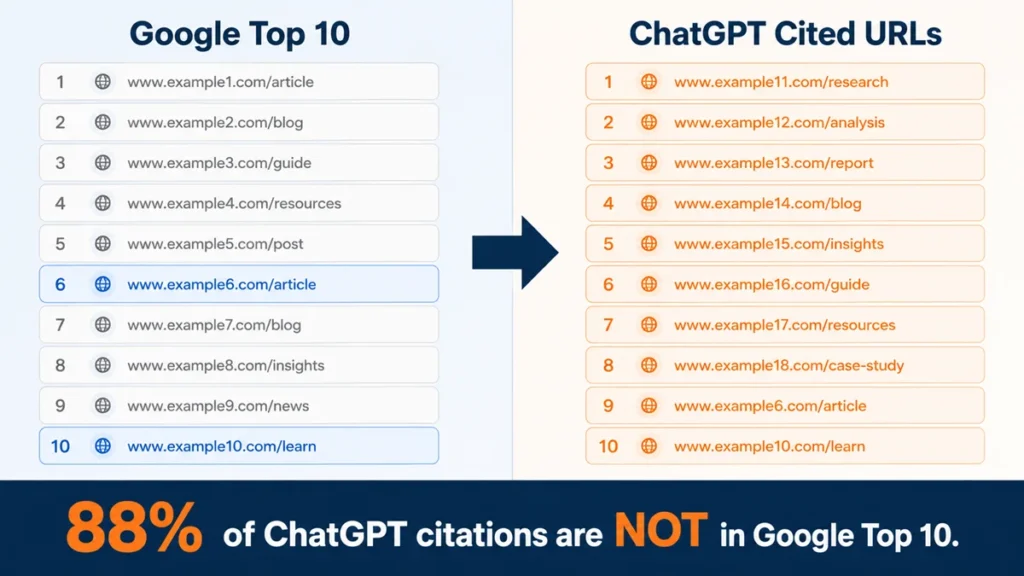
This is not an anomaly. It reflects a fundamental difference in how the two systems evaluate content. Google ranks pages based heavily on backlinks, freshness, and keyword relevance. ChatGPT evaluates sources based on a different mix: brand entity clarity, topical depth, structural readability, and third-party trust signals — most of which Google does not weigh the same way.
You cannot assume that your existing SEO footprint translates to ChatGPT answer visibility. It sometimes does. But often it does not. And the brands figuring that out early are building a significant head start.
The Core Ranking Factors for ChatGPT Answers
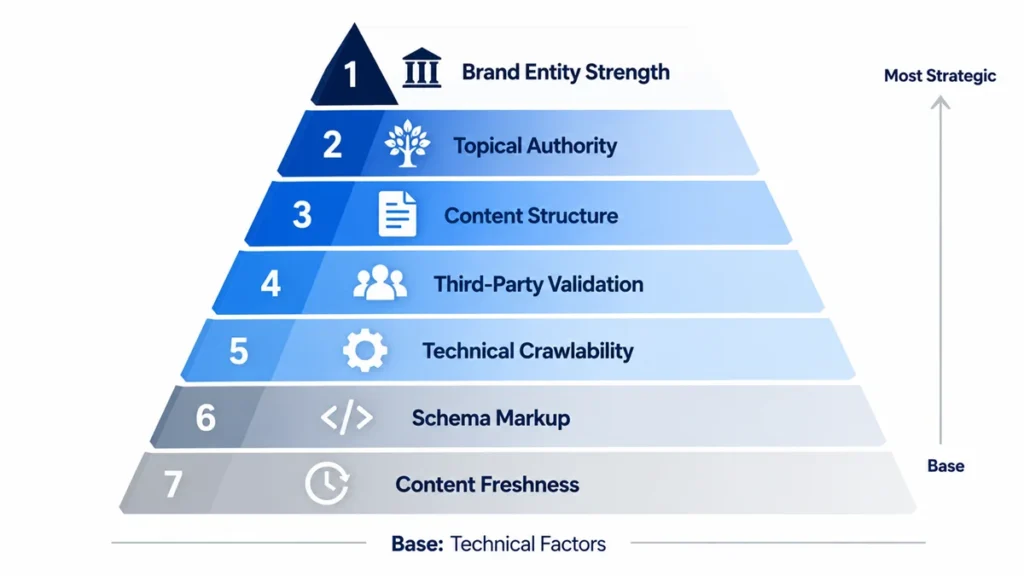
Before getting into tactics, here are the main signals that influence whether your content gets cited in ChatGPT answers. Some are confirmed by the platforms themselves. Others come from observable patterns across industry testing and research.
1. Brand Entity Strength
ChatGPT works with a concept of entities. Before it can confidently cite you in an answer, it needs a clear, consistent understanding of who you are — your brand name, what you do, your category, and how you relate to other entities in your space.
If your brand is mentioned in one place, that is a weak signal. If it appears consistently across your own website, third-party reviews, directories, industry publications, Reddit threads, and social platforms — and those mentions describe you in roughly the same terms — the model builds a stronger, more confident picture of you.
This is why Wikipedia coverage, G2 and Trustpilot profiles, Crunchbase listings, and press mentions matter more in the AI search era than many people expect.
2. Topical Authority
ChatGPT does not cite generalists on specific topics. If your website covers fifteen unrelated subjects, it is harder for the model to associate you with authority on any one of them.
Topical authority, in this context, means having a cluster of content that thoroughly covers a subject from multiple angles. If you want your content to rank in ChatGPT answers for a specific question, you need to have addressed not just that question but the surrounding questions that give it context. Pillar pages, supporting posts, and internal linking all contribute to this.
A practical test: write down the ten most common questions someone in your audience asks about your core topic. If you do not have a dedicated, thorough answer to each one, your topical coverage has gaps — and those gaps show up in your AI visibility.
3. Content Structure and “Chunking”
LLMs do not read pages the way humans do. They process content in chunks. When ChatGPT generates an answer, it is looking for specific, extractable blocks of text that directly address a query. It is not reading your 2,000-word article from top to bottom and synthesizing the whole thing.
Every section of your content needs to be able to stand alone as an answer. Each H2 or H3 heading should introduce a specific question or subtopic, and the first two to three sentences under that heading should directly answer it. Do not bury the answer at the end of a long paragraph.
Short, declarative sentences early in each section help enormously. The model can extract them cleanly. Long, winding introductions before you get to the point are essentially invisible to the retrieval mechanism.
4. Third-Party Validation
This one is often underestimated. According to a 2026 analysis of over one million AI citations, community-driven platforms like Reddit and Quora captured approximately 52.5% of citations across ChatGPT, Perplexity, and Google AI Overviews combined. Your own website content competes directly with platforms that have had decades of trust signals built into the model.
What that means practically: if real people are talking about your brand on Reddit, recommending your content in niche forums, citing your blog in third-party articles, or mentioning you positively in review threads — that activity feeds the model’s confidence in you as a source worth citing in answers.
Getting listed in “best of” articles and industry roundups matters. Earning genuine reviews on trusted platforms matters. Getting guest posts or citations on authoritative publications matters.
This is not something you can fake or shortcut. It is a long game. But it is a real factor.
5. Technical Crawlability
This is the most basic requirement and also the most commonly overlooked. Before ChatGPT’s web search mode can include you in its answers, it has to be able to find and read your page in the first place.
ChatGPT’s live search relies heavily on Bing’s index. If you have not submitted your sitemap to Bing Webmaster Tools, you may be missing citations you should be getting. Beyond that, check your robots.txt file to make sure you are not blocking GPTBot, CCBot, or Bingbot. If those bots cannot crawl your site, the live retrieval mode cannot see you.
You can generate and verify a clean robots.txt file using the Visiblytics Robots.txt Generator — it helps you configure bot access without accidentally locking out the crawlers that matter for AI visibility.
Page speed and clean HTML structure also matter because these crawlers need to process pages efficiently. Slow-loading pages and JavaScript-heavy rendering can create access issues.
6. Schema Markup and Structured Data
Schema markup is the machine-readable layer of your content. It explicitly tells AI systems what your page is about, who wrote it, when it was published, and what type of content it contains. This reduces ambiguity — the AI does not have to guess whether your page is a blog post, a product listing, or a how-to guide.
For ChatGPT’s web search mode and for Bing Copilot, schema is a meaningful structural signal. The most impactful schema types for getting cited in ChatGPT answers are Article schema (with author markup and publish date), FAQ schema, HowTo schema, and Organization schema.
If you have never set this up before, it sounds more technical than it is. The Visiblytics Schema Markup Generator lets you fill in your content details and outputs clean JSON-LD you can paste directly into your page.
One honest note here: schema alone does not guarantee citations. If your content is weak or your domain has no authority, schema will not save you. But if everything else is solid, schema makes your content more machine-readable and easier to extract cleanly.
7. Content Freshness
For SearchGPT’s live retrieval mode, freshness is a direct factor on certain query types. Anything involving current market conditions, pricing, product releases, recent events, or evolving best practices is a query where the model actively prefers newer content.
Make sure your CMS is outputting correct Last-Modified dates in HTTP headers. Keep your XML sitemap updated with accurate timestamps. For content covering evolving topics, update it regularly rather than publishing new articles and leaving older ones to stagnate.
How to Write Content That Actually Gets Cited in ChatGPT Answers
Strategy matters, but the writing itself is where it comes together. Here is what the content needs to look like at a practical level.
Lead With the Answer
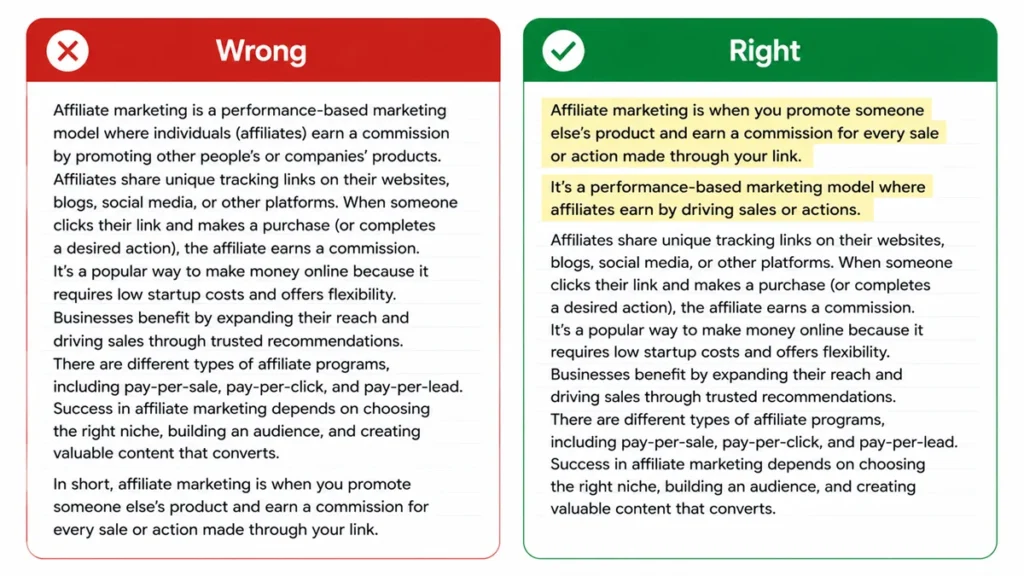
Every section should open with the direct answer to the question it is addressing. Two to four sentences, clear and declarative. Then expand, add nuance, give examples. But the answer has to come first.
This matters mechanically. When ChatGPT retrieves and summarizes content, the opening sentences of each section carry the most weight. Front-loading your answer makes it easy for the model to extract the core of what you are saying and represent it accurately in a cited response.
This is different from how a lot of traditional SEO content is written, where people bury the answer inside a long contextual setup. That structure works fine for human readers who want the context first. It is less ideal for AI retrieval.
Use Conversational Question-Based Headings
People ask ChatGPT questions the way they would ask a person. “What is the best way to X?” or “How does Y work?” or “Why is Z important?” Your heading structure should mirror this natural phrasing.
Instead of a heading like “Content Strategy,” use “What Content Strategy Helps You Rank in ChatGPT Answers?” Instead of “Schema Markup,” use “Does Schema Markup Help You Get Cited in ChatGPT?”
This creates natural alignment between the user’s query phrasing and your heading structure. The retrieval mechanism picks up on that alignment.
Mix Short and Longer Sentences
Not every sentence needs to be brief. But the most extractable content tends to mix short declarative statements with occasional longer explanations. A sentence like “ChatGPT uses Bing’s index for live retrieval” is clean, factual, and extractable. A three-clause sentence buried in a paragraph of dense text is much harder for the model to use cleanly.
Aim for a rhythm where short, punchy sentences appear throughout each section, broken up by longer explanatory ones. It reads naturally to humans and gives the AI clean extraction points.
Include Specific Facts and Data Points
ChatGPT’s training favors content that contains concrete, verifiable information. Vague statements like “AI search is growing rapidly” are not as citeable as specific ones like “ChatGPT processes more than one billion queries per day as of early 2026.” When you write factual claims, be specific. Include numbers, dates, and comparisons. Reference your sources within the content.
This makes your content behave more like a reference document — which is exactly what AI models are trained to cite in their answers.
Add a Proper FAQ Section
FAQ schema combined with a well-structured FAQ section is one of the clearest signals you can send about citation readiness. ChatGPT is frequently asked question-style queries. If your page has explicit questions and answers formatted consistently, those chunks are highly extractable and directly usable.
Keep each FAQ answer self-contained. Someone reading only that answer, without the rest of your article, should get a complete and useful response. That is the test for whether an FAQ entry is ready for AI citation.
Building Off-Page Presence to Rank in ChatGPT Answers
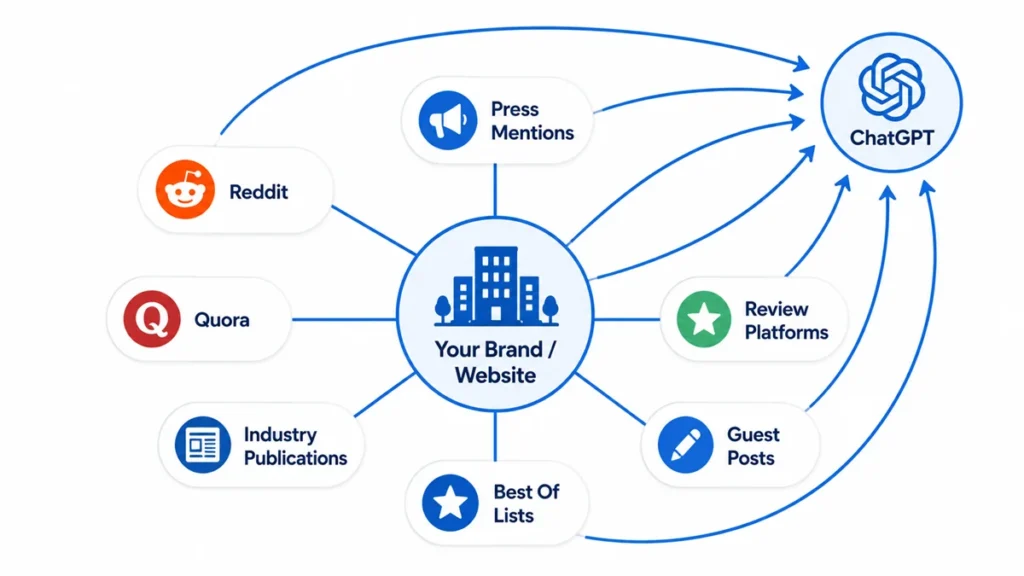
A large part of how ChatGPT forms its understanding of topics and brands happens off your own website entirely. Here is what actually moves the needle externally.
Get cited in third-party articles. When industry publications, comparison sites, or niche blogs mention your brand or content and link to it, those references become part of the web’s information landscape that the model draws from. A single mention in a well-trafficked industry publication can do more for your AI answer visibility than dozens of internal pages.
Build a genuine presence on Reddit and Quora. Community discussions on these platforms are heavily weighted in AI citations. Contributing genuinely useful answers in relevant subreddits or Quora topics, with natural references to your own content where appropriate, builds presence in the platforms the model trusts most.
Keep your brand entity information consistent. Your brand name, description, and category should be described consistently everywhere it appears — your website, your Knowledge Panel if you have one, your social profiles, third-party directories. Inconsistency in how your brand is described creates entity ambiguity, which works against you.
Earn mentions in “best of” lists and comparison articles. When someone asks ChatGPT “what are the best tools for X,” it tends to synthesize from articles that have already evaluated and compared options. Getting featured in those comparison articles increases the probability of your name appearing in AI-generated recommendations.
Training Data Mode vs. SearchGPT: Different Strategies
This distinction is worth coming back to because the approaches genuinely differ.
To rank in ChatGPT answers in training data mode, the work is long-term brand building. Publishing consistently, earning citations over time, building third-party mentions across trusted platforms. This is not something you change with a single website update. It accumulates over months and quarters.
To rank in ChatGPT answers in SearchGPT live retrieval mode, the work is more like technical SEO but optimized for Bing rather than Google. Make sure Bing can crawl you. Make sure your pages are fast and well-structured. Make sure your content is current on topics where recency matters. Focus on ranking in Bing’s top results for your target queries, because that dramatically increases the probability of being pulled into live citations.
In practice, most brands need both. Training data presence gives you baseline visibility for evergreen queries. Live retrieval optimization gives you visibility on time-sensitive and transactional queries where browsing mode is activated.
How Long Does It Take to Rank in ChatGPT Answers?
This depends on which mode you are targeting. For SearchGPT live retrieval, if your technical SEO is solid and your content is well-structured, you can sometimes see citation improvements within a few weeks to two months. The live retrieval pipeline refreshes regularly.
For training data mode, it is a much longer timeline. Training updates happen on cycles that can stretch over months. Building third-party mentions and brand presence is measured in quarters, not weeks.
Set expectations accordingly. Track your citations using referral traffic from ChatGPT in your analytics, manual query testing across your key topics, and brand mention monitoring across other AI platforms. If you are not measuring, you are guessing.
Common Mistakes That Hurt Your Visibility in ChatGPT Answers
A few things I see regularly that actively damage citation potential:
Blocking AI bots in robots.txt. Some developers add rules that block GPTBot or CCBot for privacy or bandwidth reasons. If you want to be cited in live retrieval mode, you need to allow those crawlers. Check your file.
Using JavaScript-heavy rendering for core content. If your main content is rendered by client-side JavaScript, crawlers may miss it entirely or read it incompletely. Citeable content should live in clean, server-rendered HTML.
Publishing generic, thin content. ChatGPT favors sources that clearly have depth and expertise. A 400-word article on a complex subject will not get cited over a thorough, well-structured 2,500-word resource covering the same question properly.
Ignoring Bing entirely. Many SEOs build their whole indexing strategy around Google Search Console and never touch Bing Webmaster Tools. For ranking in ChatGPT answers specifically, this is a significant oversight. Bing is the primary index behind ChatGPT’s live retrieval. Submit your sitemap there.
Writing for keyword density rather than clarity. Content that repeats the same phrase unnaturally or reads like it was optimized for an algorithm will extract poorly. Write for the person first. Clarity and structure are what the AI responds to, not repetition.
Tracking Whether Your Content Is Getting Cited in ChatGPT Answers
You cannot improve what you do not measure. Here is a practical tracking approach.
First, build a list of ten to twenty test queries relevant to your brand or content, and run them in ChatGPT regularly. Note whether your brand or content appears, and how. Keep a simple log and look for trends over time.
Second, check your analytics for referral traffic from ChatGPT. When users see your link cited in a ChatGPT answer and click through, it shows up as a referral. This is imperfect data since many users read the answer without clicking, but it is a directional signal.
Third, use Bing Webmaster Tools to monitor your Bing indexing health. Since Bing is the backbone of SearchGPT’s retrieval, your Bing coverage is a direct input to your ChatGPT answer visibility.
Fourth, watch for brand mentions in Perplexity and Claude. AI systems share some citation patterns, and growing visibility across multiple platforms indicates your broader strategy is working.
A Note on What Is Still Uncertain
The exact weighting of individual factors inside ChatGPT’s citation logic is not publicly documented by OpenAI in any granular detail. Much of what practitioners know comes from observational testing and industry research, not official documentation.
Schema markup’s direct impact on ChatGPT answers specifically (as opposed to Bing Copilot or Google AI Overviews) is not fully confirmed at the source level. It is widely believed to help, and there are good structural reasons for it, but I cannot point you to a controlled study that proves a schema change directly caused a citation.
What I can say is that the tactics in this guide are grounded in observable patterns, confirmed signals where they exist, and the fundamental logic of how large language models retrieve and synthesize content. The direction is clear even where precise weights are not.
Summary: How to Rank in ChatGPT Answers Step by Step
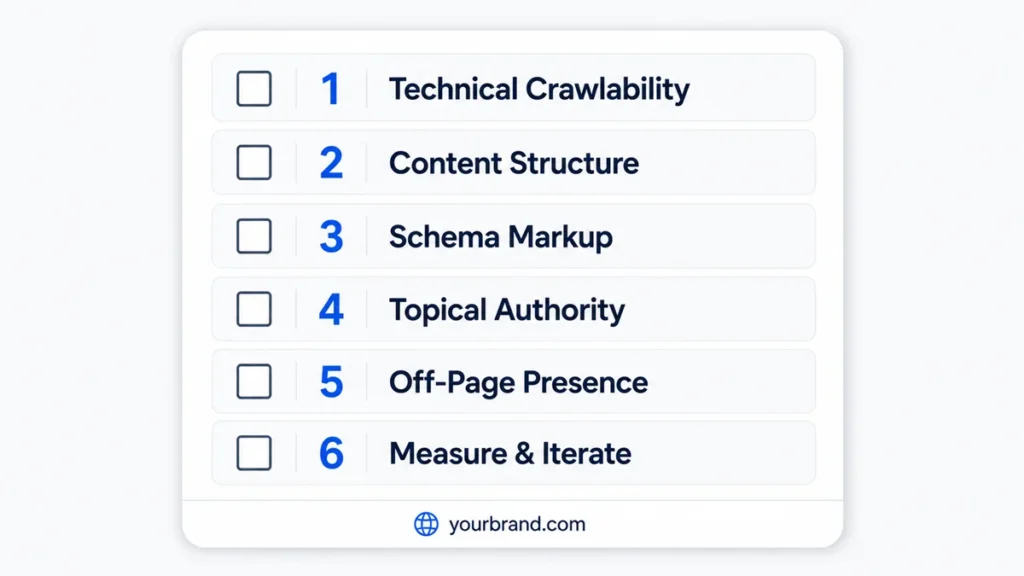
If you are starting from scratch, here is a prioritized order of operations:
Start with technical crawlability. Make sure GPTBot, CCBot, and Bingbot can access your pages. Submit your sitemap to Bing Webmaster Tools. Fix any indexing issues.
Then focus on content structure. Rewrite your most important pages with answer-first sections, conversational question-based headings, and clean extractable chunks. Add FAQ sections where appropriate.
Add schema markup to your key pages. Article schema with author info, FAQ schema where relevant, and Organization schema on your homepage and about page.
Build topical authority by filling the gaps in your content coverage. Identify the questions you have not answered yet and answer them well, in depth.
Work on off-page presence. Get cited in third-party articles. Build genuine presence on community platforms. Earn reviews on trusted platforms.
Measure and iterate. Track your citations, watch referral traffic, and keep adjusting based on what you see.
❓ Frequently Asked Questions
How do I start ranking in ChatGPT answers if I have no AI visibility right now?
Start with the technical layer first. Make sure Bing can crawl your site, submit your sitemap to Bing Webmaster Tools, and check that GPTBot is not blocked in your robots.txt. Then restructure your key pages with direct, answer-first sections and add FAQ content. That combination gives you the best chance of appearing in ChatGPT’s live retrieval results within a reasonable timeframe.
Does paying OpenAI improve my chances of appearing in ChatGPT answers?
No. There is no paid placement in organic ChatGPT responses. Citation selection is based on content quality, authority, and relevance. The only path is through legitimate content and SEO work.
Is ChatGPT using Google’s index to find content for its answers?
For live web search, ChatGPT primarily uses Bing’s index, not Google’s. This is why Bing indexing and Bing Webmaster Tools matter specifically for ranking in ChatGPT answers. Google SEO still helps indirectly, but Bing is the direct input.
Can I rank in ChatGPT answers without a high domain authority?
Yes, but it is harder. Clear, well-structured content on a specific topic with solid third-party mentions can get cited even from smaller domains. However, high-authority domains have a natural advantage. Focus on niche topical depth and off-page presence to compete.
How often should I update my content to maintain visibility in ChatGPT answers?
For topics that evolve regularly, updating every few months is a good baseline. For time-sensitive topics like pricing or product features, updates need to be much more frequent. For evergreen content, an annual refresh and structural review is reasonable.
Does social media presence help with ranking in ChatGPT answers?
Indirectly, yes. Social media activity increases the probability of your content being shared, mentioned, and linked to across the web — all of which feed into training data signals. A social presence that drives third-party coverage is more valuable than the social activity itself.