
If you have been doing SEO for any length of time, you already know that title tags matter. But in 2026, the way Google handles them has shifted quite a bit. The rules that worked three years ago do not always hold up today. So in this post, I want to cover the title tag SEO best practices for 2026 in full. What a title tag actually is, why it still matters, and what the data says you should be doing differently right now.
What Is a Title Tag?
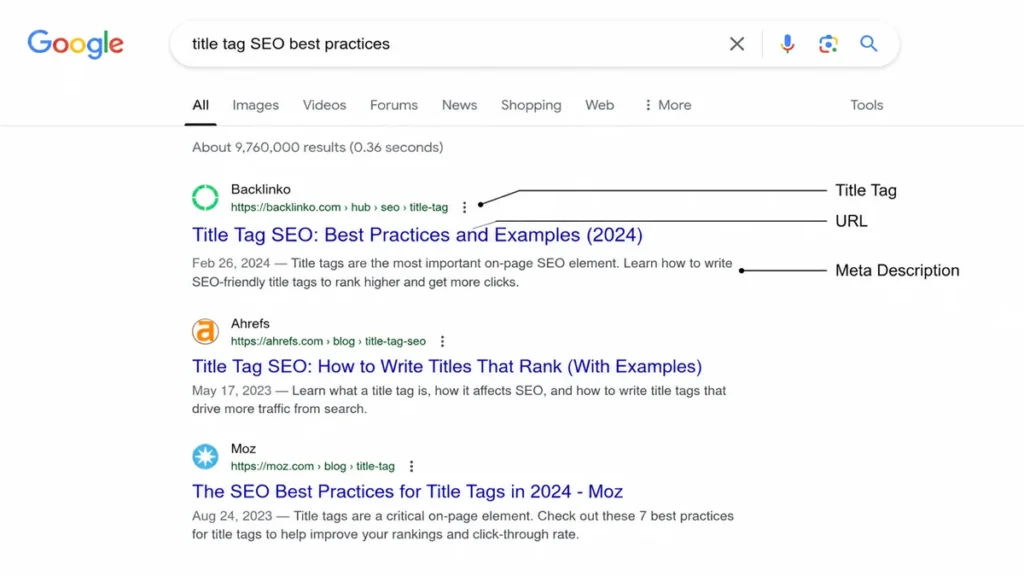
A title tag is an HTML element that defines the title of a webpage. It sits inside the <head> section of your page’s code and looks like this:
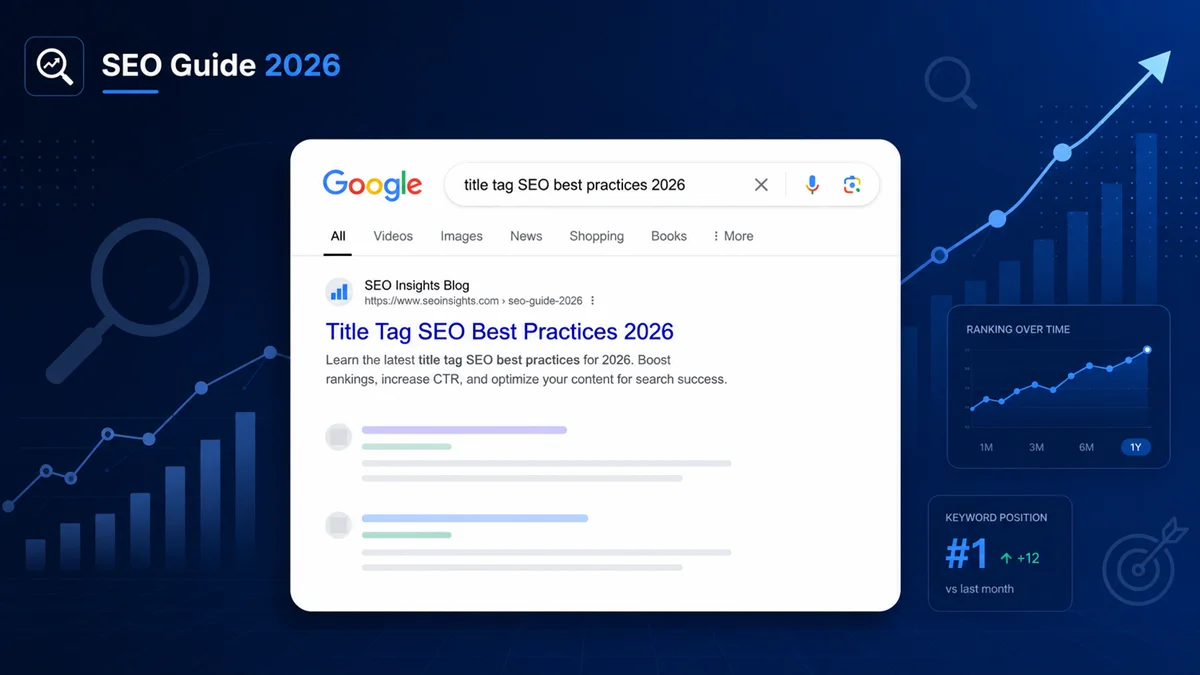
<title>Title Tag SEO Best Practices 2026 | Your Brand</title>When someone searches on Google, this is the blue, clickable headline they see in the search results. It also shows up in the browser tab when someone opens your page and as the link text when a page gets shared on most platforms.
So it serves three jobs at once: it tells search engines what your page is about, it gives users a reason to click, and it acts as a label when your page is bookmarked or shared.
The terms “title tag,” “meta title,” and “SEO title” all refer to the same thing. They are used interchangeably across the industry.
Why Title Tags Still Matter in 2026
Some SEO elements have faded in importance over the years. The title tag is not one of them. Understanding title tag SEO best practices in 2026 starts here: Google has confirmed it remains one of the strongest on-page signals for understanding what a page is about. It directly influences both where you rank and how often people click on your result.
That said, the relationship between what you write and what Google actually shows has gotten more complicated. More on that shortly.
The short version: title tags affect rankings and click-through rates. Both matter. You cannot afford to ignore them.
How Long Should a Title Tag Be in 2026?
This is the question I get asked most often, and the answer is a bit nuanced.
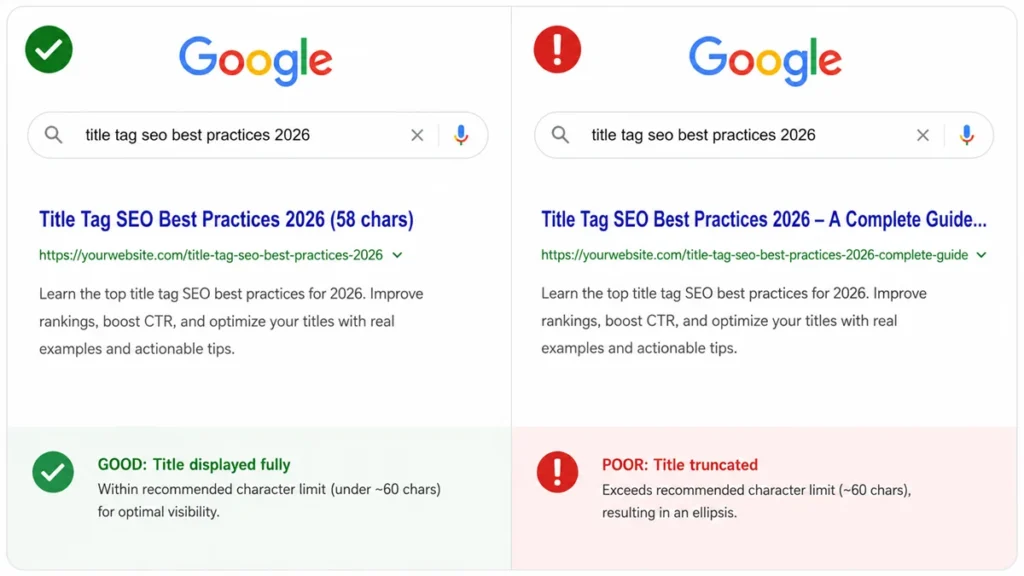
Google does not use a strict character limit. It uses pixel width, with a display cap of approximately 600 pixels. In practice, this works out to roughly 50 to 60 characters for most standard text. Titles above that threshold get cut off with an ellipsis in the search results.
Research from Q1 2025 adds more precision here. Titles that were left unchanged by Google averaged around 44 characters. And titles over 60 characters were rewritten at rates above 95%. That is a very high number.
My recommendation: aim for 50 to 58 characters. It gives you enough room to be descriptive while staying well within the safe zone. Shorter is often better than longer. A tight, clear title at 45 characters will almost always outperform a padded one at 65.
The Google Rewrite Problem (And What It Means for You)
Here is the thing nobody tells you when they list out the title tag SEO best practices for 2026. Google is rewriting your title a lot of the time.
A study by SEO consultant John McAlpin, published in Q1 2025, found that Google rewrote approximately 76% of title tags. That is up from around 61% in a similar study conducted two years earlier. The trend is moving in one direction.
When Google does rewrite a title, the changes are not minor. On average, it retains only about 35% of the original title’s content and removes around 2.71 words. In many cases, the rewritten version looks nothing like what you wrote. The most common edit is removing brand names, which happened in about 63% of modified titles.
This does not mean you should stop optimizing your titles. Google still uses the original HTML title tag for ranking purposes, even when it displays a different version in the results. So optimization still matters for rankings. But for what users actually see, you need to write titles that give Google very little reason to change them.
The titles most likely to survive rewrites share a few traits: they are between 30 and 60 characters, they match the page’s H1 heading closely, they do not stuff keywords, and they clearly describe the page content.
If you want to check whether Google is currently rewriting your titles, search for your target keywords in an incognito window and compare what shows up to the actual title tag in your page’s source code.
Title Tag SEO Best Practices 2026
Let me go through these one by one. These are not rules I invented. They reflect what the data and Google’s own guidance consistently point toward.
1. Put Your Primary Keyword Near the Front
Google gives more weight to words that appear earlier in the title. Users do too. When someone scans search results left to right, they are making a decision in less than a second. Your most important keyword should not be buried at the end.
There is a difference between “front-loading” a keyword naturally and stuffing it awkwardly. A good title reads like a normal sentence. A bad one reads like a keyword list.
Good: Title Tag SEO Best Practices 2026 | Visiblytics Bad: SEO Title Tags Title Optimization Best Practices Meta Title 2026
2. Keep It Between 50 and 58 Characters
I covered the reasoning above. Just do not exceed 60 characters if you want any chance of controlling what users see. Keep it tight. Every word should earn its place.
3. Make Every Title Unique
Each page on your site needs its own distinct title. Duplicate title tags cause two problems. First, they confuse Google about which page to rank for a given query. Second, they can create keyword cannibalization, where your own pages compete against each other. Neither is good.
Auditing for duplicate titles is one of the first things I check when doing any technical SEO review. It is a common issue on larger sites where page templates share the same default title.
4. Match Your Title to Your H1
Your title tag and your H1 heading do not have to be identical. But they should be aligned. When there is a big mismatch between the two, Google is more likely to use the H1 instead of your title tag in the search results.
Think of them as working together. The title tag is optimized for search. The H1 is what greets the user on the page. If they are saying the same thing in slightly different ways, that is fine. If they are about completely different topics, something has gone wrong.
5. Write for the User First, Then for the Search Engine
Ask yourself honestly: if you saw this title in a search result, would you click it? That is the right test. A title that ranks but does not get clicked is not really doing its job.
Avoid vague titles like “Home,” “Services,” or “Blog Post.” These waste your most valuable on-page real estate. Also avoid click-bait titles that oversell what the page delivers. Google penalizes the mismatch between what a title promises and what the page contains.
6. Match Search Intent
Someone searching “what is a title tag” is in a different mindset than someone searching “title tag best practices 2026.” The first person wants a definition. The second wants actionable guidance.
Your title needs to signal immediately that your page answers what they are looking for. If there is any ambiguity, they will scroll past you. Search intent alignment is not optional.
7. Include Your Brand Name Strategically
For important pages, adding your brand name at the end of the title (separated by a pipe or dash) builds recognition over time. The standard structure looks like this:
Primary Keyword: Supporting Context | Brand Name
For pages where space is limited, prioritize the descriptive content over the brand. Google frequently removes brand names during rewrites anyway, especially when the brand is not part of the user’s query.
8. Avoid Keyword Stuffing
I still see this regularly. Titles that repeat the same keyword two or three times, or string together four different variations. Google can detect this, and it tends to trigger rewrites. Beyond that, it looks bad to users.
Use your primary keyword once, naturally, near the front. That is all you need.
9. Do Not Use Special Characters as Decoration
Some people try to use symbols like arrows (►), stars (★), or emoji in title tags to stand out. Google typically strips these out. They do not help rankings, and they often end up looking messy when rendered. Keep it clean.
10. Include the Year When Relevant
For pages covering evolving topics like SEO best practices, including the current year in the title signals freshness. Research from the Q1 2025 study found that titles containing the current year were more likely to be left unchanged by Google. That is useful information.
What Triggers a Google Title Rewrite?
Based on what we know from the research, Google tends to rewrite titles for these reasons:
- The title is too long and gets cut off in a way that loses meaning
- The title contains keyword stuffing or repetitive language
- The title is vague or does not match the page content
- The title does not match the dominant topic of the page
- The H1 is a better description of the page than the title
- The title is missing or the tag is empty
Understanding these triggers helps you write titles that give Google less reason to override them.
How to Check Your Title Tag
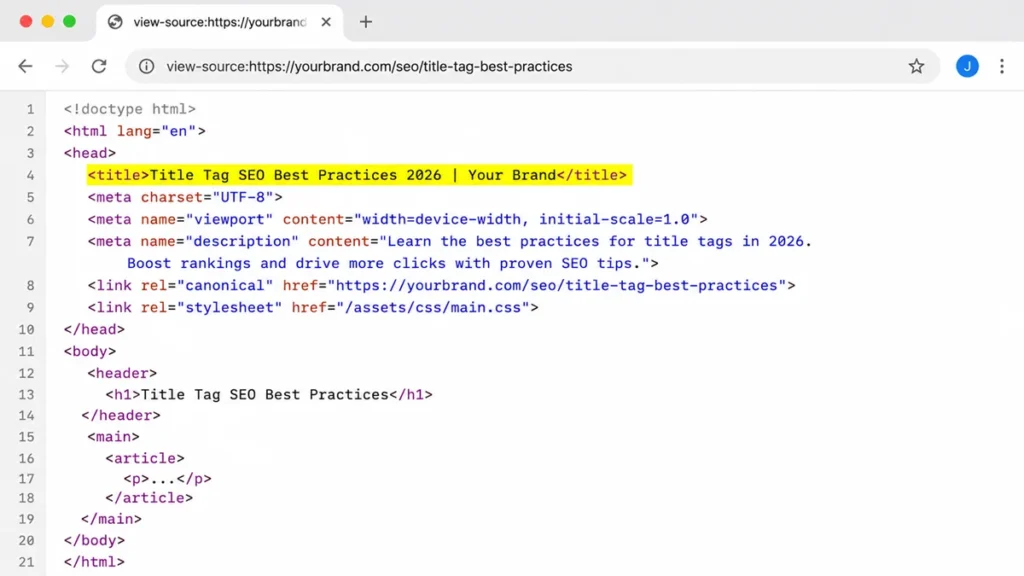
The quickest way is to view the source of your page (Ctrl+U in most browsers) and search for <title>. Whatever sits between the opening and closing title tags is what you have written.
To check what Google is actually displaying, search for your target keyword in an incognito window and look for your page in the results. If what you see does not match what you wrote, Google has rewritten it.
You can also use the SERP Snippet Previewer on Visiblytics to see how your title and meta description will appear in search results before you even publish the page. It is a simple, free tool that saves you the guesswork.
If you want help generating optimized title options, the Meta Title Generator on Visiblytics is another practical starting point.
A Note on Title Tags and AI-Powered Search
Search in 2026 is not what it was five years ago. AI-driven search features now extract answers directly from pages, and they tend to favor pages with clean structure: clear titles, tight headings, and well-written opening paragraphs.
A strong title tag still matters in this environment, but it has to work alongside your overall page structure. If your title is clear and your H1 is aligned and your content actually delivers on what both promise, you are in a much better position regardless of how search features evolve.
Common Title Tag Mistakes to Avoid
Let me list a few I see repeatedly:
- Using the same title across multiple pages
- Writing titles that are over 65 characters
- Putting the brand name first instead of the keyword
- Using generic titles like “Home” or “Welcome”
- Treating titles as keyword lists rather than descriptions
- Forgetting to update titles after changing page content
- Having no title tag at all (surprisingly common on older sites)
Each of these chips away at both your ranking potential and your CTR. They are all fixable.
❓ Frequently Asked Questions
Are title tags still relevant for SEO?
Yes, absolutely. Title tags remain one of the most important on-page elements in SEO. Google has confirmed they are used as a primary signal to understand what a page is about. They directly affect your rankings and your click-through rate. A well-written title tells both the search engine and the user what to expect from your page, and that clarity still carries real weight. Some things in SEO have gotten less important over time. This is not one of them.
Is a title tag mandatory?
Technically, no. A page will still be indexed without one. But practically speaking, yes. If you do not write a title tag, Google will generate one itself by pulling text from your page, usually your H1 or some other prominent text. That auto-generated title may not reflect what you want users to see in search results, and it almost certainly will not be optimized for the keyword you are targeting. Leaving the title tag empty means handing full control to Google. That is rarely a good trade.
What are the best practices for title tags?
The core title tag SEO best practices in 2026 come down to a handful of things done consistently. Keep your title between 50 and 58 characters to avoid truncation. Place your primary keyword near the beginning, not buried at the end. Write a unique title for every page on your site. Align your title with your H1 heading so they tell the same story. Avoid keyword stuffing. Match the title to what the user searching that query actually wants to find. And skip decorative special characters, since Google tends to strip them out anyway. That is the full playbook.
What are common title tag mistakes?
The mistakes I see most often are: using duplicate titles across multiple pages, writing titles that are too long and get cut off mid-word, stuffing in multiple keyword variations that make the title unreadable, putting the brand name first instead of the keyword, using placeholder or default titles like “Home” or “Untitled,” and simply never updating a title after the page content changes. Any one of these can limit how well a page performs. Several of them together can effectively make a page invisible.
What is a bad strategy when creating quality title tags?
The worst strategy is writing your title for search engines while ignoring the person actually reading it. Keyword stuffing is the clearest example of this. Titles like “Buy Cheap SEO Services Affordable SEO Best SEO Agency 2026” might look like they are hitting every term, but they signal nothing useful to a user and tend to trigger Google rewrites. Another bad strategy is copying the same title formula across every page with just a word or two swapped. It feels efficient, but it produces weak, generic titles that rarely compete well. Good titles require individual thought for each page.
Which comes first, the title tag or the heading?
In terms of what matters for search visibility, the title tag comes first. It is what Google primarily reads to understand the topic of your page, and it is the first thing a user sees before they even click through to your site. The H1 heading is what they see after landing on the page. But the two should not be treated as separate decisions. Writing the title tag first is usually the right order because it forces you to define the page’s purpose clearly before you start writing the content. If your title and H1 are well-aligned, your page sends a consistent signal. If they are mismatched, Google may override your title with the H1 anyway, which is worth avoiding.
Final Thoughts
Title tags are one of the few SEO elements that affect both how you rank and how many people actually click on your result. Following the right title tag SEO best practices in 2026 is not complicated, but it does require care.
The biggest shift in 2026 is the Google rewrite rate. With roughly three in four titles being changed in some way, the goal is no longer just to write a good title. It is to write a title that is so clear, so accurate, and so well-matched to the page that Google has no reason to touch it.
Keep them short. Front-load the keyword. Match the H1. Write for the user. Check the results. Then adjust.
That is the whole game.