
Schema markup is the clearest form of communication between your website and search engines. Instead of relying on algorithms to infer what your content means from natural language, schema markup states it explicitly in a machine-readable format that search engines and AI systems read natively.
In 2026, schema markup has a dual role that did not fully exist two years ago. It still powers the rich results in traditional Google search (star ratings, breadcrumbs, FAQ dropdowns, recipe cards, event listings), but it has also become a primary signal that AI systems use when evaluating whether to cite your content. When ChatGPT visits your site, it parses your JSON-LD. When Perplexity retrieves your page as a citation source, it reads your structured data. Schema is no longer purely a traditional SEO tool.
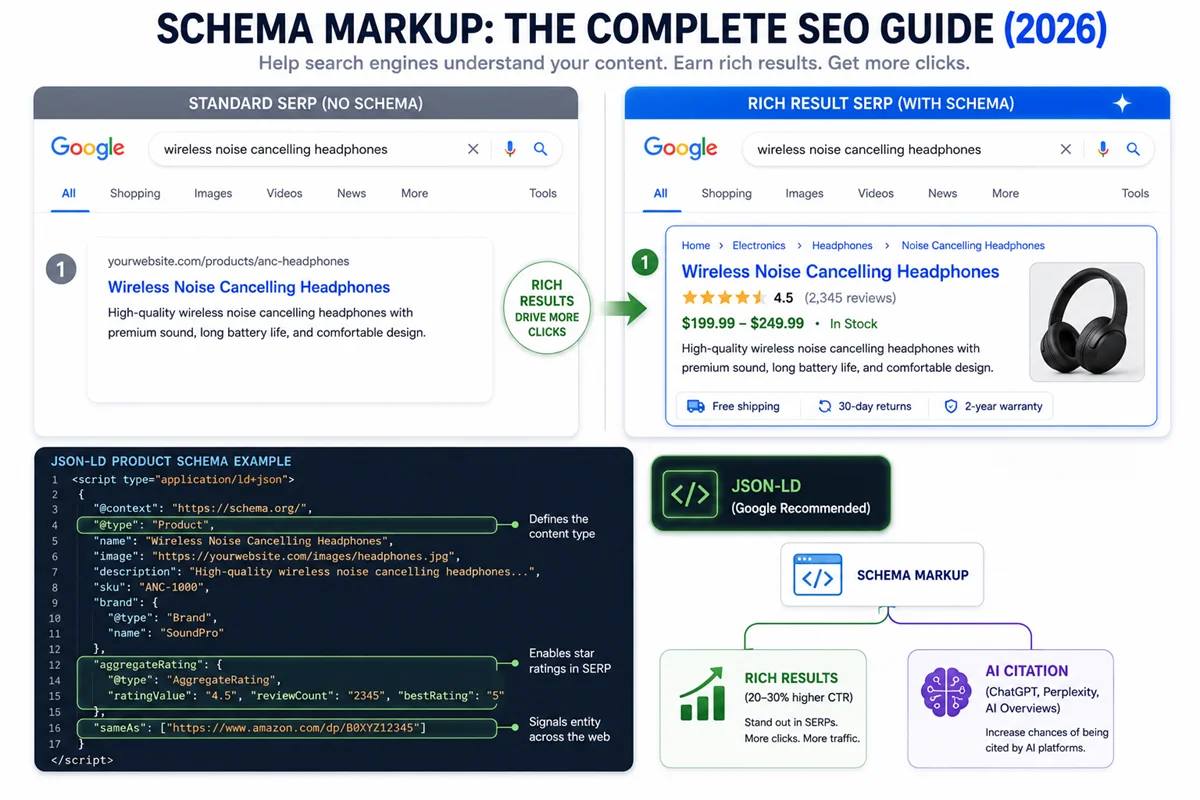
Implementing schema correctly drives measurable outcomes. Studies show pages with schema markup earn 20 to 30% higher click-through rates by triggering rich results that make listings visually distinct in search results. The investment is technical but modest once understood, and the impact compounds over time as more page types are covered.
This guide covers everything: what schema markup is, the three implementation formats and why JSON-LD is the only one worth considering, the most important schema types and which pages need them, how to implement and validate, common mistakes that silently break implementations, and what changed in 2026.
What is Schema Markup?
Schema markup — structured data code added to web pages to communicate the meaning and context of content to search engines and AI systems in a machine-readable format, beyond what natural language alone conveys.
Schema markup uses a standardised vocabulary defined at Schema.org, a collaborative project maintained by Google, Bing, Yahoo, and Yandex. The vocabulary provides hundreds of types (Article, Product, Event, Person, Organisation, and many more) with defined properties for each type that web publishers can use to describe their content.
The relationship to search engines: where natural language processing allows Google to infer what a page is about from text, schema markup states it directly. “This page contains an Article written by this named Author with these credentials, published on this date, in this category” is communicated explicitly rather than inferred.
The Three Implementation Formats
Schema markup can be implemented in three formats: JSON-LD, Microdata, and RDFa.
JSON-LD — JavaScript Object Notation for Linked Data — is Google’s recommended format and the only one worth using in 2026 for almost every use case.
JSON-LD is embedded in a standalone script block within the HTML head or body:
html
<script type="application/ld+json">
{
  "@context": "https://schema.org",
  "@type": "Article",
  "headline": "Schema Markup: The Complete SEO Guide",
  "author": {
    "@type": "Person",
    "name": "Author Name"
  }
}
</script>
The critical advantage of JSON-LD is its separation from the visible HTML. The structured data lives in its own block, completely independent of the page’s content markup. This makes it dramatically easier to add, update, debug, and maintain without touching the page’s HTML structure. It also means developers can update schema without risking changes to visible content.
Microdata and RDFa are inline formats that embed structured data attributes directly within HTML elements. They are more complex to implement and maintain, require touching the visible HTML, and are harder to audit. They were the dominant approaches before JSON-LD was adopted by Google. In 2026, there is no meaningful advantage to using either over JSON-LD for standard website implementations.
Why Schema Markup Matters in 2026
Rich Results in Traditional Search
Rich results are the enhanced search result listings that schema markup enables. Instead of a standard title, URL, and meta description, rich results display additional visual or informational elements that make the listing stand out.
Examples of rich results enabled by schema:
- Star ratings on product pages and review content
- Breadcrumb trails showing site hierarchy in the URL area
- FAQ dropdowns that expand with answers directly in search results
- Recipe cards with cooking time, ratings, and ingredient counts
- Event listings with dates, locations, and ticket availability
- Video thumbnails with duration
- Article carousels with author and publication date
Pages that earn rich results consistently show 20 to 30% higher click-through rates than equivalent pages without them, because they occupy more visual space and signal more information to searchers before the click.
AI Citation and Machine Understanding
In 2026, the value of schema markup extends beyond rich results to AI search visibility. AI systems including Google AI Overviews, ChatGPT Search, and Perplexity read structured data when crawling pages.
JSON-LD provides these systems with machine-readable facts that natural language processing must otherwise infer. An Organisation schema that explicitly identifies a brand, its sameAs links to authoritative external profiles, and its founding date gives AI systems reliable entity data to work from. An Article schema that explicitly names the author with credentials helps AI systems assess source credibility before citing the content.
Research has demonstrated that structured data improves AI extraction accuracy significantly compared to natural language alone. One study found accuracy improved from 16% to 54% when structured data was present. Citing statistics in structured format improved AI extraction rates by 33% in another study.
Schema markup is now as much an AI visibility strategy as a traditional SEO tool.
The Most Important Schema Types in 2026
Organisation Schema
Who needs it: Every website, on the homepage and About page at minimum.
Organisation schema establishes the brand as a recognised entity in Google’s Knowledge Graph and provides machine-readable information about the business: name, URL, logo, contact information, and — critically — sameAs links to authoritative external profiles.
The sameAs property is particularly important. It links the Organisation entity on your site to the same entity as it appears on LinkedIn, Crunchbase, Wikipedia (if applicable), Twitter/X, and other authoritative platforms. This cross-referencing helps Google confidently identify your brand entity, reducing disambiguation uncertainty and strengthening Knowledge Graph recognition.
A complete Organisation schema includes: name, url, logo, description, contactPoint, address (for physical businesses), and sameAs with as many authoritative external profile URLs as applicable.
Person Schema (Author)
Who needs it: All publishing sites, on author bio pages.
Person schema identifies the author as a named entity with verifiable credentials. In 2026, following the December 2025 core update that tightened author entity verification requirements, Person schema with sameAs links to external profiles is a practical ranking signal, not just a rich result enabler.
A complete Person schema for an author includes: name, url (linking to their bio page), jobTitle, description, sameAs (linking to LinkedIn, Twitter/X, industry publications where they are bylined), and image.
When implemented on an author bio page and referenced by Article schema on published content (via the author property), it creates a machine-verifiable link between content and credentialed authorship.
Article and BlogPosting Schema
Who needs it: All blog posts, guides, and news articles.
Article schema (or its more specific variant BlogPosting) provides structured metadata about written content: the headline, the author, the publication date, the modified date, the publisher, and the featured image.
The most important properties: headline (matching the H1), author (linking to a Person entity), datePublished, dateModified (updated whenever the content is substantively revised), publisher (linking to the Organisation entity), and image.
A common implementation error: Article schema with a missing or incomplete author field. This removes the E-E-A-T benefit of explicitly identified authorship. The author property must reference a complete Person schema entity, not just a plain text string.
FAQPage Schema
Who needs it: Pages with FAQ sections.
Important 2026 update: Google removed FAQPage rich results from Google Search on 7 May 2026. FAQPage schema no longer produces the expandable FAQ dropdown in standard Google search results that it previously did. This is a significant change from the previous behaviour.
However, FAQPage schema remains valid and continues to provide structured data that is read by AI systems (Bingbot, Perplexity’s crawler, voice assistant indexers, and AI agents). It is parsed as machine-readable structured content by these systems even without a Google-specific rich result.
The practical recommendation for 2026: continue implementing FAQPage schema on pages with genuine FAQ sections for AI citation benefit, but do not expect it to produce expandable FAQ rich results in Google search. Factor this change into performance expectations for pages that previously benefited from FAQ rich results.
Product Schema and AggregateRating
Who needs it: All e-commerce product pages.
Product schema provides machine-readable details about a product: name, description, image, brand, and SKU. AggregateRating (nested within Product schema) enables star ratings in search results, one of the most visually impactful rich results available.
Critical implementation note: AggregateRating will not appear in search results unless the review data behind it reflects genuine customer reviews. Google’s guidelines prohibit using AggregateRating to display ratings that are not based on actual user reviews. Fabricated or artificially inflated ratings violate guidelines and can result in manual actions.
Product schema without AggregateRating is valid but produces no star ratings in search results. Partial implementation that includes AggregateRating without required properties also produces no ratings. Completeness is non-negotiable: every required property must be present for the rich result to appear.
LocalBusiness Schema
Who needs it: Any business with a physical location or service area.
LocalBusiness schema (or its more specific subtypes: Restaurant, MedicalBusiness, LegalService, and others) provides structured business information: name, address, telephone, opening hours, geographic coordinates, and priceRange.
LocalBusiness schema supports Google Business Profile visibility, local map pack appearance, and Knowledge Panel data. It is the most important schema type for businesses that depend on local search visibility.
The address should exactly match what is listed on the Google Business Profile, with consistency across all citation sources. Inconsistent NAP (Name, Address, Phone) data across schema and external listings is a local SEO trust signal problem.
BreadcrumbList Schema
Who needs it: Every page beyond the homepage on sites with hierarchical structure.
BreadcrumbList schema tells Google the position of a page within the site hierarchy and enables breadcrumb trail display in search results, where the URL is replaced with a readable path (for example, “Home › SEO › On-Page SEO › Schema Markup”).
BreadcrumbList schema is one of the simplest to implement and one of the most universally applicable. The improved URL display in search results improves user trust and click-through rates. It should be implemented as a baseline on all sites with content hierarchy.
HowTo Schema
Who needs it: Step-by-step instructional content where completing a process is the primary goal.
HowTo schema makes step-by-step processes explicitly machine-readable, with each step defined by name, text, and optionally an image or video. When the SERP displays a HowTo rich result, the steps may appear expanded below the listing.
Note: Google’s display of HowTo rich results has become more selective in 2026, particularly on desktop. Check the current SERP for target queries before investing heavily in HowTo schema implementation.
VideoObject Schema
Who needs it: Pages where a video is central content.
VideoObject schema enables video rich results in Google search and YouTube search, displaying a video thumbnail alongside the listing. Required properties include: name, description, thumbnailUrl, uploadDate, and contentUrl or embedUrl.
For pages embedding YouTube videos, the VideoObject schema should reference the YouTube video URL and match the information displayed in YouTube’s own metadata.
The @id Graph Model: Connecting Entities
Advanced schema implementation uses the @id property to create explicit connections between schema entities on the same site.
The principle: rather than defining the Organisation in isolation and the Person (author) in isolation, connected schema uses @id identifiers to link them explicitly.
json
{
  "@context": "https://schema.org",
  "@type": "Article",
  "headline": "Schema Markup Guide",
  "author": {
    "@type": "Person",
    "@id": "https://visiblytics.com/author/author-name/",
    "name": "Author Name"
  },
  "publisher": {
    "@type": "Organization",
    "@id": "https://visiblytics.com/#organisation",
    "name": "Visiblytics"
  }
}
When the Person entity on the author bio page and the Organisation entity on the homepage both use the same @id values referenced in Article schema, Google can build a connected entity graph: this Article was written by this Person who is associated with this Organisation. This explicit graph connectivity strengthens entity recognition and AI citation eligibility.
How to Implement Schema Markup
Step 1: Identify Which Schema Types Each Page Needs
Using the types covered above:
- Homepage and About page: Organisation schema
- Author bio pages: Person schema
- All blog posts and guides: Article or BlogPosting schema (referencing Person and Organisation entities)
- Product pages: Product schema with AggregateRating where reviews exist
- Category pages (e-commerce): ItemList or breadcrumbs
- Local business pages: LocalBusiness schema
- FAQ sections: FAQPage schema (for AI citation, no longer for Google FAQ rich results)
- Step-by-step instructional content: HowTo schema
- All non-homepage pages: BreadcrumbList schema
Step 2: Write the JSON-LD
Generate or write the JSON-LD code for each schema type. Tools that assist with generation include:
- Schema Markup Generator at technicalseo.com
- Google’s Structured Data Markup Helper
- Merkle’s Schema Markup Generator
When generating schema, include all required properties for the schema type you are implementing. Missing required properties prevent rich results from appearing.
The single most common silent failure: Including HTML entities, special characters, or line breaks inside JSON-LD string values. JSON-LD must contain clean text. HTML tags, HTML entities (such as &), and rich formatting break the JSON silently without producing a visible error on the page, but the schema fails validation and does not produce rich results.
Step 3: Add the JSON-LD to the Page
The JSON-LD script block can be placed in the HTML head or within the body. Google can read it from either location. Most CMS plugins and implementations place it in the head for consistency.
For WordPress sites, plugins such as RankMath and Yoast SEO generate schema automatically for common page types. These are generally reliable starting points but should be reviewed to ensure the generated schema is complete and accurate, not just present.
Step 4: Validate with Google’s Rich Results Test
Before publishing any schema implementation, validate it with Google’s Rich Results Test (available through Google Search Console tools). This tool shows:
- Whether the page is eligible for rich results based on the schema present
- Which specific rich result types are supported
- Any errors or warnings in the implementation
- A preview of how the rich result would appear in search
Fix all errors before publishing. Warnings should be reviewed and addressed where feasible.
Step 5: Monitor in Google Search Console
After publishing, monitor the Enhancements section of Google Search Console. This section tracks:
- How many pages have each schema type detected
- How many are eligible for rich results
- How many have errors or warnings
- Whether rich results are being served
Schema errors in Search Console indicate implementations that are present but broken. These should be diagnosed and fixed because broken schema provides no benefit and may signal low technical quality to crawlers.
Schema Markup by Page Type: Quick Reference
| Page Type | Recommended Schema Types |
|---|---|
| Homepage | Organisation, WebSite, BreadcrumbList |
| About page | Organisation (expanded), Person (founders/team) |
| Author bio page | Person (complete with sameAs links) |
| Blog post / Guide | Article / BlogPosting, BreadcrumbList, FAQ (where applicable) |
| Product page | Product, AggregateRating, BreadcrumbList |
| Category page (e-commerce) | ItemList, BreadcrumbList |
| Local business page | LocalBusiness (or specific subtype), BreadcrumbList |
| FAQ page | FAQPage (for AI citation), BreadcrumbList |
| How-to guide | HowTo, Article, BreadcrumbList |
| Event page | Event, BreadcrumbList |
| Recipe page | Recipe, BreadcrumbList |
| Video page | VideoObject, Article, BreadcrumbList |
Common Schema Mistakes That Silently Break Implementations
HTML in JSON-LD values. The most common and most damaging mistake. HTML entities, tags, or special characters inside JSON-LD string values break the schema silently. Use plain text only in JSON-LD property values.
Marking up content that is not visible on the page. Schema markup should only describe content that users can actually see on the page. Marking up information that does not appear in the visible content violates Google’s guidelines and can result in manual actions for “spammy structured data.”
Incomplete required properties. Each schema type has required properties that must be present for rich results to appear. Partial implementation (a Product schema without AggregateRating, an Article schema without datePublished) produces no rich result benefit. Always implement the complete required property set.
Mismatched data between schema and visible content. The name in Organisation schema must match the name displayed on the page. The price in Product schema must match the price the user sees. Discrepancies between schema data and visible content are guideline violations.
Outdated dateModified. Article schema with a dateModified that has not been updated when the content is revised signals stale content to crawlers and reduces the freshness benefit of content updates.
Missing @id connections. Implementing Person and Organisation schema in isolation rather than using @id to connect them through Article schema misses the entity graph benefit that connected schema provides.
❓ Frequently Asked Questions
Does schema markup directly improve rankings?
Schema markup is not a direct ranking factor in the traditional sense. However, it drives rich results that improve click-through rates (20 to 30% higher), strengthens entity recognition that contributes to Knowledge Graph presence, and improves AI citation eligibility. These downstream effects produce measurable ranking and visibility benefits even without a direct algorithmic ranking boost.
How long does it take for schema to appear in search results?
After implementation and validation, rich results typically appear within one to eight weeks as Google recrawls and processes the pages. New schema on pages that are already frequently crawled by Google tends to appear faster.
Should I implement schema on every page?
BreadcrumbList and Organisation schema should be universal. Other schema types should be matched to page content type: only implement schema types that are appropriate for what the page actually contains. Irrelevant or mismatched schema does not help and can trigger policy violations.
Is schema markup still worth implementing after the FAQ rich result removal?
Yes. FAQPage schema removed from Google’s rich results does not remove schema markup’s value for AI citation, Bing’s results, voice search, and other structured data consumers. The removal affects one specific rich result type in Google, not structured data’s broader function.
What tools do I use to check if my schema is working?
Google’s Rich Results Test for per-page validation before and after implementation. Google Search Console’s Enhancements section for sitewide monitoring after deployment. Schema.org’s validator for technical JSON-LD syntax checking independent of Google’s specific rich result requirements.
Summary
Schema markup is structured data code that communicates the meaning of your content in a machine-readable format, enabling rich results in traditional search and improving AI citation eligibility across all major search systems.
The key points to carry forward:
- JSON-LD is the only format worth using: it is Google’s recommendation, easiest to implement, and simplest to maintain
- Schema drives 20 to 30% higher click-through rates through rich results
- In 2026, schema is an AI visibility tool as much as a traditional SEO tool: ChatGPT, Perplexity, and AI Overviews all read JSON-LD
- FAQPage rich results were removed from Google Search on 7 May 2026 — the schema type remains valid for AI citation but no longer produces expandable FAQ results in Google
- Partial implementation produces zero rich result benefit — all required properties must be present
- Only mark up content that is visible on the page — marking up invisible content violates Google’s guidelines
- Validate with Google’s Rich Results Test before publishing and monitor in Search Console after
Schema Markup and AI Search in Depth
The relationship between schema markup and AI search visibility deserves specific attention in 2026 because it represents the fastest-growing value driver for structured data implementation.
How AI Systems Use Schema
When AI crawlers visit a page to evaluate it as a potential citation source, they do not just read the natural language content. They parse structured data to extract facts, verify entity information, and assess content credibility.
Google’s AI Overview system, ChatGPT’s browsing capability, Perplexity’s crawler, and voice assistant indexers all process JSON-LD. The explicit entity relationships and machine-readable facts in schema markup reduce the cognitive load these systems face when evaluating whether to cite a source.
Research confirms the impact: accuracy of information extraction by AI systems improves dramatically with structured data present (from 16% to 54% in one study). Citing statistics in structured format improved AI extraction rates by 33% compared to prose formatting alone.
Schema Types with the Strongest AI Citation Impact
Organisation schema with sameAs properties. Explicitly connecting your brand entity to verified external profiles helps AI systems identify and confidently cite your brand. Brand-entity clarity is a top predictor of AI citation frequency.
Person schema for authors. When AI systems assess whether to cite a source on a specific topic, author credentials matter. Explicit Person schema linking an author to their external credentials reduces the ambiguity that would otherwise require the AI system to infer credibility from the text.
Article schema with complete metadata. datePublished and dateModified are machine-readable freshness signals. Content updated within the previous 30 days is cited more than three times as frequently in AI-generated answers as older content, according to one 2025 study. Accurate dateModified in Article schema surfaces this freshness signal explicitly.
FAQPage schema (for AI, not Google rich results). Despite the removal of FAQ rich results from Google Search in May 2026, FAQPage schema remains one of the most valuable schema types for AI citation. AI systems extract question-and-answer structured data efficiently from FAQPage markup, making it easier for them to identify when your content directly answers a specific query.
The Entity Graph and AI Visibility
Well-connected entity schema, where Organisation, Person, Article, and Product entities are linked through @id properties, creates a machine-readable knowledge graph about your site’s content and authority.
AI systems that process your site’s schema graph understand:
- Who publishes the content (Organisation, with external verification)
- Who writes the content (Person, with credential verification)
- What the content is about (Article type, headline, category)
- How recent the content is (datePublished, dateModified)
- What entities the content references (through named entities in schema)
This complete picture is significantly more useful to AI systems evaluating citation eligibility than the same information scattered through natural language alone.
Schema Implementation for Specific Platforms
WordPress
WordPress sites have the most schema tooling available. The major SEO plugins (RankMath, Yoast SEO) generate schema automatically for common content types. However, auto-generated schema requires review:
- Verify that author schema includes sameAs links to external profiles (most plugins do not add these automatically)
- Check that AggregateRating is not generated unless genuine review data exists
- Confirm that Organisation schema includes the sameAs properties for your brand’s external profiles
- Review that dateModified updates automatically when content is revised (most plugins handle this correctly)
For custom schema not covered by plugins, the best practice is to add JSON-LD directly in the theme’s head template or through a Code Snippets plugin for page-specific implementations.
Shopify
Shopify automatically generates Product schema for product pages. The auto-generated schema includes basic required properties but typically lacks complete AggregateRating (which requires integration with a review app to populate), and does not include Organisation schema by default.
Supplementing Shopify’s default schema with a metafield-based Organisation schema, and ensuring review apps are integrated to populate AggregateRating correctly, produces more complete structured data coverage.
Custom or Non-CMS Sites
Sites built without a CMS have full manual control over JSON-LD implementation. The schema should be generated once for each page template type, placed in the appropriate template file, and dynamically populated with page-specific values (title, author, date, product name) from the site’s data layer.
Template-level implementation means each new page published in a category automatically receives the correct schema without requiring manual per-page implementation.
Measuring Schema Markup Impact
Understanding how schema is performing requires monitoring two distinct data sources.
Google Search Console Enhancements. The Search Console interface shows a separate card for each schema type detected on the site: the number of valid items, the number of errors, and the trend over time. A decline in valid items, or a spike in errors, indicates a schema implementation problem that needs investigation.
Click-through rate comparison. In the Performance report in Search Console, compare the average CTR of pages with rich results (verified by the Enhancements report) against comparable pages without rich results. A consistent CTR premium on pages with rich results quantifies the value of the schema implementation.
SERP feature monitoring. Tools including Semrush and Ahrefs track which SERP features appear for your tracked keywords. Monitoring whether rich results are appearing and holding for target queries provides an operational view of schema health beyond what Search Console reports.