
Most sites focus their content effort on creation. Publish new articles, target new keywords, grow the library. This is necessary, but it is incomplete.
The average site loses 20 to 30% of its organic clicks every six months from content decay. Pages that ranked well a year ago slowly fade as statistics become outdated, competitors publish better resources, and search intent around topics shifts. The content library erodes silently while new content gets all the attention.
The data on ROI is instructive: original content yields approximately 66% return on investment. Refreshing existing content delivers 42.6%. These two activities are not in competition. They are a system. In 2026, the most effective content strategies run both simultaneously: creating new content to capture new keywords and systematically refreshing existing content to defend and improve what already ranks.
This guide covers both dimensions: how to optimise new content for search and AI visibility, and how to build a content refresh process that recovers and compounds the value in your existing content library.
What is Content Optimisation?
Content optimisation — the systematic process of improving content to rank higher in search engines, earn more organic traffic, satisfy searcher intent more completely, and increase the likelihood of being cited in AI-generated answers.
In 2026, content optimisation has four distinct objectives that must be addressed together:
Traditional ranking optimisation — ensuring content signals align with what Google needs to rank a page for its target keyword: intent match, topical completeness, on-page elements, and internal linking.
AI citation optimisation — structuring content so AI systems (Google AI Overviews, ChatGPT, Perplexity) can extract it as a citation source, with clear passage-level answers, factual accuracy, and freshness.
Click-through optimisation — ensuring title tags and meta descriptions are compelling enough that users choose your result over competing results at the same ranking position.
Conversion optimisation — ensuring that organic visitors who land on the page find what they came for and are guided toward the next step in their journey.
Part 1: Optimising New Content
The Foundation: Intent Before Everything Else
Every piece of content optimisation begins with confirming that the content matches the dominant search intent for its target keyword. This is the single most important optimisation decision and it must be made before writing begins, not after.
Search the target keyword in an incognito window. Examine the top five results. Identify the dominant content type (guide, list, product page, comparison, definition), the dominant format (step-by-step, numbered list, comprehensive overview), and the dominant angle (beginner vs expert, broad vs specific).
Your content must match this pattern. If four of the five top results are step-by-step how-to guides and you publish an opinion essay, the content will not rank regardless of quality. Intent alignment is evaluated by Google before content quality.
Content Depth and Topical Completeness
After intent alignment, topical completeness is the most important content quality signal. Content that covers its topic comprehensively outperforms content that covers it superficially, even when the superficial content is technically well-optimised.
To assess topical completeness before writing:
Map the entity landscape. What are the key concepts, tools, people, and related topics that genuinely expert coverage of this topic requires? List every entity that should be addressed. A piece about content optimisation that does not address search intent, topical authority, content refresh, or AI citation is topically incomplete.
Review the competitive content. What do the top-ranking pages cover? What questions do they answer? What topics do they include that you have not planned for? The gap between your planned content and what top-ranking pages cover is your topical completeness gap.
Review People Also Ask. The questions in the PAA box reveal what related information searchers expect alongside the main query. Answering these questions within the content or in a dedicated FAQ section improves topical completeness directly.
Writing for Both Humans and Search Engines
The distinction between writing for humans and writing for search engines is a false one in 2026. Google’s NLP systems are sophisticated enough that content written naturally by a genuine expert, using the full vocabulary of the topic, will naturally include the signals that search engines need.
The practical approach: write as a knowledgeable expert addressing a reader who is unfamiliar with the topic. Use natural language. Use the terms that practitioners in the field actually use when discussing this topic. Do not artificially insert keywords where they do not fit. Do not avoid using the primary keyword when it is naturally appropriate.
The result will be content that reads well for humans and contains all the semantic signals search engines look for, because these are the same thing.
Optimising the Core On-Page Elements
The specific on-page elements covered in T2-020 apply directly to content optimisation:
Title tag: Primary keyword near the beginning, under 60 characters, compelling enough to earn a click. For content, power words that signal comprehensiveness (“Complete Guide,” “Full Breakdown,” “Everything You Need to Know”) improve CTR.
Meta description: 140 to 160 characters. Include the primary keyword. State specifically what the reader will learn or gain from the page. A mild call to action (discover, learn, find out) encourages clicks.
H1: Should closely match the title tag and include the primary keyword. Every page has exactly one H1.
H2 and H3 structure: Each major section should have a descriptive heading that includes secondary keywords where they fit naturally. The heading structure should allow a reader scanning only the headings to understand the complete scope of the content.
Opening paragraph: State the primary keyword and the value proposition in the first 100 words. The opening paragraph is disproportionately important for AI citation (44.2% of all LLM citations come from the first 30% of a page’s text). Do not begin with context or background. Begin with the substance.
Internal Linking for New Content
Every new piece of content should:
- Link to two to three existing pages that cover related subtopics (distributing authority downward to cluster pages)
- Be linked to from two to three relevant existing pages (receiving authority from pages that already have it)
When publishing new content, immediately update the internal link structure of the most relevant existing pages to include a link to the new piece. This accelerates indexing and begins the authority flow that helps the new page rank faster.
Optimising for AI Citation from the Start
Content written in 2026 should be structured with AI citation in mind from the first draft. The principles that produce AI-citable content are not separate from good content writing. They are extensions of it.
Direct answers near the beginning of sections. The opening sentence of each section should directly answer the question implied by the heading. AI systems extract passage-level answers. A section heading that asks “What is content decay?” should have the answer in its first sentence.
Key takeaway sections. A TL;DR, key takeaways, or summary section near the top of the page (not just at the bottom) significantly increases AI citation probability. AI systems retrieve from the first 30% of page text at a disproportionate rate.
Factual accuracy and currency. AI systems prefer content that is consistent with other trusted sources. Include current statistics with their sources. Ensure all factual claims are accurate. Avoid speculative or contested claims unless clearly framed as such.
Clear structure with descriptive headings. Machine-readable structure signals topical scope clearly. Each section should be self-contained enough that it makes sense read in isolation, since AI systems may extract individual sections independently.
Part 2: Refreshing Existing Content
Content refresh is the highest-ROI activity in content strategy for most established sites. Refreshing an existing page that Google already trusts takes approximately 20% of the effort of writing a new article but captures 60 to 80% of the ranking improvement available from the better version.
The data is compelling:
- Refreshing old blog posts can increase traffic by 106% (HubSpot) and up to 146% (Backlinko)
- Quarterly refreshes yield 42% better results than annual refreshes (Semrush)
- 76% of monthly blog views come from older posts, not recent ones (HubSpot)
- AI-cited content is 25.7% fresher than traditional organic results (Ahrefs study of 17 million AI citations)
- 76.4% of ChatGPT’s most cited pages were updated within 30 days of being cited
These numbers make the case for a systematic content refresh programme as strongly as any argument can.
The 70/30 Resource Allocation Rule
A practical content investment framework for established sites with existing content libraries:
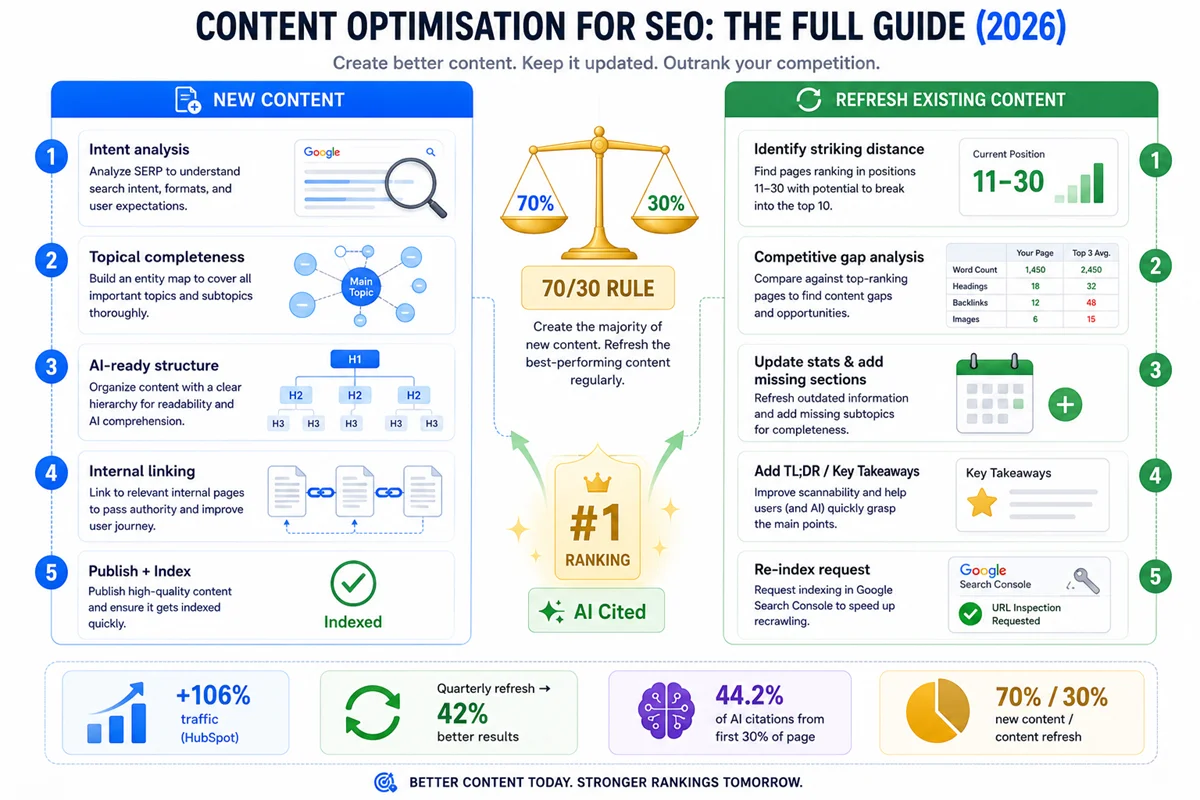
Allocate 70% of content resources to new content — targeting new keywords, expanding topical coverage, building out the content cluster.
Allocate 30% of content resources to refreshing existing content — maintaining rankings for pages that already perform, recovering traffic from decaying pages, and improving AI citation eligibility across the existing library.
This ratio maximises both growth (new keyword capture) and retention (existing ranking defence). Sites that allocate 100% to new content watch their existing rankings erode faster than new content can replace them.
How to Identify Content Refresh Priorities
Not all content needs refreshing with equal urgency. Prioritise in this order:
Priority 1: Striking distance keywords. In Google Search Console, filter the Performance report for queries where your pages rank between positions 11 and 30. These pages are visible to Google but not earning significant clicks. A refresh that improves content quality, depth, or intent alignment can move these pages onto page one, often quickly. This is the highest-ROI refresh target category.
Priority 2: Declining pages. Sort your organic traffic report by traffic change over the past 90 days. Pages with significant traffic decline are experiencing content decay. Compare these pages against current top-ranking competitors for their target keywords to diagnose what has changed.
Priority 3: Pages with outdated information. Statistics with a year in them, tool comparisons, pricing information, legal or regulatory content, and any content that references “current” practices all decay at a predictable rate. Review these on a schedule rather than waiting for traffic to decline.
Priority 4: High-traffic pages approaching their anniversary. High-performing pages that have not been updated in over twelve months are at risk of decay. Proactive refresh before traffic begins declining is more efficient than reactive recovery.
The Content Refresh Workflow
For each page identified as a refresh priority, follow this workflow:
Step 1: Capture the baseline. Before making changes, record the current organic traffic, keyword rankings, CTR, and (where trackable) AI citation status. This baseline is essential for measuring the impact of the refresh.
Step 2: Competitive gap analysis. Search the target keyword in an incognito window. Study the top three to five ranking pages. Compare them to your existing content. What do they cover that your content does not? What data or statistics do they include that your page lacks? What format or structural improvements have competitors made? This analysis tells you exactly what the refresh needs to address.
Step 3: Update statistics and data. Every statistic with a year attached should be verified against the most current available data. Outdated statistics are the most common and most visible form of content decay. Replacing 2023 statistics with 2026 figures immediately improves credibility and freshness signals.
Step 4: Fill competitive content gaps. Add sections or subsections covering topics that top-ranking competitors address but your content currently does not. A comprehensive guide that covers every relevant subtopic will outperform an incomplete one at comparable authority levels.
Step 5: Improve the structure for AI extraction. Add a TL;DR or key takeaways section near the top. Ensure each section heading is a clear question or statement that directly frames its content. Verify that the first sentence of each section directly answers the heading’s implied question.
Step 6: Update on-page elements. Refresh the title tag with the current year or updated framing where appropriate. Review the meta description for accuracy and CTR appeal. Update internal links to reference any new relevant content published since the original article.
Step 7: Update the dateModified. Update the Article schema’s dateModified property to reflect the current date. This explicitly signals content freshness to both traditional search and AI systems.
Step 8: Re-index. After publishing the refresh, use Google Search Console’s URL Inspection tool to request re-indexing. This accelerates Google’s recognition of the updated content.
What Counts as a Substantive Refresh
A substantive refresh that produces ranking improvement is not simply changing the publication date. Google’s systems distinguish between pages with genuinely updated content and pages where only metadata has changed.
A substantive refresh must include at least one of:
- Updated statistics, data, or factual claims
- Added sections covering gaps identified in competitive analysis
- Significantly improved structural organisation
- Addition of new expert perspectives, case studies, or original observations
- Updated examples or tool references reflecting current reality
Minor edits, date changes without content improvement, or rephrasing without adding information are not substantive refreshes and do not produce meaningful ranking or freshness signal improvement.
Content Optimisation Tools
Several tools assist with the content optimisation process:
Google Search Console — the essential baseline for identifying ranking positions, CTR, impressions, and striking distance opportunities. No paid tool replaces this for data about your own site.
Clearscope — analyses top-ranking content for a target keyword and generates a list of terms and topics that well-ranking pages cover. Helps identify topical completeness gaps.
Surfer SEO — provides content scoring and recommendations based on SERP analysis. Compares drafts against top-ranking pages for keyword frequency, headings, and structural elements.
Ahrefs and Semrush — used for competitive content gap analysis, identifying which keywords competing pages rank for that yours does not, and monitoring ranking changes after refresh.
Screaming Frog — useful for crawling a site to identify pages with missing or duplicate title tags, meta descriptions, and heading structures at scale.
Measuring Content Optimisation Performance
Measuring content optimisation requires distinguishing between new content and refresh performance, and tracking the right leading indicators.
For new content:
The leading indicators in the first 30 days are impressions (are pages appearing in search results?) and indexation (confirmed in Search Console). Rising impressions confirm that Google is beginning to associate the page with target queries.
After 30 to 90 days, watch for ranking movements and emerging click traffic. Conversion tracking from organic search sources validates that the content is attracting the right audience.
For content refreshes:
Compare performance in the 30-day window after refresh against the equivalent 30-day window before refresh (accounting for seasonal patterns). The metrics to track: organic traffic to the specific page, keyword ranking positions for the primary and secondary keywords, CTR from Search Console, and AI citation status for the target queries.
Refreshes that produce improvement typically show ranking movement within two to eight weeks of Google recrawling and reprocessing the updated page.
The content ROI formula: [(Traffic Increase × Conversion Rate × Average Customer Value) minus Optimisation Costs] divided by Optimisation Costs × 100. This calculation translates content performance into business ROI, making it easier to justify both new content creation and refresh investment to business stakeholders.
Common Content Optimisation Mistakes
Publishing without intent analysis. Producing content that does not match the dominant intent of the target keyword is the most expensive possible content mistake. The investment in writing, editing, and publishing is entirely wasted if the format or angle is wrong.
Optimising for only one of the four objectives. Content that ranks well but has a low CTR misses click value. Content that earns clicks but fails to satisfy the searcher’s goal produces pogo-sticking signals that erode rankings over time. Optimisation must address ranking, click-through, intent satisfaction, and conversion together.
Ignoring the existing content library. Sites that publish new content continuously without maintaining existing content watch their ranking profile decay faster than new content can grow it. The 70/30 resource allocation framework is a practical correction to pure-creation strategies.
Updating the date without updating the content. Changing a publication date or the year in a title tag without making substantive content improvements does not produce freshness signals. It may temporarily mislead readers but does not improve rankings.
Measuring new content performance too early. New content typically takes three to twelve months to reach its ranking potential. Measuring performance at four weeks and concluding the content failed produces incorrect conclusions and premature content strategy pivots. Tracking leading indicators (impressions, early position data) rather than only lagging ones (traffic, conversions) provides useful early signals without premature judgment.
❓ Frequently Asked Questions
How long does content optimisation take to produce results?
For new content, expect three to nine months to see meaningful organic traffic from competitive keywords, with some long-tail traffic appearing within weeks. For content refreshes, ranking improvements often appear within two to eight weeks of Google recrawling the page. The speed depends on the site’s crawl frequency, the current ranking position, and the degree of improvement made.
How often should I refresh existing content?
Quarterly refreshes of your highest-traffic and highest-priority content (revenue-driving pages, top organic performers) yield 42% better results than annual refreshes. Informational blog posts in stable topic areas can be refreshed every six to twelve months. Pages with statistics, tool comparisons, or rapidly evolving topics need more frequent attention.
Should I focus on new content or refreshing existing content?
Both, in proportion. The 70/30 framework (70% new, 30% refresh) is a practical starting point for established sites. For very new sites with small content libraries, the proportion should tilt toward new content since there is little existing content to refresh. As the library grows, the balance shifts toward greater refresh investment.
What is content decay and how do I prevent it?
Content decay is the gradual loss of organic traffic and rankings as content becomes outdated, as competitors publish more current resources, or as search intent around a topic shifts. Prevention requires a scheduled review programme for all high-value content, not just reactive updates after traffic declines.
Does AI-generated content hurt SEO?
Not inherently. Google evaluates content on quality, originality, and E-E-A-T signals regardless of how it was produced. AI-generated content that lacks first-hand experience, original insight, and accurate sourcing is the problem, not AI assistance itself. Using AI to assist with research, structure, and drafting while ensuring expert review and original contribution is compatible with strong content optimisation.
Summary
Content optimisation in 2026 operates across two workflows: optimising new content from creation and refreshing existing content systematically.
The key data points:
- The average site loses 20 to 30% of organic clicks every six months from content decay
- Original content yields approximately 66% ROI; content refreshes yield 42.6%
- Refreshing old posts can increase traffic by 106% to 146%
- AI-cited content is 25.7% fresher than traditional organic results
- 44.2% of LLM citations come from the first 30% of a page’s text
- Quarterly refreshes yield 42% better results than annual refreshes
- The 70/30 resource allocation (70% new, 30% refresh) maximises both growth and retention
The foundational principles: intent alignment is the first optimisation decision for any piece of content; topical completeness determines how comprehensively a page serves its searcher; AI citation potential is now a distinct optimisation objective alongside traditional rankings; and content refresh is the highest-ROI activity for established sites managing a substantial existing content library.
Advanced Content Optimisation: The Competitive Gap Framework
For sites operating in competitive niches, content optimisation must go beyond improving your own content to explicitly beating the content that currently ranks above you. The competitive gap framework provides a structured approach.
Step 1: Identify What the Top Results Have That Yours Does Not
For any page you want to rank higher, conduct a formal comparison between your content and the top three competing pages:
Coverage gaps — What topics, subtopics, or questions do competing pages address that your page does not? List each gap.
Data and evidence gaps — Do competing pages cite specific statistics, case studies, or original research that your page lacks? Original data is one of the strongest content differentiators.
Format and structure gaps — Do competing pages use tables, comparison frameworks, numbered processes, or visual structures that make their content more scannable and extractable?
Freshness gaps — Do competing pages have more recent statistics, updated tool recommendations, or current year references that make them appear more authoritative?
Experience gaps — Do competing pages include first-hand observations, documented outcomes, or specific examples from real implementation that your page does not?
Step 2: Prioritise the Gaps by Impact
Not all gaps are equally important. Prioritise:
- Gaps where the competing page’s advantage is directly related to what searchers want (coverage of the primary topic is more important than coverage of a peripheral subtopic)
- Gaps where your page is missing something that appears in two or more of the top competitors (indicating Google may view it as expected for this query)
- Freshness gaps, particularly in fast-moving or statistics-heavy topics
Step 3: Close the Gaps Without Matching Length
The goal of closing competitive gaps is not to make your page as long as the competition. It is to make your page as comprehensive and as clearly structured as the competition, while ensuring your unique angle and original contribution remain present.
Adding sections to close gaps should be accompanied by reviewing existing sections for content that can be tightened, redundant explanations, or padding that reduces overall quality without adding value.
Optimising Content for People Also Ask
People Also Ask (PAA) boxes appear in SERPs for a broad range of informational queries. Appearing in PAA is an independent visibility channel that drives brand awareness and selective traffic even when you do not hold the primary featured snippet or top organic position.
To optimise content for PAA appearances:
Identify PAA questions for your target keywords. Search each target keyword and document all PAA questions that appear. Tools like AlsoAsked show the hierarchical structure of PAA questions around any seed query.
Ensure your content directly answers each relevant PAA question. The answer should appear immediately below a heading that closely mirrors the question phrasing. The answer should be concise (two to four sentences) and directly responsive to the question.
Format PAA answers for extraction. PAA answers are extracted from a specific passage in the same way featured snippets are. Apply the same formatting principles: direct answer in the first sentence, 40 to 60 word target length for the extractable passage.
Implement FAQ schema on pages with PAA-aligned content. Although FAQ schema no longer produces FAQ rich results in Google search (as of 7 May 2026), it provides a structured, machine-readable format for the question-and-answer pairs that AI systems can extract.
Content Optimisation for Voice Search
Voice search represents a specific optimisation target with distinct characteristics from typed search. Voice queries are typically longer, more conversational, and more question-based than typed queries. Google Assistant and other voice search systems typically read aloud the featured snippet or a passage from a highly ranked page.
For voice search optimisation:
Target long-tail, conversational question queries. “What is the best time to plant tomatoes” is a voice-format query. “Best time plant tomatoes” is a typed format. Content that includes conversational question variants of its target keywords captures voice search traffic.
Provide concise, directly spoken answers. Voice search results are read aloud. An answer that reads naturally when spoken aloud, in complete sentences, at a length of two to three sentences, is optimal for voice delivery.
Optimise for local voice queries. “What’s the nearest Italian restaurant” and “Is [business name] open now” are common voice patterns. Local businesses should ensure their content includes the location-specific information voice searchers expect.
Focus on question headings. Sections with headings framed as questions (“What is content decay?” “How do I fix keyword cannibalistion?”) are inherently optimised for voice search queries that mirror those questions.
Building a Content Optimisation Calendar
A content optimisation calendar organises both new content creation and existing content refresh into a planned, scheduled workflow that prevents ad hoc, reactive content management.
Monthly tasks:
- Publish planned new content from the keyword-mapped content pipeline
- Review Search Console for any significant ranking drops on existing content
- Check AI citation status for highest-priority pages
Quarterly tasks:
- Comprehensive refresh of the highest-priority existing content (striking distance pages, high-traffic pages with declining trends, pages with statistics older than 12 months)
- Competitive gap analysis on the five most important pages
- Review internal linking structure for any published pages that lack incoming links from relevant existing pages
Annual tasks:
- Full content audit of the entire published library
- Reassessment of keyword strategy against current search volumes and competitive landscape
- E-E-A-T review: are all high-value pages attributed to named authors with updated credentials?
This calendar structure prevents the most common failure mode in content strategy: intense creation periods followed by neglect of the existing library.