
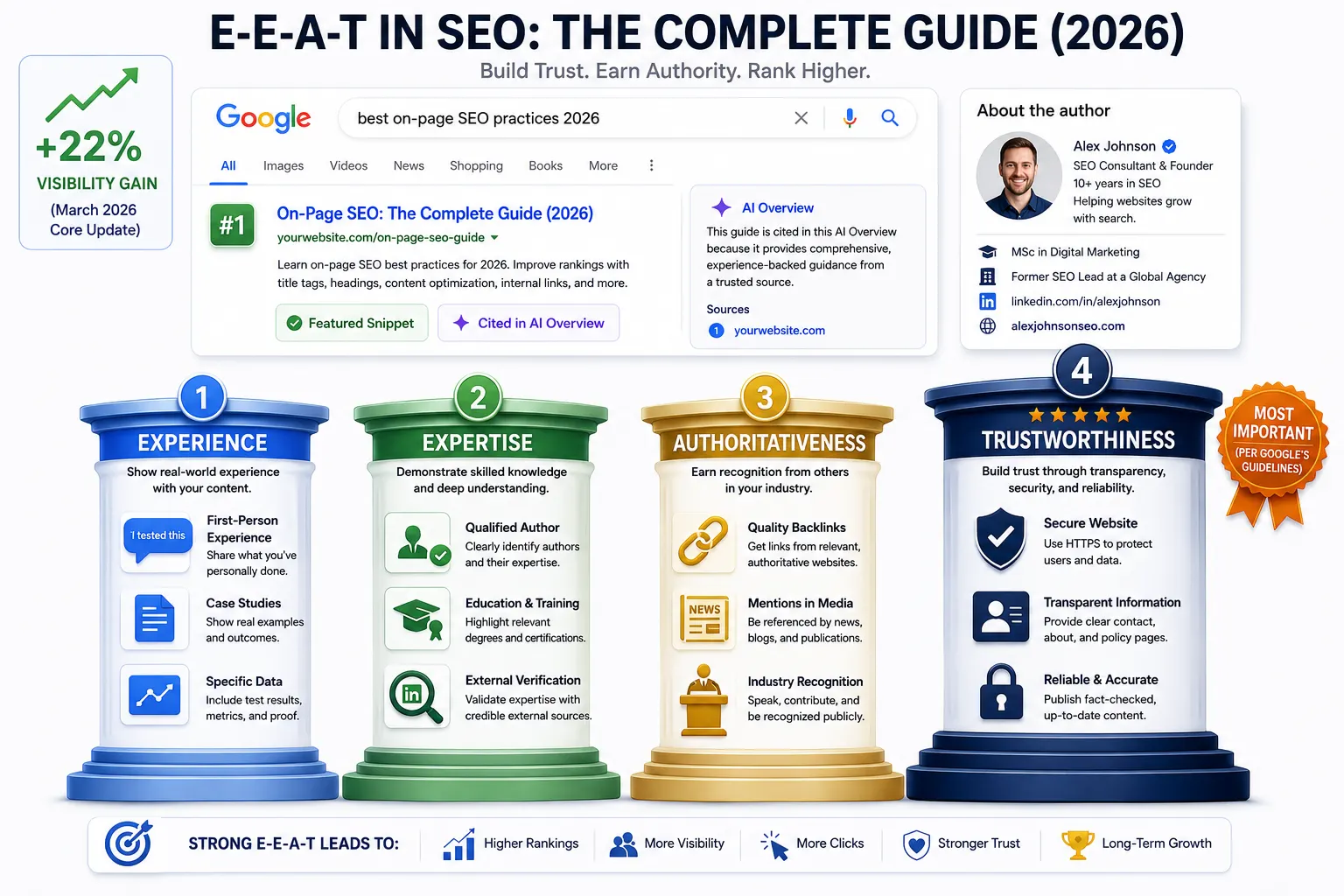
In March 2026, Google’s core update produced measurable, documented results: sites with strong E-E-A-T signals and original research saw average visibility gains of approximately 22%. Sites publishing content built primarily to rank, without genuine expertise or original contribution, experienced some of the steepest ranking drops in years.
This was not a surprise. Google has been moving consistently in this direction since 2018, when the first major E-A-T enforcement wave hit health and finance sites. The signals have been clear for years. But the 2026 enforcement cycle has removed any remaining ambiguity: E-E-A-T is no longer a quality framework to aspire to. It is the standard required to compete in organic search.
This guide explains what E-E-A-T actually means, why each component matters, what the evidence shows about how Google evaluates it in 2026, and precisely what to do on your site to demonstrate it at a level that affects rankings.
What is E-E-A-T?
E-E-A-T stands for Experience, Expertise, Authoritativeness, and Trustworthiness. It is the framework Google uses, as described in its Search Quality Rater Guidelines, to evaluate the quality of content and its creators.
The framework began as E-A-T (Expertise, Authoritativeness, Trustworthiness) in earlier versions of the guidelines. In December 2022, Google added Experience as the first E, reflecting a growing emphasis on first-hand, lived knowledge as a distinct quality signal separate from formal credentials.
One important clarification that causes significant confusion in the industry: E-E-A-T is not a direct ranking factor in the sense that there is no “E-E-A-T score” computed and applied mechanically to rankings. What exists is a framework that Google’s algorithms implement through hundreds of specific signals. When practitioners talk about improving E-E-A-T, they mean improving the signals that Google’s systems use to assess whether content meets this framework’s standards.
Trustworthiness: The Most Important Component
Google’s Search Quality Rater Guidelines state explicitly that Trustworthiness is the most important member of the E-E-A-T family. The guidelines note that an untrustworthy page has low E-E-A-T regardless of how experienced, expert, or authoritative it may otherwise appear.
This ordering is counterintuitive for many practitioners, who assume that expertise or authority drives rankings most directly. The logic behind trust being foundational: without confidence that a source can be trusted to be accurate and honest, the quality of its expertise and authority becomes irrelevant. A brilliant but deceptive expert is worse than a moderate but trustworthy one.
Trustworthiness signals include:
HTTPS across the entire site. An absolute baseline in 2026. Any site still on HTTP fails the most fundamental trust test.
Transparent contact information. A physical address (where applicable), email address, and contact form. Difficult-to-reach sites signal opacity.
Clear About and Team pages with real identities. Anonymous sites have lower trust scores than sites where real people and their credentials are visible.
Privacy policy, terms of service, and (for e-commerce) return policies. These demonstrate legal compliance and commitment to users’ rights.
Accurate, sourced, up-to-date information. Pages that contain factual errors, outdated statistics, or unsourced claims fail the trust evaluation regardless of other quality signals.
Honest handling of reviews and feedback. Sites that display only positive reviews, remove critical feedback, or have documented review manipulation practices have lower trust signals than sites with balanced, authentic review representation.
Editorial guidelines and corrections policy. Publishing sites that display their editorial standards and have a transparent corrections process signal institutional trustworthiness beyond the page level.
Experience: The Differentiator in the AI Content Era
Experience was added to the framework in 2022 precisely because Google recognised that the explosion of AI-generated content would flood the web with information that is technically accurate but lacks the signal that only comes from genuine, first-hand involvement with a topic.
The Experience signal asks: did the person who created this content actually do the thing they are writing about? Have they used the tool they are reviewing? Have they visited the place they are describing? Have they implemented the strategy they are recommending?
A content page about a software tool written by someone who has genuinely used it contains specific details, observed limitations, workflow-specific insights, and personal observations that content summarising other reviews will never contain. Google’s NLP systems are increasingly capable of detecting this difference.
How to demonstrate Experience:
Original observations and documented outcomes. Case studies, experiments, test results, and personal outcomes give content an “Experience fingerprint” that cannot be produced by synthesising existing sources.
Specific, granular details. Vague, general descriptions suggest distance from the topic. Specific details (naming specific errors encountered, exact metrics achieved, specific platform quirks observed) suggest first-hand involvement.
First-person framing where natural. “When I tested this,” “in our experience,” and “we found that” are not just stylistic choices. They are experience signals.
Process walk-throughs with real examples. Describing exactly how you did something, with actual screenshots, real data, or documented steps from a real project, is one of the strongest Experience signals available.
What Experience is not: Simply adding “in my experience” to generic content. The content itself must reflect first-hand knowledge. Formulaic phrases attached to content that could have been written without ever doing the thing ring hollow and do not produce the underlying signals that Google actually measures.
Expertise: Credentials and Knowledge Depth
Expertise means demonstrating deep, accurate, well-developed knowledge in the subject area. It encompasses both formal credentials (professional qualifications, academic background, industry certifications) and demonstrated knowledge depth (the quality of reasoning, accuracy of information, and sophistication of analysis in the content itself).
The Google March 2026 Core Update and the May 2026 Core Update both reinforced a specific and increasingly important aspect of expertise evaluation: author entity verification.
Google’s systems now cross-reference author identities with external sources. This includes LinkedIn profiles, speaker pages at industry conferences, bylines on other authoritative publications, and publication history. An author name listed in a bio that does not connect to a verifiable external identity carries significantly less weight than an author name associated with a rich, externally verifiable professional presence.
Industry tracking following the March 2026 Core Update found that 73% of top-ranking YMYL pages now display detailed author credentials, up from 58% before this update cycle. The shift is significant and directional.
In 2026, anonymous authorship carries ranking risk across all content types, not just YMYL topics. Health, finance, and legal content face the highest standards, but Google’s guidelines have expanded the expectation of named, verifiable authorship broadly.
How to demonstrate Expertise:
Named authors with comprehensive bio pages. Each author’s bio page should include their professional background, credentials relevant to the topics they cover, links to verifiable external profiles (LinkedIn, publications, conference speaker profiles), and a profile photograph.
Author schema with external verification links. Implement Person schema that links the author entity to their external profiles using sameAs properties. This explicitly connects the on-site author to their externally verifiable identity for Google’s entity recognition systems.
Credential signals within content. Referencing professional experience, citing specific industry data, and demonstrating command of technical nuance are content-level expertise signals beyond author page credentials.
Topic focus by author. An author who covers only SEO topics demonstrates more expertise credibility in those topics than an author who covers SEO, cooking, parenting, and travel within the same publication.
Accurate, well-sourced information. Content with factual errors undermines expertise claims regardless of the credentials attached to it.
Authoritativeness: Reputation Beyond Your Own Site
Authoritativeness is about external recognition. While Experience and Expertise can be demonstrated on your own site, Authoritativeness is built through signals that originate elsewhere and point back to you.
The most important Authoritativeness signals are backlinks from relevant, credible sources. When authoritative publications in your industry, established news outlets, academic institutions, or widely respected practitioners link to your content, it signals that the broader expert community recognises your contribution.
But Authoritativeness extends beyond links. It encompasses:
Brand mentions in authoritative contexts. Being cited by name in industry publications, quoted in news coverage, or referenced in academic research builds brand authority signals even without a hyperlink.
Guest bylines in reputable publications. Contributing expert content to established publications in your field builds both author entity recognition and site authority through association.
Industry recognition. Awards, certifications, inclusion in professional directories, and recognition by industry bodies all contribute to authority signals that Google can identify and evaluate.
Consistent presence in relevant communities. Active, credible participation in industry forums, conferences, and professional communities builds the kind of recognised expertise that links and mentions reflect.
The HubSpot warning. Sites that published at scale outside their core topic expertise experienced dramatic authority loss in 2025 to 2026 core updates, with some reporting 70 to 80% organic traffic losses. Publishing beyond your demonstrated expertise territory undermines authoritativeness even when individual articles are well-written. Authority is topic-specific: recognised expertise in SEO does not transfer to recognised authority in medical topics.
YMYL: Where E-E-A-T Requirements Are Highest
YMYL — Your Money or Your Life — describes content categories where Google applies its highest E-E-A-T standards because inadequate or inaccurate information in these areas can cause real-world harm.
YMYL categories include: health, medical, and mental health information; financial advice (investments, tax, insurance, retirement); legal information; safety advice; and major life decisions.
Health and finance pages experienced the largest ranking volatility in the March 2026 Core Update, with some sites seeing double-digit traffic losses. YMYL topics face the highest content quality thresholds: original reporting, demonstrated subject authority, verifiable professional credentials, and peer-reviewed sourcing are the standards that top-ranking YMYL content now consistently meets.
For any site publishing YMYL content without meeting these standards, the risk is not just lower rankings. It is potential removal from the index for specific pages, or sitewide quality suppression that affects all content regardless of topic.
The practical requirement for YMYL content in 2026:
- Named authors with professional credentials in the relevant field (medical degree for health, financial licence for financial advice, legal qualification for legal content)
- Medical, financial, and legal content reviewed or co-authored by licensed professionals
- Sources cited to primary, peer-reviewed, or official sources rather than to secondary or derivative content
- Regular expert review and update of content to maintain factual accuracy
- Clear disclaimers where professional advice should be sought
E-E-A-T and AI Search
E-E-A-T signals have become even more important with the rise of AI-generated search answers. Generative engines including Google AI Overviews, ChatGPT Search, and Perplexity rely heavily on E-E-A-T signals to determine which sources to cite in their generated answers.
The reason is structural: AI systems that synthesise answers from multiple sources must evaluate the trustworthiness of those sources to avoid propagating inaccurate information. They use many of the same signals that traditional search ranking uses: site authority, author credentials, content accuracy, source reputation, and structured data that makes entity relationships explicit.
Content that demonstrates strong E-E-A-T is more likely to be selected as a citation source in AI-generated answers, often independently of its traditional organic ranking position. A highly credible source on a specific subtopic may be cited in an AI Overview even when its overall page does not rank in the top ten for the broader keyword.
This creates a new strategic dimension: E-E-A-T is not just about protecting traditional rankings. It is the primary determinant of AI search visibility.
Practical E-E-A-T Audit: Assessing Your Site
Before improving E-E-A-T signals, assess where your site currently stands.
Author Presence Audit
For every piece of content on your site that targets meaningful keywords:
- Does it have a named author?
- Does clicking the author name lead to a comprehensive bio page with verifiable credentials?
- Does the author have a verifiable external presence (LinkedIn, published bylines, speaker credits)?
- Is Person schema implemented linking the author to their external profiles?
If your content has no author attribution, or if author names lead to empty or generic bio pages, author presence is the highest-priority E-E-A-T improvement to make.
Content Quality Audit
For your highest-traffic and highest-value pages:
- Does the content contain specific, original observations that could only come from first-hand experience with the topic?
- Are claims sourced to primary, credible sources rather than secondary or derivative content?
- Is the information factually accurate and current?
- Does the content go beyond summarising existing information to add something genuinely new: original analysis, first-hand data, a unique perspective based on real experience?
Pages that fail this audit are candidates for substantial content improvement or replacement, not minor optimisation.
Site Trust Audit
- Is HTTPS implemented across the entire site with no mixed content errors?
- Is there a clear, accessible About page with real team information?
- Is contact information (email at minimum) clearly displayed?
- Does the site have a privacy policy that complies with current regulations?
- If the site runs ads or has commercial relationships, are these disclosed transparently?
Authority Audit
- What is the quality and topical relevance of backlinks pointing to the site?
- Has the site been cited by or mentioned in authoritative publications in its field?
- Do any authors publish content under their name in other reputable publications?
- Is the site’s topical focus consistent, or does it publish across unrelated subjects?
How to Build E-E-A-T: A Prioritised Action Plan
Based on what the 2026 algorithm updates have demonstrated, the following actions produce the most measurable E-E-A-T improvement in priority order.
Priority 1: Establish named, credentialed authorship across all content. This is the single highest-priority action for most sites in 2026. Add named authors to all content, build out comprehensive author bio pages with verifiable credentials, and implement Person schema with sameAs links to external profiles. For existing anonymously published content, assign existing credentialed team members retroactively.
Priority 2: Add Experience signals to existing content. Review the highest-traffic pages on your site. For each, identify where first-hand experience can be demonstrated: replace generic descriptions with specific observations from actual use, add original data or test results, incorporate case study elements, and include specific examples drawn from real work.
Priority 3: Build original research into your content strategy. Sites that saw 22% visibility gains after the March 2026 Core Update share a common feature: investment in original research and proprietary data. Publishing original studies, surveys, or data analysis that becomes cited by other sources is the most sustainable Authoritativeness builder available.
Priority 4: Establish and maintain site trust infrastructure. Ensure HTTPS, clear contact information, transparent About pages, privacy policy, and (for commercial sites) clear disclosure of commercial relationships. These are hygiene requirements, but their absence actively suppresses E-E-A-T evaluation.
Priority 5: Build topical authority through focused publication. Publish consistently within your core expertise areas. Expanding publication scope across unrelated topics dilutes topical authority and introduces the risk of the authority-loss pattern seen with sites that published at volume outside their expertise territory.
Priority 6: Earn authoritative backlinks through digital PR. Create content that earns citations: original research, comprehensive definitive resources, expert commentary on current events in your field. Prioritise link acquisition from topically relevant, high-authority sources over volume from unrelated sources.
❓ Frequently Asked Questions
Is E-E-A-T a direct ranking factor?
No. There is no single “E-E-A-T score” that Google applies. E-E-A-T is a framework described in the Search Quality Rater Guidelines that Google implements through hundreds of specific algorithmic signals. Improving E-E-A-T means improving the signals those systems evaluate, which measurably affects rankings.
Can a new site build E-E-A-T?
Yes. A new site with credentialed authors, original research, and a focused topic area can build strong E-E-A-T signals relatively quickly on the Experience and Expertise dimensions. Authoritativeness takes longer because it requires third-party recognition (backlinks, mentions) that must be earned over time. Trustworthiness can be established from launch through site infrastructure.
Does AI-generated content harm E-E-A-T?
Not inherently. Google’s position is that AI-assisted content is acceptable when it demonstrates human expertise and genuine value. The problem is AI content that lacks first-hand experience signals, original insight, and accurate sourcing — which describes most AI content published without meaningful editorial oversight. Using AI to assist with research and structure while ensuring the content reflects genuine expert knowledge and original insight is compatible with strong E-E-A-T.
How long does it take to see ranking improvements from E-E-A-T work?
Variable. Author page additions and content improvements that fix specific quality issues can show results within weeks when Google recrawls the pages. Building site authority through backlinks and external recognition takes months to years. The March 2026 update showed that sustained E-E-A-T investment over six to twelve months produces cumulative gains that compound across multiple update cycles.
Does E-E-A-T apply to all sites or only YMYL?
All sites are evaluated against E-E-A-T, but the standards differ by content category. YMYL topics face the highest requirements. Non-YMYL informational content and commercial sites face meaningful but comparatively lower standards. In 2026, however, anonymous authorship is a ranking risk across all content types, not just YMYL.
Summary
E-E-A-T stands for Experience, Expertise, Authoritativeness, and Trustworthiness. It is the framework Google uses to evaluate content quality, and the 2026 enforcement cycle has made it the most consequential quality signal in organic search.
The key data points from 2026:
- 73% of top-ranking YMYL pages now display detailed author credentials, up from 58% before the March 2026 update cycle
- Sites with original research and strong E-E-A-T saw approximately 22% average visibility gains following the March 2026 Core Update
- Sites publishing outside their core expertise at volume experienced 70 to 80% traffic losses in some cases
- Anonymous authorship now carries ranking risk across all content types, not just YMYL
- Trustworthiness is explicitly the most important E-E-A-T component per Google’s own guidelines
The most important practical actions: establish named, credentialed, externally verifiable authorship across all content; add first-hand experience signals to existing pages; build original research into the content strategy; and maintain the site trust infrastructure that underpins all other E-E-A-T signals.
E-E-A-T Signals by Content Category
The signals that best demonstrate E-E-A-T vary by the type of content being published. Applying the framework generically produces weaker results than tailoring signal implementation to content category.
Health and Medical Content
The most stringent E-E-A-T standards apply here. Effective health content E-E-A-T signals in 2026:
Medical professional authorship is effectively mandatory for content providing health advice. Authors should be licensed practitioners in the relevant field (physicians for medical advice, registered dietitians for nutrition guidance, licensed therapists for mental health content).
Content should be reviewed periodically against current clinical guidelines. Health information that was accurate in 2022 may conflict with current consensus. An explicit “last reviewed” date by a named medical professional signals ongoing accuracy commitment.
Sources should cite peer-reviewed research, official health authority guidelines, and primary medical literature rather than secondary health publications.
Disclaimers should be clear and prominent: content is for informational purposes and not a substitute for professional medical advice.
Financial Content
Financial content E-E-A-T requirements are among the most rigorous outside of medical content:
Authorship by licensed financial professionals (CFP, CFA, CPA, or similar credentials relevant to the specific content) significantly strengthens ranking potential.
Clear disclosure of any commercial relationships, sponsored content, or financial products the publisher profits from is required for both trust signals and regulatory compliance.
Content should distinguish clearly between general information and financial advice, with appropriate disclaimers.
Data and statistics should cite official financial authority sources, peer-reviewed research, or primary industry data.
SEO and Digital Marketing Content
For a site like Visiblytics, the most relevant category. E-E-A-T requirements are lower than YMYL but meaningful:
Authors should have demonstrable professional SEO experience (professional history, published work in the field, conference presentations, original research or case studies).
Content should demonstrate first-hand knowledge of the tactics and tools described, not just summarise what others have documented.
Original data (performance data from real campaigns, test results, case studies with specific numbers) is particularly valuable as an Experience signal in a field where many practitioners publish primarily opinion or summaries.
Active participation in the SEO community (conferences, professional forums, published research) builds Authoritativeness signals beyond the site itself.
E-commerce and Product Content
E-E-A-T for product-focused content differs from informational content:
Product reviews that demonstrate personal testing, with specific observations and documented outcomes, carry strong Experience signals. Reviews that aggregate specifications without first-hand testing are explicitly targeted by Google’s product reviews updates.
Expert editorial curation, where curated product selections are explained and justified with demonstrated knowledge of the product category, is stronger than simple product listing.
User reviews and ratings, when genuine, contribute Trust signals.
E-E-A-T and the Information Gain Concept
One of the most useful frameworks for understanding what Google is measuring within the Experience and Expertise dimensions is information gain: what does this page add that does not already exist in the top-ranking content?
Information gain is the quantitative measure of how much new, useful, and previously unavailable information a page contributes relative to what searchers can already find. Pages that summarise existing content without adding anything new contribute zero information gain. Pages that contain original research, first-hand observations, proprietary data, or unique analytical frameworks contribute positive information gain.
Google’s quality systems in 2026 are specifically designed to identify and reward information gain. The March and May 2026 Core Updates both targeted content that aggregated or rephrased existing information without adding original value. Sites publishing original research saw average visibility gains of 22%, while aggregators saw declines.
For every piece of content planned for publication, the information gain question should be asked: what does this specific page offer that the ten pages currently ranking for this keyword do not? If the honest answer is “nothing substantially different,” the content strategy should be revised before publication.
Practical information gain sources:
- Original survey data with statistically significant samples
- First-hand case study results with real performance metrics
- Expert analysis that applies deep domain knowledge to publicly available information in a way that produces new insights
- Synthesis of information from primary sources that have not previously been combined in the specific way this content does
- Personal experience data from real implementation of the tactics being described
E-E-A-T Monitoring and Maintenance
Building E-E-A-T is not a one-time project. It requires ongoing maintenance to remain effective as Google’s systems evolve and as the competitive landscape around your content changes.
Monitor author entity recognition. Search your authors’ names in Google periodically. Do knowledge panels or entity recognition results appear? Is the author appearing in searches for their areas of expertise? Growing entity recognition is a positive signal. Declining visibility suggests the entity signals need strengthening.
Track the performance of content by author. In sites with multiple authors, comparing the organic performance of content attributed to credentialed versus less credentialed authors provides a measurable signal of how author E-E-A-T is affecting rankings.
Review content accuracy quarterly. Particularly for statistics-heavy content or content in rapidly evolving fields, facts that were accurate at publication can become outdated or incorrect. A quarterly review process that updates statistics, checks for changed guidance, and refreshes sourcing maintains the trust signals that factual accuracy provides.
Monitor competitor E-E-A-T signals. How are top-competing pages implementing author credentials, experience signals, and trust infrastructure? If competitors are raising their E-E-A-T standards and yours are static, the relative signal quality shifts in their favour.