
To understand SEO in 2026, you need to understand how it got here.
Every rule in modern SEO exists because someone broke the old rules. Every algorithm update was a response to manipulation. Every best practice today was earned through a decade of misuse, correction, and refinement.
The history of SEO is not just an academic exercise. It is the clearest possible explanation for why Google works the way it does, why certain tactics get sites penalised, and why quality, expertise, and genuine usefulness are now the only sustainable path to organic visibility.
This guide traces SEO from its chaotic beginnings in the mid-1990s to the AI-driven search landscape of 2026.
The Origins of SEO: The Early Internet (1991 to 1997)
The world’s first website launched in 1991. By the mid-1990s, the internet was growing faster than anyone could navigate. Thousands of websites existed with no organised way to find them.
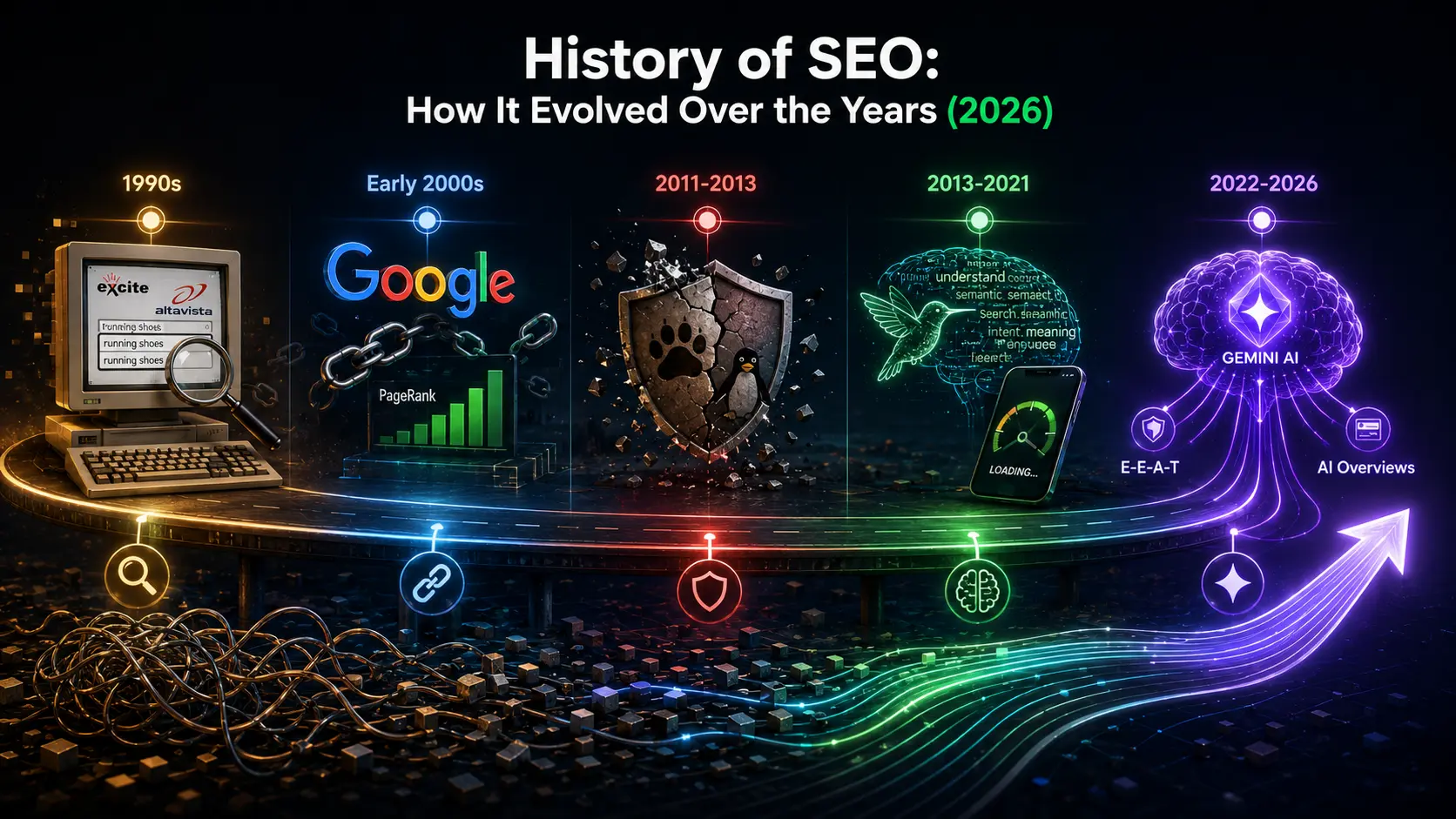
This problem created an urgent need: a way to discover and catalogue web content. The first search engines emerged to fill that gap. Excite launched in 1994. AltaVista went live in 1995. Yahoo began as a human-curated web directory. Lycos, WebCrawler, and Infoseek all emerged around the same period.
These early search engines were primitive by today’s standards. They ranked pages primarily based on keyword frequency. If a page mentioned “running shoes” ten times, it ranked higher for that query than a page that mentioned it twice. There was no evaluation of quality, authority, or user satisfaction.
The first act of what we now call SEO happened almost by accident. In 1995, a music lawyer named Bob Heyman discovered that a website for a band he represented ranked better when the band’s name appeared more frequently on the page. He began adjusting page text to manipulate positions in early search engines. The practice spread quickly.
By 1997, webmasters were actively optimising their pages for search engines. The techniques were crude: repeat keywords as many times as possible, stuff hidden text into pages using the same font colour as the background, submit to as many directories as possible. It worked because the search engines of the era had nothing more sophisticated to evaluate.
The lesson this era teaches: Search engines were built to serve users. Every manipulation tactic that worked in the 1990s worked because the system could not yet detect it. Every update since has been an attempt to close those gaps.
Google Changes Everything (1998 to 2003)
In 1998, two Stanford PhD students named Larry Page and Sergey Brin published a paper describing a new approach to search. Their system, called PageRank, ranked web pages not just by keywords but by the number and quality of other pages linking to them.
The insight was elegant: if many other websites link to a page, it is probably more useful than a page with no links. Links functioned as votes of confidence. A link from an important, well-linked page was worth more than a link from an obscure one.
Google launched publicly in 1998 with this foundation. Within a few years it had become the dominant search engine globally, outcompeting AltaVista, Yahoo Search, and the rest of the field largely on the basis of result quality.
The introduction of PageRank transformed SEO. Keyword stuffing alone was no longer sufficient. Links became the new currency, and website owners began pursuing them aggressively.
In 2000, Google launched AdWords (now Google Ads), establishing the paid search model that funds Google to this day. In 2003, Google launched AdSense, which allowed publishers to display Google ads and earn revenue.
By 2003, SEO was a recognisable industry. Agencies offered optimisation services. Communities of practitioners shared tactics. The first attempts at link manipulation, including link exchanges and link farms (networks of low-quality sites that existed purely to generate links), were already widespread.
The lesson this era teaches: When a new ranking signal is introduced, it will be abused. Google has spent the 25 years since PageRank’s launch continuously evolving its ability to detect and discount manipulated links.
The Wild West of Links and Spam (2003 to 2010)
The years between 2003 and 2010 are often called the “Wild West” of SEO. Google dominated search. Links drove rankings. And the SEO industry was deeply divided between practitioners building legitimate sites and those building whatever it took to rank.
Common tactics of this era included:
Link farms and link networks. Sites created specifically to generate links, with no value for readers. Networks of low-quality sites all linking to each other and to client websites.
Keyword stuffing. Still widespread. Pages would repeat target keywords at unnatural densities, sometimes in footers or in white text on white backgrounds.
Hidden text and hidden links. Content visible to search engine crawlers but invisible to users.
Article spinning. Taking one article and automatically generating hundreds of variations with slightly different wording to use for link building.
Exact-match domains. Registering domain names containing exact keyword phrases, such as bestcreditcards.com, because Google’s algorithm at the time gave ranking boosts to domains matching keywords.
Directory submissions. Mass submission to web directories of every quality level, simply to generate links.
These tactics worked. A skilled practitioner in 2007 could rank almost any page for almost any keyword using them, regardless of content quality.
Google released regular updates throughout this period, attempting to reduce the effectiveness of low-quality tactics. The Florida Update in 2003 was an early major signal that Google was taking spam seriously, causing widespread ranking drops. But enforcement was inconsistent, and the arms race between manipulators and the search engine continued.
The lesson this era teaches: Rankings built on manipulation are fragile. Millions of sites built on link schemes in this era lost everything when Panda and Penguin arrived.
Google Fights Back: Panda, Penguin and the Quality Era (2011 to 2013)
February 2011 marked a turning point in SEO history. Google launched the Panda update.
Panda targeted content quality. Its algorithm identified and demoted websites with thin, duplicate, or low-quality content. Sites that had grown by publishing enormous volumes of low-quality articles (content farms) were devastated. Demand Media, one of the largest content farm operations of the era, lost roughly 40% of its search traffic overnight following Panda.
The message was clear: volume without quality was no longer a viable strategy. Content needed to be genuinely useful, original, and substantive.
In April 2012, Google launched Penguin. While Panda targeted content quality, Penguin targeted link quality. It demoted sites with manipulative backlink profiles: excessive links from irrelevant websites, links from known link networks, over-optimised anchor text, and links clearly obtained for ranking purposes rather than earned naturally.
Penguin caused widespread panic in the SEO industry. Sites that had spent years building large quantities of low-quality links saw dramatic ranking drops. The link-building industry was forced to fundamentally change its approach.
In August 2012, Google launched the Exact Match Domain (EMD) update, reducing the ranking advantage of exact-match keyword domains.
In 2012, Google also introduced the Disavow Tool, allowing webmasters to tell Google which links they wanted to exclude from their backlink profile. This was a response to the large number of sites suffering from poor-quality links, both self-built and in some cases built by competitors in deliberate “negative SEO” attacks.
The lesson this era teaches: Panda and Penguin defined the standards that still apply today. Content must be genuinely valuable. Links must be earned, not manufactured. Sites built on the shortcuts of the previous era paid dearly, and many never recovered.
Understanding Intent: Hummingbird and the Semantic Era (2013 to 2015)
By 2013, Google had substantially reduced the effectiveness of content spam and link manipulation. The next frontier was understanding language more deeply.
The Hummingbird update, launched in September 2013, was the most fundamental change to Google’s core search algorithm in years. Previous updates had adjusted how Google weighted signals. Hummingbird rebuilt the underlying approach to query interpretation.
Hummingbird moved Google from keyword matching to semantic understanding. Instead of treating a search query as a collection of individual words, Hummingbird interpreted queries as complete thoughts with intent.
This had profound implications. A user searching “what’s the best way to get rid of ants in my house” was no longer matched purely on the basis of which pages contained those words. Google now tried to understand what the person actually needed: practical pest control advice.
Conversational search became possible. Voice search, which was beginning to emerge through Siri (launched 2011) and Google Now (launched 2012), required this kind of natural language understanding.
In 2015, Google confirmed RankBrain, its first machine learning system applied to search ranking. RankBrain helped Google interpret the approximately 15% of daily searches that it had never seen before, mapping unfamiliar queries to related known concepts.
Also in 2015, Google introduced Mobilegeddon, a mobile-friendliness update that gave ranking boosts to pages that delivered good experiences on smartphones. This was the first formal acknowledgement that mobile search was not just growing but had become the primary search interface.
The lesson this era teaches: SEO stopped being about optimising for keywords and started being about optimising for intent. Understanding what a searcher actually wants, not just matching the words they use, became the defining skill of modern SEO.
The Trust Era: Expertise, Authority and HTTPS (2014 to 2018)
As Google’s ability to evaluate content quality improved, it also focused increasingly on trust.
In 2014, Google released the first version of its Search Quality Rater Guidelines publicly. These guidelines, used by human quality raters to evaluate search results, introduced the concept of E-A-T (Expertise, Authoritativeness, Trustworthiness). While not a direct algorithm, the guidelines gave the clearest picture yet of what Google was trying to measure.
Also in 2014, Google announced HTTPS as a ranking signal, encouraging sites to migrate from unencrypted HTTP to the secure HTTPS standard. By 2026, HTTPS is universal. Any site still serving over HTTP faces ranking disadvantages and browser security warnings.
In 2016, Google confirmed it was using its Penguin algorithm in real time, meaning backlink penalties and recoveries now applied as Google recrawled and reprocessed pages, rather than waiting for periodic updates.
In 2018, the Medic Update caused significant ranking changes, particularly for health, financial, and legal content. This update strongly reinforced E-A-T. Sites providing potentially life-affecting information without demonstrable expertise, credentialed authors, and authoritative sources saw dramatic drops. The medical and health content industry had to fundamentally rethink its approach to demonstrating expertise.
The lesson this era teaches: Authority and trust cannot be manufactured. They must be demonstrated through credentials, citations, transparency about authorship, factual accuracy, and consistency over time. Sites in sensitive categories (health, finance, legal) without genuine expertise have no sustainable path to high rankings.
Language, Context and AI: BERT and the NLP Era (2019 to 2021)
In October 2019, Google launched BERT (Bidirectional Encoder Representations from Transformers), which it described as one of the most significant advances in search quality in five years.
BERT enabled Google to understand the nuance and context of language in a way that was not previously possible. By reading the words in a query or document bidirectionally (understanding both the words before and after each word), BERT could interpret subtle meanings that word-level analysis missed.
The practical effect was that Google became significantly better at returning relevant results for complex, conversational, and nuanced queries, particularly where small words changed meaning. Queries like “can you get medicine for someone pharmacy” were now correctly interpreted as someone asking whether they could pick up a prescription for another person, not a general query about pharmacy services.
For SEO practitioners, BERT reinforced what Hummingbird had started: write naturally for human readers. Keyword optimisation techniques based on manipulating individual words became counterproductive in an environment where Google understood context.
In 2021, Google launched Core Web Vitals as confirmed ranking signals. These three specific measurements of page loading speed, responsiveness, and visual stability set a technical performance baseline that all websites were expected to meet. Page experience became a formal part of ranking.
Also in 2021, Google introduced the Helpful Content System as part of its broader quality signals. This system evaluated whether a website’s content was primarily created for people or primarily created to rank in search engines.
The lesson this era teaches: User experience became indistinguishable from SEO. Technical performance, content quality, and genuine usefulness are all signals that feed the same algorithm objective: deliver the most helpful result.
The AI Revolution: 2022 to the Present
The years from 2022 to 2026 have brought the most rapid transformation in SEO’s history.
November 2022 saw the launch of ChatGPT, which reached one million users within five days and 100 million within two months. For the first time, a widely available AI tool offered a viable alternative to Google Search for many informational queries. Users could ask a question and receive a direct, conversational answer without clicking through any website.
Google’s response was significant. In May 2023, Google launched the Search Generative Experience (SGE), an AI-powered answer layer built directly into search results. This evolved through 2024 into AI Overviews.
The Helpful Content Updates of 2022 through 2024 progressively strengthened Google’s ability to identify and suppress content created primarily for search engines rather than users. Multiple major updates penalised sites that had grown by publishing high volumes of SEO-optimised content without genuine expertise or original value.
E-A-T became E-E-A-T in late 2022 when Google added “Experience” as a fourth pillar alongside Expertise, Authoritativeness, and Trustworthiness. This change reflected a growing emphasis on first-hand experience. A review written by someone who actually used the product carries more weight than one written by someone summarising what others have said.
In 2026, AI Overviews appear on roughly 25% of Google search queries. For the queries they appear on, studies report zero-click rates as high as 83%, meaning the majority of users get their answer directly from the AI summary without clicking to any website. This is the most significant structural change in search traffic distribution since Google began.
Simultaneously, the SEO services market has grown to an estimated $84 billion globally, projected to reach $148 billion by 2031. The discipline has not collapsed under the weight of AI. It has become more important and more sophisticated.
The lesson this era teaches: The fundamental purpose of SEO has always been to help search engines understand and trust your content. AI search amplifies that purpose. The sites that are cited in AI Overviews are the same sites that have always followed the foundational principles: genuine expertise, well-structured content, strong authority, and excellent user experience.
The Major Algorithm Updates: A Reference Timeline
| Year | Update | What It Changed |
|---|---|---|
| 2003 | Florida | First major spam-targeting update. Hit sites relying on keyword manipulation. |
| 2011 | Panda | Penalised thin, duplicate, and low-quality content. Content farms destroyed. |
| 2012 | Penguin | Penalised manipulative link schemes, link farms, and over-optimised anchor text. |
| 2012 | EMD Update | Reduced ranking advantages of exact-match keyword domain names. |
| 2013 | Hummingbird | Rebuilt query interpretation around semantic understanding and intent, not keyword matching. |
| 2014 | HTTPS Update | Made HTTPS a confirmed ranking signal. |
| 2015 | Mobilegeddon | Made mobile-friendliness a ranking factor. |
| 2015 | RankBrain | Introduced AI to handle novel, never-before-seen search queries. |
| 2018 | Medic Update | Strengthened E-A-T requirements, particularly for health and finance content. |
| 2019 | BERT | Enabled deep contextual language understanding in query and document processing. |
| 2021 | Core Web Vitals | Made page speed, responsiveness, and visual stability confirmed ranking signals. |
| 2022 | Helpful Content System | Introduced sitewide signal for content created primarily for search vs. for people. |
| 2022 | E-E-A-T | Added Experience to Expertise, Authoritativeness, and Trustworthiness framework. |
| 2024 | AI Overviews | Launched AI-generated answer summaries at the top of results for eligible queries. |
| 2026 | AI Mode | Full rollout of conversational AI search with query fan-out and multi-source synthesis. |
What the History of SEO Teaches Us
Looking at the complete arc of SEO history, several patterns are clear.
Every manipulation tactic eventually stops working. Keyword stuffing, link farms, hidden text, article spinning, exact-match domains, private blog networks — every shortcut that worked for a period was eventually neutralised by an algorithm update. The investment required to implement these tactics was wasted.
Google’s direction has never changed. Despite thousands of algorithm updates, Google has always been trying to do the same thing: surface the most genuinely helpful, authoritative, and trustworthy content for each query. The method of measuring that has evolved, but the goal has not.
Long-term SEO investment consistently outperforms short-term manipulation. Sites that built quality content and earned links through genuine value in 2010 are still ranking. Sites that built link networks and content farms in 2010 are gone.
AI has accelerated every existing trend, not reversed them. The arrival of AI in search has made quality more important, not less. AI Overviews cite trusted, authoritative, well-structured sources. The skills that matter most for AI-era SEO, genuine expertise, clear structure, factual accuracy, and strong authority, are the same skills that have mattered since Google’s earliest years.
The practitioners who thrive are those who understand the purpose, not just the tactics. SEO practitioners who understood that Google was trying to serve users, not reward clever techniques, navigated every major update successfully. Those who chased algorithm signals without understanding the underlying goals were repeatedly caught out.
SEO in 2026: The End of an Era or the Start of a New One?
There is a reasonable concern that AI search reduces the value of SEO. If users get answers without clicking, why invest in organic search visibility?
The question misunderstands what SEO delivers.
SEO is not merely about driving clicks from search results pages. It is about being the source that search engines, including AI systems, trust and cite when they construct answers. Being cited in an AI Overview can drive brand awareness, authority, and qualified traffic even when fewer users click through to the full page.
The sites that are cited in AI Overviews are the sites that invested in genuine expertise and content quality. The correlation is not coincidental.
The SEO services market at $84 billion globally and growing suggests that businesses understand this. Organic visibility remains one of the highest-value and most cost-efficient channels for sustainable growth. The methods for achieving it have changed. The value of achieving it has not.
❓ Frequently Asked Questions
Who invented SEO?
SEO was not invented by a single person. It emerged organically as webmasters discovered that search engine rankings could be influenced by page content and structure. The practice became recognisable around 1995, with figures like Bob Heyman among the earliest documented practitioners. The term “search engine optimisation” is generally traced to 1997.
When did Google become the dominant search engine?
Google launched in 1998 and grew rapidly through the early 2000s. By approximately 2003 to 2004, it had surpassed Yahoo and become the global default for search. It has held over 90% global market share for most of the time since.
Which Google update had the biggest impact on SEO?
Different updates affected different practices most severely. Panda (2011) had the biggest single-day traffic impact on content-heavy sites. Penguin (2012) most fundamentally changed link-building practice. Hummingbird (2013) was the most significant change to the underlying ranking approach. For the current era, the Helpful Content System and AI Overviews represent the biggest structural shifts since Panda and Penguin.
Is SEO still relevant in 2026?
Yes. Despite the rise of AI-generated search answers, organic search visibility remains a critical channel for most businesses. The methods have evolved to account for AI search, but the fundamental investment in quality content, technical excellence, and genuine authority remains as valuable as ever.
How long has SEO existed?
Depending on the definition, SEO is approximately 30 years old. The earliest documented practices date to around 1995. The first professional SEO agencies emerged around 1996 to 1998.
Summary
SEO has evolved through five broad eras: the Wild West of keyword manipulation (1990s), the link-building arms race (early 2000s), the quality crackdowns of Panda and Penguin (2011 to 2012), the semantic and trust era (2013 to 2021), and the AI era (2022 to present).
Each era was shaped by the misuse of whatever signal the previous era had established, followed by Google’s response to close that gap. The consistent theme across 30 years is that Google’s goal has never changed: reward genuinely useful, trustworthy content, and make it harder to rank for any other reason.
In 2026, the stakes are higher than they have ever been. AI search is redirecting traffic patterns, raising the bar for content quality, and rewarding expertise and authority more directly than any previous system. The history of SEO is, ultimately, a story about quality winning in the long run. That story has not changed.