
The phrase “SEO best practices” gets thrown around so frequently that it has become almost meaningless. Every guide says the same things: write quality content, build backlinks, optimise your title tags. The advice is not wrong. But it is not enough.
This guide goes further. It explains not just what the best practices are but why each one matters, how they interact with each other, and what specifically has shifted in 2026 based on the most recent data and algorithm updates. If you apply everything in this guide consistently, you will be doing more than most websites currently do.
How to Think About SEO Best Practices
Before diving into specific practices, one framing point matters.
SEO best practices are not a checklist to complete once. They are a set of ongoing standards your website should meet and maintain. Completing them at launch and ignoring them thereafter is one of the most common ways businesses underinvest in SEO without realising it.
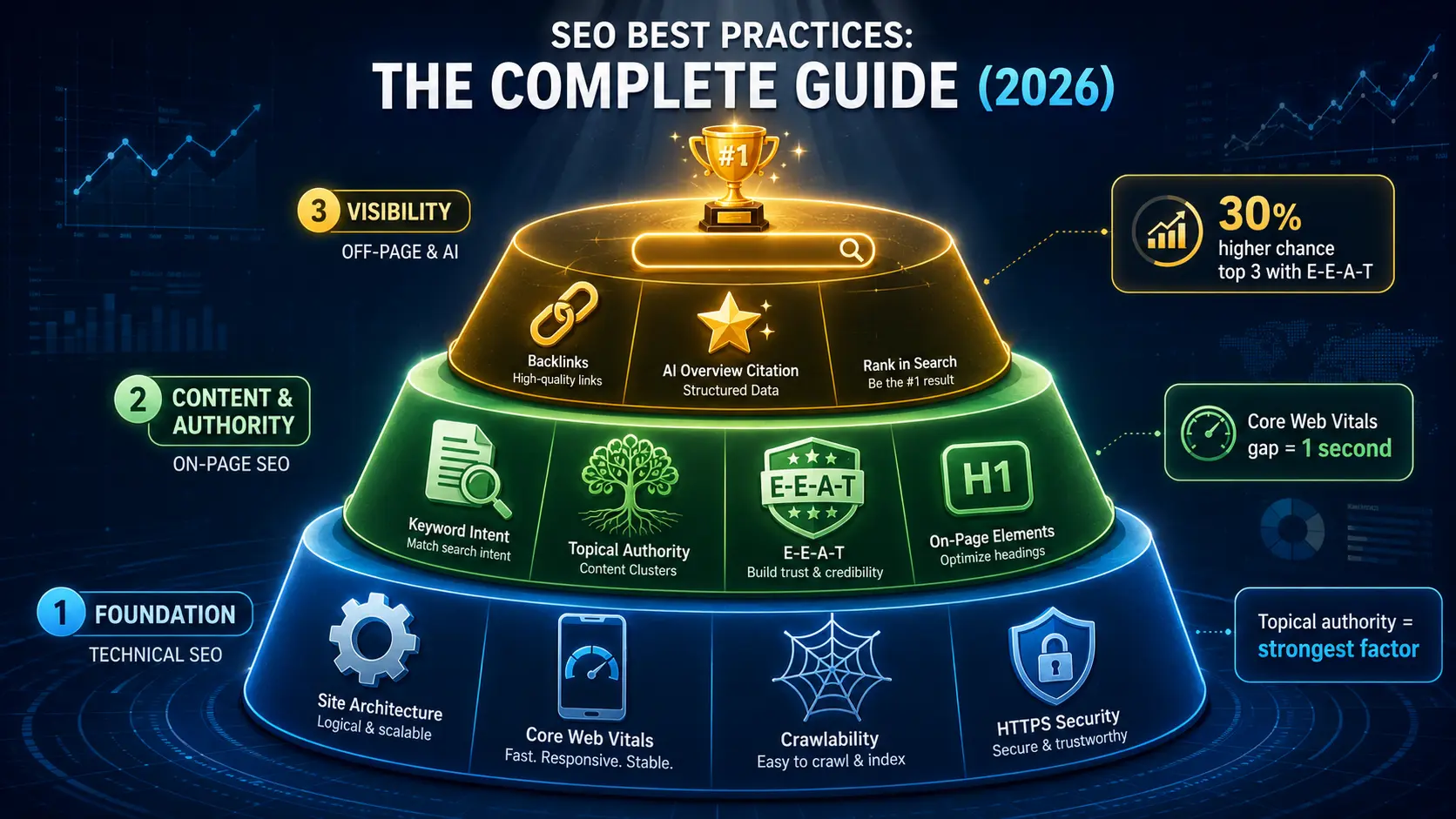
They also have a hierarchy. Technical SEO creates the conditions for content to rank. Content and topical authority determine whether you deserve to rank. Off-page signals (primarily backlinks) tell Google how much trust to extend. User experience signals tell Google whether your rankings are justified after the fact.
Get the order right. Many sites invest heavily in link building while ignoring technical issues that prevent their best content from ranking. Others publish content relentlessly without building the topical authority that would make each new piece land faster. Understanding the hierarchy prevents wasted effort.
1. Build Topical Authority, Not Just Individual Pages
The single most significant shift in SEO over the past two years has been confirmed by a 2026 analysis of over 250,000 search results: topical authority is now the strongest on-page ranking factor, surpassing even domain traffic.
Topical authority — the degree to which a website is recognised as a credible, comprehensive source on a specific subject area, demonstrated through the depth and breadth of interconnected content across that topic.
Google does not just evaluate individual pages in isolation. It evaluates whether a site has covered a topic deeply and consistently. A site with 50 articles covering SEO from multiple angles and depths will outrank a site with one very good SEO article, even if that single article is technically superior.
The practical implication is a shift from page-level thinking to topic-level thinking.
How to build topical authority:
Start with a pillar page covering a core topic at a broad level (for example, “What is SEO?”). Then create cluster content that covers every meaningful subtopic in depth: keyword research, on-page optimisation, technical SEO, link building, and so on. Link the cluster pages back to the pillar and to each other where relevant.
This structure signals to Google that your site is the authoritative resource on the subject, not just a site that published one relevant article. It also means each new piece of content you publish benefits from the authority of the existing cluster, compounding over time.
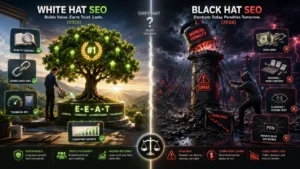
2. Satisfy E-E-A-T at Every Level
Google’s E-E-A-T framework, which stands for Experience, Expertise, Authoritativeness, and Trustworthiness, has moved from a quality guideline into a practical ranking differentiator.
Research by Semrush found that sites with strong E-E-A-T signals have a 30% higher chance of ranking in the top three positions. The Google May 2026 Core Update intensified this further, with Google now more aggressively verifying author credentials, professional bios, and real-world expertise, even cross-referencing structured data signals with external sources.
Experience means demonstrating first-hand involvement with the subject. Content that includes original observations, specific details only a practitioner would know, personal mistakes and lessons, and hands-on testing outperforms content that synthesises what others have already said.
Expertise means demonstrating deep subject knowledge. Author credentials, professional background, and the quality of reasoning within the content all contribute.
Authoritativeness means being recognised as a credible source by others in the field, primarily through editorial backlinks from relevant, trusted publications and platforms.
Trustworthiness is the most foundational element. Google’s Search Quality Rater Guidelines state that trust is the most important member of the E-E-A-T family, because an untrustworthy page has low E-E-A-T regardless of how experienced or expert the author may be. Trust is built through factual accuracy, transparent authorship, clear contact information, verifiable business details, and consistent, non-deceptive presentation.
Practical actions: Add author bios with verifiable credentials. Cite sources accurately. Keep factual content updated. Avoid misleading headlines. Include clear information about who operates the site and how to contact them.
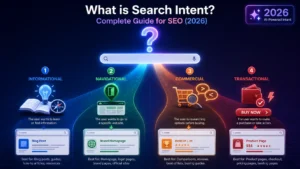
3. Match Content to Search Intent Before Everything Else
Every other on-page best practice is secondary to search intent alignment. A perfectly optimised page that does not match the intent behind its target keyword will not rank well, regardless of technical quality.
Before writing any piece of content, search the target keyword in an incognito window and analyse what Google already ranks. Note the content type (guide, list, product page, tool), the format (step-by-step, comparison, definition), and the angle (beginner vs expert, broad overview vs specific detail).
Your content must match the dominant pattern. If four of the top five results are listicles, publish a listicle. If they are comprehensive step-by-step guides, publish a comprehensive guide. Getting the format wrong is an intent mismatch that technical optimisation cannot overcome.
4. Write for Depth, Not Length
Word count is not a ranking factor. Depth is.
The distinction matters. A 5,000-word article that repeats the same points multiple times, includes unnecessary sections to pad length, and adds no original insight is worse than a 2,000-word article that covers the topic thoroughly and leaves nothing important unaddressed.
Depth means:
- Covering the full scope of the topic the searcher needs to understand
- Answering the follow-up questions a reader would logically have after reading the main content
- Including original data, specific examples, or first-hand observations that cannot be found on every other page about the topic
- Addressing counterarguments or common misunderstandings, not just the main point
The Google May 2026 Core Update specifically targeted sites with shallow coverage of many topics, demoting them in favour of sites with deep, interconnected content clusters on focused subject areas. Breadth without depth is now actively penalised.
5. Optimise Title Tags and Meta Descriptions Properly
Title tags are one of the most important on-page signals. They tell both Google and users what a page is about, and they are the primary text shown in search results.
Title tag best practices:
- Include the primary keyword, ideally near the beginning
- Keep length between 50 and 60 characters to avoid truncation in search results
- Write for the human reader first: make it accurate, compelling, and clear
- Avoid duplicate title tags across pages
- Do not stuff multiple keywords into a single title
Meta descriptions are not a direct ranking factor, but they directly influence click-through rate, which affects how much traffic your ranking actually generates.
Meta description best practices:
- Keep length between 140 and 160 characters
- Include the primary keyword naturally
- Write a genuine, specific description of what the page delivers
- Include a mild call to action where appropriate
- Avoid duplicating meta descriptions across pages
6. Use Heading Structure Logically
Headings (H1, H2, H3) serve two purposes: they help readers navigate the content and they signal structure to search engines.
Every page should have exactly one H1, which is typically the page title and should include the primary keyword. H2 headings should cover the major sections of the content. H3 and lower headings break those sections into subsections where necessary.
The most common heading mistakes are: using headings purely for visual styling (bolding a sentence without wrapping it in a heading tag), skipping heading levels (jumping from H2 to H4), and using keyword-stuffed headings that read unnaturally.
Headings are also a significant contributor to being cited in AI Overviews. Google’s AI systems extract answers from clearly labelled sections. A well-structured page with descriptive headings is far more likely to have individual sections surfaced in AI-generated answers than a page with poor or missing heading structure.
7. Build Internal Links Deliberately
Internal linking is one of the most underutilised practices in SEO. Most sites link internally in an ad hoc way, if at all, and leave significant ranking potential unrealised as a result.
Internal links serve three functions: they help search engines discover and understand all your content, they distribute authority from high-performing pages to other pages, and they guide users to related content that deepens engagement.
Internal linking best practices:
- Every new piece of content should link to at least two to three relevant existing pages
- Every relevant existing page should link back to new content where appropriate
- Use descriptive anchor text that describes the destination page’s content, not generic phrases like “click here”
- Prioritise links from your highest-authority pages to the pages you most want to rank
- Ensure no important page is more than three clicks from the homepage
For a content-heavy site like a blog, a disciplined internal linking structure can meaningfully accelerate rankings for pages that would otherwise struggle to earn external backlinks.
8. Earn Backlinks Through Value, Not Volume
Backlinks remain one of Google’s strongest ranking signals in 2026. What has changed is the type of backlinks that matter and the tactics that earn them.
A single backlink from a highly authoritative, topically relevant publication is worth more than hundreds of links from low-quality or irrelevant sources. Google’s SpamBrain system continuously evaluates backlink profiles for manipulation patterns, and large quantities of low-quality links can now actively harm rankings.
What earns high-quality backlinks in 2026:
Original research and data. Publishing studies, surveys, or analysis that generates insights nobody else has is the single most reliable way to earn editorial backlinks. Journalists and bloggers cite original data because it gives them something new to reference.
Genuinely comprehensive resources. The most-linked-to content tends to be the most useful and thorough treatment of a topic available. If your guide is the best resource available on a subject, people link to it naturally.
Digital PR. Proactively pitching relevant stories, expert commentary, and data to journalists and publications earns links from high-authority news and industry sites.
Guest contributions. Writing for reputable industry publications as a genuine editorial contribution, not as a vehicle for keyword-stuffed links, earns both exposure and authority.
9. Implement Structured Data
Structured data has become significantly more important in 2026 than it was two years ago, for reasons beyond rich results in traditional search.
Structured data now feeds directly into Google’s AI Overview citations and entity recognition systems. Pages that use proper schema markup to identify key content, entities, and facts are more likely to be selected as sources in AI-generated answers. This creates a visibility pathway that does not depend on ranking in position one or two.
Priority schema types:
Article schema for blog posts and guides, with author details, publication date, and content type specified.
FAQ schema for pages that include question-and-answer sections. FAQ-marked content frequently appears in People Also Ask features and AI Overviews.
Organisation and Person schema for establishing entity recognition, linking your brand to its Knowledge Graph entity.
LocalBusiness schema for any site with a physical location or local service area.
Product and Review schema for e-commerce and review content.
The one rule for structured data: only mark up content that is actually visible on the page. Marking up content that does not exist on the page for rich result purposes violates Google’s guidelines and can result in manual actions.
10. Prioritise Core Web Vitals and Page Experience
Google completed its full transition to mobile-first indexing in 2024. All sites are now evaluated primarily based on their mobile experience, not their desktop version.
Core Web Vitals, which are the three specific measurements of loading speed, interactivity, and visual stability, are confirmed ranking factors. Research from 2026 confirms their practical impact: when content quality and authority are comparable between competing pages, Core Web Vitals scores frequently determine which page ranks higher. The gap between position three and position eight can come down to a one-second difference in loading time in competitive niches.
The three Core Web Vitals:
LCP (Largest Contentful Paint) — how quickly the main visible content of a page loads. Google’s benchmark is under 2.5 seconds. Slow LCP is most commonly caused by unoptimised images, slow server response times, and render-blocking resources.
INP (Interaction to Next Paint) — how quickly the page responds to user interactions. Google’s benchmark is under 200 milliseconds.
CLS (Cumulative Layout Shift) — how stable the page layout is as it loads. Elements that jump around as the page renders create poor user experience and poor CLS scores.
Beyond Core Web Vitals, mobile-friendliness, HTTPS, and the absence of intrusive interstitials (pop-ups that block the main content) are baseline page experience requirements that affect rankings.
11. Optimise for AI Search Citations
In 2026, appearing in AI Overviews is a meaningful visibility outcome even for queries where traditional click-through rates are lower. Being cited as a source builds brand recognition and positions your site as an authority that AI systems trust.
The content qualities that increase AI citation likelihood:
Clear, direct answers near the top of relevant sections. AI systems extract specific passages to answer specific questions. A section that opens with a direct, accurate answer to the question its heading implies is far more extractable than one that buries the answer in the third paragraph.
Factual accuracy and verifiable claims. AI systems favour content that is factually consistent with other trusted sources. Inaccurate or contested claims reduce citation likelihood.
Comprehensive subtopic coverage. AI Mode’s query fan-out process searches for the best answer to each subtopic of a complex query. A page that covers a topic’s full depth, including its subtopics clearly labelled with headings, has multiple opportunities to be cited for different sub-questions.
Strong E-E-A-T signals recognised by structured data. Author credentials identified in Person schema, organisation details in Organisation schema, and article metadata all help AI systems evaluate source credibility before selecting citations.
12. Keep Content Fresh and Accurate
Freshness is not equally important for all content types. For rapidly changing topics (news, technology, current events), freshness is a strong ranking signal. For stable evergreen topics, it matters less but still affects rankings over time as content becomes outdated.
Every published page should be on a review schedule. At minimum, review key pages annually. Prioritise pages that:
- Contain statistics, data, or year-specific information that becomes outdated
- Target keywords where search intent or competitive landscape has shifted
- Have declining traffic or rankings that do not correspond to changes in link profile
When updating content, the goal is to improve accuracy and depth, not just change the date. Simply updating a publication date without improving the content does not fool Google and does not improve rankings.
13. Monitor Performance and Iterate
SEO without measurement is guesswork. Google Search Console and Google Analytics 4 are the two essential free tools for tracking SEO performance.
Google Search Console tells you:
- Which queries are driving impressions and clicks to each page
- Which pages are indexed and which have indexing issues
- Core Web Vitals scores from real user data
- Any manual actions or security issues affecting your site
- How your pages are performing in AI Overviews (an emerging feature in the interface)
Google Analytics 4 tells you:
- Where your organic traffic comes from and how it behaves
- Conversion rates from organic search visitors
- Which pages contribute most to business outcomes
Review Search Console weekly for technical issues. Review rankings and traffic monthly. Review your content strategy quarterly based on what is performing and what is not.
What the Google May 2026 Core Update Confirmed
The May 2026 Core Update is the most recent significant algorithm update at the time of writing. Its effects confirm several trends that had been building for months.
Sites with deep, interconnected content clusters gained visibility at the expense of sites with broad but shallow coverage. AI-generated content with no original insight or editorial oversight was significantly devalued. E-E-A-T signals were evaluated more aggressively, with author credentials cross-referenced against external data sources. User experience signals, including bounce rate, dwell time, and Core Web Vitals, showed stronger correlations with post-update rankings than before previous updates.
The overall direction is consistent with every core update over the past five years: quality, depth, trust, and genuine usefulness are rewarded. Surface-level compliance with the letter of Google’s guidelines, without the substance behind it, is increasingly penalised.
❓ Frequently Asked Questions
How often should I update my SEO practices?
Review your approach at least quarterly. Major algorithm updates happen several times per year and sometimes shift which practices matter most. Following Google’s Search Central blog and credible SEO industry publications keeps you informed of significant changes.
Which SEO best practice has the biggest single impact?
It depends on what is currently weakest in your setup. For sites with technical crawling issues, fixing those produces the fastest improvement. For sites with strong technical foundations but weak content depth, topical authority building delivers the highest long-term return. For sites with great content but no backlinks, link building is the priority. The practice with the biggest impact is always the one addressing your current weakest point.
Do I need to follow all these practices simultaneously?
Not at launch. Prioritise in this order: fix technical issues that block crawling and indexing, then create high-quality, intent-matched content, then build internal links as content accumulates, then pursue backlinks, then optimise for structured data and AI citation. Layer in the practices progressively rather than attempting everything at once.
Is there a difference between SEO best practices for a new site vs an established site?
The practices are the same. The priorities differ. A new site should invest most heavily in technical foundations and content creation initially. An established site with existing authority often benefits most from content depth improvements, internal link audits, and structured data implementation, which can unlock rankings from pages that already have some authority but are not yet reaching their potential.
Summary
SEO best practices in 2026 are built on a clear hierarchy: get technical foundations right so your content can be found, then build topical authority so you deserve to rank, then earn backlinks so Google extends trust, then maintain user experience so your rankings are justified.
The most important practices, confirmed by both the Google May 2026 Core Update and current ranking factor research, are:
- Building topical authority through deep, interconnected content clusters rather than isolated pages
- Demonstrating genuine E-E-A-T through first-hand experience, author credentials, factual accuracy, and transparency
- Matching every piece of content to the dominant search intent for its target keyword
- Implementing structured data to improve AI citation likelihood and rich result eligibility
- Maintaining Core Web Vitals scores that meet Google’s benchmarks, particularly on mobile
- Building backlinks through original research, genuinely useful resources, and digital PR rather than volume tactics
- Monitoring performance in Search Console and iterating based on data
The thread running through all of these is the same principle that has defined good SEO since Google launched: make things that genuinely deserve to rank, and make it easy for search engines to understand and trust them.