
Every few years, a wave of articles announces that SEO is finished. It happened when Google launched Panda in 2011. It happened again when the Knowledge Graph arrived in 2012. It happened with featured snippets, with voice search, with mobile-first indexing, and now, louder than ever, with AI-powered search.
In 2026, the claim sounds more credible than before. Google’s AI Overviews answer questions directly on the results page without sending users to any website. ChatGPT and Perplexity handle millions of queries that would have gone to Google two years ago. Traffic reports from publishers across the web look alarming.
So is SEO actually dead this time?
The short answer is no. But the longer answer is more interesting, more honest, and more useful for anyone making decisions about where to invest in digital marketing.
Where the “SEO is Dead” Claim Comes From
The concern in 2026 is not baseless. It is rooted in real, observable changes to search behaviour.
AI Overviews are reducing clicks on some queries. Google’s AI-generated answer summaries now appear at the top of results for a significant proportion of informational queries. When a user’s question is answered directly on the results page, they have less reason to click through to any website. For queries where AI Overviews appear, zero-click rates are high.
AI tools are capturing search queries that previously went to Google. ChatGPT, Gemini, Perplexity, and similar tools have built audiences of users who now turn to conversational AI for information rather than typing into a traditional search bar. Gartner predicted a 25% decline in traditional search volume by the end of 2026 as a result.
Some publishers have reported traffic declines. Particularly in content-heavy niches where informational queries are the primary traffic driver, some sites have reported meaningful organic traffic drops over the past twelve to eighteen months.
These are real trends. Anyone who dismisses them entirely is not being honest about the current environment.
But the data, when examined carefully, tells a considerably more nuanced story than “SEO is dead.”
What the Data Actually Shows
The traffic decline is far smaller than reported. A large-scale analysis of more than 40,000 major websites found that organic search traffic declined by only 2.5% year over year in 2025. This is a far cry from the 25% to 60% drops that frequently circulate in industry commentary. The sites most affected tend to be mid-sized websites in competitive informational niches where AI Overviews appear most frequently. That is a structural shift in traffic distribution, not a collapse of SEO as a channel.
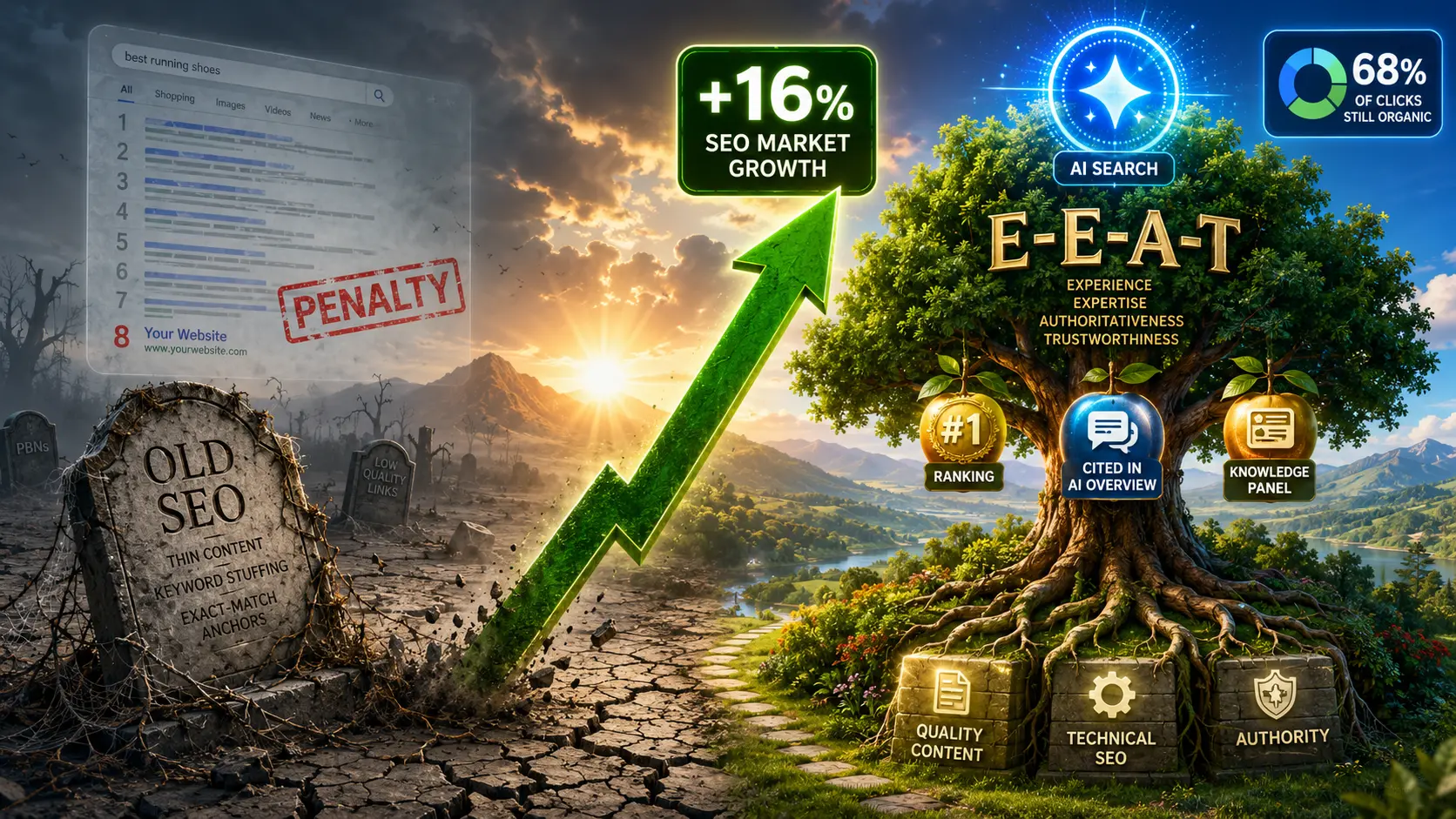
68% of clicks still come from organic search. Despite AI Overviews taking the top position on many results pages, BrightEdge data from 2026 confirms that organic search continues to account for the majority of web traffic. The channel has not been displaced. It has been compressed at the top of certain query types.
The SEO industry is growing, not shrinking. The global SEO services market is expanding at approximately 16% per year. If SEO had stopped working, the businesses investing in it would have stopped paying for it. The market trajectory says the opposite.
91% of marketers report SEO helps them hit their goals. A channel that 91% of practitioners report as effective is not dying. It is evolving.
Google still processes billions of searches every day. Google held approximately 89% of all US web traffic in 2025 and roughly 79% of the global search market. It remains by a significant margin the dominant way people find information, products, and businesses online.
The Pattern: “SEO is Dead” Has Been Wrong Before
Understanding the history of this claim helps evaluate it in 2026.
The pattern is consistent. A significant change to search results happens. Some sites lose traffic. Industry commentators declare SEO dead. The businesses that adapt their approach continue to earn organic traffic. The businesses that abandon SEO lose ground they then spend years trying to recover.
In 2011, Google’s Panda update devastated content farms. The traffic losses were real and severe for the sites affected. The conclusion drawn by some was that content-based SEO was finished. The conclusion drawn by others was that low-quality content was finished, and quality content had a larger opportunity than ever. The second group was right.
In 2012, the Knowledge Graph began answering simple factual questions directly in the SERP. Fewer people clicked through to Wikipedia for “what is the capital of France.” The conclusion drawn by some was that informational SEO was dying. The conclusion drawn by others was that simple, easily answered queries were being commoditised, and depth and expertise were becoming more valuable. Again, the second group was right.
Each wave of “SEO is dead” has been correct about one thing: a specific, already-low-quality version of SEO was becoming less effective. The broader channel, executed with genuine quality and expertise, has grown stronger through each of these transitions.
What Has Actually Changed in 2026
Honesty requires acknowledging that some things have genuinely changed and that pretending otherwise is not useful.
Zero-click searches have increased. When Google answers a query directly in an AI Overview, fewer users click any result. For queries like “how tall is the Eiffel Tower” or “what is the capital of Australia,” users get their answer in seconds with no click. This is real, and it has reduced traffic to pages that existed primarily to answer simple, easily synthesised questions.
The type of content that earns clicks has shifted. The queries that still drive clicks in 2026 tend to be the ones where users need more than a summary answer: complex decisions, product comparisons, in-depth guides, local services, and content where the reader needs to engage with the full page rather than absorb a three-sentence AI answer.
AI has flooded the web with generic content. The accessibility of AI writing tools has made it trivially easy to produce keyword-matched content at scale. The resulting flood of generic, undifferentiated content has made the bar for standing out significantly higher. Average content is now less visible, not more.
Search is no longer only on Google. A meaningful and growing share of search intent is being directed at TikTok (especially for younger audiences), YouTube, Amazon (for product searches), Reddit, and AI tools. An SEO strategy that focuses exclusively on Google rankings is missing a growing share of where audiences are discovering content.
What is Dead vs What is Thriving
The most useful way to answer “is SEO dead?” is to separate what genuinely is no longer working from what is performing better than ever.
What is dead or dying
Thin, keyword-matched content with no original value. Pages that existed to rank for a query without genuinely helping the reader have been systematically suppressed by Google’s Helpful Content System since 2022. AI has flooded the web with more of this content, making Google’s enforcement of it more aggressive, not less.
Keyword stuffing and exact-match anchor text manipulation. These tactics have been ineffective for years. If they are still part of anyone’s strategy in 2026, the traffic problems they are experiencing predate AI Overviews.
SEO that targets only easily synthesised informational queries. If your entire content strategy is based on answering the kinds of questions that can be summarised in three sentences, AI Overviews have made that strategy significantly less effective. This is the category where real traffic losses are concentrated.
Ranking without authority or expertise. The days of a new site with thin content outranking established, expert sources through technical manipulation alone are genuinely over.
What is thriving
Expertise-based content with original insight. Content that demonstrates genuine first-hand experience, makes original arguments, cites real data, and offers perspectives that AI cannot synthesise from existing sources is performing better in 2026 than three years ago. Google’s E-E-A-T framework explicitly rewards this, and AI search systems cite it as sources.
Content that serves decision-making, not just information retrieval. Reviews, comparisons, buying guides, and in-depth analysis of complex topics still drive substantial click-through traffic because users need more than a summary to make a decision. These are the queries where organic search remains most powerful.
Local SEO. Local search is almost entirely unaffected by AI Overviews in the way that informational content has been. Someone searching for a dentist, a restaurant, or a plumber needs a local business, not an AI summary. Local SEO is as important and effective as ever.
Structured data and technical optimisation. Pages with proper schema markup are significantly more likely to appear as cited sources in AI Overviews and rich results. Technical SEO has become more valuable, not less, in the AI search era.
Brand authority and entity recognition. Brands that have built genuine recognition across multiple platforms, not just search, are better positioned to appear in AI-generated answers and brand knowledge panels. Building a recognisable, trustworthy brand is now part of SEO strategy in a way it was not before.
The Honest Verdict
SEO is not dead. But the version of SEO that worked by gaming signals rather than earning them has been dying for years, and AI has accelerated its decline.
What is replacing it is a discipline that looks quite different from the SEO of 2015. It is less about individual keyword rankings and more about building genuine topical authority. It is less about a single channel (Google organic) and more about earning visibility across search surfaces including AI answers, video platforms, and knowledge panels. It is less about quantity of content and more about depth and demonstrable expertise.
The businesses that are struggling with SEO in 2026 tend to have one thing in common: their strategy was built on the signals that search engines use to measure quality, rather than on the quality itself. When the measurement became more sophisticated, the shortcut stopped working.
The businesses that are growing through SEO in 2026 also tend to have one thing in common: they have invested in building genuine expertise, authoritative content, and a trustworthy brand presence that earns organic visibility across multiple surfaces.
What This Means Practically
If you are deciding whether to invest in SEO in 2026, the evidence supports a clear answer: yes, with an adjusted approach.
Stop producing content that exists to capture queries, and start producing content that exists to serve the reader’s actual goal. The distinction sounds obvious. Most content strategies are still built on the wrong side of it.
Invest in expertise signals. Author credentials, first-hand experience, original research, and specific case studies are what differentiate content that earns citations and rankings from content that disappears into the noise.
Broaden your definition of search visibility. Rankings in Google’s ten blue links are one form of visibility. Appearing in AI Overviews, YouTube search, Google Maps, and knowledge panels are others. A modern SEO strategy accounts for all of them.
Build technical SEO foundations properly. Structured data, Core Web Vitals, and mobile performance are more important to AI-era visibility than they were in the traditional link-count era.
Measure the right things. If your SEO strategy’s success metric is only click-through traffic, you will undervalue the brand visibility that comes from AI citations, knowledge panel appearances, and zero-click mentions. These are real business value even when they do not produce a click.
❓ Frequently Asked Questions
Will SEO exist in five years?
Yes. As long as people search for information, products, and services online, there will be a discipline focused on earning visibility in those search results. The platforms and formats will evolve, as they always have, but the fundamental activity of helping search systems understand and trust your content will remain.
Is it worth starting SEO on a new site in 2026?
Yes, if you are committed to building genuine expertise and consistent quality. The barrier to entry for low-quality, high-volume content strategies has never been higher. But the opportunity for genuinely authoritative, well-structured content has never been greater.
Should I shift budget from SEO to AI marketing?
AI-era SEO and traditional SEO are not competing activities. Being visible in AI-generated answers requires the same foundational investments as ranking organically: quality content, technical credibility, and genuine authority. Redirect budget toward AI marketing only if you have already built those foundations.
Is social media replacing SEO?
For some audiences and some query types, yes. TikTok search is growing rapidly among younger demographics. YouTube is the second-largest search engine in the world. An effective visibility strategy in 2026 includes both traditional search and these platforms. But social media does not replace the commercial intent that search captures. Someone ready to buy something or find a local service still primarily uses Google.
Summary
SEO is not dead in 2026. The evidence is consistent and clear: organic search drives 68% of web traffic, the SEO services market is growing at 16% per year, and 91% of marketers report SEO helps them achieve their goals.
What is dead is the old version of SEO that worked by manufacturing signals rather than earning them. Thin content, keyword stuffing, and tactics built to exploit algorithm weaknesses rather than serve users are genuinely finished. They were always a liability waiting for the algorithm to catch up.
The version of SEO that is thriving in 2026 is built on expertise, genuine usefulness, technical credibility, and visibility across multiple search surfaces. It is more demanding than the SEO of 2015. The returns, for those who execute it properly, are also more durable.