
“How long does SEO take?” is the most frequently asked question in search marketing, and it is almost always answered with a frustratingly vague “it depends.”
That answer is technically correct but practically useless. This guide gives you something better: realistic timelines based on your specific situation, the factors that determine how fast your results arrive, what milestones to look for at each stage, and what you can do to move faster.
The Short Answer
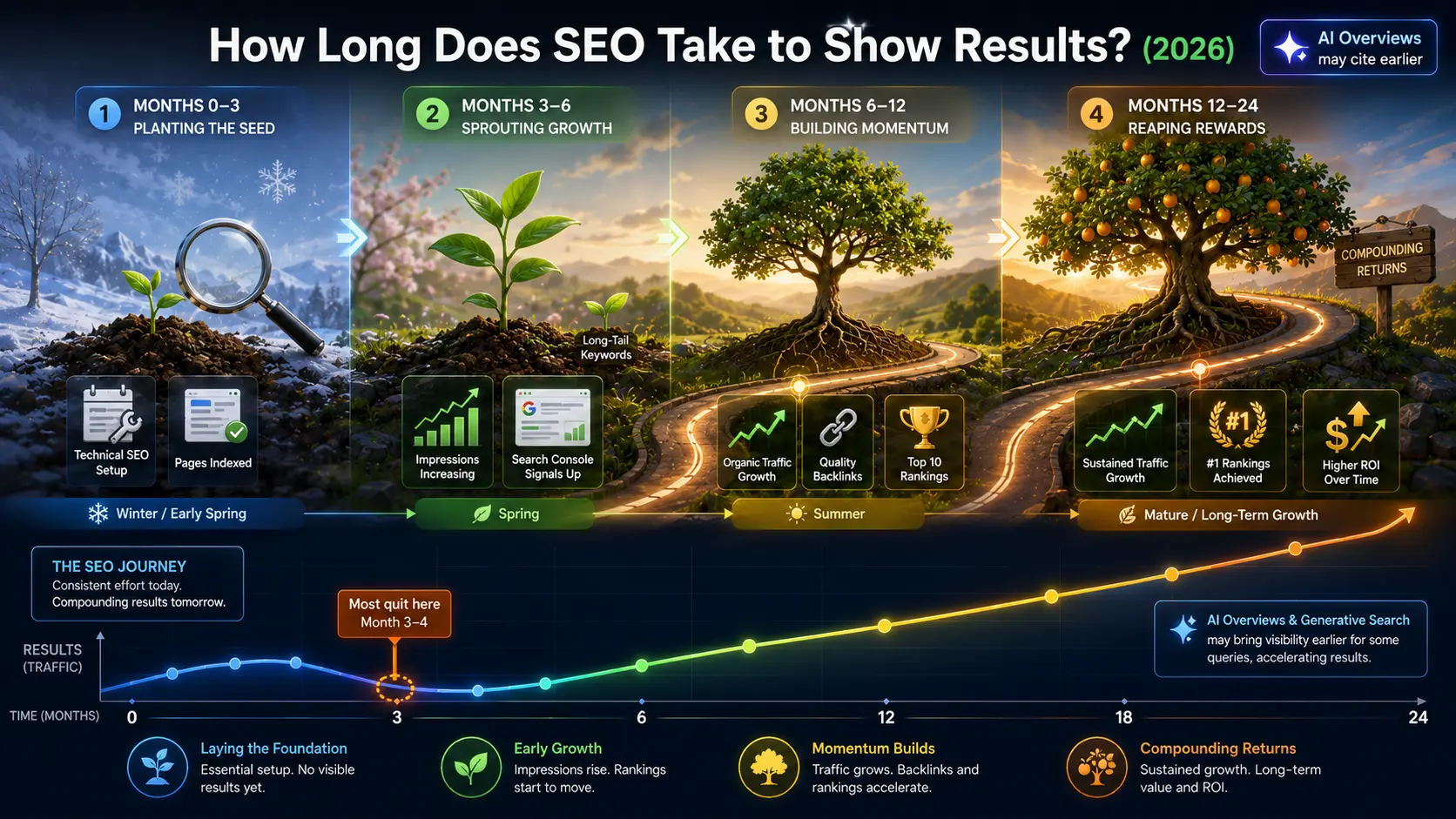
For most websites, SEO begins showing measurable results within three to six months. Significant organic growth, the kind that meaningfully impacts traffic and business outcomes, typically occurs between six and twelve months. For highly competitive industries or brand-new domains, twelve to twenty-four months is a realistic expectation for substantial results.
These are not estimates from a single agency. A poll of 3,680 SEO practitioners found that three to six months is the most commonly reported timeframe for first seeing meaningful results. The caveat everyone emphasises is that this range varies enormously depending on your starting point, your competition, and the quality of the work.
Why SEO Takes Time at All
Before discussing timelines, it helps to understand why SEO is not faster.
Search engines are designed to be cautious. Google’s entire value to users depends on the quality and trustworthiness of its results. If rankings changed overnight based on whoever published the most content or built the most links that day, the system would be trivially manipulable. The delay in SEO results is, in large part, a deliberate mechanism to ensure that the sites that rank have genuinely earned their positions over time.
There are three specific phases that introduce delay.
Crawling and indexing. Before a page can rank, Google must discover it, crawl it, and add it to its index. For new pages on established sites, this can happen within days. For new sites with no links pointing to them, it can take weeks or months.
Trust building. Google evaluates a site’s quality and trustworthiness through accumulated signals: consistent content quality, earned backlinks, user engagement patterns, and site age. These signals take time to build regardless of how much effort you put in at launch.
The Google Sandbox. New domains often struggle to rank for competitive keywords in their first few months even when everything is technically correct and the content is genuinely good. This phenomenon, known informally as the Google Sandbox, reflects Google’s caution about new sites before they have established a credible track record. The effect is more pronounced in competitive niches and less significant for very low-competition, long-tail keywords.
Realistic Timelines by Situation
The timeline you should expect depends heavily on where you are starting from.
Brand New Website (No existing authority)
Months 1 to 3: Technical setup, content creation, and initial indexing. Your pages start appearing in Google’s index. You may rank for very low-competition, specific long-tail keywords. Traffic is minimal or negligible. This phase is about building the foundation.
Months 4 to 6: Pages begin accumulating some engagement signals. You start appearing for a wider range of long-tail terms. Some early backlinks may begin to arrive if your content is actively promoted. Small but measurable organic traffic begins.
Months 7 to 12: If content quality is strong and link building is consistent, rankings for target keywords begin to stabilise. Organic traffic grows meaningfully but is still well below its long-term potential.
Year 2 and beyond: The compounding effect of SEO becomes visible. Authority accumulates, rankings improve across a broader keyword set, and the cost per organic visit decreases continuously. This is when SEO delivers its best return.
Realistic expectation: For most new websites targeting moderate competition keywords, meaningful business results begin at around nine to twelve months. Early-stage tracking of impressions, clicks, and indexing progress helps confirm the strategy is on track before traffic arrives.
Established Website (Existing authority, adding new content or targeting new keywords)
An established website with existing authority, backlinks, and a clean technical foundation moves considerably faster.
Weeks 2 to 8: New content is crawled and indexed quickly. Initial rankings appear for target keywords, often in positions 10 to 30.
Months 2 to 4: With ongoing content updates and any link building, rankings climb toward the top ten for less competitive terms. Traffic from new content begins arriving.
Months 4 to 8: Well-targeted content on an authoritative domain can reach positions one to five for moderate-competition keywords within this window. Established sites can see significant traffic gains from a sustained content programme within a single year.
Local Business (Local SEO focus)
Local SEO operates on a faster timeline than national or e-commerce SEO because competition is more contained and Google Business Profile optimisation produces some of the quickest visible wins in the discipline.
Weeks 4 to 8: Google Business Profile optimisation and local citation cleanup can begin improving local pack visibility within weeks, especially in lower-competition local markets.
Months 2 to 4: Consistent local content, review generation, and citation building produce measurable improvements in local rankings for most businesses in this window.
Months 4 to 6: Most local businesses operating in moderate competition environments see meaningful visibility improvements within six months. Very competitive local markets (multiple well-optimised competitors in a major city) can take nine to twelve months.
Highly Competitive National or E-commerce Markets
Industries like legal services, insurance, finance, health, and software operate in environments where competitors have invested years in SEO and possess enormous content libraries and authority. New entrants cannot shortcut this.
In these environments, expect twelve to twenty-four months before achieving competitive rankings for valuable head terms. The strategy is to build authority progressively: start with long-tail, low-competition keywords and use that foundation to climb toward more competitive terms over time.
The Seven Factors That Determine Your Timeline
Understanding these variables allows you to assess your own situation honestly and identify where you can accelerate progress.
1. Domain age and history. An older domain with a clean history has pre-existing trust signals and often a backlink profile accumulated over years. A brand-new domain must build these from zero. Domain age is not a direct ranking factor, but it correlates strongly with the things that are.
2. Existing content and authority. A site with a well-structured, high-quality existing content library gives new content a stronger platform to rank from. A site starting from scratch must build the topical authority that established competitors already have.
3. Keyword competition level. Ranking for “best running shoes” is categorically more difficult and time-consuming than ranking for “best trail running shoes for flat feet under £80 women.” Starting with lower-competition, long-tail keywords and building toward head terms is both faster and more strategically sound.
4. Content quality and publication rate. Google rewards consistent, high-quality content publication. Sites that publish two to four well-researched, thoroughly useful articles per month build topical authority faster than sites that publish sporadically. Thin or AI-generated content with no original insight is effectively ignored regardless of publication volume.
5. Technical SEO health. A site with crawlability issues, slow load times, mobile usability problems, or duplicate content forces Google to work harder to understand and rank its pages. Fixing technical issues often produces faster, more immediate ranking improvements than content alone, because it removes blockers that were suppressing pages that already deserved to rank higher.
6. Link building pace and quality. Backlinks remain one of the strongest ranking signals. Sites that earn high-quality backlinks from relevant, authoritative sources consistently rank faster than comparable sites without them. The operative word is “earn.” Manufactured or purchased links do not accelerate timelines sustainably and carry significant risk.
7. Consistency of effort. Perhaps the most underestimated factor. SEO compounds. The benefits of consistent monthly effort over twelve months substantially exceed the benefits of intensive effort for three months followed by inactivity. Most businesses that abandon SEO do so at the three to four month mark, precisely when the foundation has been built but visible results are just beginning to emerge. The businesses that persist through this gap are the ones that see the compounding returns.
What to Track Before Rankings Arrive
One of the biggest sources of SEO frustration is that practitioners focus only on rankings and traffic, which are lagging indicators. There are earlier signals that confirm your SEO investment is working, even before rankings fully materialise.
Indexation rate. Use Google Search Console to verify that your pages are being discovered and indexed. Rising indexed pages is a positive early signal.
Impressions. In Search Console’s Performance report, impressions show how often your pages are appearing in search results even if they are not yet being clicked. Rising impressions for target keywords confirm that Google is beginning to surface your content, even if at lower positions.
Average position trends. A keyword moving from position 40 to position 25 to position 15 is SEO working as it should. Traffic at position 40 is negligible, which makes it easy to assume nothing is happening. Tracking the trend rather than the absolute position reveals progress.
Crawl frequency. If Googlebot is visiting your site more frequently over time, that indicates growing trust and signals that Google considers your content worth checking regularly for updates.
Backlink acquisition. Are other sites beginning to link to your content naturally? Growing backlink count from relevant sources confirms that your content is earning authority.
How AI Search Affects the Timeline in 2026
One development worth acknowledging in 2026 is how AI Overviews have introduced a new form of visibility that operates on a different timeline from traditional organic rankings.
A page does not need to rank in position one to be cited in an AI Overview. Google’s AI systems scan a broader set of pages and extract specific, clearly structured, authoritative passages to include in AI-generated answers. This means well-structured, authoritative content can earn citation-level visibility in AI answers before it achieves top organic rankings for the same query.
This does not make traditional rankings irrelevant. But it does mean that investing in high-quality, clearly structured content that directly answers specific questions can produce visible results in AI Overviews faster than the traditional ranking timeline suggests. For informational content especially, monitoring whether your pages appear in AI Overviews is a useful additional indicator of SEO progress.
Why Most Businesses Quit Too Early
The data on SEO abandonment points consistently to the same pattern: most businesses that abandon SEO do so just as momentum is beginning to build.
The three to four month mark is where the invisible work of building technical foundations, indexing content, and beginning to accumulate authority produces no visible traffic yet. It feels like the investment is not working. In reality, this is exactly when the foundation being built will determine whether results arrive in months six to twelve or not at all.
The businesses that persist through this period, continuing to publish quality content and build links consistently, are the ones that experience compounding organic growth. The businesses that stop at month three typically never benefit from the foundation they built.
The antidote to early abandonment is tracking the right leading indicators (impressions, indexation, crawl frequency, position trends) rather than only the lagging ones (traffic and conversions), and understanding that the return on SEO investment is disproportionately concentrated in the second half of the first year and beyond.
❓ Frequently Asked Questions
Can you speed up SEO results?
Yes, within limits. Fixing technical issues that are blocking crawling and indexing can produce improvements within days or weeks. Targeting low-competition keywords accelerates early rankings. Publishing consistently and building high-quality backlinks both accelerate timeline. However, there is no shortcut to the trust-building that takes time by design. The most important acceleration lever is starting earlier.
Does paid advertising help SEO rankings faster?
No. Google Ads spending does not influence organic rankings. However, running paid campaigns alongside SEO provides keyword conversion data faster, which can help prioritise your organic content strategy. The indirect benefit is real, but there is no direct connection between PPC spend and organic position.
Is there a Google “sandbox” for new websites?
Yes, informally. New domains frequently struggle to rank for competitive keywords in their first few months regardless of content quality. This is widely observed but not officially confirmed by Google as a named system. The practical implication is that new sites should target very low-competition keywords initially and expect a longer ramp-up period on competitive terms.
How quickly does local SEO show results?
Faster than most other SEO types. Google Business Profile optimisation can improve local map pack visibility within four to eight weeks. Most local businesses in moderate competition markets see meaningful improvements within three to six months.
What happens to rankings if I stop doing SEO?
Rankings do not immediately disappear when SEO activity stops. The authority and rankings already earned persist in the short term. However, competitors that continue investing will gradually outpace a static site, and without fresh content and ongoing link acquisition, rankings erode over months and years. SEO is better understood as an ongoing investment than a one-time project.
Summary
SEO takes time because the signals Google uses to evaluate quality, trust, and authority accumulate gradually and by design. The realistic timeline for most websites is three to six months for early results, six to twelve months for meaningful growth, and twelve months or more for highly competitive markets.
The key variables that determine your timeline are domain authority, keyword competition, content quality and consistency, technical health, and link building. Most of these can be influenced but not eliminated as time factors.
The most important practical insight is this: the businesses that see strong SEO returns are not necessarily those who invest the most, but those who invest consistently over the longest period. Compounding is the mechanism, and patience is the prerequisite.
Track leading indicators (impressions, indexation, position trends) from the beginning so you can confirm progress before traffic arrives, and avoid the common mistake of abandoning SEO at the three to four month mark when the foundation is built but the returns have not yet materialised.