
Here is one of the most common and costly mistakes in SEO: spending weeks writing a high-quality, well-researched article, publishing it with proper on-page optimisation, building links to it, and then watching it sit on page three with almost no traffic.
The article is good. The technical SEO is solid. The backlinks are legitimate. So why is it not ranking?
In most cases, the answer is search intent mismatch. The content does not match what the person searching that keyword actually wants, so Google does not show it.
Search intent is arguably the single most important concept in content strategy and SEO. This guide explains exactly what it is, why it matters so deeply, how to identify it correctly for any keyword, and how to create content that satisfies it.
What is Search Intent?
Search intent — the underlying goal or purpose behind a search query. It is not the words a person uses. It is the reason they used those words.
Consider two searches: “running shoes” and “best running shoes for flat feet under £100.” Both are about running shoes. But the person typing the first query might be browsing casually, curious about what is available. The person typing the second has a specific need, a budget constraint, and is actively comparing options before buying.
Same topic. Completely different intent. Google recognises this difference and returns very different results for each query.
Understanding search intent means understanding what a searcher is trying to accomplish. When your content aligns with that goal, Google rewards it. When your content does not align, Google ignores it, regardless of how well it is written or optimised.
This is why search intent sits at the foundation of any effective SEO content strategy.
Why Search Intent Matters So Much in 2026
Google’s entire business model depends on returning results that satisfy users. Every algorithm update over the past decade has been, at least in part, an attempt to better understand and satisfy search intent.
In 2026, Google’s ability to evaluate intent has reached a new level of sophistication. The search engine uses natural language processing, entity recognition, and large-scale behavioural data to determine not just what a page is about but whether it actually satisfies the goal behind the query that surfaces it.
Google measures intent satisfaction through several signals:
Dwell time — how long a visitor stays on a page before returning to the search results. Long dwell time suggests the page delivered what the searcher needed. Short dwell time suggests it did not.
Pogo-sticking — when a user clicks a search result, quickly realises it does not answer their need, and immediately returns to the results page to try another. Repeated pogo-sticking on a page is a direct signal to Google that the content failed the intent test, and it accelerates that page’s demotion in rankings.
Return searches — when a user reads a page but then immediately searches again for the same or related query, it signals the content did not fully satisfy their need.
These signals mean that intent mismatch has consequences beyond just failing to rank. A page that attracts clicks but mismatches intent actively damages its own rankings over time by generating negative engagement signals.
The most important implication: intent alignment is evaluated before content quality. According to SEO professionals and recent research, Google assesses whether a page is the right format for a query before evaluating how well-written it is. A perfectly written, deeply researched article published in the wrong format for the query will not outrank a simpler page in the correct format.
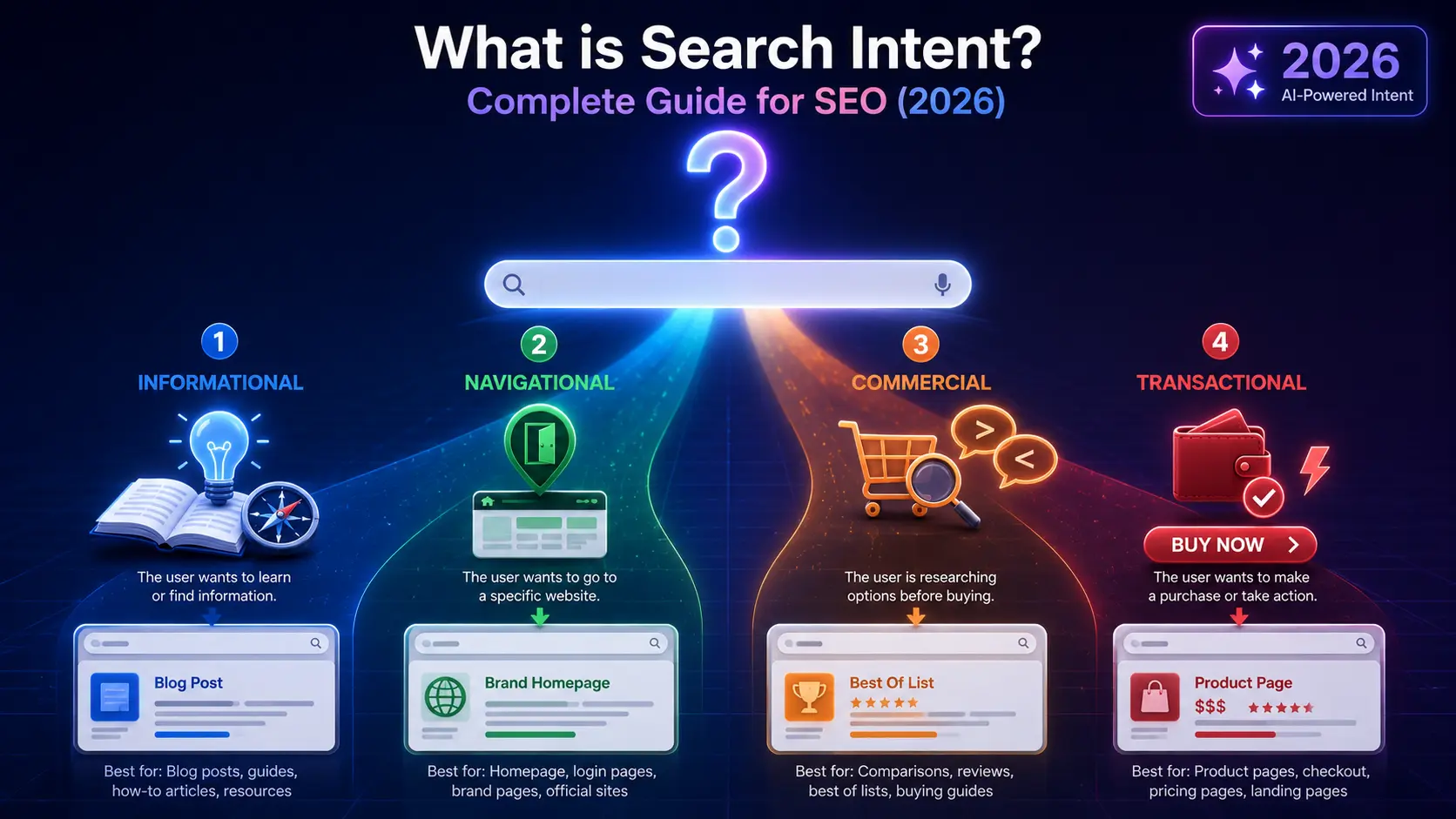
The Four Types of Search Intent
Search intent is traditionally categorised into four types. Understanding each one shapes every content decision you make.
1. Informational Intent
Informational intent — the user wants to learn something.
These queries are questions, broad topics, how-to requests, and educational searches. The person is not looking to buy anything. They want information, explanation, or guidance.
Examples: “what is search intent,” “how does photosynthesis work,” “history of the internet,” “how to fix a leaking tap.”
Informational queries make up the largest share of all searches. Research indicates that approximately 52% of all searches are informational in nature. This category dominates Google’s AI Overviews, People Also Ask boxes, and featured snippets.
The right content format: comprehensive guides, how-to articles, explainer posts, tutorials, FAQs, and definitions. The goal is to educate and inform thoroughly.
2. Navigational Intent
Navigational intent — the user wants to find a specific website, page, or brand.
These queries are often brand names, website names, or specific product names. The person already knows where they want to go. They are using Google as a shortcut to get there.
Examples: “Facebook login,” “Visiblytics tools,” “BBC news,” “Ahrefs keyword explorer.”
Optimising for navigational intent means ensuring your brand pages are clean, fast, correctly indexed, and that your homepage and key landing pages rank for your own brand terms. If competitors are appearing for your brand name, that is a navigational SEO problem worth addressing.
The right content format: brand pages, login pages, product pages, and homepage. Content depth matters less than clarity and speed here.
3. Commercial Intent
Commercial intent — the user is researching before making a decision.
These queries involve comparisons, reviews, recommendations, and “best of” lists. The person is not ready to buy yet but is actively evaluating options. They want help choosing.
Examples: “best keyword research tools,” “Ahrefs vs Semrush,” “iPhone 15 review,” “cheapest web hosting comparison.”
Commercial intent queries account for approximately 14.5% of all searches. They are often the highest-value queries for businesses because they capture users at the consideration stage of the buying journey, people close to a purchasing decision.
The right content format: comparison articles, best-of lists, review posts, pros and cons breakdowns, and buying guides. The user wants honest, balanced evaluation that helps them choose. Overly promotional content that avoids acknowledging trade-offs performs poorly here because it fails to satisfy the evaluative goal.
4. Transactional Intent
Transactional intent — the user wants to take action right now.
These queries signal immediate purchase or conversion intent. The person has decided what they want and is ready to act. They are looking for the best place to complete that action.
Examples: “buy Nike Air Max size 10,” “sign up for Semrush,” “download Google Analytics,” “book hotel Edinburgh city centre.”
Transactional queries account for approximately 10% of searches but are the highest direct commercial value per click. The right content format here is laser-focused: product pages, service pages, and landing pages with clear pricing, strong calls to action, social proof, and minimal friction. Every element of the page should facilitate the action, not educate or compare.
The Three Dimensions of Intent
Most SEO guides cover the four intent types and stop there. But intent has three distinct dimensions, and understanding all three is what separates effective content strategy from mediocre output.
Dimension 1: Intent Type
This is the four-category framework covered above. Informational, navigational, commercial, or transactional.
Dimension 2: Content Type
Beyond the intent category, each query has an implied content format. This is the structural type of page Google expects to see in the results.
Common content types include:
- Blog post or article
- Product page
- Category or collection page
- Landing page
- Tool or calculator
- Video
- Forum discussion
The content type is not always obvious from the intent category alone. A transactional query might expect a product page, a category page, or a landing page depending on the specific keyword. An informational query might expect a guide, a listicle, a video, or a short definition page.
The only reliable way to identify the expected content type is to look at what Google already ranks. If the top five results for your target keyword are all listicles, the expected format is a listicle. If they are all product pages, a blog post will not rank regardless of its quality.
Dimension 3: Content Angle
The angle is the specific framing or perspective that resonates for the query. It is the answer to “what is the main thing this content emphasises?”
Some keywords signal a clear angle through the phrasing itself. “Running shoes for beginners” signals a beginner-friendly angle. “Advanced SEO techniques” signals an expert-level angle. “Budget laptops under £500” signals a cost-conscious angle.
Getting the angle wrong is a subtler form of intent mismatch. You might publish the right content type (a guide) in the right format (listicle) but framed for the wrong audience (experts vs. beginners). The mismatch is less obvious but the result is the same: lower rankings and weaker engagement.
The Fifth Intent Type: Generative or AI Intent (2026)
In 2026, a fifth intent category has emerged that a growing number of practitioners recognise: generative or AI intent.
Generative intent — the user wants an AI system to produce something or synthesise information across multiple sources, not just return a list of links.
This type of query is increasingly directed at AI tools like ChatGPT, Perplexity, and Google AI Mode rather than traditional search results pages. “Write me a product description for X,” “summarise the key findings from these three articles,” and “explain quantum computing in simple terms” are examples.
For traditional organic SEO, generative intent is most relevant in two ways. First, Google’s AI Overviews now satisfy some informational queries directly in the SERP, meaning the informational content that earns citations in those AI answers needs to be structured and authoritative enough to be extracted and referenced. Second, if your audience increasingly uses AI tools for discovery, being a credible, well-cited source that those tools draw on requires the same foundational quality that ranks well organically.
How to Identify Search Intent for Any Keyword
Theory is only useful when you can apply it. Here is a reliable, step-by-step process for identifying the true intent behind any keyword before you create content.
Step 1: Search the keyword in an incognito window. Incognito removes your search history from personalising the results. You want to see what Google shows most users, not what it shows you based on your browsing patterns.
Step 2: Analyse the top five organic results. For each result, note three things:
- What type of page is it? (article, product page, tool, video, category page)
- What format is it in? (step-by-step guide, listicle, comparison table, definition, review)
- What angle does it take? (beginner vs expert, budget vs premium, broad overview vs deep specific)
Step 3: Look at SERP features. What special features does Google show for this query? A featured snippet suggests informational intent with a clear, direct answer format. A product carousel suggests transactional or commercial intent. A local map pack suggests local intent. People Also Ask boxes reveal related informational questions that searchers expect answered.
Step 4: Identify the dominant pattern. If four out of five top results are listicles, the dominant expected format is a listicle. If three out of five are comparison articles, that is the dominant format. The pattern the top results share reveals what Google has determined best satisfies the intent for that query.
Step 5: Check for mixed or ambiguous intent. Some keywords carry multiple plausible intents. “Best running app” could be commercial (looking to compare apps) or informational (looking to understand what makes a running app good). When intent is genuinely ambiguous, Google often shows a mix of formats. In these cases, look at what ranks highest and which format is represented most in positions one through three, as these positions reflect Google’s strongest intent signal.
Step 6: Create content that matches the dominant pattern. Your content type, format, angle, depth, and structure should align with what the top-ranking content already shows. This does not mean copying competitors. It means understanding the expected form and then executing it better.
Common Search Intent Mistakes and How to Avoid Them
Targeting informational keywords with a product or service page
If someone searches “how to do keyword research,” they want a tutorial. Publishing a page that briefly explains keyword research and then pitches your keyword research service fails the intent. The page may attract some traffic but will not rank well for the informational keyword, and the traffic it does attract will bounce quickly.
Fix: Create genuinely educational content for informational keywords. If you want to mention your service, do so briefly at the end, after fully satisfying the informational intent.
Targeting commercial keywords with a pure information post
If someone searches “best SEO tools for small businesses,” they want a comparison with clear recommendations. A 3,000-word philosophical essay about the importance of SEO tools will not satisfy that intent. Neither will a product page that only promotes one tool.
Fix: For commercial keywords, create honest, structured comparisons with clear recommendations. Acknowledge trade-offs. The user wants help choosing.
Publishing a blog post for a transactional keyword
If someone searches “buy running shoes online,” Google will rank product and category pages, not blog posts. Publishing a guide about running shoes for this query will not rank for it, no matter how well it is written.
Fix: Use keyword research to identify the intent and match the page type. Transactional keywords need dedicated product or landing pages, not articles.
Writing for the wrong audience level
Even with the right format and type, framing content for beginners when the query targets experienced users (or vice versa) creates an angle mismatch that weakens performance. A search for “advanced link building techniques” means the searcher already knows the basics and is looking for sophisticated strategies. Starting with “what is link building?” wastes their time and signals a mismatch.
Fix: Read the angle of the top-ranking content carefully. Match the audience sophistication level your competition is targeting for each specific keyword.
Search Intent and Content Planning
Understanding search intent transforms how you approach keyword research and content planning.
Rather than building a list of keywords and then deciding what to write, the intent-first approach works in reverse. You identify what intent each keyword carries, then plan content that satisfies that intent specifically.
This has several practical implications:
Not every keyword should become a blog post. Some keywords need product pages. Some need landing pages. Some need tools or calculators. Assigning the wrong page type to a keyword is a structural SEO mistake that no amount of quality content can overcome.
Intent determines content length. A transactional query landing page may need only 300 to 500 words of highly targeted copy. An informational guide may need 3,000 words to fully satisfy the searcher’s learning goal. Length should follow intent, not be set arbitrarily.
Intent informs internal linking. Pages with informational intent naturally link to related informational content and to commercial or transactional pages covering the products the informational content discusses. This mirrors the buyer journey and helps both search engines and users navigate your site logically.
Intent shapes calls to action. A transactional page CTA is “buy now” or “get started.” An informational page CTA might be “download our complete guide” or “see how our tool handles this.” Mismatching the CTA to the intent (putting a hard sell on an informational page) reduces both conversions and ranking signals.
❓ Frequently Asked Questions
What is the most common type of search intent?
Informational intent is the most common, representing approximately 52% of all searches. Most people using search engines are looking for information, answers, explanations, or guidance rather than actively trying to buy or navigate to a specific site.
How do I know if my content matches search intent?
The most reliable method is SERP analysis: search your target keyword in an incognito window and compare the top five results to your own content. If the top results use a different format, angle, or content type than yours, there is likely an intent mismatch. You can also check performance metrics in Google Search Console. A high click-through rate combined with a high bounce rate and low dwell time often signals an intent mismatch.
Can one piece of content satisfy multiple intents?
Sometimes. Queries with genuinely mixed intent may allow content that addresses more than one goal. But in most cases, trying to satisfy multiple distinct intents in one page creates confusion for both users and search engines. It is usually better to create separate, focused pages for keywords with different dominant intents.
Does search intent change over time?
Yes. A keyword’s dominant intent can shift as user behaviour, technology, and context change. “Best SEO tools” in 2018 may have meant something different to searchers than it does in 2026. Updating existing content includes reassessing whether the intent behind the target keywords has evolved and whether the page still matches the current dominant intent.
How does search intent relate to the buyer journey?
Intent types map closely to the buyer journey. Informational intent corresponds to the awareness stage: users learning about a topic or problem. Commercial intent corresponds to the consideration stage: users evaluating solutions. Transactional intent corresponds to the decision stage: users ready to act. Content that aligns with each stage of the buyer journey naturally aligns with the corresponding intent types.
Summary
Search intent is the reason behind a search query. It is the most important signal Google uses to evaluate whether a piece of content deserves to rank, and it is the most common reason well-written, technically sound content fails to earn the traffic it deserves.
The four primary intent types are informational (learning), navigational (finding), commercial (comparing), and transactional (acting). In 2026, a fifth category, generative intent, has emerged for queries directed at AI systems rather than traditional results.
The three dimensions of intent, type, content format, and content angle, all need to align for a page to rank competitively. Getting the type right but the format wrong is still a mismatch. Getting both right but the angle wrong still limits performance.
The process for identifying intent correctly: search the keyword in an incognito window, analyse the top five results for pattern, note the dominant content type, format, and angle, and then create content that matches that pattern while executing it better than what already exists.
Every content decision, from page structure to length to calls to action to internal linking, should flow from a clear understanding of the intent behind the keyword being targeted.