
If you have spent any time in digital marketing, you have almost certainly seen the terms SEO and SEM used in ways that seem to contradict each other. Sometimes SEM means everything search-related. Sometimes it means only paid ads. Sometimes SEO is described as a part of SEM, and sometimes as its opposite.
The confusion is real, and it matters, because choosing between these two strategies, or knowing how to combine them, is one of the most consequential decisions in any digital marketing plan.
This guide explains exactly what SEO and SEM mean, where the confusion comes from, how they differ in practice, and how to decide which one your business needs right now.
Defining the Terms
What is SEO?
SEO — Search Engine Optimisation — is the practice of improving a website’s visibility in organic (unpaid) search results.
When you search for something on Google and click one of the standard results below any advertisements, that click cost the website owner nothing. It was earned through SEO: a combination of content quality, technical performance, backlink authority, and relevance to the search query.
SEO takes time to deliver results, but the traffic it generates is durable. A page that earns a top organic ranking continues to receive traffic without ongoing payment per click.
What is SEM?
Here is where the terminology gets genuinely complicated.
SEM — Search Engine Marketing — has two distinct definitions that are used in parallel across the industry.
The broader definition: SEM encompasses all activities aimed at gaining visibility in search engines, including both organic (SEO) and paid (PPC) strategies. Under this definition, SEO is a subset of SEM.
The narrower definition (most commonly used in practice): SEM refers specifically to paid search advertising, meaning the use of platforms like Google Ads to bid on keywords and display paid results at the top and bottom of the search results page.
In most practical marketing conversations today, when someone says “SEM,” they typically mean paid search. When they want to distinguish between the two, they say “SEO and SEM” or “organic and paid search.” This guide uses SEM in the narrower, paid-search sense throughout, as that is the context in which the comparison with SEO is most useful.
How Each One Works
How SEO Works
SEO works by making your website easier for search engines to find, understand, and trust. It operates across three areas.
On-page SEO covers everything on your own pages: content quality, keyword targeting, title tags, heading structure, internal linking, and image optimisation. It signals to Google what each page is about and how well it answers a searcher’s query.
Off-page SEO covers what happens outside your site, primarily the backlinks other websites create pointing to yours. Each link from a credible, relevant site acts as a vote of authority. Pages with strong, relevant backlink profiles tend to rank higher than comparable pages without them.
Technical SEO covers the infrastructure your site runs on: page speed, mobile-friendliness, crawlability, HTTPS, structured data, and site architecture. Technical issues can prevent even excellent content from ranking well.
SEO results build slowly. Most sites see meaningful organic traffic growth beginning somewhere between three and twelve months after consistent effort. Once rankings are established, however, they tend to be sticky. A well-optimised, authoritative page can maintain its position with relatively modest ongoing maintenance.
How SEM (Paid Search) Works
Paid search operates through an auction. Advertisers bid on keywords, and when a user searches that keyword, Google runs an instant auction among all advertisers bidding on it. The winning advertiser’s ad appears at the top of the results page, labelled “Sponsored.”
The auction does not award placement solely to the highest bidder. Google calculates an Ad Rank for each competing advertiser based on the bid amount, the expected click-through rate of the ad, and the quality of the landing page. This means a highly relevant, well-written ad with a strong landing page can outrank a competitor willing to pay more per click.
Advertisers pay only when someone clicks their ad (pay-per-click, or PPC). The cost per click varies enormously by industry. Competitive industries like legal services, finance, and insurance can have average costs per click well above £10 or $10. Less competitive niches may cost pennies per click.
SEM results are immediate. A campaign can drive traffic within hours of going live. But traffic stops the moment the campaign budget runs out or is paused.
SEO vs SEM: The Key Differences
| SEO | SEM (Paid Search) | |
|---|---|---|
| Cost structure | No cost per click. Requires investment in content, technical work, and links. | Pay for every click. Budget consumed continuously. |
| Time to results | 3 to 12 months for meaningful traffic | Hours to days once live |
| Traffic durability | Persists after you stop active work (gradually) | Stops immediately when budget stops |
| Trust and credibility | Organic results carry higher user trust | Paid results labelled “Sponsored” — lower trust |
| Click-through rates | Top organic positions average 27 to 39% CTR | Paid search averages 2 to 6% CTR for most queries |
| Targeting control | Limited (keyword optimisation, not direct audience targeting) | Precise (demographics, location, time, device, income, intent) |
| Scalability | Scales slowly with authority and content volume | Scales immediately with budget increase |
| Best for | Long-term, sustainable growth | Fast results, promotions, testing |
The Compounding vs Renting Analogy
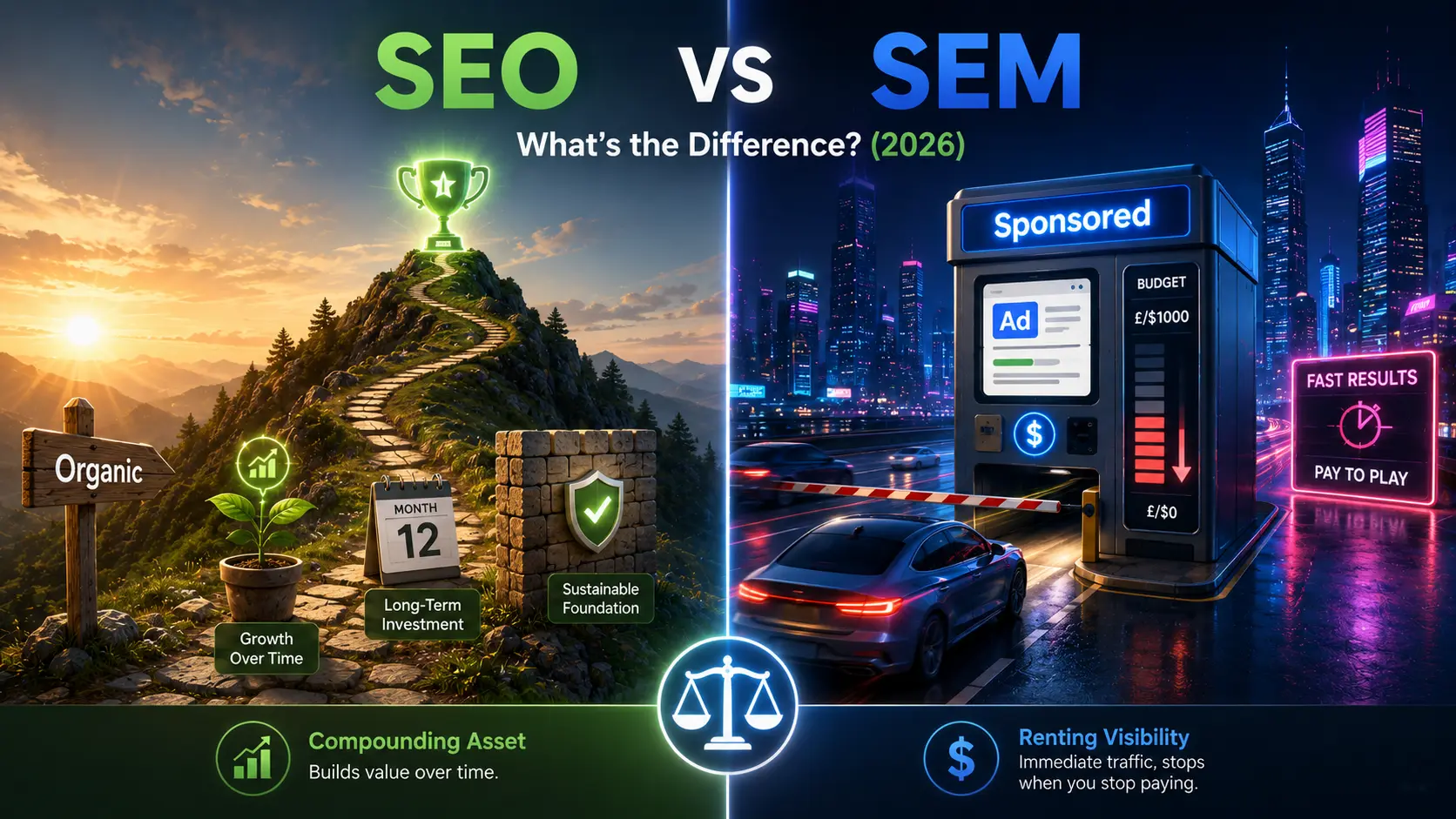
The clearest way to understand the strategic difference between SEO and SEM is through the lens of owning versus renting.
SEM is renting visibility. You pay for a position in search results and you occupy it for as long as you keep paying. The moment you stop, the position disappears. You get exactly what you pay for, nothing more and nothing less. It is entirely predictable and entirely dependent on continued budget.
SEO is building an asset. Every piece of quality content you publish, every backlink you earn, every technical improvement you make adds to the cumulative authority of your domain. Over time, that authority compounds. A page published two years ago may be generating thousands of visits per month with minimal ongoing investment. If you stop actively working on SEO tomorrow, most of that traffic continues arriving for months or years.
The trade-off is timeline. Renting gives you immediate access. Building an asset takes time before it delivers returns.
The Terminology Confusion Explained
The ambiguity in SEM’s definition is not an accident. It has a history.
In the early 2000s, the term SEM genuinely was used to cover all search marketing activity, including SEO. Industry publications including Search Engine Marketing Professional Organization (SEMPO) used the broad definition.
Over time, as Google Ads grew to dominate paid search and SEO became a recognised discipline in its own right, practitioners began using the terms separately. “SEM” gradually narrowed in common usage to mean paid search specifically.
Today, if you see a job posting for an “SEM Manager,” it almost certainly means a paid search or Google Ads specialist. If you see “SEO and SEM” listed as two separate skills, the writer is distinguishing organic from paid. Understanding this context prevents misreading job descriptions, agency proposals, and marketing strategies.
SEM in the AI Search Era (2026)
The search landscape in 2026 has added a new layer of complexity to the SEO vs SEM conversation: AI-generated results.
Google’s AI Overviews now appear at the top of results for a significant portion of queries, sitting above both paid ads and organic results. For the queries where they appear, AI Overviews generate very high zero-click rates, meaning many users get their answer directly without clicking any result.
Google has responded to this by integrating paid placements into AI Overview responses. Advertisers can now appear as cited sources within AI-generated answers, not just in the traditional sponsored slots. This development blurs the line between SEM and organic visibility further.
For SEO, the implication is that appearing as a cited source in AI-generated answers has become a new form of organic visibility, even when no click results. For SEM, the new AI-integrated ad placements represent an additional reach channel alongside traditional paid search positions.
What has not changed is the fundamental principle: SEM delivers immediate paid placement, and SEO builds durable organic authority. Both are now being evaluated in an environment where AI answers increasingly sit between the user and the traditional search result.
When to Use SEO, When to Use SEM, and When to Use Both
The right answer depends on your business stage, goals, and resources.
Use SEO as your primary channel when:
- You are building a long-term content asset (blog, resource hub, comparison site)
- You have a modest budget but significant time and content capability
- You are in an industry where organic trust and authority matter heavily (health, finance, professional services)
- You want sustainable traffic that does not depend on ongoing ad spend
- You are targeting informational and research-phase keywords where organic content performs well
Use SEM as your primary channel when:
- You need traffic immediately (product launch, event promotion, seasonal offer)
- You are testing a new market or keyword set and want fast data before committing to content
- Your conversion keywords are highly transactional and competitive enough that organic ranking is a very long-term goal
- You have a proven, profitable conversion funnel and can scale spend against a positive return on ad spend
- You are a local service business that needs calls and enquiries now rather than in six months
Use both together when:
Most mature businesses are best served by running SEO and SEM in parallel, with each channel doing what it does best.
A typical integrated approach looks like this:
- SEM handles immediate commercial intent. High-value, high-competition transactional keywords are bid on through Google Ads, delivering traffic and conversions now while organic rankings are being built.
- SEO handles informational and research-phase content. Blog posts, guides, and comparison content attract users earlier in the buying journey, building brand awareness and trust that eventually converts.
- SEM data informs SEO strategy. Google Ads provides click and conversion data on keywords much faster than organic testing. High-converting keywords identified through paid campaigns can then be prioritised in the SEO content plan.
- SEO reduces SEM dependency over time. As organic rankings improve on key terms, ad spend can be reduced or reallocated to newer opportunities, improving overall marketing efficiency.
The Cost Reality
One of the most common misconceptions about SEO is that it is “free.” It is not. It simply does not involve paying per click.
SEO requires investment in:
- Content creation (writer time, research, editing)
- Technical infrastructure (developer time, tools)
- Link building (outreach, digital PR, content promotion)
- SEO tools (keyword research, rank tracking, technical auditing)
For a business outsourcing SEO to an agency or hiring in-house, monthly costs typically range from a few hundred pounds or dollars for basic ongoing work to many thousands for competitive industries with significant content output requirements.
SEM costs are more direct and variable: budget spent on ads plus management costs. The significant advantage of SEM is that costs are directly tied to results. If a campaign generates a profitable return on every pound spent, scaling it is straightforward. If it does not, it can be paused immediately.
The realistic comparison is not “free SEO vs expensive SEM.” It is “deferred-return investment in SEO vs immediate-return, ongoing-cost SEM.” Both require money. They deliver returns on very different timelines.
A Note on Industry Terminology
Beyond SEO and SEM, you will increasingly encounter two additional terms in 2026: GEO (Generative Engine Optimisation) and AEO (Answer Engine Optimisation). Both refer to practices aimed at making content more likely to be cited in AI-generated search answers.
Google’s own guidance, published in May 2026, explicitly states that optimising for AI search is simply good SEO applied more rigorously. There is no entirely separate discipline required. The same content quality, authority, and structural clarity that earns organic rankings also earns AI citations. GEO and AEO are better understood as refinements within SEO rather than new categories alongside it.
❓ Frequently Asked Questions
Is SEM the same as PPC?
In common usage, SEM and PPC are often used interchangeably to mean paid search advertising. Technically, SEM is the broader term that encompasses both paid and organic search strategies, while PPC (pay-per-click) is a specific pricing model used in paid advertising. In practice, when someone says SEM in a business or agency context, they usually mean paid search.
Which delivers better ROI, SEO or SEM?
Neither universally. SEM delivers faster, more measurable short-term ROI and is easier to scale. SEO delivers compounding long-term ROI that becomes increasingly cost-efficient as authority builds. Most businesses achieve the best overall ROI by combining both.
Can I do SEO without doing SEM?
Yes. Many businesses build substantial organic traffic entirely through SEO without running paid search campaigns. SEO is an independent strategy that does not require paid search to function.
Does SEM help SEO rankings?
No. Google is explicit that paying for Google Ads does not improve your organic rankings. The two systems operate independently. However, running SEM campaigns generates keyword performance data that can inform your SEO strategy, and higher brand visibility from paid ads can indirectly increase branded searches and brand authority over time.
What is a realistic monthly budget for SEM?
It varies enormously by industry and goals. A local service business might run effective campaigns for a few hundred pounds or dollars per month. An e-commerce business targeting competitive national keywords might spend tens of thousands. The relevant question is not what the budget is but what the return on ad spend is.
Summary
SEO and SEM are complementary, not competing, strategies.
SEO — the practice of earning organic search visibility through content, authority, and technical excellence — delivers durable, compounding traffic that does not stop when you pause a campaign. It requires a patient, long-term investment approach.
SEM — paid search advertising through platforms like Google Ads — delivers immediate, controllable, scalable traffic tied directly to budget. It is ideal for fast results, testing, and high-intent commercial queries.
The key differences to carry forward:
- SEO is building an asset. SEM is renting placement.
- SEO takes months to show results. SEM delivers traffic within hours.
- SEO traffic persists when you stop working. SEM traffic stops when your budget stops.
- Organic search results carry higher user trust than paid placements.
- Most growing businesses benefit most from running both in parallel, with SEM filling immediate gaps and SEO building the long-term foundation.
In 2026, both channels are evolving in response to AI-powered search. The fundamentals remain unchanged, but the landscape now includes AI-generated answers, integrated paid placements within those answers, and new expectations for content authority and structure that apply to both organic and paid strategies.