
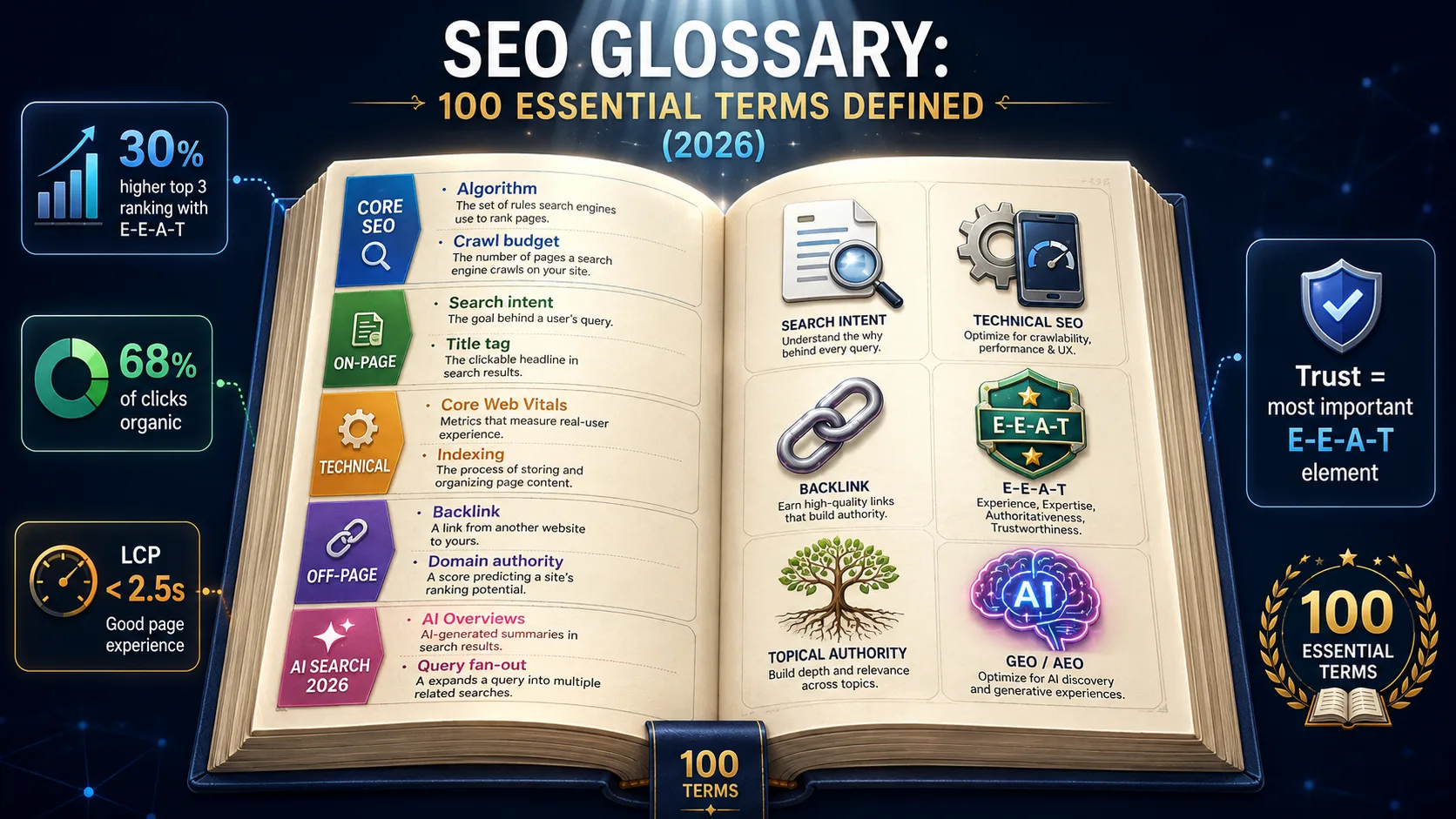
SEO has its own language, and that language changes faster than almost any other discipline in digital marketing. A term that meant one thing in 2018 may mean something different today, and entirely new categories of terminology have emerged with AI-powered search.
This glossary covers 100 essential SEO terms organised by category so you can find what you need quickly. Each definition explains not just what a term means but why it matters in practice. Bookmark it as a reference and return whenever a term appears in an article, audit report, or strategy discussion that you need to understand clearly.
Core SEO Concepts
Algorithm — the set of rules, signals, and calculations a search engine uses to determine the relevance, quality, and ranking order of pages in response to a search query. Google’s algorithm evaluates hundreds of signals and is updated thousands of times per year.
Crawling — the process by which search engine bots (such as Googlebot) discover and read web pages by following links across the internet. Pages that cannot be crawled cannot be indexed or ranked.
Indexing — the process by which a search engine analyses and stores information about a crawled page in its database (the index). Only indexed pages can appear in search results.
Ranking — the position a page occupies in search engine results for a specific query. Rankings are determined by the search algorithm and vary by query, location, device, and user context.
Organic search — traffic that arrives at a website from unpaid search engine results. Organic search is earned through SEO rather than bought through advertising.
SERP — Search Engine Results Page, the page displayed after a user submits a search query. Modern SERPs include organic results, paid ads, AI Overviews, featured snippets, local packs, image carousels, and more.
Search intent — the underlying goal or purpose behind a search query. The four primary intent types are informational (wanting to learn), navigational (wanting to find a specific site), commercial (wanting to compare options), and transactional (wanting to take action). Matching content to search intent is foundational to ranking.
Impressions — the number of times a page appeared in search results, regardless of whether it was clicked. Impressions are tracked in Google Search Console and are a leading indicator of SEO progress.
Click-through rate (CTR) — the percentage of impressions that result in a click. A page appearing 1,000 times in search results and receiving 30 clicks has a 3% CTR. CTR is influenced primarily by ranking position, title tag quality, and meta description quality.
Organic traffic — visitors who arrive at a website by clicking an unpaid search result. Distinct from paid traffic (which comes from ads), direct traffic (typed URL), referral traffic (links from other sites), and social traffic.
Search visibility — a measure of how prominently a website appears across its target keywords in search results. High search visibility means appearing frequently and in prominent positions for relevant queries.
Domain authority — a third-party metric (not a Google metric) developed by SEO tools such as Moz and Ahrefs that estimates how likely a domain is to rank well based on its backlink profile. Useful for benchmarking against competitors but not a direct ranking factor.
On-Page SEO
On-page SEO — optimisation activities performed directly on a web page to improve its relevance and clarity for both search engines and users. Includes content, title tags, headings, URLs, internal links, and image optimisation.
Title tag — the HTML element that defines the title of a web page, displayed as the clickable headline in search results. One of the most important on-page signals. Should include the primary keyword and be between 50 and 60 characters.
Meta description — a short HTML summary of a page’s content displayed below the title tag in search results. Not a direct ranking factor but significantly influences click-through rate. Best kept between 140 and 160 characters.
H1 tag — the primary heading of a page, typically matching or closely reflecting the page title. Each page should have exactly one H1 tag. It signals to search engines the main topic of the page.
Heading hierarchy — the structured use of H1, H2, H3, and lower heading tags to organise page content logically. A clear heading hierarchy helps both readers and search engines understand content structure and is critical for AI citation eligibility.
Keyword — a word or phrase that users type into search engines. In SEO, keywords are researched and targeted to align content with what an audience is searching for.
Primary keyword — the main keyword a page is optimised for. A page should have one primary keyword that reflects its central topic and appears in the title tag, H1, URL, and naturally throughout the content.
Secondary keywords — related terms and phrases that support the primary keyword. Including secondary keywords naturally improves topical coverage and helps pages rank for a broader range of related queries.
Long-tail keyword — a specific, typically longer search phrase with lower search volume but also lower competition and often higher commercial intent. Long-tail keywords are easier to rank for and often convert better because the searcher’s need is more defined.
Keyword density — the frequency with which a keyword appears on a page relative to total word count. Formerly treated as an important optimisation metric, keyword density is no longer a meaningful signal. Natural, contextually appropriate use of keywords is what matters.
Keyword stuffing — the manipulative practice of overloading a page with keywords to try to influence rankings. Explicitly against Google’s guidelines and actively penalised. Content that reads unnaturally due to keyword repetition is a clear signal of stuffing.
Semantic SEO — optimising content around complete topics and conceptually related terms rather than isolated keywords. Reflects how modern search engines, using natural language processing, evaluate content based on meaning and context rather than keyword frequency.
LSI keywords — Latent Semantic Indexing keywords, a term used in SEO to describe conceptually related terms that provide context to a page’s main topic. The term is technically outdated as a description of how Google works, but the practice of including contextually related language remains valid.
URL structure — the format and content of a page’s web address. Clean, descriptive URLs that include the primary keyword perform better than long, parameter-heavy URLs. An example of a good URL is: yoursite.com/keyword-research-guide.
Alt text — a written description of an image embedded in the HTML, readable by search engines and screen readers. Properly written alt text helps search engines understand image content and improves accessibility. Should describe the image accurately and include the keyword where it is naturally relevant.
Internal link — a link from one page on a website to another page on the same website. Internal links help search engines discover and understand content, distribute ranking authority between pages, and guide users to related content.
Anchor text — the visible, clickable text of a hyperlink. Descriptive anchor text that reflects the destination page’s topic is better for both users and search engines than generic anchor text such as “click here.”
Canonical tag — an HTML element (rel=”canonical”) that tells search engines which version of a page is the preferred or original version when duplicate or near-duplicate content exists across multiple URLs. Prevents ranking signals from being split between duplicate pages.
Duplicate content — blocks of content that appear on more than one URL, either within the same site or across different sites. Duplicate content can confuse search engines about which version to rank and may dilute ranking signals.
Thin content — pages with very little substantive, original content that offer minimal value to readers. Thin content is explicitly targeted by Google’s Helpful Content System and Panda-era quality signals. May cause indexing suppression across an entire site.
Content decay — the gradual loss of search rankings and organic traffic on older content over time as it becomes outdated, as competitors publish fresher resources, or as search intent around the topic shifts.
Topical authority — the degree to which a website is recognised as a credible, comprehensive source on a specific subject, demonstrated through deep and interconnected content coverage. Analysis of 250,000 search results in 2026 confirmed topical authority as the strongest on-page ranking factor.
Pillar page — a comprehensive, broad page that covers a core topic at a high level and links to more specific cluster pages on related subtopics. Pillar pages anchor a topic cluster and signal topical authority to search engines.
Content cluster — a group of interlinked pages covering a central topic (the pillar) and its related subtopics (the cluster). Content clusters build topical authority more effectively than isolated, unconnected pages.
Keyword cannibalistion — an issue that occurs when multiple pages on the same website target the same keyword, causing them to compete against each other in search results. Can be resolved by consolidating, redirecting, or differentiating the competing pages.
Technical SEO
Technical SEO — optimisation of a website’s infrastructure and backend so search engines can efficiently crawl, index, and understand all of its content. Covers site speed, mobile-friendliness, crawlability, site architecture, and structured data.
Googlebot — Google’s web crawling bot. Googlebot continuously traverses the internet following links, reading page content, and sending information back to Google’s indexing systems. There are separate Googlebots for desktop and mobile, with the mobile version now primary under mobile-first indexing.
Crawl budget — the number of pages Google will crawl on a given website within a specified time period. Large sites with thousands of pages need to manage crawl budget actively to ensure important pages are crawled regularly. Low-value pages (duplicates, thin content, parameter URLs) consume crawl budget without benefit.
Robots.txt — a file at the root of a website that instructs search engine crawlers which pages or directories they should not access. Incorrectly configured robots.txt files can accidentally block important content from being crawled.
XML sitemap — a file that lists all the important URLs on a website to help search engines discover and index content more efficiently. Best practice is to include only canonical URLs that return a 200 status code and to keep lastmod dates accurately updated.
Mobile-first indexing — Google’s approach of using the mobile version of a website as the primary basis for crawling, indexing, and ranking. Google completed its full transition to mobile-first indexing in 2024. All sites are now evaluated on their mobile experience first.
Core Web Vitals — three specific measurements of page performance used by Google as ranking signals: LCP (Largest Contentful Paint, measuring load speed), INP (Interaction to Next Paint, measuring responsiveness), and CLS (Cumulative Layout Shift, measuring visual stability). Google’s benchmarks are LCP under 2.5 seconds, INP under 200 milliseconds, and CLS under 0.1.
LCP — Largest Contentful Paint. Measures how quickly the largest visible content element on a page loads. A key Core Web Vital with Google’s benchmark of under 2.5 seconds.
INP — Interaction to Next Paint. Replaced FID (First Input Delay) in 2024 as the responsiveness Core Web Vital. Measures how quickly a page responds to user interactions such as clicks and key presses. Benchmark: under 200 milliseconds.
CLS — Cumulative Layout Shift. Measures the visual stability of a page as it loads. A high CLS score means page elements are jumping around as the page renders, which creates a poor user experience. Benchmark: under 0.1.
HTTPS — the secure version of the HTTP protocol, indicated by a padlock icon in the browser. Google has used HTTPS as a confirmed ranking signal since 2014. Any site still operating on HTTP faces both ranking disadvantages and browser security warnings.
Redirect — an instruction that sends users and search engines from one URL to another. A 301 redirect is permanent and passes most ranking signals to the destination URL. A 302 redirect is temporary and does not reliably pass ranking signals.
404 error — the HTTP status code returned when a page cannot be found. Broken links leading to 404 pages waste crawl budget, create poor user experience, and lose any ranking signals from links pointing to the missing page.
Schema markup — structured data code (typically written in JSON-LD format) added to a page to help search engines understand its content more precisely. Enables rich results in SERPs and, in 2026, feeds directly into AI Overview citations and entity recognition.
Structured data — machine-readable information added to a page’s code that provides explicit context about the content, entities, and relationships on the page. Schema.org vocabulary is the standard used for most structured data implementation.
Rich results — enhanced search result listings that include additional visual or informational elements such as star ratings, recipe details, FAQs, event dates, or product availability. Eligibility for rich results requires correct structured data implementation.
Page experience — a set of signals Google uses to measure how well a page serves users beyond its informational content. Includes Core Web Vitals, mobile-friendliness, HTTPS, and the absence of intrusive interstitials.
Site architecture — the structure and organisation of a website’s pages and the links between them. A logical site architecture with a clear hierarchy (homepage to category pages to individual posts or products) helps both search engines and users navigate efficiently.
Crawl depth — the number of clicks required to reach a page from the homepage. Pages more than three to four clicks deep are crawled less frequently and tend to accumulate less authority. Important pages should be accessible within a small number of clicks.
Log file analysis — the examination of server log files to understand exactly how search engine crawlers are interacting with a website. Reveals which pages are being crawled, how frequently, and where crawl budget is being wasted.
JavaScript SEO — the practice of ensuring that JavaScript-rendered content is properly crawled and indexed by search engines. Since Googlebot renders JavaScript separately from HTML, JavaScript-heavy pages may experience indexing delays.
Off-Page SEO
Off-page SEO — SEO activities conducted outside of the website itself to improve search engine rankings and authority. Primarily involves backlink acquisition but also includes brand mentions, digital PR, and reputation signals.
Backlink — a link from one website to another. Backlinks from authoritative and relevant websites are one of Google’s strongest ranking signals, functioning as votes of confidence in a page’s quality.
Link equity — the ranking value or authority passed from one page to another through a backlink. Also called “link juice.” High-authority pages pass more link equity than low-authority pages.
Domain rating / Domain authority — metrics developed by SEO tools (Ahrefs uses Domain Rating, Moz uses Domain Authority) to estimate the overall authority of a domain based on its backlink profile. Not Google metrics but useful for benchmarking.
PageRank — Google’s original algorithm for measuring the importance of a page based on the quantity and quality of backlinks pointing to it. While Google no longer publicly displays PageRank scores, the underlying principle of link-based authority remains central to how Google ranks pages.
Dofollow link — a standard backlink that passes link equity to the destination page. Most editorial links are dofollow by default.
Nofollow link — a backlink containing the rel=”nofollow” attribute, which instructs search engines not to pass ranking authority through the link. Used for paid links, user-generated content, and links the publisher does not want to endorse.
Sponsored attribute — the rel=”sponsored” tag added to links that are part of paid arrangements (advertisements, sponsorships). Required by Google for any paid link placement to avoid violating link scheme guidelines.
UGC attribute — the rel=”ugc” tag applied to links in user-generated content such as forum posts and comments, indicating the link was not editorially placed by the site owner.
Anchor text — the visible, clickable text of a hyperlink. For off-page SEO, the anchor text of backlinks pointing to a page provides context to search engines about the content of the destination page.
Link building — the process of acquiring backlinks from other websites. Ethical link building focuses on earning links through original content, digital PR, and genuine relationship building. Manipulative link building (buying links, link farms, PBNs) violates Google’s guidelines.
Digital PR — the practice of earning press coverage and links from high-authority publications through newsworthy content, original research, expert commentary, and story pitching. One of the most effective white-hat link building strategies.
Guest posting — writing articles for other websites as a genuine editorial contribution, typically in exchange for an author credit and sometimes a backlink. Acceptable as a link building strategy when content is genuinely valuable. Problematic when done at scale purely for link acquisition.
Private Blog Network (PBN) — a network of websites created specifically to generate backlinks to a target site. A black hat tactic explicitly against Google’s guidelines, carrying significant penalty risk.
Link profile — the complete set of backlinks pointing to a website. A healthy link profile includes links from a diverse range of relevant, authoritative domains with varied anchor text. An unnatural link profile (many links from irrelevant or low-quality sites, over-optimised anchor text) can trigger algorithmic or manual penalties.
Disavow tool — a Google Search Console feature that allows webmasters to tell Google to ignore specific backlinks when evaluating their site. Used to address toxic backlink profiles, typically those caused by past black hat link building or negative SEO attacks.
Brand mention — a reference to a brand name on another website, with or without a hyperlink. Unlinked brand mentions from authoritative sources contribute to overall brand authority signals even without passing direct link equity.
Content and Strategy
E-E-A-T — Experience, Expertise, Authoritativeness, and Trustworthiness. Google’s framework for evaluating the credibility and quality of content and its creators. Trustworthiness is the most foundational element. Sites with strong E-E-A-T signals have a 30% higher chance of ranking in the top three positions according to Semrush research.
YMYL — Your Money or Your Life. Google’s classification for content that could significantly affect a reader’s health, financial stability, safety, or life outcomes. YMYL content (health, medical, financial, legal) is held to the highest E-E-A-T standards because poor quality information in these areas can cause real-world harm.
Featured snippet — a highlighted block appearing above organic search results that provides a direct answer extracted from a web page. Earns significantly higher visibility and click-through rates than standard organic results. Also called “position zero.”
People Also Ask — a SERP feature showing a list of related questions that expand to display brief answers. Optimising content to appear in People Also Ask boxes is a form of featured snippet optimisation and increases SERP real estate.
Knowledge panel — an information box appearing on the right side of Google search results (on desktop) that displays structured information about an entity (a person, organisation, place, or concept). Powered by Google’s Knowledge Graph.
Knowledge Graph — Google’s structured database of entities and their relationships, used to power knowledge panels, direct answers, and entity understanding across search results. Building entity recognition in the Knowledge Graph is increasingly important for brand visibility.
Content freshness — the recency and currency of content as a ranking signal. More important for time-sensitive queries (news, current events, seasonal topics) than for evergreen informational content, though outdated statistics and facts reduce E-E-A-T quality signals over time.
Evergreen content — content that remains relevant and valuable over a long period without requiring frequent updates. Tutorials, definitions, and foundational guides are typically evergreen. Forms the backbone of sustainable organic traffic strategies.
Search snippet — the text preview of a page displayed in search results, consisting of the title tag, URL, and meta description (or a dynamically generated excerpt).
AI Search Terms (2026)
AI Overviews — Google’s AI-generated answer summaries that appear at the top of search results for eligible queries, synthesising information from multiple web pages and citing sources. Appeared on roughly 15 to 30% of queries in 2026, primarily informational and commercial intent searches.
AI Mode — Google’s advanced conversational AI search experience that uses query fan-out to break complex queries into sub-queries, search across multiple sources, and synthesise comprehensive answers. Expanded broadly in 2026.
Query fan-out — the process by which AI search systems decompose a single complex query into multiple related sub-queries, run them simultaneously, and synthesise the results into a comprehensive answer. A core mechanism of Google AI Mode and a key reason why deep, well-structured content covering subtopics earns AI citations.
GEO — Generative Engine Optimisation. The practice of optimising content to be cited and referenced in AI-generated search answers, not just to rank in traditional organic results. Google’s official May 2026 guidance positioned GEO as an extension of good SEO rather than a separate discipline.
AEO — Answer Engine Optimisation. Optimising content specifically to appear in direct answer features including AI Overviews, featured snippets, and voice search results. Shares significant overlap with GEO and traditional featured snippet optimisation.
AIO — AI Optimisation (or AI Overview Optimisation). An umbrella term for making a brand and its content visible, citable, and recommended across AI-powered search platforms including Google AI Overviews, ChatGPT Search, Perplexity, and Gemini.
Zero-click search — a search query that is answered directly on the results page without the user clicking through to any website. Common for simple factual queries. AI Overviews have increased zero-click rates on informational queries.
SpamBrain — Google’s AI-powered spam detection system that processes billions of signals daily to identify manipulative practices including unnatural link patterns, thin content, cloaking, and other black hat tactics. Updated continuously and applied in near real-time.
Helpful Content System — a Google sitewide quality signal introduced in 2022 and progressively strengthened through 2026 that identifies and demotes content created primarily to rank in search rather than to genuinely help users. Affects the entire domain, not just the pages with poor content.
Analytics and Measurement
Google Search Console — a free Google tool that provides data on how a website performs in Google Search. Tracks keyword impressions, clicks, rankings, indexing status, Core Web Vitals, and manual actions. Essential for any SEO programme.
Google Analytics 4 — Google’s current web analytics platform. Tracks user behaviour on a website including traffic sources, pages visited, engagement metrics, and conversion events. The successor to Universal Analytics, which was sunset in 2023.
Organic conversion rate — the percentage of organic search visitors who complete a desired action (purchase, sign-up, contact form submission). A key metric for measuring the business value of organic traffic beyond raw visit counts.
Bounce rate — the percentage of visitors who leave a website after viewing only one page without any further interaction. A high bounce rate may signal content that does not match visitor expectations or poor page experience, though it must be interpreted in context.
Dwell time — the amount of time a user spends on a page after clicking from search results before returning to the SERP. Long dwell time generally signals that the content satisfied the visitor’s intent. Short dwell time, especially combined with rapid return to the SERP (pogo-sticking), signals intent mismatch.
Pogo-sticking — the behaviour of a user who clicks a search result, quickly finds the content unsatisfying, and immediately returns to the search results page to try another result. Repeated pogo-sticking is a strong negative signal to Google that a page does not satisfy search intent.
Rank tracking — the monitoring of a website’s keyword positions in search results over time. Tools such as Ahrefs, Semrush, and Google Search Console’s Performance report are used for rank tracking.
Share of voice — the proportion of total organic search traffic a brand captures across its target keyword set, relative to competitors. A metric for measuring competitive position in organic search.
Impressions — in Google Search Console, the number of times a page appeared in search results whether or not it was clicked. A leading indicator of SEO progress, rising impressions for target keywords confirm early ranking traction even before significant traffic arrives.
Quick Reference: Terms to Know by Experience Level
Beginner: algorithm, crawling, indexing, organic search, keyword, title tag, meta description, backlink, SERP, search intent, on-page SEO, off-page SEO, technical SEO, E-E-A-T, Google Search Console.
Intermediate: canonical tag, crawl budget, Core Web Vitals, structured data, topical authority, content cluster, pillar page, link equity, anchor text, featured snippet, Knowledge Graph, robots.txt, XML sitemap, keyword cannibalistion, dwell time.
Advanced: query fan-out, AI Mode, GEO, AEO, SpamBrain, log file analysis, JavaScript SEO, crawl budget management, Helpful Content System, schema markup implementation, entity optimisation, link profile analysis, Knowledge Graph entity establishment.
❓ Frequently Asked Questions
How often does SEO terminology change?
Faster than almost any other marketing discipline. Core terms like keyword, backlink, and crawling have been stable for decades. But new categories emerge regularly, particularly around algorithm updates and platform changes. AI-related terminology (AI Overviews, GEO, AEO, query fan-out) has largely emerged since 2023. Reviewing glossaries and SEO publications annually keeps terminology current.
What is the most important SEO term to understand first?
Search intent. Understanding that every ranking decision Google makes is an attempt to serve the goal behind a query, not just match keywords, is the single most foundational concept in modern SEO. All other practices flow from understanding this.
Are all of these terms used by Google officially?
No. Many terms (domain authority, link juice, pogo-sticking, Google Sandbox) are industry terms used by practitioners to describe observed phenomena, not official Google terminology. Google’s own official terms are documented in its Search Central documentation and Search Quality Rater Guidelines. Both are worth reading directly.
What is the difference between SEO and SEM in terms of terminology?
SEO terminology covers organic search activities. SEM (Search Engine Marketing) in its narrow, common usage refers to paid search, and its terminology overlaps significantly with Google Ads vocabulary (CPC, Quality Score, Ad Rank, impression share). When someone says “SEM terms,” they typically mean paid search metrics rather than organic SEO concepts.
Summary
This glossary covers the 100 most important SEO terms across core concepts, on-page SEO, technical SEO, off-page SEO, content strategy, AI search, and analytics. Understanding this vocabulary is the foundation for reading any SEO audit, strategy document, or industry publication with confidence.
The most significant terminology shift in recent years has been the emergence of AI search terms. GEO, AEO, AI Overviews, and query fan-out are now part of standard SEO vocabulary rather than specialist terms. As AI-powered search continues to evolve through 2026 and beyond, this will be the fastest-growing section of any SEO glossary.