
The first result on Google earns an average click-through rate of 39.8%. The second position earns 18.7%. That gap represents more than twice the traffic for the same search query, from the same number of impressions.
On-page SEO is what separates these positions. It is the collection of optimisations made directly on a web page that determine whether search engines can understand it, whether it aligns with what the searcher wants, and whether it convinces people browsing search results to click. Done well, on-page SEO is one of the highest-leverage activities in the entire SEO workflow, because it does not require building links or waiting for external factors to change. Changes to a page’s title tag can shift rankings within days of a recrawl.
This guide covers every significant on-page SEO element, from the HTML signals that search engines read first to the content structure that AI systems extract for generated answers. It is organised by impact level, not alphabetically, so you know where to invest effort first.
What is On-Page SEO?
On-page SEO — the practice of optimising everything on a web page that affects its ability to rank in search engines and appear in AI-generated search answers. This includes the content itself, the HTML elements that structure it, the internal links that connect it to related pages, and the technical performance signals that affect user experience.
On-page SEO is distinct from:
Off-page SEO — signals from outside the site, primarily backlinks, brand mentions, and external reputation.
Technical SEO — the infrastructure of the site, including server configuration, crawl architecture, and mobile-first indexing, which affects all pages rather than individual page optimisation.
Every page on a website that is meant to rank for a target keyword needs deliberate on-page SEO. Backlinks and domain authority help a site compete, but on-page optimisation determines whether individual pages rank for the specific queries they target.
Why On-Page SEO Matters More in 2026
On-page SEO has always mattered. In 2026, its importance has increased for two reasons.
AI search evaluates content at the passage level. Google’s AI Overviews and AI Mode do not just rank pages. They extract specific passages from pages to include in generated answers. A well-structured, clearly written page that provides direct answers within identifiable sections has more opportunities to be cited than a page that is technically sound but poorly structured. On-page SEO now directly affects AI citation potential, not just traditional ranking positions.
The bar for content quality has risen. Google’s May 2026 Core Update intensified its preference for topically deep, genuinely useful content over pages that are technically optimised but semantically thin. On-page signals that demonstrate depth, expertise, and user-serving quality are more heavily weighted than they were two years ago.
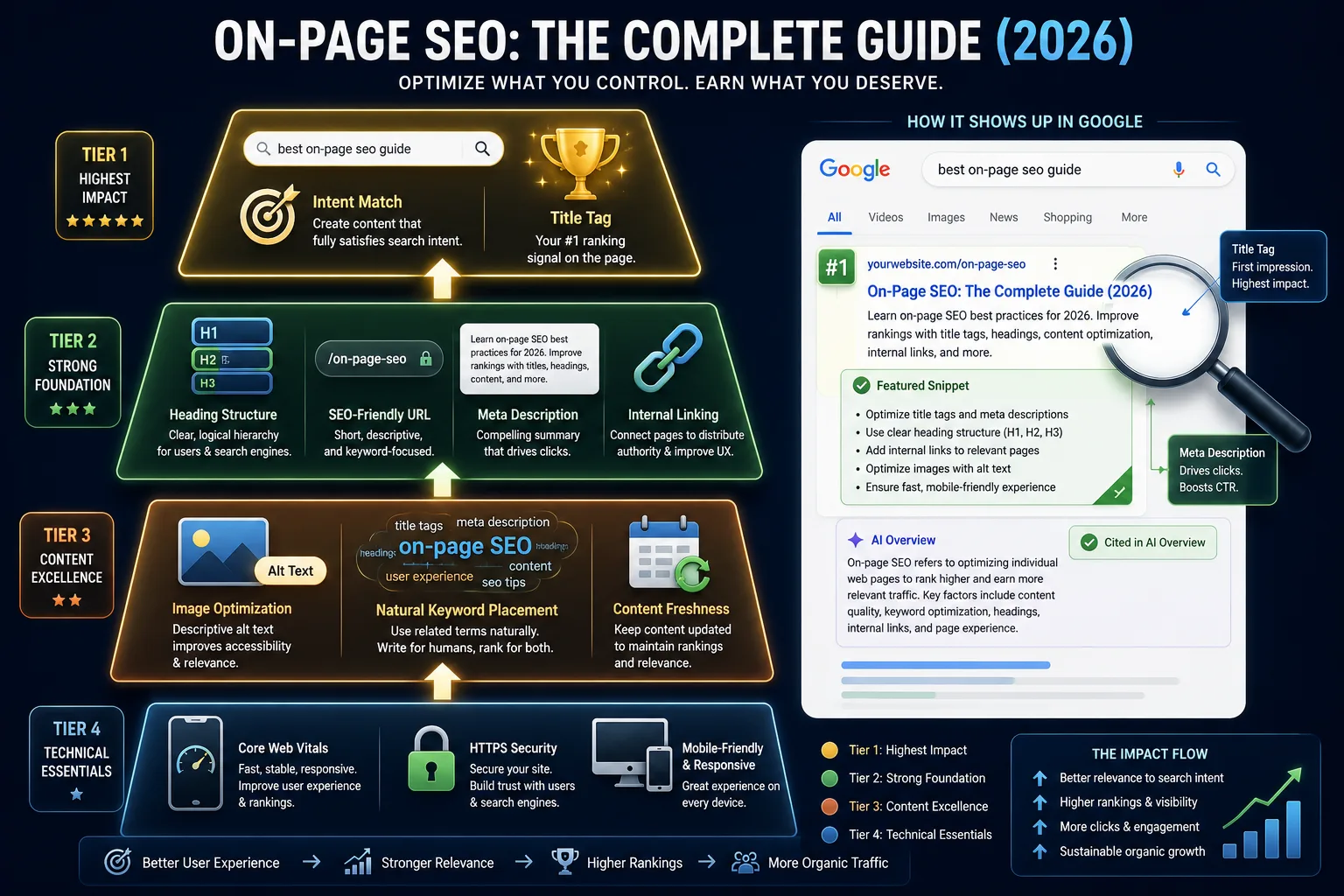
The On-Page SEO Hierarchy: Where to Invest First
Not all on-page elements carry equal weight. This hierarchy reflects their relative impact on rankings and traffic.
Tier 1 (Highest impact): Search intent alignment, content quality and depth, title tag
Tier 2 (High impact): H1 and heading structure, URL, internal linking, meta description (via CTR)
Tier 3 (Moderate impact): Image optimisation, keyword placement, schema markup, content freshness
Tier 4 (Foundational): Page speed, mobile responsiveness, HTTPS, Core Web Vitals
The tier structure does not mean lower tiers can be ignored. Deficiencies at any tier can suppress pages that are strong in higher tiers. But when prioritising a limited optimisation budget, focus flows from Tier 1 downward.
Tier 1: Search Intent Alignment
Why Intent is the First On-Page Factor
Before any HTML element is optimised, the page must serve the right purpose for the right search. Intent alignment is evaluated by Google before content quality. A page that does not match the dominant intent for its target keyword will not rank well regardless of technical excellence.
For every page, confirm:
- What is the dominant intent of the target keyword (informational, commercial, transactional, navigational)?
- What content type does the SERP show for this keyword (guide, listicle, product page, comparison)?
- What angle or audience level do the top-ranking pages serve?
If the page format does not match the dominant SERP pattern, no amount of on-page optimisation will compensate. This is the most common reason technically well-optimised pages fail to rank.
Content Quality and Depth
Quality and depth are the most important on-page signals in 2026 and the hardest to reduce to a checklist item.
Google’s evaluation of content quality encompasses:
Topical completeness. Does the page cover the full scope of what a genuine expert would address on this topic? A page on “on-page SEO” that omits internal linking, URL structure, or schema markup is topically incomplete regardless of how well it covers title tags.
Original value. Does the page offer insights, examples, data, or perspectives not available by summarising other sources? AI-generated content that regurgitates existing information without original contribution has been specifically targeted by Google’s 2024 to 2026 Helpful Content enforcement.
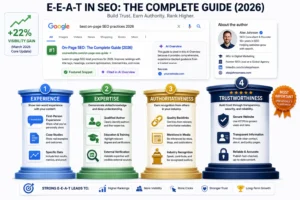
E-E-A-T signals. Does the content demonstrate experience (first-hand involvement with the topic), expertise (deep subject knowledge), authoritativeness (recognised standing in the field), and trustworthiness (accurate, transparent, well-sourced)?
Reading depth signals. Dwell time and pogo-sticking (returning to search results quickly after clicking a result) are signals Google uses to evaluate whether content genuinely satisfied the searcher’s intent. Content that answers questions completely reduces pogo-sticking and increases dwell time.
Tier 1: Title Tags
What the Title Tag Does
The title tag is the HTML element that defines the page’s headline in search results. It is the clickable blue text that appears for every organic result and is one of the most important single on-page signals Google uses to understand a page’s topic.
It is also the highest-leverage, lowest-effort on-page improvement available. A well-optimised title tag change can move a page from position 14 to position 7 after a single recrawl, without changing any other element. No other on-page change produces comparable results with comparable speed.
Title Tag Best Practices
Include the primary keyword, ideally near the beginning. The closer the keyword is to the start of the title, the stronger the relevance signal. “Keyword Research Guide: Complete 2026 Process” is stronger than “A Complete Guide to the Keyword Research Process in 2026.”
Keep length under 60 characters. Google truncates titles that exceed approximately 60 characters in standard desktop display. Mobile truncates earlier, at approximately 50 to 55 characters. Truncated titles lose their full message and look incomplete in search results.
Write for the human reader first. A title that includes the keyword but reads awkwardly or is uninviting to click defeats the purpose. The title must make a searcher want to choose your result over the alternatives.
Include compelling signals where appropriate. Numbers (specificity), years (recency), and power words that match the searcher’s goal (Complete, How to, Guide, Checklist) improve click-through rates on comparable keyword targeting.
Make every title unique. Duplicate title tags across multiple pages prevent search engines from distinguishing between those pages’ topics and produce lower-quality search result displays.
Do not stuff multiple keywords. A title that attempts to target four different keyword phrases is not targeting any of them effectively. One primary keyword target per title.
Using Search Console to Find Title Tag Opportunities
Pages with high impressions and low click-through rates in Google Search Console are the highest-priority title tag improvement targets. The page is appearing in search results frequently, meaning Google considers it relevant, but searchers are not choosing it over alternatives. A more compelling, accurate, or intent-matched title tag directly addresses this problem.
Tier 2: Heading Structure (H1, H2, H3)
The H1 Tag
Every page should have exactly one H1 tag. It is the primary heading of the page and should:
- Closely mirror or match the title tag, including the primary keyword
- Accurately describe what the page covers
- Appear at or very near the top of the page content
Some content management systems automatically set the page title as the H1. Others require it to be set independently. Verify that your H1 is present and correctly set for every important page.
H2 and H3 Tags
H2 tags define the major sections of a page. H3 tags define subsections within H2 sections. A logical hierarchy of headings serves two purposes simultaneously.
For users, headings allow scanning. Research consistently shows that most users scan page content before committing to reading it. Clear, descriptive headings that communicate what each section covers improve engagement and reduce bounce rates.
For search engines and AI systems, headings define the structure of the content and make individual sections extractable. Google’s passage indexing reads pages at the section level, meaning a well-headlined section has its own opportunity to rank for related queries and be cited in AI Overviews, independent of the overall page position.
Heading best practices:
- H2 headings should describe major topic sections and include secondary keywords naturally where they fit
- H3 headings break H2 sections into logical subsections
- Never skip heading levels (do not jump from H2 directly to H4)
- Do not use headings purely for visual styling without semantic structure
- Make headings descriptive enough that a reader could understand the content outline from headings alone
Tier 2: URL Structure
What Makes a Good URL
A page’s URL is a relevance signal to both search engines and users. Keywords in URLs correlate with approximately 45% higher click-through rates compared to URLs without keyword relevance.
Best practices for URL structure:
Keep URLs short and descriptive. The ideal URL includes the primary keyword and nothing else. yourdomain.com/on-page-seo is better than yourdomain.com/blog/2026/04/15/what-is-on-page-seo-and-how-to-do-it.
Use hyphens to separate words. Hyphens are the standard word separator in URLs that search engines read correctly. Underscores are not treated the same way and should be avoided in URL slugs.
Use lowercase letters only. Mixed case URLs can cause duplicate content issues if different cases resolve to the same page.
Include the primary keyword. The keyword in the URL reinforces the relevance signal and is visible to users in search results, providing an additional trust signal.
Avoid parameter-heavy URLs. URLs with session IDs, tracking parameters, and multiple query strings are harder for search engines to process and create duplicate content risks.
Keep URL structure stable after publication. Changing URLs requires permanent redirects to preserve link equity, and link rot (broken links pointing to old URLs) gradually weakens the page’s authority.
Tier 2: Meta Description
Why Meta Descriptions Matter
The meta description is not a direct ranking factor. Google has confirmed this. But it is a critical click-through rate lever, which makes it indirectly important for rankings through engagement signals.
The meta description appears below the title tag in search results. It is the search engine equivalent of advertising copy: a brief opportunity to tell the searcher exactly why your page is the best result for their query and compel them to click.
In 2026, meta descriptions have additional importance because AI systems may extract the description or the opening paragraph of a page to use in generated answer summaries. A well-written meta description that accurately and compellingly summarises page content also serves this function.
Meta description best practices:
Length: 140 to 160 characters for desktop display. Mobile can truncate earlier. Write the most important message within the first 120 characters.
Include the primary keyword naturally. Google bolds the search query terms in the meta description snippet, making the keyword appear more prominent and relevant to the searcher.
Address the searcher’s specific goal. What are they trying to accomplish with this search? The meta description should directly speak to that goal.
Include a mild call to action where appropriate. “Learn how,” “Discover,” “Get the complete guide” encourage clicks without being manipulative.
Write unique meta descriptions for every important page. Google will auto-generate a snippet from page content if the meta description is missing, duplicated, or mismatched to the query. Auto-generated snippets are less reliable than intentionally written descriptions.
Tier 2: Internal Linking
Why Internal Linking is Undervalued
Internal linking is one of the most underutilised on-page activities in SEO. Most sites link internally in a passive, ad hoc way rather than as a deliberate strategy.
Strong internal linking serves three purposes:
Authority distribution. Link equity flows from linked pages to destination pages. Linking from a high-traffic, high-authority page to a newer page transfers some of that authority to the newer page, helping it rank faster.
Topic relationship signals. Internal links tell search engines which pages are related to each other and how. A well-linked topic cluster signals stronger topical authority than a set of unconnected pages covering the same topics.
User journey support. Internal links guide users to related content that deepens their engagement and reduces the need to return to search results for follow-up questions.
Internal linking best practices:
Every new piece of content should link to at least two to three relevant existing pages.
Every relevant existing page should be updated to link back to newly published content.
Use descriptive anchor text that accurately describes the destination page’s content. Avoid “click here,” “read more,” or other generic anchor text that provides no topic signal.
Prioritise links from your highest-authority pages to the pages you most want to rank. Authority flows through links.
Avoid orphan pages: pages with no internal links pointing to them. They accumulate no authority from the rest of the site and are crawled less frequently.
Tier 3: Keyword Placement
Natural Keyword Integration
Keywords should appear in several specific locations on a page, but the governing principle is natural integration. Content that reads naturally for a human reader while covering its topic comprehensively will incorporate keywords appropriately without artificial placement.
The locations where keyword presence matters most:
First paragraph. Including the primary keyword within the first 100 to 150 words confirms the page’s topic to both readers and crawlers immediately.
Subheadings. Naturally incorporating the primary and secondary keywords into H2 and H3 tags reinforces topic signals while structuring content for scanners.
Image alt text. Alt text that accurately describes the image and includes the keyword where relevant improves both image search rankings and semantic relevance signals.
Throughout the body. The primary keyword should appear multiple times in natural context. Secondary keywords and semantically related terms (co-occurrence vocabulary) should appear throughout the content.
What to avoid: Forcing keyword repetition at unnatural densities. Repeating the exact phrase in every paragraph at the expense of reading quality. Using the keyword in contexts where it does not fit the surrounding meaning.
Tier 3: Image Optimisation
Why Image Optimisation Matters for On-Page SEO
Images affect three distinct SEO signals: page load speed (Core Web Vitals), image search visibility, and page content understanding.
File format. WebP and AVIF are the modern image formats that deliver significantly smaller file sizes than JPEG and PNG at comparable quality. Smaller files load faster, improving LCP (Largest Contentful Paint) scores.
File size. Even in modern formats, images should be compressed to the smallest size that maintains acceptable visual quality. Uncompressed high-resolution images are one of the most common causes of slow page load times.
Descriptive file names. Name image files with descriptive, hyphen-separated words before uploading: keyword-research-process.webp rather than IMG_4829.jpg. File names are a minor relevance signal.
Alt text. Alt text serves two purposes: it describes the image to screen readers (accessibility) and communicates image content to search engines that cannot process visual content directly. Alt text should accurately describe the image and include the keyword where it is genuinely relevant to the image content. Do not add keywords to alt text for images where they are not relevant.
Dimensions. Specifying explicit width and height attributes for images prevents layout shift (CLS) as the page loads, improving CLS scores.
Tier 3: Content Freshness
When to Update Content and Why
Content freshness is a ranking signal for time-sensitive topics and a quality signal for all content over time. For queries where Google has determined that recency matters (news, current events, rapidly evolving topics), fresher content ranks higher. For evergreen topics, freshness matters less but content that becomes factually outdated or references obsolete statistics is gradually demoted.
Every published page should be on a review schedule. Recommended review intervals:
- Statistics-heavy content: Review every twelve months to update figures with current data
- Tool or product comparisons: Review every six months as products update
- How-to guides and tutorials: Review when significant changes to the process or platform being documented occur
- Evergreen conceptual content: Review every eighteen to twenty-four months
When updating content, the goal is substantive improvement: adding new information, updating outdated statistics, addressing new developments in the topic. Simply changing the publication date without improving content does not fool Google and does not improve rankings.
Tier 4: Core Web Vitals and Page Experience
The Performance Foundation
Core Web Vitals are confirmed ranking factors. When content quality and authority are comparable between competing pages, performance metrics frequently determine which page ranks higher.
LCP (Largest Contentful Paint) — how quickly the main content element loads. Target: under 2.5 seconds.
INP (Interaction to Next Paint) — how quickly the page responds to user interactions. Target: under 200 milliseconds.
CLS (Cumulative Layout Shift) — how stable the layout is as the page loads. Target: under 0.1.
Mobile-first indexing. Google evaluates your mobile version to determine rankings for all devices. Pages that perform well on desktop but poorly on mobile are ranked based on their mobile experience.
HTTPS. A confirmed ranking signal since 2014 and a baseline user trust requirement. Any site still on HTTP is at a ranking disadvantage.
Use Google PageSpeed Insights and Search Console’s Core Web Vitals report to identify and prioritise performance improvements. Images, JavaScript, and unoptimised fonts are the most common causes of poor Core Web Vitals scores.
On-Page SEO for AI Search
Optimising for Passage Extraction
In 2026, on-page SEO must account for how AI systems read and extract content alongside traditional ranking optimisation.
AI Overviews and AI Mode read content at the passage level. A single well-written, clearly structured paragraph that directly answers a specific question can earn a citation in an AI-generated answer even when the overall page is not in the top three organic positions for the broader keyword.
This creates a new optimisation target: passage-level clarity.
For each major section of a page, ask:
- Does the opening sentence of this section directly state what the section covers?
- Is the answer to the implied question in this section’s heading contained clearly within the section itself?
- Is the section self-contained enough that it makes sense read in isolation?
Sections that pass these tests are more extractable by AI systems.
The Opening Paragraph as a Standalone Asset
The opening paragraph of a page serves multiple functions in 2026 that did not apply a few years ago:
It is the text AI systems most often use when selecting a snippet for generated answers. It is frequently used as the meta description if no custom meta description is provided. It is the first content a scanner reads to decide whether to stay on the page.
A strong opening paragraph should:
- State the primary topic and keyword in the first sentence
- Deliver a concrete promise of what the reader will learn or accomplish
- Be comprehensible as a standalone passage (it will sometimes be read without the rest of the page)
- Not begin with background context or preamble — lead with the substance
On-Page SEO Audit: Where to Start on an Existing Site
For sites with existing content, an on-page SEO audit identifies the highest-priority improvements.
Step 1: Find high-impressions, low-CTR pages in Search Console. These pages are ranking but not earning the clicks their position should generate. The most common cause is a weak or poorly targeted title tag. Fix these first as they deliver immediate traffic gains.
Step 2: Find pages ranking in positions 5 to 20 for their primary keyword. These pages are close to breaking into the top positions. Improvements to content depth, internal linking, and on-page elements can push them over the threshold. These are faster wins than trying to rank pages currently on page three or below.
Step 3: Check for missing or duplicate title tags and meta descriptions. Pages without these elements, or with duplicates, are basic on-page failures that can be addressed systematically.
Step 4: Audit internal linking for orphan pages and thin link structures. Identify pages with no inbound internal links. Connect them to relevant content to begin passing authority to them.
Step 5: Review top pages for content freshness. Are the highest-traffic pages current? Outdated statistics, deprecated tools, or obsolete information on high-traffic pages is an opportunity to maintain rankings that might otherwise decay.
❓ Frequently Asked Questions
How long does on-page SEO take to show results?
Faster than most other SEO activities. Title tag changes can affect rankings within 24 to 72 hours of a recrawl for pages that are already indexed and regularly crawled. Content improvements and internal link additions typically show ranking effects within two to eight weeks. For new pages, the timeline depends on how quickly Google indexes the page.
How many keywords can one page target?
One primary keyword and multiple secondary keywords. A comprehensive page naturally ranks for dozens or hundreds of related queries beyond its primary keyword target. The key is one clear primary focus per page, with secondary keywords incorporated naturally within the same topical scope.
Should I optimise every page on my site?
No. Focus on pages that are meant to rank for specific keywords: your most important content, product, and service pages. Utility pages (contact, privacy policy, login) do not require keyword optimisation.
Does keyword density still matter?
Not as a specific percentage target. Writing content that comprehensively covers a topic will naturally incorporate the primary keyword at appropriate frequency. Forcing keywords at a specific density produces unnatural writing that signals manipulation. Write naturally and let the coverage of the topic determine keyword frequency.
Is on-page SEO more important than backlinks?
Both are necessary. On-page SEO determines whether a page deserves to rank for its target keyword and whether users click and engage with it. Backlinks determine how much authority the domain and page carry. In competitive niches, strong backlinks are required to rank. In lower-competition spaces, strong on-page SEO and topical authority can achieve top rankings without significant link building.
What is the most important on-page SEO element?
Search intent alignment is the foundational requirement, but the title tag produces the most immediate and measurable impact on rankings and traffic. It is the highest-leverage, lowest-effort on-page change available.
Summary
On-page SEO encompasses every optimisation made directly on a web page to improve its ranking potential and click-through rate. In 2026, it covers both traditional HTML and content signals and the newer requirements of AI search optimisation.
The elements by priority:
- Tier 1: Search intent alignment (foundational, no other optimisation matters if this is wrong), content quality and depth, title tag (highest-leverage single element)
- Tier 2: Heading structure, URL, meta description (via CTR), internal linking
- Tier 3: Keyword placement, image optimisation, schema markup, content freshness
- Tier 4: Core Web Vitals, mobile responsiveness, HTTPS
For existing sites, the fastest wins come from fixing high-impressions, low-CTR pages (title tag improvements) and improving pages ranking in positions 5 to 20 for their primary keywords (content depth and internal link improvements).
For new content, the process is: confirm intent alignment first, plan content to cover the full topical scope, write for human readers using natural expert vocabulary, optimise HTML elements, and connect new content to the site’s internal link structure.
Schema Markup as an On-Page Signal
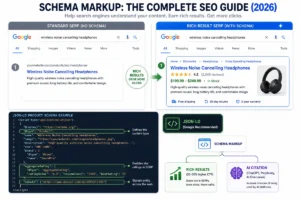
Schema markup bridges the gap between on-page content and the structured data that search engines and AI systems use to understand and display information. While covered in full in the Schema Markup guide (T2-023), its relationship to on-page optimisation deserves treatment here.
Schema markup provides explicit, machine-readable context that supplements the NLP interpretation of your content. Where Google’s AI systems infer meaning from natural language, schema states it directly.
For on-page SEO purposes, the most impactful schema types are:
Article schema on every blog post and guide. At minimum, include headline, author (with Person schema linking to author credentials), datePublished, dateModified, and image. In 2026, Google’s May Core Update has increased its scrutiny of author credentials, making properly implemented author schema with external credential verification links significantly more valuable.
FAQ schema on pages with question-and-answer sections. FAQ-marked content appears in People Also Ask features and is preferentially extracted for AI Overview answers. Any page with an FAQ section should have FAQ schema implemented.
BreadcrumbList schema on all pages. Shows the site hierarchy in search results, improving both click-through rates and crawl efficiency.
Organisation schema on the homepage and About page. Establishes the site’s brand entity with logo, contact information, social profiles, and sameAs links to authoritative external profiles (LinkedIn, Crunchbase, Wikipedia where applicable). This entity establishment feeds into Knowledge Graph recognition and AI citation credibility assessment.
The practical implementation note: all schema should be implemented in JSON-LD format (the format Google recommends), placed in the head section of the page, and validated with Google’s Rich Results Test before deployment.
On-Page SEO for Different Page Types
The on-page SEO framework applies across all page types, but the specific implementation priorities differ by page purpose.
Blog Posts and Guides
For content pages targeting informational intent, the primary on-page priorities are: search intent alignment (correct format and angle), content depth and topical completeness, heading structure (for both human scanning and AI extraction), internal linking to related cluster pages, and a strong opening paragraph.
Title tags on blog posts benefit from including the year for freshness signals and from being specific about the content scope (“The Complete Guide” signals comprehensive coverage).
Product Pages
Transactional-intent pages prioritise different elements. Title tags should include the product name and primary differentiator (model number, key specification). Content depth is less important than accuracy, specificity, and trust signals (detailed specifications, clear pricing, prominent reviews). Schema includes Product, Review, and Offer markup to enable rich results with pricing and ratings.
Internal linking from product pages should point upward to category pages and outward to relevant guides that help shoppers make decisions.
Category Pages (E-commerce)
Category pages target commercial intent: shoppers browsing and comparing options. The title tag should name the category and its primary keyword. The page should include a descriptive introduction that establishes the category’s purpose, followed by product listings. Schema includes ItemList markup to make the category structure explicit.
Landing Pages
Conversion-focused landing pages have specific on-page requirements. Title tags should include the offer and primary keyword. Content is structured around the conversion goal, with clear hierarchy: headline, value proposition, proof elements, call to action. Long-tail keyword targeting is typical for landing pages, matching the very specific intent of visitors arriving from specific campaigns or queries.
On-Page Optimisation and the Competitive Gap
One of the most valuable applications of on-page SEO analysis is competitive benchmarking. Before optimising a page, compare it against the top three to five ranking pages for the target keyword on every on-page dimension:
- Is the content notably longer or shorter? (More importantly: is it notably more or less complete?)
- Are the headings more or less descriptive?
- Is the page structure clearer or more confusing?
- Are there content types present in competitors (comparison tables, step-by-step numbered lists, original data) that your page lacks?
- Are there questions answered by competitors that your page does not address?
The competitive gap analysis identifies precisely what the page needs to close the gap with current top-ranking content. Generic on-page optimisation improves a page in isolation. Competitive gap analysis improves it relative to the pages it needs to outrank, which is what actually determines whether rankings improve.
On-Page SEO Checklist
Use this checklist for every page before publishing and when reviewing existing pages.
Search intent and content
- Primary keyword confirmed with SERP analysis
- Content type matches dominant SERP format
- Content angle matches dominant SERP angle
- Full topical scope covered (no significant subtopics missing)
- Opening paragraph leads with substance (no preamble)
- Content demonstrates first-hand knowledge or expert perspective
- Statistics and data are current (within last twelve to eighteen months)
HTML elements
- Title tag: primary keyword near beginning, under 60 characters, compelling
- H1: present, unique on page, includes primary keyword
- H2 and H3: logical hierarchy, descriptive, naturally include secondary keywords
- Meta description: 140 to 160 characters, keyword included, specific to page content
- URL: short, descriptive, includes primary keyword, uses hyphens
Images
- Images use WebP or AVIF format
- All images are compressed
- Alt text is descriptive and accurate for each image
- Image dimensions are specified in HTML
Internal linking
- Page links to two to three relevant existing pages
- Relevant existing pages link to this page
- Anchor text is descriptive (not “click here”)
- No significant related pages are orphaned
Technical
- Page is indexed (verified in Search Console)
- Page loads under 2.5 seconds on mobile (LCP)
- No layout shift during loading (CLS under 0.1)
- Page is mobile-responsive
- HTTPS is serving correctly
Schema
- Article/FAQ/Product schema implemented where applicable
- Schema validated with Google’s Rich Results Test
- No schema errors or warnings
Advanced On-Page Techniques for Competitive Rankings
The elements covered so far represent the foundation that every page should have. The following techniques separate pages that rank in positions 4 to 10 from those that break into positions 1 to 3 in competitive searches.
The Inverted Pyramid Content Structure
Borrowed from journalism, the inverted pyramid places the most important information first, with supporting detail and context following. This structure serves three purposes in 2026 SEO.
It satisfies impatient readers who scan the opening to confirm relevance before committing to reading. It ensures the most important content is extracted by AI systems that often prioritise early content. It aligns with Google’s preference for pages that answer the searcher’s primary question without burying it in preamble.
Applied to on-page SEO: lead each section with its conclusion or key answer, then provide supporting explanation, examples, and context. A reader who reads only the first sentence of each section should come away with the page’s most important insights.
Jump Links and Table of Contents
For long-form content (typically 2,000 words and above), a table of contents with jump links to sections serves both users and SEO.
For users, a table of contents allows direct navigation to the specific section that answers their question. This reduces bounce rate for users who land on the page for a specific subtopic and can find it immediately.
For AI extraction, a visible table of contents signals the page’s structural scope. It also provides additional anchor text signals within the page that reinforce the relevance of the linked sections.
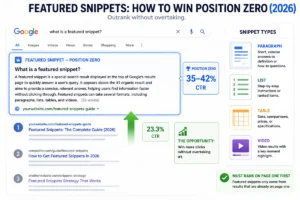
Answering the Featured Snippet Question
For informational keywords where Google shows a featured snippet, the page that holds position zero is explicitly answering a concisely phrased question in a format that Google can extract: a paragraph, a numbered list, or a table.
Identify the specific question being answered by the featured snippet for your target keyword. Include a section in your content that directly answers that question in the format Google prefers for that query type:
- Definition queries: one to two sentence definition immediately after the section heading
- Process queries: numbered step-by-step list
- Comparison queries: HTML table
- “Why” queries: brief paragraph with clear sentence structure
Formatting your answer to match the snippet format is a direct on-page optimisation for a feature that earns significantly higher visibility than a standard organic result.
Structured Summaries
Adding a structured summary at the beginning or end of an article serves both users who scan and AI extraction systems.
An effective summary is not a repetition of the article in full but a concise structured list of the key takeaways: what the reader learned, the main conclusions, or the action items from the content.
Formatted with a clear heading (“Summary,” “Key Takeaways,” or “What We Covered”) and using bullet points or numbered items, a structured summary is one of the most AI-extractable content formats available. AI Overview systems frequently pull from clearly structured summaries when generating answers that reference a page.
Measuring On-Page SEO Performance
Tracking the right metrics ensures on-page improvements are evaluated against outcomes rather than activities.
Click-through rate by page in Google Search Console. Compare CTR before and after title tag changes. A successful title tag improvement produces a measurable CTR increase within one to four weeks.
Average position trends for primary keywords. Track position changes for the primary keyword on each page following content improvements, heading updates, and internal link additions.
Impressions growth for individual pages. Rising impressions for a target keyword confirm that Google is surfacing the page more frequently, a leading indicator that rankings are improving before CTR gains materialise.
Organic traffic per page in Google Analytics 4. The ultimate measure of on-page SEO success is traffic from organic search. Monitor by individual page rather than sitewide to connect on-page changes to specific outcomes.
AI citation monitoring. In 2026, tracking whether your pages appear as cited sources in AI Overviews for target queries is an emerging but increasingly important metric. Tools including Semrush and specialised AI visibility monitors now provide this data.