
The debate between SEO and PPC is one of the most frequently asked questions in digital marketing. And it is almost always answered the same way: “it depends on your goals.”
That answer is true but not very useful.
This guide goes further. It gives you the actual data on how SEO and PPC compare across cost, conversions, ROI, and speed. It explains specifically when each channel wins, when it loses, and how to combine them intelligently. By the end, you will have a clear decision framework you can apply to your specific situation, not a generic “use both” conclusion.
What is SEO and What is PPC?
Before comparing them, a brief definition of each.
SEO — Search Engine Optimisation — is the practice of earning organic search visibility by improving your website’s content quality, authority, and technical performance. You do not pay per click. Traffic from SEO is earned, not bought.
PPC — Pay-Per-Click advertising — is a paid search model where you bid on keywords through platforms like Google Ads and pay a fee each time someone clicks your ad. Ads appear at the top and bottom of the search results page, labelled “Sponsored.”
Both appear on the same search results page. Both target people actively searching for something. But almost everything about how they work, what they cost, and what they deliver is different.
The Core Trade-Off: Speed vs Durability
Every meaningful difference between SEO and PPC flows from one fundamental trade-off.
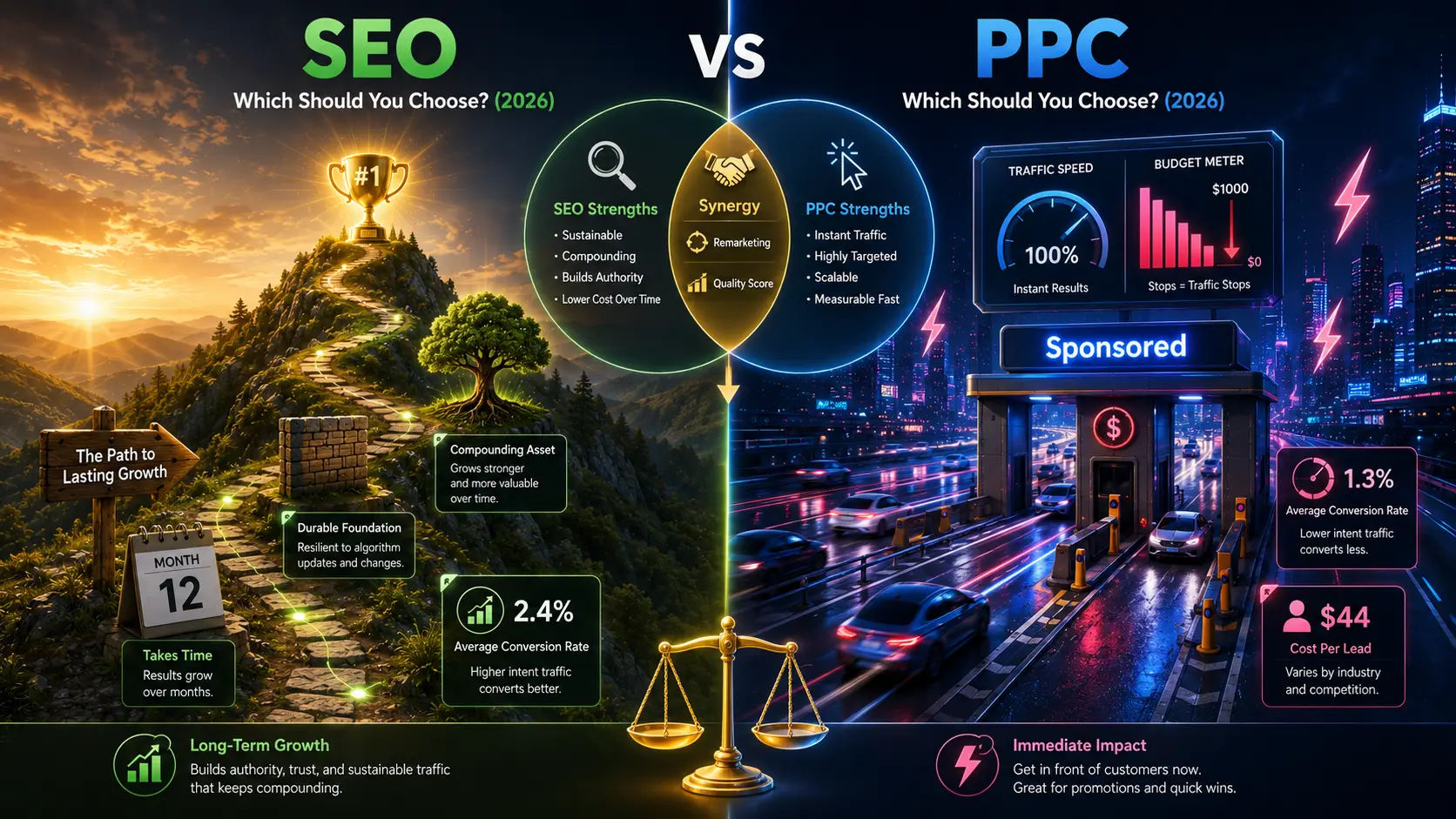
PPC gives you speed. A Google Ads campaign can go live today and deliver qualified traffic by this afternoon. There is no waiting period, no authority to build, no algorithm to satisfy. You bid on a keyword, win the auction, and your ad appears immediately.
SEO gives you durability. Organic rankings, once earned, continue generating traffic without ongoing payment. A blog post that reaches position one for a valuable keyword might deliver thousands of visits per month for years, with no incremental cost per click.
The trade-off is that SEO requires months of investment before meaningful traffic arrives, while PPC delivers traffic immediately but stops the moment your budget runs out.
Neither approach is universally better. The right choice depends entirely on what you need and when you need it.
Comparing the Data: Cost, Conversions, and ROI
The discussion about SEO vs PPC becomes much clearer when you look at actual performance data rather than theoretical trade-offs.
Cost
The average cost per click (CPC) across all industries on Google Ads reached $5.26 in 2025, and 87% of industries saw their CPC increase year over year. In high-competition sectors the numbers are far higher. Legal services, financial products, insurance, and healthcare regularly see CPCs of $20 to $100 or more.
SEO does not charge per click. The investment is in content creation, technical work, and link building, but once rankings are established, each additional visitor costs nothing.
The cost-per-lead comparison is telling. Across industries, organic search generates leads at an average cost of approximately $14, compared to roughly $44 for PPC. That is roughly a 68% cost advantage for SEO on a per-lead basis, over the long term.
The critical qualifier is “long term.” SEO requires upfront investment that may take six to twelve months to produce results. PPC delivers leads from day one. The cost comparison only favours SEO once enough time has passed for organic traffic to compound.
Conversion Rates
One of the most significant data points in the SEO vs PPC comparison is the difference in conversion rates.
SEO traffic converts at an average of 2.4% across industries. PPC traffic converts at an average of 1.3%. That is roughly double the conversion rate for organic visitors.
The reason is trust. Users know that organic results were not placed there because someone paid for the position. Organic rankings imply a degree of independent endorsement by the search engine. Paid results, however relevant, carry a lower inherent trust level with a meaningful proportion of users.
This does not mean PPC conversions are weak. A well-targeted PPC campaign for high-intent keywords (someone searching “buy running shoes size 10”) can deliver strong conversion rates because the searcher is so close to a purchase decision. The conversion rate difference reflects averages across all query types, not the best-case scenarios for either channel.
ROI Over Time
PPC delivers faster, more immediately measurable ROI. The return is typically framed as revenue per pound or dollar spent on ads. Industry benchmarks suggest PPC returns approximately $2 for every $1 spent across platforms, though this varies enormously by industry and execution quality.
SEO’s ROI is harder to measure in the short term because the investment period precedes the returns period. However, as organic traffic compounds and the cost per additional visit effectively approaches zero, the long-term ROI of SEO consistently exceeds PPC for most businesses. One analysis found SEO delivers approximately 25% higher ROI than PPC over comparable timeframes, once the organic traffic has matured.
The ROI difference also widens significantly in high-CPC industries. A law firm paying $80 per click on PPC versus $22 per lead through organic rankings is looking at a cost difference of over $56,000 per 1,000 leads. At scale, the SEO advantage becomes decisive.
Where PPC Wins Clearly
There are specific circumstances where PPC is the clearly superior choice, regardless of budget size.
You need traffic now. A product launch, a seasonal promotion, a time-sensitive campaign. SEO cannot respond on a 30-day timeline. PPC can be live within hours.
You are testing a new market. Before investing months in SEO for a new product, keyword set, or audience, PPC gives you conversion data within days. If the traffic converts, the SEO investment is validated. If it does not, you have saved months of wasted effort.
You are in a highly competitive industry with a proven funnel. If your cost per acquisition from PPC is profitable and scalable, there is no reason not to run it aggressively while SEO builds alongside it.
You are targeting very specific, high-intent commercial keywords. Someone searching “buy iPhone 15 Pro 256GB midnight black” is ready to purchase. Capturing that exact intent with a precisely targeted ad can deliver strong immediate returns even at a high CPC.
You need precise targeting control. SEO targets keywords but cannot precisely segment by location radius, household income, time of day, device type, or remarketing audience in the same way PPC can. For campaigns that require granular targeting, PPC has no organic equivalent.
Where SEO Wins Clearly
You are building a long-term content asset. A resource hub, a blog, a glossary, a comparison site. This type of content compounds in value over years. Funding it through PPC would be prohibitively expensive. SEO is the only viable model.
Your industry has very high CPCs. If every click from Google Ads costs $30 to $100, the economics of PPC become very challenging unless your conversion rates and average order values are exceptionally high. For these industries, organic rankings represent a massive cost advantage.
You are targeting informational and research-phase queries. Someone searching “how to choose a mortgage” is not ready to apply today. They are researching. A PPC ad for a mortgage product targeting this query will have a very low conversion rate. A helpful, authoritative organic blog post that builds trust over time is far more appropriate.
You want traffic that does not stop when your budget stops. For businesses with limited or variable marketing budgets, the durability of organic traffic is a significant resilience advantage. A site with strong organic rankings can weather a period of reduced marketing spend in a way a PPC-dependent site cannot.
You are building brand authority. Consistent presence in organic search results builds brand recognition and credibility over time. Users who see your content repeatedly across their research journey develop trust that paid ad impressions alone do not create.
The Synergy: How PPC and SEO Make Each Other Better
The framing of SEO vs PPC as a binary choice misses the most effective approach: running both channels in a way that makes each stronger.
PPC data improves SEO strategy. Google Ads campaigns generate conversion data on keywords within days or weeks. You can see exactly which keywords convert at what rate, which ad copy resonates, and which landing page messages work. This data is invaluable for prioritising your SEO content plan. Instead of guessing which keywords will drive business results, you have evidence.
SEO reduces PPC costs over time. The Quality Score Google assigns to each PPC ad is influenced by the relevance and quality of the destination landing page. Pages that are well-optimised for SEO tend to have better Quality Scores, which means lower CPCs and better ad positions. Strong SEO foundations directly improve paid campaign efficiency.
Dominating both channels increases total SERP real estate. When your brand appears in both paid and organic positions for the same high-value query, you occupy more of the results page, reduce the likelihood of a competitor capturing that click, and signal credibility to searchers who see you in both positions.
Remarketing bridges the gap. PPC remarketing allows you to serve ads specifically to users who previously visited your site through organic search but did not convert. This technique uses SEO-generated traffic as the audience pool for paid campaigns, often achieving significantly lower CPAs than cold PPC traffic.
PPC in the AI Search Era (2026)
Search in 2026 looks different from search two years ago, and the changes affect PPC specifically.
Google’s AI Overviews now appear at the top of results for a growing share of queries. Initially, AI Overviews sat above all other content including paid ads. Google has since integrated paid placements within and alongside AI Overview responses, creating new ad positions that did not exist before.
AI search ad spending is projected to double between 2025 and 2026 and reach over $25 billion by 2029. Advertisers are actively pursuing these new AI-adjacent placement opportunities.
For businesses relying heavily on PPC, the AI search shift introduces new uncertainty. Queries that previously delivered reliable paid traffic are increasingly answered directly by AI summaries, reducing the click pool available to advertisers. The advertisers who adapt most successfully are those who combine PPC with strong SEO and content authority, ensuring they appear as cited sources in AI answers regardless of whether a user clicks a paid ad.
A Practical Decision Framework
Rather than asking “which is better,” ask these four questions:
1. How long is your time horizon? If you need results within 90 days, prioritise PPC. If you are building a 12 to 24 month growth plan, SEO should be the foundation.
2. What are CPCs in your industry? If clicks in your niche cost $1 to $3, PPC is very accessible. If they cost $30 to $100, the economics strongly favour building organic traffic as fast as possible.
3. Do you have a proven, profitable conversion funnel? If you know your conversion rate and average customer value, and PPC delivers a positive return at current CPCs, scale it. If you do not yet have a proven funnel, use PPC to test and validate before committing to either channel at scale.
4. What stage is your business at? Early-stage businesses with limited budgets but significant content capability often do well prioritising SEO. Growth-stage businesses with revenue to reinvest often benefit most from running both channels simultaneously. Mature businesses typically treat SEO as their primary growth engine and PPC as a complementary tool for specific campaigns.
❓ Frequently Asked Questions
Is SEO or PPC better for a new website?
A new website with no authority will struggle to rank organically for competitive keywords in the short term. PPC gives a new site immediate visibility while SEO is being built. The smartest approach for most new websites is to use PPC for quick traffic and conversion data while investing in SEO for long-term growth.
Can PPC hurt my SEO rankings?
No. Google is explicit that paid advertising has no influence on organic rankings. The two systems are entirely separate. Running or not running Google Ads does not affect where your pages appear in organic results.
Does organic search really convert better than paid?
On average, yes. Organic search converts at approximately 2.4% versus 1.3% for paid search. The gap is driven primarily by user trust. However, conversion rates vary significantly by keyword intent, industry, and landing page quality. High-intent transactional PPC keywords can deliver conversion rates well above the average for paid search.
How much should I spend on PPC vs SEO?
There is no universal ratio. A reasonable starting framework is to allocate enough to PPC to maintain immediate lead flow while gradually increasing investment in SEO content and technical work. As organic traffic grows and proves itself, the proportion allocated to PPC can be reduced or redirected to new campaigns and keywords.
Will AI search make PPC less effective?
It is changing PPC, not eliminating it. AI Overviews have introduced new ad placements alongside AI-generated answers. The total paid search market is growing. However, queries that are answered directly in AI summaries generate fewer clicks overall, which reduces the available inventory for traditional paid ads on those queries. Businesses most resilient to this shift combine PPC with strong organic and AI citation strategies.
Summary
SEO and PPC each solve a different problem.
PPC solves the immediate visibility problem. It delivers traffic, leads, and conversion data quickly and predictably, at a cost that scales directly with budget.
SEO solves the long-term acquisition cost problem. It builds durable traffic that does not depend on ongoing payment, converts at a higher rate due to user trust, and compounds in value as authority grows.
The key data points to remember:
- SEO converts at 2.4% on average vs 1.3% for PPC, roughly double
- Organic leads cost an average of $14 to acquire vs $44 for PPC
- PPC costs are rising: 87% of industries saw CPC increases in 2025
- SEO delivers approximately 25% higher long-term ROI than PPC once organic traffic matures
- PPC delivers immediate results and stops immediately when budget stops
For most businesses, the best answer in 2026 is not to choose between SEO and PPC but to run them in a way that makes each channel more effective. Use PPC for immediate traffic, conversion data, and high-intent commercial campaigns. Use SEO to build the durable, compounding organic foundation that reduces your dependence on paid traffic over time.