
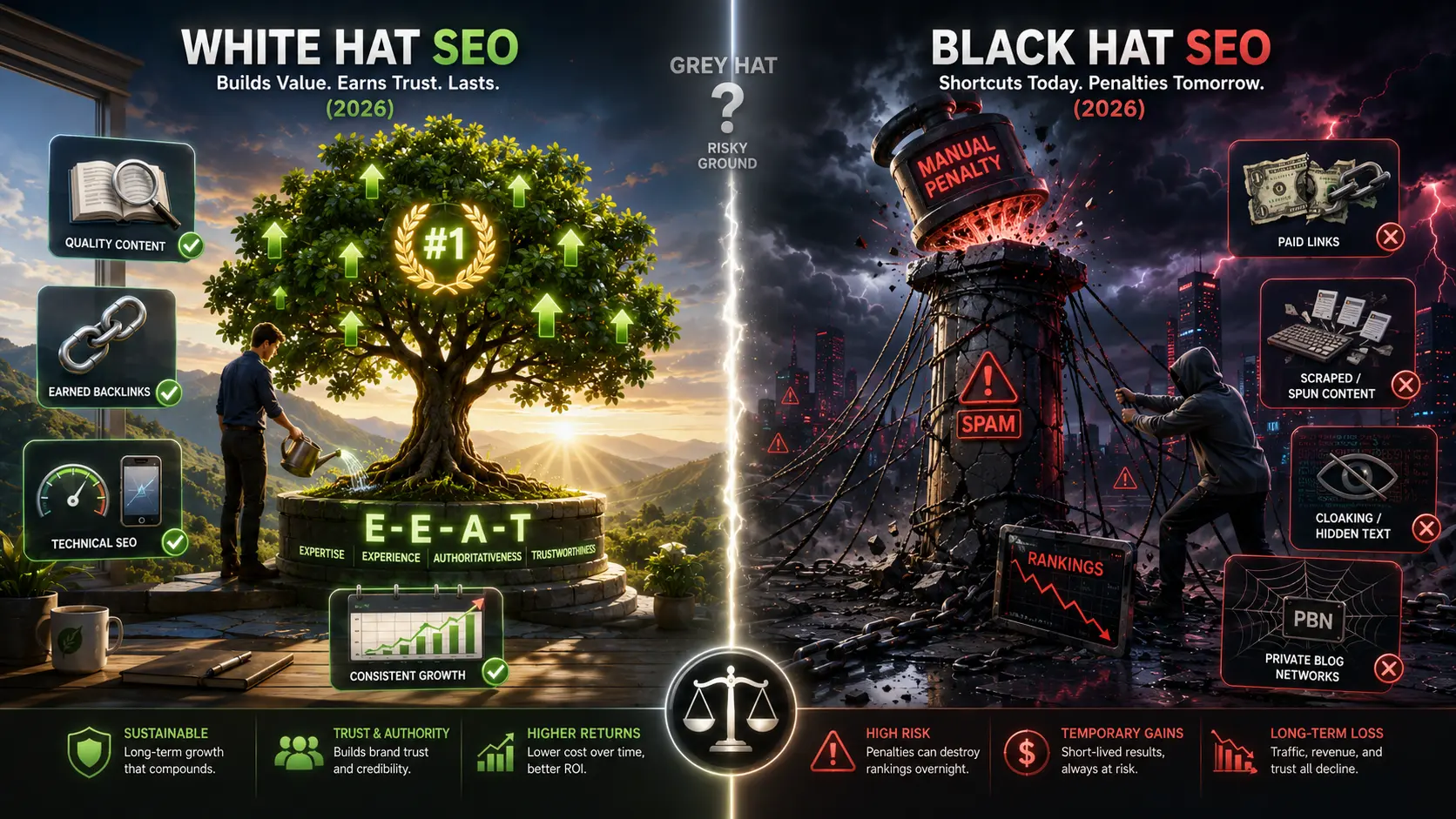
Every SEO decision you make falls somewhere on a spectrum. At one end are practices that align with what search engines explicitly encourage. At the other end are tactics designed to manipulate rankings in ways that violate those guidelines. In the middle sits a zone of ambiguity that is shrinking every year.
Understanding where different practices fall on this spectrum is not just an ethical question. It is a practical business question. The wrong choice can destroy a site’s traffic overnight, close a business, and require years to recover from, if recovery is possible at all.
This guide explains what white hat and black hat SEO actually mean, what tactics fall into each category, where grey hat SEO sits, and why the business case for ethical SEO has never been stronger than in 2026.
What is White Hat SEO?
White hat SEO — the practice of improving a website’s search engine visibility using methods that comply with search engine guidelines and focus on delivering genuine value to users.
White hat SEO is not defined by any single tactic. It is defined by intent and approach. If the goal of an activity is to make a website more useful, more accessible, and more trustworthy for the people who visit it, and if the methods used align with what Google and other search engines recommend, it is white hat.
Google’s own guidelines distil this principle into a single sentence: “Make pages primarily for users, not for search engines.”
White hat SEO includes:
High-quality content creation. Writing genuinely useful, accurate, well-researched content that answers the questions your audience is searching for. Content created to serve readers, not to game ranking algorithms.
Keyword research and natural integration. Identifying the terms your audience uses and incorporating them naturally into content where they are relevant, without forcing or stuffing them.
On-page optimisation. Writing accurate, descriptive title tags and meta descriptions. Using heading structure logically. Optimising images with descriptive alt text. Building clean, readable URL structures.
Earning backlinks. Acquiring links through merit: creating content worth referencing, reaching out to relevant publications with genuinely useful resources, earning coverage through digital PR. Links that exist because the content deserves to be cited.
Technical SEO. Improving site speed, mobile-friendliness, crawlability, and site architecture so that search engines can access and understand content and users have a good experience.
E-E-A-T signals. Demonstrating genuine experience, expertise, authoritativeness, and trustworthiness through author credentials, accurate information, transparent sourcing, and site reputation.
White hat SEO takes longer to show results. Rankings are earned rather than manufactured. But they are durable, sustainable, and not at risk of disappearing the next time Google updates its algorithm.
What is Black Hat SEO?
Black hat SEO — the use of tactics that violate search engine guidelines with the intention of manipulating rankings through deception or exploitation of algorithm weaknesses.
Black hat SEO is not about using aggressive or ambitious tactics. It is specifically about tactics designed to trick search engines into ranking a page higher than it deserves based on actual quality and relevance.
The defining characteristic is the intent to deceive rather than to serve users.
Common Black Hat Tactics
Keyword stuffing. Repeating a target keyword at unnatural densities throughout a page to manipulate relevance signals. Modern examples include packing keywords into footers, hidden sections, or content that becomes unreadable. Google’s SpamBrain AI flags this pattern reliably.
Cloaking. Showing different content to search engine crawlers than to human visitors. A page might show Google a keyword-rich, well-structured document while showing users a completely different, often irrelevant page. This is one of the most directly deceptive practices in SEO and one of the most severely penalised.
Hidden text and hidden links. Text or links made invisible to users by matching the font colour to the background, setting font size to zero, or hiding elements behind images. The content is visible to crawlers but not to humans, with the sole purpose of manipulating keyword signals or link equity.
Link schemes. Building or buying backlinks in ways that violate Google’s guidelines. This includes purchasing links from link farms, participating in private blog networks (PBNs), using automated tools to create large numbers of links, and excessive link exchanges. The goal is to artificially inflate a site’s apparent authority.
Doorway pages. Creating large numbers of low-quality pages targeting slight keyword variations, each designed to funnel visitors to a single destination. The pages exist to capture search traffic but offer no genuine value of their own.
Content scraping and spinning. Copying content from other websites and republishing it (scraping), or using software to automatically generate variations of existing content with slightly different wording (spinning). Both create content that exists only to fill pages, with no original value.
Sneaky redirects. Sending users to a different URL than the one Google indexed, so the indexed version looks useful and high-quality while the actual user destination is different and often lower quality.
Negative SEO. Attempting to harm a competitor’s rankings by deliberately building toxic backlinks to their site, scraping and republishing their content to trigger duplicate content issues, or other manipulative attacks.
AI-generated spam. Producing large volumes of AI-generated content with no original insight, expertise, or editorial oversight, for the sole purpose of generating keyword-matched pages at scale. Google’s 2024 to 2026 Helpful Content enforcement has explicitly targeted this category.
The Real Consequences of Black Hat SEO
Black hat tactics are often framed as a risk-reward trade-off. The framing suggests that the risk is abstract, future, and avoidable. The data does not support this framing.
Traffic penalties are immediate and severe. When Google detects manipulative behaviour, algorithmic or manual penalties can cause traffic drops of 50 to 95% within 72 hours. This is not a gradual decline. It is a collapse.
Recovery is not guaranteed. Only 30% of penalised sites recover their rankings within a year. Many never recover. The investment made in building the site, its content, and its authority is effectively lost.
The business consequences are fatal for many. Research tracking post-penalty businesses found that fewer than 40% of businesses that receive a Google penalty remain operational after six months. The loss of organic traffic is often existential for businesses that depend on it for customer acquisition.
Major brands are not immune. The 2024 to 2025 enforcement cycle demonstrated that domain authority provides no protection. Forbes Advisor, CNN Underscored, and WSJ’s Buy Side section all received manual actions or heavy algorithmic demotions for hosting affiliate content that lacked genuine editorial oversight. If established media properties with decades of brand authority can be penalised, a new or mid-sized website has no basis for assuming immunity.
Google issues approximately 750,000 manual web spam penalties every month. This is not a niche enforcement operation. It is a systematic, industrial-scale process targeting manipulative practices at every level of the web.
Recovery is getting harder in 2026. The traditional reconsideration request pathway, where you fix the problem, submit a request to Google, and get reinstated, is becoming less reliable. Reconsideration requests are being rejected at a higher rate even when violations have been addressed. Google’s systems are classifying some penalised sites at a domain level, making it extremely difficult to change the algorithm’s assessment regardless of corrective action.
How Google Detects Black Hat SEO
Understanding how Google detects manipulation helps explain why black hat tactics that once worked have become increasingly ineffective.
SpamBrain. Google’s AI-powered spam detection system, SpamBrain, analyses billions of signals daily. It identifies unnatural patterns in link acquisition, content quality, user behaviour, and site structure. It processes signals at a scale no human team could match and updates continuously.
Algorithmic detection. Specific algorithm components, including Penguin (links), Panda (content quality), and the Helpful Content System, are specifically calibrated to identify the signatures of manipulative practices. These systems now update in near real-time, meaning penalties can apply within days or hours of a new pattern being detected.
Manual review teams. Google employs human quality raters who review flagged sites against its Search Quality Rater Guidelines. Manual reviews can result in manual actions, which are distinct from algorithmic penalties and visible in Google Search Console.
User behaviour signals. Pogo-sticking, high bounce rates, short dwell times, and rapid return to the search results page all signal to Google that a page is not satisfying users. These signals accumulate against sites whose content does not match what visitors expect, which is often the case for sites using cloaking, doorway pages, or scraped content.
What is Grey Hat SEO?
Grey hat SEO sits between white and black hat. It involves tactics that are not explicitly banned by Google but push against the boundaries of its guidelines. Practitioners who use grey hat tactics are not clearly violating rules, but they are not clearly following the spirit of them either.
Common grey hat tactics include:
Buying niche edits. Paying to have a link inserted into existing, published content on another website. Not a fresh article, but an edit to content already in the index. Not explicitly banned, but payment for links is against Google’s guidelines regardless of placement.
Guest posting at scale for links. Publishing guest posts on external sites primarily for the backlink rather than for the genuine value of the content. Small-scale guest posting for relevant audiences is acceptable. Large-scale guest posting programmes built primarily as link acquisition pipelines cross into grey hat territory.
Exact-match anchor text patterns. Building backlinks where the anchor text exactly matches the target keyword across a high proportion of links. Natural backlink profiles have varied, organic anchor text. A portfolio of links all using “best SEO agency in London” as anchor text looks manufactured.
Scaled AI content without editorial oversight. Publishing large volumes of AI-generated content that is technically coherent but lacks original expertise, first-hand experience, or editorial judgement. Not explicitly banned, but firmly in the crosshairs of Google’s Helpful Content System.
Expired domain SEO. Purchasing expired domains with existing authority and either redirecting them to a target site or rebuilding content on them to exploit existing backlink equity. Legitimate when the content genuinely serves the original domain’s audience. Manipulative when the domain is used purely as a link vehicle for an unrelated site.
The critical point about grey hat SEO in 2026 is that the “safe middle ground” has largely disappeared. Google’s 2024 to 2026 enforcement updates specifically targeted many formerly grey hat practices. Sites that relied on grey hat tactics for competitive advantage have seen significant traffic losses. The ambiguity that once made these tactics tempting has been substantially reduced by both algorithmic and manual enforcement.
White Hat, Black Hat, and Grey Hat: A Side-by-Side Comparison
| White Hat | Grey Hat | Black Hat | |
|---|---|---|---|
| Guideline compliance | Fully compliant | Ambiguous | Violates guidelines |
| Primary goal | Serve users | Manipulate rankings | Manipulate rankings |
| Risk level | Low | Medium to high | High |
| Result timeline | Months to years | Variable | Fast but fragile |
| Durability | Stable and growing | Vulnerable to updates | Collapses with detection |
| Recovery if penalised | Not applicable | Difficult | Often impossible |
| Long-term ROI | Highest | Unpredictable | Negative overall |
The Business Case for White Hat SEO
The argument for white hat SEO is sometimes framed as an ethical one: follow the rules because it is the right thing to do. That argument is valid, but it is not the most compelling one for a business context.
The most compelling argument is purely economic.
White hat rankings are assets. Black hat rankings are liabilities.
A white hat SEO investment builds something durable. The content, authority, and technical foundation you build compounds over time. A page that earns a top organic ranking through genuine quality continues delivering returns without ongoing maintenance cost.
A black hat SEO investment is, at best, a time-limited arbitrage. The tactic works until it is detected. Then the entire investment is wiped out, often with the additional cost of a recovery period that may last 12 to 18 months or may never materialise at all.
When the full lifecycle is considered, including the recovery cost, the lost revenue during the penalty period, and the probability that full recovery never happens, black hat SEO has a deeply negative expected return for most businesses.
The only scenarios where black hat makes economic sense are those involving throwaway sites with no brand investment, pure arbitrage plays designed to extract value before a penalty hits, and operations where the cost of losing the site is negligible. For any business with a genuine brand, a real customer base, and long-term growth objectives, black hat SEO is not just ethically problematic. It is a bad investment.
❓ Frequently Asked Questions
Can I accidentally use black hat SEO without knowing it?
Yes. Some black hat tactics, particularly in link building, can be applied to your site by third parties without your knowledge. Competitors can build toxic links to your site in a deliberate negative SEO attack. More commonly, businesses hire SEO agencies or freelancers who use black hat or grey hat tactics without disclosing this. Regularly auditing your backlink profile using tools like Google Search Console, Ahrefs, or Semrush helps identify and disavow toxic links before they trigger a penalty.
How do I know if my site has a Google penalty?
Manual actions appear directly in Google Search Console under the “Security and Manual Actions” section. Algorithmic penalties do not generate a specific notification, but they typically produce a sudden, significant drop in rankings and traffic that correlates with a known algorithm update date. Tracking organic traffic and rankings over time and comparing fluctuations to known algorithm update dates is the standard diagnostic approach.
Is all link buying black hat?
Any payment intended to pass PageRank (ranking authority) through a link violates Google’s guidelines and qualifies as black hat. This includes paying for standard paid links, purchasing niche edits, and funding PBN links. Legitimate paid link placements that include a rel=”nofollow” or rel=”sponsored” attribute are not violations because the attribute signals to Google not to pass ranking authority through the link.
Does grey hat SEO ever make sense?
For most businesses with a genuine brand and long-term objectives, grey hat tactics carry risks that are not justified by the marginal benefit. The “ambiguous zone” has narrowed significantly since 2024. Tactics that were once reliably grey hat, such as unreviewed AI content at scale and aggressive guest posting link programmes, are now being penalised regularly. The expected risk-adjusted return for grey hat tactics is lower in 2026 than at any previous point.
If I have already used black hat tactics, what should I do?
Audit your site comprehensively. Identify all black hat or grey hat practices currently active. Remove or disavow toxic links. Replace or remove low-quality, stuffed, or scraped content. Fix any cloaking or redirect violations. Once violations are addressed, submit a reconsideration request through Google Search Console for any manual actions. Accept that algorithmic recovery takes time and is not guaranteed. Rebuilding on white hat foundations from this point is the only sustainable path.
Summary
White hat SEO and black hat SEO represent fundamentally different philosophies: build something that genuinely deserves to rank versus manipulate systems to rank regardless of merit.
The practical difference in 2026 is this: white hat SEO builds durable assets that compound in value over time. Black hat SEO creates temporary advantages at a high risk of catastrophic loss, with recovery increasingly difficult or impossible once penalties are applied.
The key data to remember:
- Black hat penalties can drop traffic by 50 to 95% within 72 hours
- Only 30% of penalised sites recover rankings within a year
- Fewer than 40% of businesses that receive a Google penalty remain operational after six months
- Google issues approximately 750,000 manual spam penalties every month
- High-authority brands including Forbes Advisor and CNN Underscored were penalised in 2024 to 2025, confirming that authority provides no immunity
- The grey hat “safe zone” has largely disappeared due to 2024 to 2026 enforcement intensification
For any business with genuine brand equity and long-term objectives, white hat SEO is not just the ethical choice. It is the rational one.