
Featured snippets do something counterintuitive: they let you outrank the number one organic result without being the number one organic result.
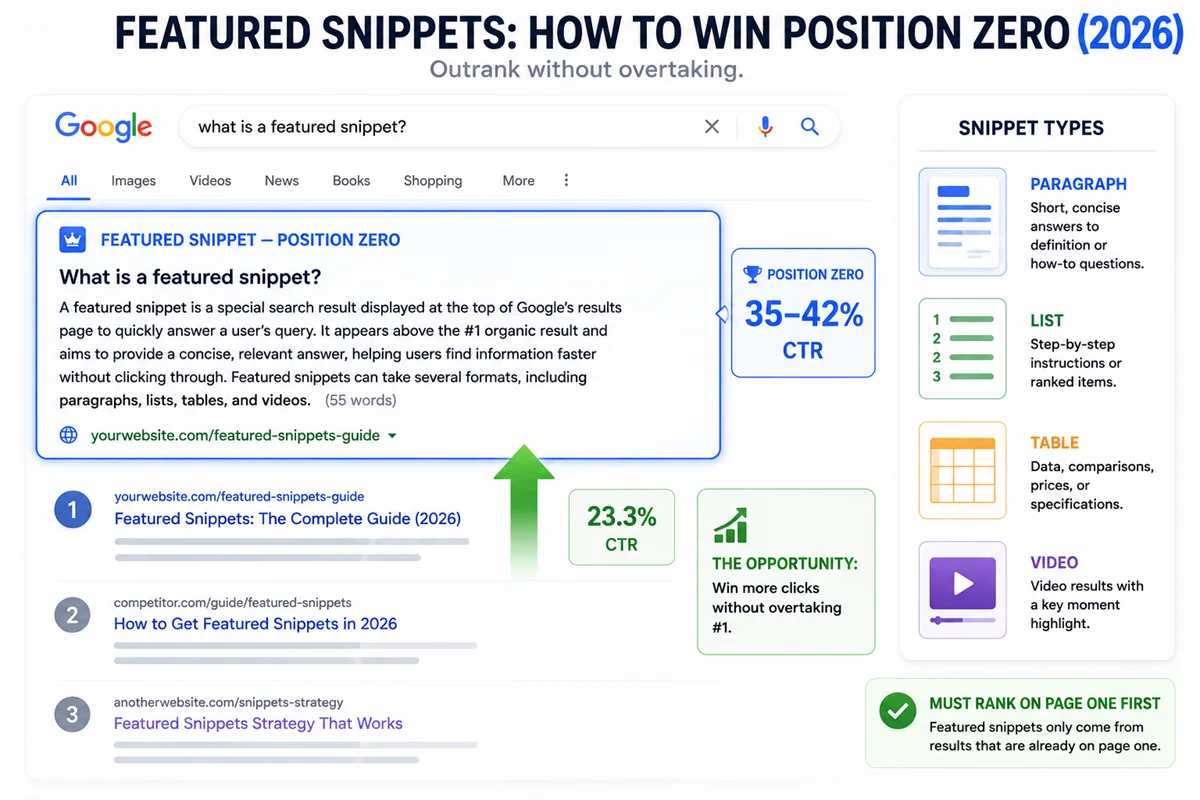
Position zero sits above all organic listings, below paid ads. The page selected for a featured snippet is displayed in a highlighted box with its answer, URL, and sometimes an image, before anyone scrolls to the first standard blue link. Research by BrightEdge found that the cited URL in a featured snippet captures approximately 35% of clicks on that query, compared to 23.3% for the first organic result when a snippet is present. You earn more traffic from position zero than from position one on those queries.
The mechanics of winning featured snippets are teachable. They depend on structural formatting, content clarity, and knowing which queries to target, not on domain authority or the size of your backlink profile. Ranking for a featured snippet is approximately three times easier than ranking for traditional position one, because the competition is targeting the ranking, not the snippet.
This guide covers every aspect of featured snippets: how Google selects them, the four types and how to optimise for each, the step-by-step process for capturing position zero, the relationship between snippets and AI search, and how to defend positions once earned.
What is a Featured Snippet?
A featured snippet — a highlighted answer box that Google displays at the top of search results for certain queries, above all organic results, automatically pulling content from a web page to provide a direct answer.
Featured snippets are sometimes called “position zero” because they appear before the standard ranked results begin. They are distinct from paid ads (which also appear above organic results) and from Knowledge Panel results (which are drawn from Google’s Knowledge Graph rather than web page content).
The featured snippet typically includes:
- An extracted answer in paragraph, list, or table format
- The title of the source page
- The URL of the source page
- Sometimes an accompanying image (which may come from a different source than the text)
Google determines which pages earn featured snippets algorithmically. There is no way to “opt in” to featured snippets or submit content for consideration. However, content structured to match Google’s snippet selection criteria is dramatically more likely to be chosen.
The Featured Snippet Prerequisite: You Must Be on Page One
The most important rule of featured snippet optimisation that many practitioners overlook: Google only selects featured snippets from pages that already rank on page one of the search results.
If your page is on page two or below for the target query, no amount of snippet formatting will earn the position. The first action is always to ensure the page ranks in the top ten before investing in snippet formatting.
This makes featured snippet optimisation a second-stage optimisation for pages that already have page-one presence. For pages currently ranking in positions 2 to 10, snippet optimisation is one of the highest-leverage improvements available because it can effectively move the page above position one without requiring the additional authority that would be needed to overtake that position conventionally.
Why Featured Snippets Matter in 2026
The Traffic Advantage
The click-through rate data makes featured snippets compelling targets:
- Featured snippets earn approximately 35% of clicks on queries where they appear (BrightEdge)
- Position one organic results earn approximately 23.3% of clicks when a snippet is present
- First Page Sage data puts featured snippet CTR at approximately 42.9% on popular queries
- Without a featured snippet, the first organic position earns approximately 39.8% of clicks
The implication: winning a featured snippet from position three produces more traffic than position one would generate on the same query without snippet presence.
Brand Visibility Beyond Clicks
Even on queries with high zero-click rates, featured snippets provide brand exposure. Your URL, page title, and brand appear in the most prominent SERP position before any organic result. This brand impression happens even when users read the snippet answer and do not click through.
Voice Search
Featured snippets are the primary source for voice search answers from Google Assistant, Google Home, and voice-enabled devices. When someone asks a voice query, Google typically reads aloud the featured snippet answer from the selected source. For voice-optimised content strategies, winning the featured snippet is effectively winning voice search visibility.
AI Overview Connection
Featured snippet optimisation and AI Overview citation optimisation are closely related in 2026. The structural patterns that make content eligible for a featured snippet, direct answers, clear headings, appropriate length, and well-formatted responses, are largely the same patterns that make content extractable for AI Overviews.
The important distinction: for many definitional informational queries, AI Overviews have replaced the featured snippet entirely. A query that returned a paragraph snippet in 2025 may now return an AI Overview citing multiple sources. For these queries, snippet optimisation efforts will not recover the slot because the slot no longer exists in snippet format.
For procedural queries (“how to do X”), list snippets remain dominant. For comparison queries, table snippets remain stable. For video queries, video snippets are the dominant pattern. Checking the current SERP for a target query to determine whether a snippet or AI Overview is shown is essential before investing optimisation effort.
The Four Types of Featured Snippets
Each snippet type is triggered by different query patterns and requires different formatting to win.
1. Paragraph Snippets (approximately 40% of all snippets)
Paragraph snippets are the most common type. Google extracts a passage of text from the page to directly answer the query. They are triggered by definition queries (“what is X”), explanatory queries (“why does X happen”), and some comparison queries.
Optimal length: Research consistently finds that the most successful paragraph snippets are between 54 and 58 words. Shorter answers are sometimes too sparse. Longer answers are truncated. The 54 to 58 word range is the practical target.
Structure: The answer should appear immediately after a heading that closely matches the query. The heading poses the question. The paragraph directly below it answers it without preamble.
What Google does not want: A 200-word contextual introduction before the actual answer. The answer must be in the first sentence of the section, not buried five sentences in.
Example of effective paragraph snippet structure:
Heading: What is a Featured Snippet? Answer paragraph: A featured snippet is a highlighted answer box that appears at the top of Google search results above all organic listings. Google automatically extracts content from a web page to answer a specific search query directly on the results page. The source page’s URL and title are displayed alongside the extracted answer. (approximately 50 words)
2. List Snippets (approximately 30% of all snippets)
List snippets display a numbered or bulleted list extracted from the page. They are triggered by process queries (“how to do X step by step”), ranking queries (“best X for Y”), and “types of” queries.
Numbered lists are selected for sequential processes where order matters. “How to do keyword research” produces a numbered list because the steps have a specific order.
Bulleted lists are selected for non-sequential collections: types, examples, characteristics, features.
How to optimise: Format the list content using actual HTML list tags (ol for ordered, ul for unordered). Write each list item as a clear, complete statement. Google typically shows 5 to 8 items in a list snippet.
The truncation opportunity: When Google shows a list snippet with “more items” at the bottom, users are prompted to click through for the full list. This creates a click incentive even for queries with otherwise high zero-click rates. Long list content (ten or more items) often performs better for driving actual traffic than short lists where the full content is shown.
3. Table Snippets (approximately 8 to 12% of all snippets)
Table snippets display structured comparison or data in a formatted table. They are triggered by comparison queries (“X vs Y”), data queries (statistics, specifications), and pricing queries.
How to optimise: Build actual HTML tables in the content (not images of tables). Google extracts table data directly from HTML, not from screenshots. Tables should have clear column headers. Comparison tables should include a question or heading that frames what is being compared.
Google’s extraction behaviour: Google may display only selected rows or columns from a larger table rather than the full table. Structure the most important comparison data in the first few rows so partial extraction still delivers value.
4. Video Snippets (approximately 5 to 8% of all snippets)
Video snippets display a YouTube video (sometimes with a timestamp) in the snippet position. They are triggered by how-to queries that are inherently visual or physical (“how to tie a bow tie,” “how to do a push-up correctly”).
How to optimise: Embed a relevant YouTube video near the top of the page. The video must directly answer the query. Include a text transcript of the video content on the page. Add clear chapter markers or timestamps within the YouTube video itself.
Note: AI Overviews rarely compete with video snippets for visual how-to queries. Video snippet opportunities are relatively stable against AI search disruption.
Step-by-Step: How to Win Featured Snippets
Step 1: Identify Your Snippet Opportunities
The fastest snippet wins come from queries where you already rank on page one but no featured snippet currently exists, or where the current snippet is held by a competitor ranking lower than you.
In Google Search Console, identify queries where your pages rank in positions 2 to 10. These are candidates for snippet targeting. Then search each query to check:
- Is there currently a featured snippet?
- If yes, who holds it and what does it look like?
- If no featured snippet exists, is this a query type that typically triggers one (informational, how-to, definition, comparison)?
Also look for queries where AI Overviews appear. If the query now returns an AI Overview instead of a featured snippet, snippet formatting will not recapture that position. Focus effort on queries with stable snippet patterns.
Tools like Semrush and Ahrefs allow filtering keyword reports by SERP features, making it more efficient to identify which keywords you rank for that have active featured snippets.
Step 2: Analyse the Incumbent Snippet
Before optimising your content for a snippet, study the current snippet holder:
- What is the snippet type (paragraph, list, table, video)?
- How long is the answer?
- How is it formatted?
- What heading appears immediately before the extracted content?
- What specific question does the snippet answer?
Winning a featured snippet almost always requires out-formatting the current snippet holder, not just writing good content. If the incumbent uses a 55-word paragraph, your answer needs to be clearer, more accurate, and better structured for the same word count, not longer.
Step 3: Format Your Content for the Snippet
For paragraph snippets:
Identify the specific question the query implies. Create a heading that matches or closely mirrors the query phrasing. Write a clear, direct answer in the first sentence of the section below the heading. Target 54 to 58 words total. Do not start with context, history, or background. Start with the answer.
For list snippets:
Use a heading that frames the process or collection the list addresses. Immediately below the heading, start the list using proper HTML list tags. Write each item as a complete, standalone statement. Include five to eight items as the primary visible content. If the full list is longer, the “see more items” prompt drives additional clicks.
For table snippets:
Use a heading that frames the comparison or data set. Build the table using proper HTML with clear column headers. Include the most important data in the first three to four rows. Add a brief explanatory paragraph immediately preceding or following the table.
The universal rule: The answer must be immediately below the heading. Not two paragraphs below. Not after a contextual introduction. Immediately below. Google’s extraction algorithm finds the closest qualifying content to the section heading.
Step 4: Match the Query Phrasing in the Heading
The heading immediately above your snippet-targeted answer should closely match the way the query is phrased.
If the target query is “what is keyword cannibalistion,” the heading should be “What is Keyword Cannibalistion?” not “Understanding the Concept of Keyword Cannibalistion in SEO.” The closer the heading matches the query, the stronger the extraction signal.
For long guides covering multiple subtopics, each H2 or H3 subheading can independently target a different snippet query. A comprehensive on-page SEO guide might have individual sections targeting snippets for “what is a title tag,” “how long should a title tag be,” “what is a meta description,” and “how to write a meta description” separately, each formatted as its own snippet-eligible section.
Step 5: Verify and Monitor
After publishing or updating content for snippet targeting, use Google Search Console to monitor whether the page begins appearing for the target query with a featured snippet. The timeline is typically two to six weeks from Google’s next crawl of the page.
Tools including Semrush and Ahrefs track featured snippet presence over time, making it easier to monitor both new acquisitions and losses.
People Also Ask and Featured Snippets
The People Also Ask (PAA) box and featured snippets are closely connected. Questions that appear in PAA boxes often become featured snippet opportunities when searched as standalone queries.
When you identify PAA questions related to your target keyword and create content that directly answers those questions in the correct format, you position yourself for:
- Citation in the PAA box for the related query
- Potential featured snippet for the question when searched as a standalone query
- Citation in AI Overviews that address the broader topic
This multiplier effect makes PAA research an efficient complement to featured snippet strategy. Content structured to answer five related PAA questions has five potential snippet and citation entry points from a single page.
Defending Your Featured Snippets
Featured snippets are not permanent. Google can replace your snippet with a competitor’s at any time, and this happens regularly when a competitor improves their content or when Google’s algorithm reevaluates the best answer.
To defend existing snippets:
Keep the answer accurate and current. Outdated statistics or information that conflicts with current expert consensus are grounds for losing a snippet. Review snippet-holding content quarterly.
Maintain the formatting that won the snippet. Do not reorganise or rewrite the specific section that Google is extracting without understanding the impact. Changes to the heading, the answer format, or the answer length can cause the snippet to be lost.
Monitor competitors. Use Semrush or Ahrefs to check whether competing pages are optimising for your held snippets. If a competitor publishes a better-formatted answer, they may displace you.
Improve surrounding content depth. While the snippet itself is extracted from a specific section, the overall quality and authority of the page influence snippet retention. Pages with growing authority and high engagement signals hold snippets more durably than pages with declining traffic or stagnant content.
Featured Snippets vs AI Overviews: Knowing When to Optimise for Which
In 2026, deciding where to direct snippet optimisation effort requires understanding the relationship between featured snippets and AI Overviews.
Where AI Overviews have replaced featured snippets:
- Broad informational definition queries (“what is SEO,” “what is digital marketing”)
- Complex multi-part questions where synthesis of multiple sources is more useful than a single answer
- Queries where Google determines an AI-generated synthesis serves users better than a single-source extraction
Where featured snippets remain dominant:
- Procedural how-to queries (step-by-step lists)
- Video-eligible visual how-to queries
- Stable data and comparison queries (tables)
- Very specific, narrow factual queries where one authoritative source provides the definitive answer
- Long-tail question queries where AI Overview coverage is lower
The practical rule: Check the live SERP before investing optimisation effort. If AI Overviews dominate the query, invest in the AI citation optimisation strategies (clear structure, authoritative sourcing, entity salience, structured data) rather than traditional snippet formatting. If a featured snippet box still appears, apply standard snippet optimisation. The structural formatting required for both overlaps significantly, so effort invested in one benefits the other.
❓ Frequently Asked Questions
Does having a featured snippet always increase traffic?
Not always. For queries with very high zero-click rates (where the snippet completely satisfies the user’s need), click-through can be low even with position zero. However, featured snippets provide brand visibility and voice search presence even without clicks. For queries with medium zero-click rates, featured snippets typically produce more traffic than standard position one.
Can I stop Google from featuring my content in a snippet?
Yes. Adding the meta tag data-nosnippet attribute to a specific section, or using the robots meta tag “nosnippet” at the page level, prevents Google from extracting snippet content from that element or page. Most sites have no reason to do this, but it is an option for sites with specific content licensing concerns.
How do I find out if my page holds a featured snippet?
Google Search Console reports SERP features for queries where your pages appear. Paid tools like Semrush and Ahrefs also track featured snippet positions and alert you to changes. Searching your target queries in an incognito browser shows the live SERP status.
Does winning a featured snippet hurt rankings for the underlying position?
Generally no. A page that holds a featured snippet typically also appears in its earned organic position on the page (though Google sometimes removes the duplicate from the organic list to avoid showing the same page twice). The net effect is usually positive or neutral for the holding page.
What is the fastest path to a featured snippet?
Target queries where you already rank in positions 2 to 10 and no snippet currently exists, or where the current snippet is held by a page ranking below yours. These represent low-competition snippet gaps where improving your content formatting can result in a snippet within two to six weeks of a crawl.
Summary
Featured snippets are one of the highest-leverage opportunities in SEO because they allow a page ranked in positions 2 to 10 to earn more clicks than the page ranked first, by occupying position zero.
The key principles:
- You must rank on page one before snippet formatting can help. Improve the underlying ranking first.
- Featured snippet CTR is approximately 35 to 43% on qualifying queries, significantly higher than standard position one
- There are four snippet types: paragraph (40% of all snippets), list (30%), table (8 to 12%), and video (5 to 8%), each requiring specific formatting
- The optimal paragraph snippet length is 54 to 58 words
- The answer must appear immediately below the matching heading, with no preamble or delay
- Study the incumbent snippet before optimising. Winning requires out-formatting the current holder, not just writing quality content
- Check the live SERP before investing in snippet optimisation. AI Overviews have replaced snippets for many broad informational queries
- Featured snippet optimisation and AI Overview citation optimisation share significant structural overlap, making snippet-focused effort a double investment
Advanced Featured Snippet Tactics
Once the foundational approach is in place, several advanced tactics extract additional value from featured snippet optimisation.
The Snippet-to-Cluster Strategy
Featured snippets do not just drive traffic to the holding page. They establish topical authority signals that strengthen the entire topic cluster the page belongs to.
When a page in a content cluster earns a featured snippet, Google receives a strong signal that the site is a credible authority on that topic. This topical authority signal improves the ranking potential of related cluster pages, creating a compounding effect beyond the traffic generated by the snippet itself.
The practical application: when planning which pages to prioritise for snippet optimisation, give weight to pages that are topical anchors (pillar pages or highly linked cluster pages) rather than purely targeting the highest-volume snippet opportunities in isolation. A snippet win on a pillar page produces cluster-wide authority benefits in addition to direct traffic gains.
Targeting “Snippets Without Holders” First
A particularly efficient targeting strategy is finding queries that logically should have featured snippets but currently do not.
Some informational queries consistently produce featured snippets. Others of similar structure and intent do not, simply because no page in the top ten has formatted an answer specifically for extraction. These represent opportunities to win a snippet without having to displace a well-optimised incumbent.
To find these opportunities: identify informational question keywords where you rank in the top ten. Search each in an incognito window. For those showing standard organic results with no snippet box, check whether the query pattern (definition, how-to, comparison) would typically trigger a snippet on similar queries. If it would, format your content with a snippet-eligible answer and monitor whether Google introduces a snippet.
This “first to format” approach earns snippets with lower competitive difficulty than trying to displace established snippet holders.
Using PAA Research to Find High-Value Snippet Targets
People Also Ask questions appearing beneath a snippet or in organic results are pre-validated snippet opportunities. Google is already identifying these questions as related to the main query intent. For each question that appears in PAA for your target queries:
Search the PAA question as a standalone query in Google. Check whether a featured snippet appears for that question. If a snippet appears and your site does not hold it, assess whether your existing content can be formatted to compete. If no snippet appears and you have relevant content, structure it appropriately and publish.
This method produces a list of highly targeted, pre-validated snippet opportunities drawn directly from Google’s own question identification, removing the guesswork from identifying which queries trigger snippets.
Optimising for the “Click-to-Expand” Effect
For list snippet queries, including more items than Google displays in the snippet box creates a “click-to-expand” prompt at the bottom of the snippet. Users who want the complete list must click through to the full page.
This mechanism drives click-through even on queries that would otherwise satisfy user intent entirely within the snippet. Lists of ten or more items consistently generate higher click-through than shorter lists where all items appear in the snippet.
The optimisation: for list-format content on queries where a snippet is targeted, include a genuinely comprehensive list of all relevant items rather than a brief top-five or top-seven version. Google’s truncation of the list at five to eight items in the snippet box is precisely what drives the click-through.