

If you have been working in SEO for any length of time, you have probably felt the ground shift under your feet over the last 18 months. Rankings are fluctuating. Clicks are dropping on queries that you still rank for. And clients are asking about things like ChatGPT and Perplexity in the same breath as Google. That is not noise. That is the signal.
The core of the confusion right now sits in one question: what exactly are the GEO vs SEO 2026 differences, and does one replace the other? I want to answer that clearly, based on what I have seen in practice and what the data is telling us.
What Is SEO in 2026? (It Has Not Died, But It Has Changed)
SEO in 2026 is still the foundation of how search engines find, crawl, index, and rank your content. That has not changed. What has changed is how much of the reward chain flows through a click.
Google still dominates with billions of daily searches. Crawlability, page speed, Core Web Vitals, internal linking, E-E-A-T signals, backlinks — all of it still matters. Technical SEO is not going anywhere. If anything, a poorly structured website now hurts you in two directions: it tanks your traditional rankings and makes it harder for AI systems to read and reference your content.
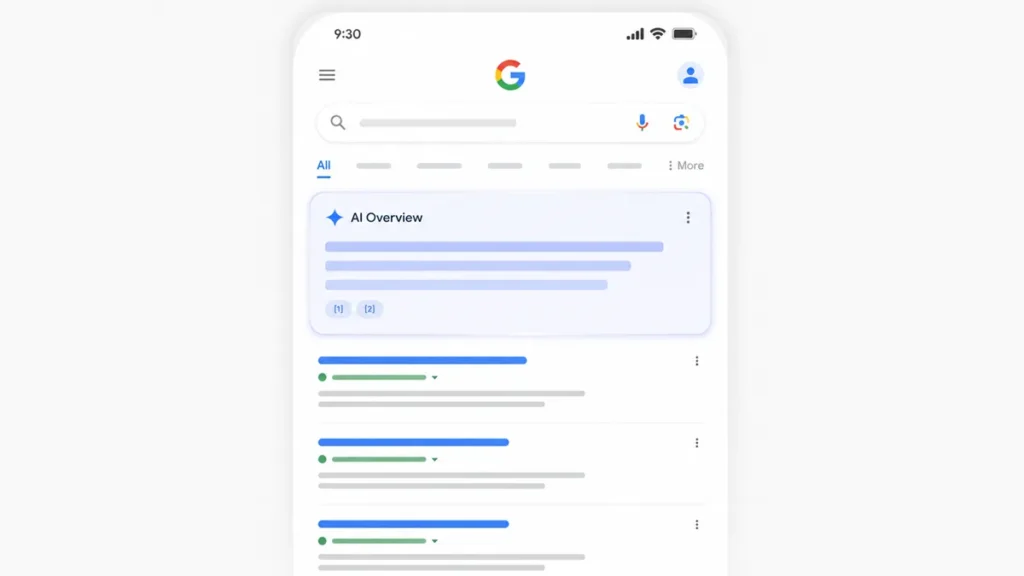
Where SEO specifically has evolved is in the output layer. Google now surfaces AI Overviews at the top of many query types, particularly informational and comparison searches. Users get the answer before they ever see your blue link. So the traffic you used to earn from a #1 ranking is often not the same traffic anymore. The click-through rate on some informational queries has dropped noticeably, even for pages holding strong positions.
This does not mean SEO is broken. It means the intent behind SEO work is shifting slightly. You are no longer just optimizing to rank. You are optimizing to be the source that the search engine trusts enough to surface, cite, or summarize.
What Is GEO? (And Why It Feels Different from Everything Before It)
GEO stands for Generative Engine Optimization. It is the practice of structuring and presenting your content so that AI-driven platforms like ChatGPT, Google’s AI Overviews, Perplexity, Gemini, and Claude are more likely to reference, paraphrase, or cite it when generating answers.
The key distinction is the output format. Traditional search returns a list of links. Generative AI returns a synthesized answer, sometimes with citations, sometimes without. When a user asks ChatGPT a question about your industry, they are not getting ranked results. They are getting a paragraph written by the model, drawn from whatever it considers authoritative sources.
GEO asks: is your content one of those sources? And more importantly, is it structured clearly enough that an AI can extract and accurately represent your ideas?
This is where the GEO vs SEO 2026 differences become very concrete. SEO is about discovery through search crawlers. GEO is about comprehension and citation by language models. Same content. Different audience. Different rules.
GEO vs SEO 2026 Differences: A Direct Comparison
Let me lay this out without the fluff. These are the actual differences that matter to practitioners.
1. The Primary Goal Is Different
SEO’s goal is to rank a page and earn a click. Every optimization decision, from title tags to keyword placement to link building, points toward that outcome. Traffic is the measurable result.
GEO’s goal is to be cited, summarized, or referenced inside an AI-generated response. The user may never visit your site. The win is in brand presence, authority signals, and accuracy of representation within the AI’s answer.
This is a fundamental mindset shift. You are no longer optimizing only for a ranking position. You are optimizing to be the entity that an AI trusts.
2. Keywords vs. Entities
Traditional SEO centers on keywords. You find the phrase people type, you optimize a page around it, and you earn visibility when that phrase is searched.
GEO operates more on entities. An entity is a clearly defined thing: a brand, a person, a concept, a product. Language models do not think in keyword strings the way a search index does. They think in relationships between entities. If your brand is clearly defined, consistently named across the web, and associated with authoritative information on a topic, AI systems can recognize and reference it with confidence.
This is one of the more subtle but significant GEO vs SEO 2026 differences. Keyword research is not dead, but it is no longer the whole game.
3. Content Structure Matters More Than It Ever Did
In traditional SEO, content structure is important for user experience and crawlability. In GEO, structure is everything. AI systems parse content by extracting declarative statements, pulling facts from clearly marked sections, and referencing answers that are written cleanly enough to be summarized without distortion.
Long, winding paragraphs that bury the answer work poorly for GEO. Content that opens each section with a direct answer, then expands, is far more likely to be pulled into an AI response accurately. This is not just a stylistic preference. Research from Princeton and IIT Delhi found that structured GEO techniques can increase visibility in AI-generated responses by up to 40%.
4. How Success Is Measured
SEO has a mature measurement ecosystem. Rankings, impressions, click-through rate, organic traffic sessions — you can pull all of this from Google Search Console and any rank tracking tool.
GEO measurement is still developing. You track things like brand mentions inside AI responses, citation frequency in LLM outputs, inclusion in AI Overviews, and traffic attributed to platforms like ChatGPT or Perplexity. Some tools are emerging to help with this, but it is nothing like the precision of traditional rank tracking. You are partly tracking presence, partly tracking perception.
5. Authority Signals Are Built Differently
In SEO, authority comes primarily from backlinks. A strong link profile from credible domains is the most reliable ranking signal at scale.
In GEO, authority is broader. It includes backlinks, but also: consistent brand mentions across the web, your presence in established publications, clear authorship signals, schema markup that defines who you are and what you cover, and the sheer volume of high-quality content that establishes your topical depth. Language models build trust from multiple signals simultaneously, not just one dominant factor.
SEO vs GEO: The Side-by-Side Comparison Table
Sometimes the clearest way to see a difference is to put it in a table. Here is a clean comparison across the dimensions that actually matter in day-to-day work.
| Dimension | SEO | GEO |
|---|---|---|
| Primary goal | Rank pages, earn clicks | Be cited inside AI-generated answers |
| Output format | Search results with links | Synthesized answers, sometimes with citations |
| Success metric | Rankings, CTR, organic traffic | Brand mentions in AI, citation frequency, AI-referred sessions |
| Core content type | Keyword-optimized articles, landing pages | Declarative, entity-rich, clearly structured content |
| Authority signal | Backlinks from credible domains | Backlinks + brand mentions + schema + topical depth + consistent entity definition |
| Keyword role | Central to strategy | Supporting role; entities and topics matter more |
| Crawling | Googlebot, Bingbot | AI crawlers, LLM training data, live retrieval |
| Timeline to results | 3 to 6 months for new content | 2 to 4 months for citation pickup on established content |
| Measurement tools | Google Search Console, Ahrefs, Semrush | Brand monitoring tools, manual AI queries, ChatGPT/Perplexity traffic in GA4 |
| Click dependency | High — traffic requires a click | Low — value is in citation, even without a click |
| Structured data role | Helpful for rich results | Critical for AI comprehension and accurate citation |
The sharpest takeaway from this table: the two disciplines share the same content inputs but diverge entirely on what they count as a win. That is why you need to think about both simultaneously rather than sequencing them.
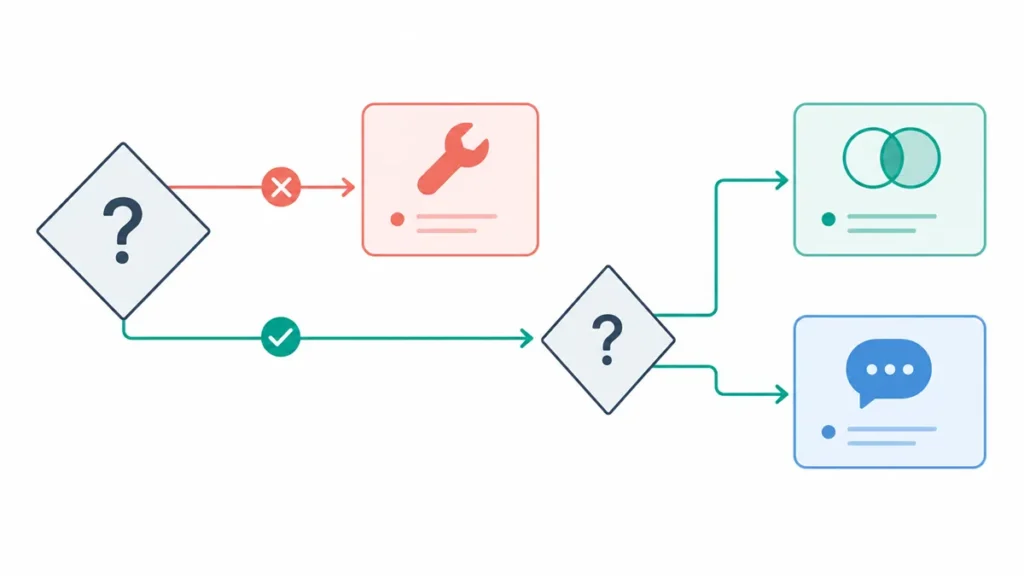
When to Prioritise SEO vs GEO: A Decision Framework
This is the question I get asked most often by clients who are trying to allocate their time and budget sensibly. The honest answer is that it is not an either/or choice, but there are situations where one deserves more immediate attention.
Prioritise SEO first if:
Your website is new or has significant technical issues. Broken crawlability, slow load times, poor site architecture, thin content — these problems have to be fixed before anything else, because AI systems cannot cite a page they cannot access or understand. GEO has no shortcut around a poor SEO foundation.
Your target queries are primarily transactional. If people are searching to buy, book, or compare specific products, traditional search still drives the majority of that behavior. E-commerce, local service businesses, and SaaS products with high purchase intent should ensure their SEO foundations are solid before shifting focus.
You have zero ranking presence and limited brand recognition. Content needs to exist and be indexed before it can be cited. Build the authority base first.
Prioritise GEO first if:
Your content already ranks well but organic traffic is declining despite stable positions. This is the clearest sign that AI Overviews are absorbing your clicks. The rankings are not the problem; the extraction layer above them is. Restructuring your content for GEO can recover presence without abandoning what SEO has already built.
Your industry involves high-consideration, research-heavy decisions. Categories like B2B software, finance, healthcare, education, and professional services are exactly where buyers turn to AI tools for synthesis and recommendations before they ever visit a website. Visibility in those AI responses is increasingly where consideration begins.
Your brand name is being mentioned in your category but not by AI systems. If you run a manual test by asking ChatGPT or Perplexity a category-level question and your competitors appear but you do not, that is a GEO gap worth addressing immediately.
Prioritise both simultaneously if:
You are in a competitive B2B or professional services category with a content team capable of handling both. The GEO optimizations required — clearer structure, direct answers, entity definition, schema — will make your SEO content better too. There is rarely a reason to sequence them if you have the capacity to run them in parallel.
The Budget Allocation Model: How to Split Investment Between SEO and GEO
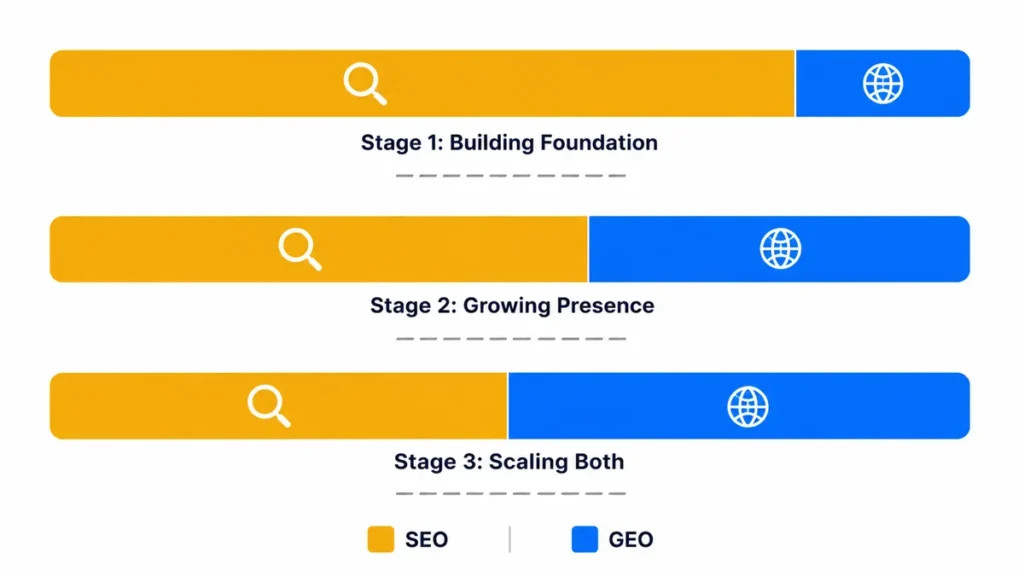
There is no single right ratio. The split that makes sense for your business depends entirely on where you are in your content maturity cycle.
If you are starting from scratch or your SEO foundation is weak: 90/10
Ninety percent of effort goes toward technical SEO and foundational content. Getting indexed, getting structured, getting authoritative on your core topics. Ten percent goes toward GEO-specific refinements: schema markup on your key pages, entity clarity, direct-answer structure. You cannot be cited if you cannot be found.
If you have a solid SEO base but limited GEO presence: 60/40
Your existing content ranks and earns traffic. Now the job is to make that content citation-ready for AI systems without disrupting the SEO signals that are working. Sixty percent of effort stays on SEO maintenance and new content creation. Forty percent goes toward restructuring existing pages, adding schema, building entity consistency, and earning the third-party mentions that establish AI-readable authority.
If you have strong SEO and significant AI visibility: 50/50
At this point, both channels are contributing. SEO is compounding. AI citations are building brand presence with audiences who may never click. The work is equally distributed: maintaining and growing your search rankings while systematically expanding your GEO footprint across more topic areas.
One thing I want to be clear about: GEO’s entry cost is lower than most people assume. You do not need a separate content budget. You need the same content, written more clearly, structured more deliberately, and supported by schema markup. The incremental cost of making existing SEO content GEO-ready is far lower than the cost of starting a fresh content program. That is part of why the 80/20 framing from the competitor article slightly overstates the separation. For most teams, it is more like: do your SEO work well, then spend 20% more effort on GEO structure and entity signals on top of it.
What Has Not Changed: The Shared Foundation
Here is something I want to be clear about, because it gets muddied in a lot of discussions about the GEO vs SEO 2026 differences. The underlying quality requirements are the same.
Good technical architecture. Clear, helpful content. Demonstrated expertise. Trust signals that third parties can verify. A fast, accessible website that search engines and AI crawlers can navigate cleanly.
If your site is technically broken or your content is thin, you will struggle in both channels. GEO is not asking you to tear down what you have built with SEO. It is asking you to go a layer deeper in how you structure information and how clearly you define your authority.
Schema markup is a good example of this overlap. It has always helped with rich results in traditional SEO. It is now also a primary signal for AI systems trying to understand your content type, authorship, and topical coverage. A Schema Markup Generator can help you implement structured data correctly and consistently across your site. That one technical step serves both SEO and GEO at the same time.
The Click-Through Problem: Where the Real Disruption Is Happening
If you want to understand why GEO has become a serious conversation in 2026, look at click behavior. A Pew Research analysis found that when AI summaries appear in search results, users click through to actual websites only 8% of the time, compared to 15% when no AI summary is present.
That is nearly half the traffic gone on queries where an AI Overview appears.
This is the crux of it. You can still rank at #1. Your organic position has not changed. But the click rate has dropped because the user got what they needed from the summary. Your SEO is working, and your traffic is declining. That is a new kind of problem.
GEO is, in part, a response to this. If you cannot prevent the summary from appearing, you can at least be the source it draws from. Being cited in an AI Overview or a ChatGPT response is visibility, even if the user never clicks. And in many cases, that visibility builds the brand trust that drives a direct search or a referral visit later.
How to Optimize for Both: Practical Adjustments
The good news is that most of what makes content excellent for GEO also makes it better for SEO. You are not choosing between them. You are doing SEO well enough that GEO follows naturally, with a few intentional additions.
Write direct answers first. Every section of your content should open with the answer, not build toward it. Users and AI systems alike reward this structure. The explanation, nuance, and examples come after.
Establish entity clarity. Be consistent about your brand name, your author names, your product names, and your area of expertise across every page, your social profiles, your third-party mentions, and your schema markup. The more consistently defined you are as an entity, the more confidently AI systems can reference you.
Build topical depth, not just keyword breadth. A cluster of deeply interconnected content on a specific subject builds the kind of topical authority that both Google and AI models recognize as expertise. Thin coverage of many topics is less valuable than deep coverage of fewer ones.
Use structured data proactively. FAQ schema, Article schema, Author schema — these help AI systems parse your content type and pull it accurately. If you are not already implementing structured data, this is the single most straightforward step you can take toward GEO readiness.
Earn third-party mentions. Get your brand cited by credible publications, referenced in industry content, and discussed across forums and communities where your audience exists. Language models source from across the web, not just your own site.
Is GEO Replacing SEO? No. Here Is Why That Question Misses the Point.
GEO is not a replacement. It is an expansion. Google is still the dominant search engine by a vast margin. Traditional search is not disappearing this year. But an increasing share of information-seeking behavior is moving toward AI-native interfaces, and that share is growing fast.
The right way to think about GEO vs SEO 2026 differences is not as a competition. It is as two overlapping optimization disciplines that both require your content to be genuinely excellent, clearly structured, and authoritative. One measures success in rankings and clicks. The other measures success in citations and presence. Both matter for total search visibility in 2026.
Brands that focus only on SEO will increasingly find that their traffic does not reflect their ranking positions. Brands that chase GEO without the SEO foundation will have nothing for AI systems to reference or crawl. The winning approach combines both.
For anyone doing on-page SEO work, it is also worth reviewing how your existing pages are structured from a content clarity standpoint. A well-optimized on-page SEO foundation — from title tags and meta descriptions to internal linking and heading structure — directly feeds into GEO readiness, because the signals AI systems trust overlap heavily with what good on-page SEO already does. Visiblytics’ SERP Snippet Previewer is one tool I use to check how a page appears in traditional search before I worry about how it will read to an AI crawler.
What Changes in Practice: A Summary for 2026
The GEO vs SEO 2026 differences come down to this:
SEO asks: can search engines find, crawl, and rank this page? GEO asks: can AI systems understand, trust, and cite this content?
Both questions need a yes. And the path to both answers runs through the same place: content that is technically sound, genuinely helpful, clearly structured, and backed by real authority signals.
The shift in 2026 is not that a new discipline arrived and the old one ended. It is that the definition of “search visibility” expanded. Your content now has to perform in more places, for more types of engines, measuring success in more ways.
Adapting means doing SEO better, not differently. And then adding the structural and entity-level layers that GEO requires on top of that.
❓ Frequently Asked Questions
Does GEO replace SEO in 2026?
No. GEO builds on top of SEO. You need a technically sound, well-indexed site for AI systems to reference your content at all. SEO remains the foundation; GEO is the layer that ensures AI-native visibility.
What is the biggest practical difference between GEO and SEO?
SEO measures success through rankings and clicks. GEO measures success through citations, mentions, and inclusion in AI-generated responses. The underlying content quality requirements overlap significantly, but the goals and metrics are different.
Do backlinks matter for GEO?
They matter, but less exclusively than in traditional SEO. GEO authority is built from a broader mix of signals: consistent brand mentions, schema markup, topical depth, third-party citations, and clear entity definition across the web.
How do I know if my content is being cited by AI systems?
Track traffic sessions attributed to platforms like ChatGPT, Perplexity, and Gemini. Monitor brand mentions in AI-generated responses manually by querying those systems with your target topics. Dedicated AI visibility tools are emerging to make this more systematic.
Should small businesses focus on GEO or SEO?
Start with SEO fundamentals. A technically clean site with high-quality, clearly structured content is the prerequisite for both. Once that foundation is in place, applying GEO-specific structure to your best content is a natural next step.