
Every day, billions of people type questions into Google. They are looking for answers, products, services, local businesses, and solutions to problems. The websites that appear at the top of those results do not get there by accident.
They get there through SEO.
If you have ever wondered why one website appears at the top of Google while another sits buried on page five, this guide is for you. By the end, you will understand exactly what SEO is, how search engines decide which pages to rank, what types of SEO exist, and how to start building an SEO strategy that actually works in 2026.
What is SEO?
SEO — Search Engine Optimisation — is the process of improving a website so that it appears higher in search engine results pages (SERPs) for relevant search queries, without paying for placement.
When someone searches “how to start a podcast” on Google, the results they see are ordered by Google’s algorithm. SEO is the discipline of understanding that algorithm and optimising your website to earn better positions within it.
The goal is simple: get your pages in front of people who are actively searching for what you offer.
Unlike paid advertising, where you pay for each click, SEO focuses on earning organic traffic. Organic traffic is free in the sense that you do not pay per click. However, it requires an investment of time, expertise, and consistent effort.
Why SEO Matters
Here is why SEO is one of the most important channels in digital marketing:
- Organic search is the single largest source of website traffic globally, accounting for over 50% of all web traffic
- The first result on Google receives an average click-through rate of 27 to 39%, meaning nearly a third of all searchers click that top result
- Results on the first page of Google receive 91% of all search traffic. The second page receives less than 6%
- Unlike paid ads, SEO traffic continues arriving even when you are not actively spending money
- People trust organic results more than paid ads. Appearing organically builds credibility and brand authority
In 2026, SEO has expanded beyond traditional search. AI-powered tools like Google AI Overviews, ChatGPT, Gemini, and Perplexity now answer many queries directly, and the websites that power those answers are typically those with the strongest SEO foundations.
How Search Engines Work
To understand SEO, you first need to understand what search engines actually do. The process happens in three stages.
Stage 1: Crawling
Search engines use software programmes called crawlers (also called spiders or bots) to discover content on the internet. These bots follow links from page to page across the web, visiting billions of URLs and collecting information about what they find.
If a page cannot be found by a crawler, because it has no links pointing to it, or because its code blocks crawlers from accessing it, that page will not appear in search results.
Stage 2: Indexing
Once a crawler visits a page, the search engine processes and stores the information in a massive database called the index. Think of the index as a library containing every web page the search engine has discovered and analysed.
When a page is indexed, the search engine has catalogued its content, understood what it is about, and made it available to appear in search results.
Not all pages get indexed. Pages with thin content, duplicate content, technical errors, or explicit “no-index” instructions are often excluded.
Stage 3: Ranking
When someone types a search query, the search engine retrieves relevant pages from its index and ranks them in order of estimated usefulness for that specific query. This ranking is determined by an algorithm that evaluates hundreds of signals.
The goal of the ranking algorithm is to surface the most helpful, accurate, trustworthy, and relevant result for each individual search. SEO is the discipline of helping your pages satisfy those criteria better than competing pages.
How Google Decides What to Rank
Google does not publish its full algorithm, but years of research, official documentation, and observed results have given the SEO industry a solid understanding of how rankings are determined. The signals broadly fall into three areas.
Relevance
Does this page actually answer what the person searched for?
Google analyses the content of a page, including its words, structure, headings, and topics, to determine whether it matches the intent behind a search query. This is why keyword research is foundational to SEO. If your page does not address what people are searching for, it will not rank regardless of how technically perfect it is.
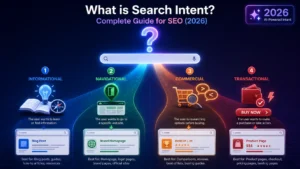
Search intent is a critical concept here. The same topic can have very different intents:
- Someone searching “running shoes” may be browsing
- Someone searching “best running shoes for flat feet” is researching before a purchase
- Someone searching “buy Nike Air Zoom running shoes” is ready to buy
Google distinguishes between these intents and ranks different types of pages accordingly. A product page will rank for the third query. A review article will rank for the second. An informational guide may rank for the first.
Authority
Can Google trust this page as a credible source?
Authority is largely built through backlinks — links from other websites pointing to yours. When a trusted website links to your page, it signals to Google that your content is worth referencing. A site with many high-quality backlinks from authoritative sources is generally considered more authoritative than a site with few or low-quality links.
But authority in 2026 is more than just links. Google’s E-E-A-T framework (Experience, Expertise, Authoritativeness, and Trustworthiness) plays a significant role. Google evaluates whether the content demonstrates real experience, whether the author or site is a recognised expert, and whether the site can be trusted overall.
E-E-A-T — the four qualities Google evaluates to determine whether content is credible and worth showing to users:
- Experience — does the author have real, first-hand experience with the topic?
- Expertise — does the content demonstrate deep subject knowledge?
- Authoritativeness — is the website or author a recognised source in their field?
- Trustworthiness — is the site transparent, accurate, and safe?
User Experience
Is the page actually a good experience for visitors?
Google measures how users interact with search results. Pages that load slowly, are difficult to navigate on mobile, display intrusive pop-ups, or cause users to immediately return to the search results (known as “pogo-sticking”) receive negative signals.
Google’s Core Web Vitals are a set of specific measurements related to page speed and visual stability that are confirmed ranking factors. The three main ones are:
- Largest Contentful Paint (LCP) — how quickly the main content of a page loads
- Interaction to Next Paint (INP) — how responsive the page is to user interactions
- Cumulative Layout Shift (CLS) — how stable the page layout is (whether elements jump around as the page loads)
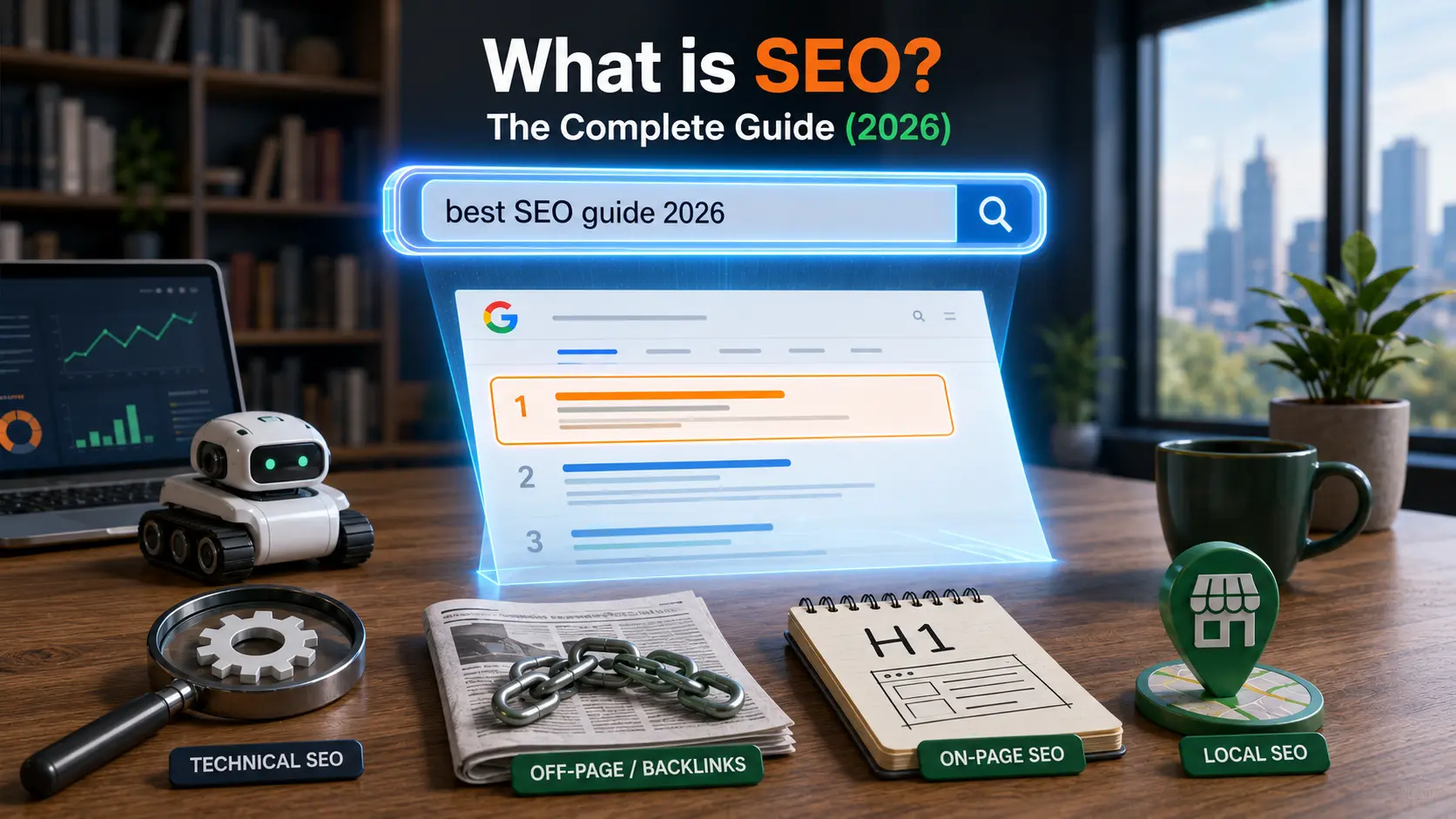
The Four Types of SEO
SEO is not a single activity. It is a discipline made up of several distinct areas that work together. Neglecting any one of them limits your overall results.
1. On-Page SEO
On-page SEO — the practice of optimising the content and elements directly on your web pages to improve their relevance and clarity for both users and search engines.
It includes:
Keyword targeting. Identifying the terms your audience searches for and incorporating them naturally into your content, titles, headings, and URLs.
Title tags. The clickable headline that appears in search results. It is one of the most important on-page signals. A well-written title tag that includes your primary keyword and a compelling reason to click can significantly improve your rankings and click-through rates.
Meta descriptions. The short summary that appears below your title in search results. While not a direct ranking factor, a well-written meta description improves click-through rates, which indirectly helps rankings.
Heading structure. Using H1, H2, and H3 tags to structure your content logically, making it easier for both readers and search engines to understand.
Content quality and depth. Writing content that genuinely and thoroughly answers the searcher’s question. In 2026, this means covering a topic comprehensively rather than superficially, demonstrating expertise, and including original insights or data where possible.
Internal linking. Linking from one page on your site to another relevant page. This helps search engines understand the structure and hierarchy of your site, and distributes ranking authority (also called “link equity”) between pages.
Image optimisation. Using descriptive file names and alt text for images so search engines understand what they depict.
URL structure. Using clean, descriptive URLs that include the target keyword. A good URL looks like yoursite.com/keyword-research-guide rather than yoursite.com/page?id=1234.
2. Off-Page SEO
Off-page SEO — everything done outside your own website to improve your search engine rankings and authority.
The most important off-page signal is backlinks. When authoritative websites link to your content, Google interprets it as a vote of confidence in the quality and relevance of your page.
Not all backlinks are equal. A single link from a highly authoritative and relevant website (a major industry publication, a university, a well-known news site) is worth far more than hundreds of links from low-quality or unrelated websites.
Off-page SEO also includes:
Digital PR. Earning press coverage and mentions on high-authority news and industry websites. A well-executed digital PR campaign can earn high-quality backlinks at scale.
Guest posting. Writing articles for other reputable websites in your industry, with a link back to your own site. This builds both authority and visibility.
Brand mentions. Even unlinked mentions of your brand name on reputable websites contribute to your overall authority in Google’s eyes.
Social signals. While not direct ranking factors, content shared widely on social media tends to earn more backlinks and visibility over time.
3. Technical SEO
Technical SEO — the optimisation of a website’s infrastructure and backend so that search engines can efficiently crawl, index, and understand all of its content.
If on-page SEO is about what your pages say, and off-page SEO is about who vouches for you, technical SEO is about whether search engines can even access and process your site in the first place.
Key areas of technical SEO include:
Site speed. Slow-loading pages frustrate users and are penalised by Google. Core Web Vitals measurements directly assess this.
Mobile-friendliness. Google uses mobile-first indexing, which means it primarily uses the mobile version of your site to determine rankings. If your site works poorly on smartphones, your rankings will suffer.
Crawlability. Ensuring search engine bots can access all the pages you want indexed. Issues with robots.txt files, broken links, and redirect chains can block crawlers from reaching important content.
Site architecture. How your pages are organised and linked to each other. A logical hierarchy (with a clear homepage, category pages, and individual posts or product pages) helps search engines understand the relationship between your content.
XML sitemaps. A file that lists all the important pages on your site, helping search engines find and index them more efficiently.
HTTPS. Serving your site over HTTPS (secure connection) is a confirmed Google ranking factor. Any site still on HTTP in 2026 is at a disadvantage.
Structured data. Adding schema markup to your pages to give search engines additional context about your content. This can result in rich results in SERPs, such as star ratings, FAQs, recipes, and event listings, which increase click-through rates.
Canonicalisation. Specifying the preferred version of a page when duplicate or near-duplicate content exists, to avoid splitting ranking signals across multiple URLs.
4. Local SEO
Local SEO — the practice of optimising a business’s online presence to appear in location-based search results.
When someone searches “dentist near me” or “Italian restaurant in Manchester,” Google displays a map pack with local business listings alongside organic results. Local SEO determines whether your business appears in that map pack and in local organic results.
Local SEO is essential for any business with a physical location or that serves a specific geographic area. Key activities include:
Google Business Profile optimisation. Claiming, completing, and actively managing your Google Business Profile is the single most important local SEO action. It controls how your business appears in Google Maps and local search results.
Local citations. Consistent mentions of your business name, address, and phone number (NAP) across directories like Yelp, TripAdvisor, and industry-specific listings.
Local keyword targeting. Including location-specific terms in your on-page content (for example, “plumber in Birmingham” rather than just “plumber”).
Reviews. The quantity and quality of Google reviews is a significant local ranking factor. A consistent strategy for encouraging satisfied customers to leave reviews is essential.
White-Hat SEO vs Black-Hat SEO
SEO practices generally fall into two broad categories, and understanding the difference is critical.
White-Hat SEO
White-hat SEO — the practice of optimising a website using methods that align with search engine guidelines and focus on delivering genuine value to users.
This includes creating high-quality content, earning backlinks through merit, optimising for user experience, and following Google’s Webmaster Guidelines. White-hat SEO takes longer to show results but builds durable, sustainable rankings.
Black-Hat SEO
Black-hat SEO attempts to manipulate search rankings through tactics that violate search engine guidelines. Common black-hat tactics include:
- Keyword stuffing — repeating a keyword excessively in content to manipulate relevance signals
- Buying backlinks — paying for links from low-quality websites in bulk
- Cloaking — showing search engines different content than what users see
- Private blog networks (PBNs) — creating networks of websites solely to generate links
Black-hat tactics sometimes produce short-term ranking gains. However, Google’s algorithm updates consistently target and penalise these practices. The consequences include sudden drops in rankings, removal from the index entirely, or manual penalties that are difficult to recover from.
The risk-reward calculation does not work in favour of black-hat SEO. White-hat SEO, done consistently, produces better long-term results without the risk of losing all your rankings overnight.
Grey-Hat SEO
Grey-hat SEO sits between the two. Tactics in this zone are not explicitly banned by Google but push the boundaries of what is considered best practice. Guest posting at scale for links, for example, is technically permitted but can become manipulative depending on how it is executed.
SEO and AI Search in 2026
The SEO landscape in 2026 is shaped significantly by artificial intelligence, both in how search engines work and in how marketers use tools to execute SEO.
AI Overviews and Generative Search
Google’s AI Overviews now appear at the top of results for many informational queries, providing a synthesised answer directly on the search results page before a user clicks anywhere. Similar features exist on Bing (with Copilot) and in standalone AI tools like ChatGPT and Perplexity.
This has introduced a new challenge: some queries that previously drove clicks to websites are now answered directly in the search interface, reducing traffic to individual pages.
However, the websites cited as sources in these AI-generated answers tend to be those with strong SEO fundamentals: clear structure, authoritative content, strong E-E-A-T signals, and excellent technical health. The best response to AI search is not to abandon SEO, but to do it better.
Generative Engine Optimisation (GEO)
GEO — the practice of optimising content specifically to be cited and referenced by AI-generated search answers, not just to appear in traditional organic results.
GEO builds on the same principles as traditional SEO but emphasises clearly structured, definitive, factual content that AI systems can easily extract and summarise. Concise definitions, clear headings, well-cited facts, and authoritative authorship all contribute to being cited in AI-generated answers.
In 2026, the most forward-thinking SEO strategies account for both traditional search rankings and AI citation potential simultaneously.
AI Tools in SEO Workflows
On the practitioner side, AI tools have changed how SEO work is done. Tools now assist with:
- Generating keyword ideas and clustering them by topic
- Drafting content outlines based on SERP analysis
- Identifying content gaps by comparing your site to competitors
- Automating technical SEO audits
- Personalising content recommendations at scale
AI speeds up many SEO tasks. But it does not replace the need for genuine expertise, original insights, and the kind of experience-backed content that both users and search engines ultimately reward.
Key SEO Ranking Factors in 2026
While Google uses hundreds of signals, these are the ones that carry the most weight in 2026.
Content quality and relevance. The most important factor. Content must genuinely and comprehensively address the search intent behind a query. Thin, vague, or keyword-stuffed content does not rank.
Backlink quality and quantity. High-quality links from authoritative and relevant websites remain one of the strongest ranking signals.
E-E-A-T signals. Demonstrable experience, expertise, authoritativeness, and trustworthiness. Especially important for YMYL (Your Money or Your Life) topics, such as health, finance, and legal content.
Core Web Vitals. Page speed, interactivity, and visual stability. Sites that fail these thresholds are at a ranking disadvantage.
Mobile-friendliness. A non-negotiable baseline in 2026 given that the majority of searches now happen on mobile devices.
Search intent alignment. Matching the format and depth of your content to what the searcher actually wants. A list post works for “best tools for X.” A step-by-step guide works for “how to do X.”
Internal linking. A strong internal link structure helps search engines discover and understand all your content, and distributes authority across your site.
Freshness. For time-sensitive topics, regularly updated content outperforms stale pages. For evergreen topics, freshness matters less, but content that has grown outdated should be refreshed.
HTTPS and site security. A confirmed ranking signal and a basic trust requirement.
Structured data. Helps search engines understand your content and unlocks enhanced SERP features.
SEO vs Paid Search (PPC): What is the Difference?
A common point of confusion for beginners is the difference between organic SEO results and paid search ads. Here is a clear comparison.
| SEO (Organic) | PPC (Paid Search) | |
|---|---|---|
| Cost per click | Free | You pay for each click |
| Time to results | 3 to 12 months typically | Can drive traffic same day |
| Longevity | Rankings persist when you stop actively working | Traffic stops when budget stops |
| Trust | Higher user trust | Lower user trust |
| Click-through rate | Higher for top organic positions | Lower (users often skip ads) |
| Best for | Long-term sustainable growth | Fast results, promotions, testing |
Paid search and SEO are not competitors. They work best together. PPC can deliver immediate traffic while your SEO strategy builds long-term authority. Many businesses run both simultaneously.
How Long Does SEO Take to Work?
This is the question every beginner asks, and the honest answer is: it depends.
For a brand new website with no existing authority, you can expect:
- Months 1 to 3: Technical setup, content creation, and initial indexing. Little to no visible traffic from SEO.
- Months 3 to 6: Pages begin indexing and appearing for low-competition queries. Small amounts of organic traffic start arriving.
- Months 6 to 12: Traffic grows meaningfully if content and link building are consistent. Rankings for target keywords begin to stabilise.
- Year 2 and beyond: Compounding returns. Content earns more links over time, rankings improve, and organic traffic grows significantly faster than in year one.
These timelines assume consistent, quality execution. A site in a low-competition niche may see results faster. A site competing in a crowded, high-authority space may take longer.
The single biggest mistake beginners make is abandoning SEO after three months because they do not see results. SEO is a long-term investment, and the returns are disproportionately weighted toward those who persist.
Why Most Beginners Fail at SEO
Understanding the common failure points saves you significant time and wasted effort.
Targeting keywords that are too competitive. A new site cannot rank for “best credit cards” or “weight loss tips” against established, high-authority competitors. Starting with lower-competition, specific keywords (called long-tail keywords) is the faster path to early traffic and momentum.
Publishing thin or low-quality content. In 2026, Google is sophisticated at identifying content that exists only to target keywords rather than to genuinely help readers. Low-quality content does not rank, and publishing it at volume actually signals poor quality across your entire site.
Ignoring technical SEO. Beautiful content on a slow, uncrawlable, mobile-unfriendly website will not rank well. Technical foundations must be in place before content can perform at its potential.
Expecting links to build themselves. High-quality content is necessary but not sufficient to earn backlinks in competitive spaces. Active outreach, digital PR, and link-building strategies are required.
Targeting keywords without understanding intent. Writing a blog post for a keyword where Google wants to rank an e-commerce page, or writing a product page for a keyword where searchers want an informational guide, results in rankings that never materialise.
Giving up too soon. The compounding nature of SEO means that consistent effort over 12 to 24 months produces dramatically better results than intense effort for 3 months followed by inactivity.
How to Start SEO: A Simple Roadmap
If you are new to SEO and want a clear starting point, follow this sequence.
Step 1: Get the technical basics right. Ensure your site loads quickly, is mobile-friendly, uses HTTPS, and can be crawled by search engines. Set up Google Search Console and Google Analytics 4.
Step 2: Understand your audience and their search behaviour. Before you create any content, research the keywords your target audience uses to find information relevant to your business.
Step 3: Create a content plan based on keyword research. Identify the topics you want to rank for, organised from lowest to highest competition. Plan content that addresses each topic at an appropriate depth.
Step 4: Publish high-quality content consistently. Focus on content that genuinely and thoroughly answers the questions your audience is asking. Quality over quantity, but consistency matters.
Step 5: Build internal links. As you publish more content, link between related pages on your site to distribute authority and help search engines understand your content structure.
Step 6: Earn backlinks. Share your content, pursue digital PR opportunities, write guest posts for relevant publications, and build relationships in your industry.
Step 7: Monitor, measure, and improve. Track your keyword rankings, organic traffic, and conversion rates. Identify what is working and where opportunities for improvement exist. Update and improve your existing content regularly.
SEO Glossary: Key Terms Explained
Algorithm — the set of rules and signals search engines use to rank pages in search results.
Backlink — a link from one website to another. Backlinks from authoritative sites are a major ranking signal.
Crawl budget — the number of pages a search engine will crawl on your site within a given time period.
Domain authority — a metric (developed by SEO tools, not Google itself) that estimates how likely a domain is to rank well in search results based on its backlink profile.
Index — the database of web pages that a search engine has discovered and made available to appear in search results.
Keyword — a word or phrase that people type into search engines.
Long-tail keyword — a specific, longer search phrase with lower search volume but also lower competition and often higher intent.
SERP — Search Engine Results Page, the page of results displayed after a user submits a search query.
Organic traffic — visitors who arrive at your website by clicking a non-paid search result.
PageRank — Google’s original algorithm for measuring the importance of a web page based on the quantity and quality of links pointing to it.
Rich results — enhanced search results that include additional visual elements such as star ratings, images, or FAQs, made possible by structured data.
Robots.txt — a file on your website that instructs search engine crawlers which pages or sections they should or should not access.
XML sitemap — a file that lists all the important pages on your website to help search engines find and index them.
❓ Frequently Asked Questions
Is SEO free?
SEO does not require you to pay for clicks, unlike paid advertising. However, it requires investment in time, content creation, and potentially tools and expertise. Many businesses also invest in professional SEO services. The traffic itself is free. The work to earn it is not.
How is SEO different from SEM?
SEM (Search Engine Marketing) is a broader term that covers both organic SEO and paid search advertising (PPC). SEO refers specifically to the organic, non-paid side of appearing in search results.
Do I need an SEO expert or agency?
Not necessarily, especially when starting out. Many fundamentals of SEO are learnable and actionable without professional help. As your site grows and competition increases, specialist expertise becomes more valuable.
Does social media help SEO?
Social media is not a direct ranking factor. However, social distribution increases the visibility of your content, which can lead to more people discovering it, linking to it, and sharing it. These downstream effects can indirectly benefit rankings.
How often should I publish new content?
Consistency matters more than frequency. Publishing one genuinely valuable, comprehensive article per week is better than publishing five shallow posts. Google rewards quality and usefulness, not publishing volume.
What is the difference between SEO and content marketing?
Content marketing is the strategy of creating valuable content to attract an audience. SEO is the practice of optimising that content and your website so search engines can find and rank it. In practice, the two are deeply intertwined. Great content without SEO may go undiscovered. SEO without great content has nothing to rank.
Can I do SEO on my own?
Yes. Many business owners and bloggers manage their own SEO successfully, particularly for websites targeting low to medium competition keywords. The learning curve is real, but the fundamentals are learnable. Tools like Google Search Console, Ahrefs, Semrush, and Moz have made it significantly more accessible than it was a decade ago.
Summary
SEO is the practice of optimising your website to earn higher rankings in organic search results, bringing in free, targeted traffic from people actively searching for what you offer.
Understanding SEO means understanding three core stages: how search engines crawl, index, and rank content. It means working across four disciplines: on-page, off-page, technical, and local SEO. And in 2026, it means accounting for AI-driven search features that are changing how users interact with results.
The key principles to carry forward:
- SEO is a long-term investment. Results compound over time, and the biggest rewards go to those who execute consistently over months and years.
- Quality is the only sustainable strategy. Google’s mission is to surface the most helpful content for users. The best SEO simply makes that easier.
- All four types of SEO must work together. Strong content on a technically broken site underperforms. A fast, well-structured site with weak content underperforms. The whole system must function.
- AI is reshaping search, but not replacing the fundamentals. E-E-A-T, quality content, strong backlinks, and technical excellence remain the foundations of ranking in 2026 just as they were before.