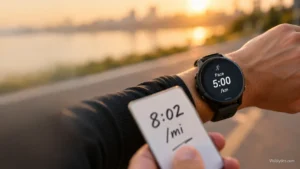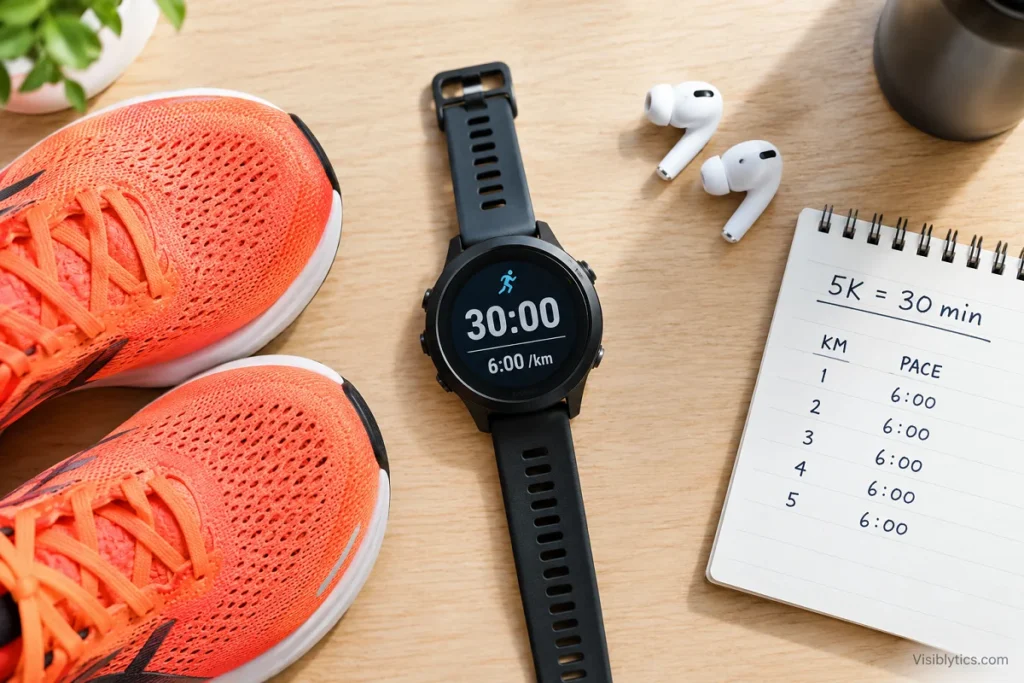
You have a 5K coming up, or you have decided to run one, and you want to finish in 30 minutes. The number you need first is simple: to run a 5K in 30 minutes you have to average 6:00 per kilometre, which is 9:39 per mile. Everything else in this post is about whether that number fits you today, how to hold it for five kilometres, and what changes if you want to finish under 30 rather than at exactly 30.
Most people who search this are not really asking for the maths. They want to know whether 6:00 per kilometre feels like a steady jog or a hard effort, and what to do if their last 5K took 33 or 35 minutes. I have written the sections below around those questions.
The Pace You Need to Run a 5K in 30 Minutes
You need an average pace of 6:00 per kilometre, or 9:39 per mile, to run a 5K in 30 minutes. That is the same as a speed of 10 kilometres per hour, or about 6.2 miles per hour. If you hold that average from the start line to the finish, the clock reads 30:00.
The maths is short. Thirty minutes divided by five kilometres gives six minutes per kilometre. A 5K is 3.107 miles, so thirty minutes divided by 3.107 gives 9.65 minutes per mile, which is 9 minutes and 39 seconds.
Pace and speed are not the same thing, and mixing them up causes more confusion than any other part of this goal. Pace is time per distance, such as minutes per kilometre. Speed is distance per time, such as kilometres per hour. Watches usually show pace, treadmills usually show speed. A runner who sets a watch to miles and aims for 6:00 is chasing a pace almost four minutes per mile faster than the goal requires, so check the unit before every run.
5K Splits for a 30-Minute Finish
At an even 6:00 per kilometre you pass 1 km at 6:00, 2 km at 12:00, 3 km at 18:00 and 4 km at 24:00. The mile markers fall at 9:39 for the first mile and 19:19 for the second. Splits give you a checkpoint every few minutes, which is easier to manage than waiting for the finish line to find out how the race went.
| Distance | Clock time at 6:00 per km |
|---|---|
| 1 km | 6:00 |
| 1 mile (1.61 km) | 9:39 |
| 2 km | 12:00 |
| 3 km | 18:00 |
| 2 miles (3.22 km) | 19:19 |
| 4 km | 24:00 |
| 3 miles (4.83 km) | 28:58 |
| 5 km | 30:00 |
If you reach 3 km at 17:50, you are ten seconds ahead and can simply keep going. If you reach it at 18:20, you are thirty seconds behind, and the useful response is a small, steady increase in effort rather than a sprint. Trying to win back thirty seconds in a single kilometre usually costs more than it gains.
Exactly 30 Minutes or Under 30 Minutes: Which Pace Do You Need?
Running 6:00 per kilometre gives a finish of exactly 30:00, which is not under 30 minutes. If your goal is a time that starts with 29, you need to average slightly faster than 6:00. Many runners aiming for sub-30 target 5:55 per kilometre, which produces a 29:35 finish and leaves 25 seconds of margin.
The table below shows what a few paces turn into over 5 km, with the mile equivalent for anyone who thinks in miles.
| Pace per km | Pace per mile | 5K finish time |
|---|---|---|
| 5:45 | 9:15 | 28:45 |
| 5:50 | 9:23 | 29:10 |
| 5:55 | 9:31 | 29:35 |
| 6:00 | 9:39 | 30:00 |
| 6:10 | 9:55 | 30:50 |
| 6:20 | 10:12 | 31:40 |
The margin matters for a practical reason. Race distances on a watch rarely match the official distance exactly, and the next sections explain how that can cost you the seconds you were hoping to keep.
How to Calculate Your Own Pace for a 5K in 30 Minutes
Divide your goal time by the distance. Thirty minutes over 5 kilometres is 6 minutes per kilometre, and the same method works for any other target. Doing it by hand is fine for round numbers, but it gets awkward once seconds and miles are involved.
A running pace calculator handles the conversion in either unit. It is most useful when you enter a recent race result instead of the goal. A 5K in 33:30 works out to 6:42 per kilometre, which is 42 seconds per kilometre slower than the target. A 35:00 finish is 7:00 per kilometre, a gap of a full minute per kilometre. A 32:00 finish is 6:24 per kilometre, a gap of 24 seconds.
That gap tells you how far you are from the goal, and it decides how long the work will take. Closing 24 seconds per kilometre is a very different project from closing 60.
Is a 30-Minute 5K Realistic for You Right Now?
It is realistic if you can already run 5 kilometres without stopping and your recent 5K time is under about 33 minutes. Runners slower than that can usually get there with several weeks of structured training. If you cannot yet run 3 to 5 kilometres continuously, building that base comes before any pace work.
Those thresholds are rules of thumb, not guarantees. They match the starting points used by most of the sub-30 plans I have read, which tend to assume either a recent 5K near 33 minutes or the ability to jog about 3 to 5 kilometres at any pace.
A quick check helps. After a proper warm-up, run one kilometre at 5:50 to 6:00 on a flat stretch. If it feels hard but controlled, a full 5K at that pace is within reach with training. If you cannot hold it for a single kilometre, give yourself more time and focus on building the distance first.
If you are returning from a long break or have any health concerns, it is sensible to speak with a doctor before adding fast running.
Run/walk routines can also work, but the maths changes. Every walking break is slower than 6:00 per kilometre, so the running sections have to be faster than 6:00 per kilometre to bring the overall average back to the goal.
How to Pace a 30-Minute 5K on Race Day
Run the first kilometre at goal pace or a few seconds slower, then settle into an even rhythm. A fast start is a common reason runners miss 30 minutes by a small margin. Even splits, or a slightly faster second half, give you the best chance of finishing under the line.
Here is why it matters in numbers. If you go through the first kilometre in 5:35, which feels comfortable in the excitement of a start, the remaining four kilometres must average 6:06 just to finish in 30:00. You have turned an even-paced plan into a plan that needs the hardest running when you are most tired.
Distance error is the other issue. A certified 5K course is measured along the shortest legal route, but runners weave around others and cut corners imperfectly, so a watch can read 5.05 to 5.1 km at the finish. If your watch shows 5.1 km, covering that distance in 30:00 means an average of 5:53 per kilometre on the watch. A pace calculator lets you convert any watch distance and target time into the pace you need, which is why I suggest aiming for 5:55 per kilometre on the display.
Conditions also change the picture. Heat, wind and hills slow the same effort, so being a few seconds per kilometre slower in those conditions is normal. Judge the effort by breathing and feel, and treat the watch as a guide rather than an instruction.
Treadmill and Track Settings for a 5K in 30 Minutes Pace
On a treadmill, set the speed to 10.0 km/h, or 6.2 mph, and run for 30 minutes to cover 5 km. On a standard 400 metre track, 6:00 per kilometre is 2:24 per lap, and 12.5 laps make 5 km. Both give you a controlled way to practise the target pace without worrying about GPS.
For a sub-30 target, a treadmill speed of 10.2 km/h works out to about 5:53 per kilometre and a finish near 29:25. On the track, 2:20 per lap gives a 5:50 per kilometre pace and a 29:10 finish.
Treadmill running often feels easier than the same pace outdoors because there is no wind and the belt helps move the foot back. Belts can also be slightly off from their displayed speed. If you train indoors, a few outdoor or track runs at goal pace will show you what the race will actually feel like.
Training Runs That Build a 6:00 per Kilometre Pace
Most of your running should be easy, with one or two faster sessions each week. Easy runs sit roughly 90 seconds to 2 minutes per mile slower than race pace, which is about 11:10 to 11:40 per mile, or 6:55 to 7:15 per kilometre. A common mistake is running every session at a medium pace that is too hard to recover from and too slow to improve speed.
The sub-30 plans I looked at, which ran from about 8 to 12 weeks, share the same building blocks.
- Easy runs. Conversational pace for 20 to 40 minutes. These build the aerobic base without taking much out of your legs.
- Tempo runs. A comfortably hard effort, just slower than 10K pace, for 10 to 20 minutes after a warm-up. Many coaches add a couple of minutes each week until the tempo reaches about 30 minutes.
- Intervals. A session such as 4 x 1000 metres slightly faster than race pace, with a two-minute jog between each repeat. If you can complete it at the right pace, you can usually run close to that pace for a full 5K.
- A long easy run. Longer than the race distance and slow enough to talk. Being able to run beyond 5 km makes 5 km at goal pace feel more manageable.
An example week for a runner training four days looks like this.
| Day | Session |
|---|---|
| Monday | Rest |
| Tuesday | Easy run, 30 minutes |
| Wednesday | Rest or cross-training |
| Thursday | Intervals or tempo run |
| Friday | Rest |
| Saturday | Easy run, 30 minutes |
| Sunday | Long easy run, 40 to 50 minutes |
Keep the week light in the final days before the race. Shorter runs with a couple of short goal-pace efforts keep your legs sharp without adding fatigue.
Why Runners Miss a 30-Minute 5K by a Minute or Two
The usual causes are a fast first kilometre, training every run at the same moderate pace, and a goal that sits a few minutes beyond current fitness. All three are fixable with pacing discipline and a clear picture of today’s pace.
A fourth cause is plain arithmetic. Pace in miles and pace in kilometres get mixed, or a watch distance of 5.1 km is judged against a 5.0 km target. Write your goal pace on your wrist or phone in the same unit your watch uses, and decide in advance what the watch should show at 1, 2, 3 and 4 kilometres.
Fatigue before the start also counts. A hard session two days before a race, a poor night of sleep or an unplanned long walk to the start line all cost seconds that a 30-minute goal has little room to spare.
Quick Answer: Pace for a 5K in 30 Minutes
A 5K in 30 minutes needs 6:00 per kilometre, 9:39 per mile, 10 km/h on a treadmill or 2:24 per 400 metre lap. For a finish under 30 minutes, aim for about 5:55 per kilometre on your watch. The goal is realistic when you can run 5 km nonstop and your recent time is near 33 minutes, and it comes from mostly easy running, one faster session each week and an even first kilometre on race day.