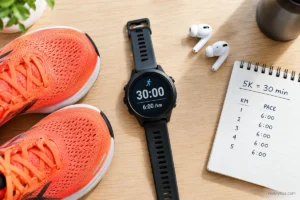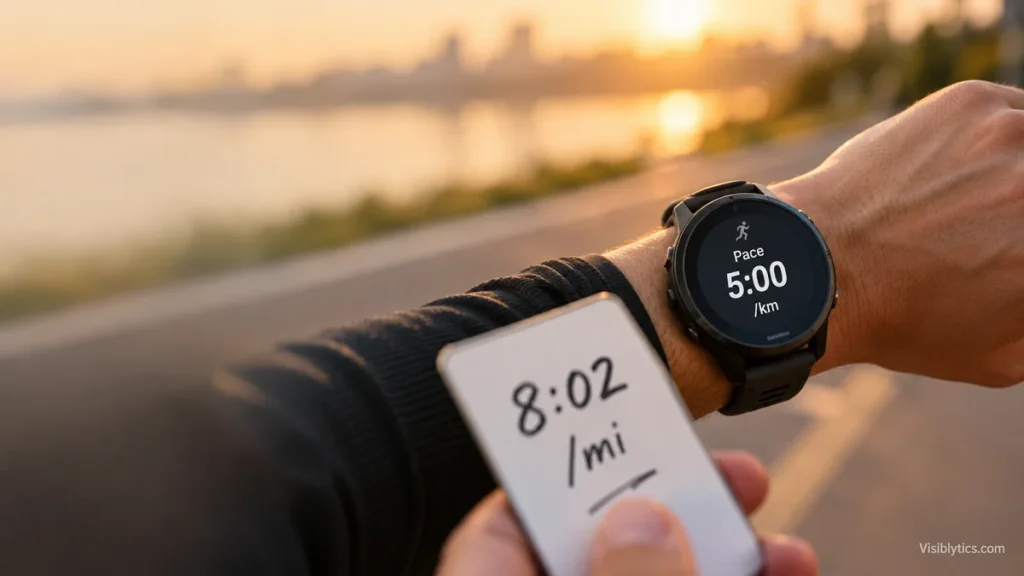
You have a pace in one unit and a watch, plan, or race that uses the other. Maybe your training plan is written in minutes per mile while your watch reports minutes per kilometer. Maybe you are racing abroad and the markers use a different unit. This guide shows how to convert running pace from min/km to min/mile with one multiplication, explains the single mistake behind most wrong answers, and gives you charts to check your numbers against.
I wrote it for the moment when you want a number quickly but also want to trust it. So every example below is worked out in full, and you can repeat each one yourself.
What Is the Formula to Convert Min/Km to Min/Mile?
To convert min/km to min/mile, multiply your pace by 1.609344, which is the number of kilometers in one mile. A mile is longer than a kilometer, so each mile takes longer to cover and the number gets bigger. To go the other way, divide by 1.609344.
The logic is simple. Pace is time per unit of distance. If every kilometer takes you 5 minutes, a mile contains 1.609344 kilometers, so it takes you 1.609344 times as long. Many sources round the factor to 1.60934 or 1.609. The difference is far too small to matter for training, but the rounding in the middle of a calculation can add up, so I keep the full factor when working by hand.
One quick sanity check: the mile pace should always be a larger number than the kilometer pace. If you convert 5:00 per km and get something under 5:00 per mile, the direction went wrong.
How to Convert Running Pace From Min/Km to Min/Mile Step by Step
The most reliable method is to work in seconds, multiply once, and convert back to minutes and seconds. This avoids the base-60 problems that come from multiplying minutes and seconds directly.
- Turn the pace into seconds. Multiply the minutes by 60 and add the seconds.
- Multiply by 1.609344. The result is your pace in seconds per mile.
- Turn it back into minutes and seconds. Divide by 60. The whole number is the minutes and the remainder is the seconds. Round to the nearest second.
Here is a full example with a pace of 5:42 per km.
- 5 minutes × 60 = 300 seconds, plus 42 gives 342 seconds.
- 342 × 1.609344 = 550.4 seconds.
- 550.4 ÷ 60 is 9 with a remainder of about 10 seconds.
So 5:42 per km equals roughly 9:10 per mile.
A second example uses 4:15 per km. That is 255 seconds, and 255 × 1.609344 = 410.4 seconds. Divide by 60 and you get 6 minutes and 50 seconds, so 4:15 per km is about 6:50 per mile.
Why 5:30 per Km Is Not 5.30 (The Most Common Conversion Mistake)
The most common error is treating a pace like 5:30 as the decimal number 5.30. Minutes and seconds use base 60, so 5:30 means five and a half minutes, which is 5.5 in decimal form. The number 5.30 actually means 5 minutes and 18 seconds.
The difference changes your result noticeably. Here is the same pace converted both ways.
- Correct: 5:30 is 5.5 minutes. 5.5 × 1.609344 = 8.85 minutes. The 0.85 is 51 seconds, so the answer is 8:51 per mile.
- Wrong: Using 5.30 directly gives 5.30 × 1.609344 = 8.53 minutes, which reads as 8:32 per mile.
That is a 19 second gap per mile. Over a 10 mile run, you would be off by more than three minutes, which is enough to ruin a pacing plan.
The fix is the seconds method above, or converting the seconds to a fraction first by dividing them by 60. If you ever see a conversion that produces an odd result, check whether someone entered 5:30 as 5.30.
Min/Km to Min/Mile Conversion Chart
This chart gives the mile pace for common kilometer paces, rounded to the nearest second. Use it to check your own calculation or to find a number without doing any math.
| Pace (min/km) | Pace (min/mile) |
|---|---|
| 3:30 | 5:38 |
| 4:00 | 6:26 |
| 4:15 | 6:50 |
| 4:30 | 7:15 |
| 4:45 | 7:39 |
| 5:00 | 8:03 |
| 5:15 | 8:27 |
| 5:30 | 8:51 |
| 5:45 | 9:15 |
| 6:00 | 9:39 |
| 6:15 | 10:04 |
| 6:30 | 10:28 |
| 6:45 | 10:52 |
| 7:00 | 11:16 |
| 7:30 | 12:04 |
| 8:00 | 12:52 |
If your pace sits between two rows, or you want it down to the second, a min/km to min/mile calculator handles any value without a lookup.
How to Convert Min/Mile to Min/Km
To convert min/mile to min/km, divide your mile pace by 1.609344. The method is the same as before, with the multiplication replaced by division. Work in seconds, divide, then turn the result back into minutes and seconds.
Take a pace of 8:30 per mile. That is 510 seconds. Then 510 ÷ 1.609344 = 316.9 seconds, which is 5 minutes and 17 seconds. So 8:30 per mile is about 5:17 per km.
Here are the reverse values for common mile paces.
| Pace (min/mile) | Pace (min/km) |
|---|---|
| 6:00 | 3:44 |
| 7:00 | 4:21 |
| 8:00 | 4:58 |
| 9:00 | 5:36 |
| 10:00 | 6:13 |
| 11:00 | 6:50 |
| 12:00 | 7:27 |
Notice that 8:00 per mile is 4:58 per km, not 5:00. Rounding a mile pace to a tidy kilometer number is a common habit, and it creates a two second per kilometer error that adds up over a marathon.
How to Estimate the Conversion in Your Head
For a fast mental estimate, multiply the pace by 1.6 and add a few seconds. The extra seconds correct for the fact that 1.6 is slightly lower than 1.609344.
Try 5:00 per km. Multiply 300 seconds by 1.6 and you get 480 seconds, which is 8:00. Add about 3 seconds and you reach 8:03, which matches the exact answer. The correction runs from about 2 seconds near 4:00 per km up to about 5 seconds near 8:00 per km.
For the reverse, divide the mile pace by 1.6 and subtract a couple of seconds. Take 8:00 per mile, which is 480 seconds. Dividing by 1.6 gives 300 seconds, or 5:00, and subtracting 2 seconds lands on 4:58.
I use this when I only need to know roughly where a pace sits, for example while reading a plan on a phone. For anything that goes into a pacing strategy, I use the full calculation.
How to Convert Pace in a Spreadsheet
In a spreadsheet, store the pace as a time value, multiply it by 1.609344, and format the result as minutes and seconds. The formula for min/km to min/mile is =A2*1.609344. For min/mile to min/km, use =A2/1.609344.
There is one trap. If you type 5:30 into a cell, most spreadsheets read it as 5 hours and 30 minutes. Enter the pace as 0:05:30 instead, so it is read as minutes and seconds. Then set the formatting of the result cell to a custom mm:ss format. Without that, the cell may display a long clock time or an unreadable decimal.
This works the same way in Excel and Google Sheets, and it is the easiest way to convert a whole training log in one go.
Min/Km and Min/Mile Paces for Common Race Goals
Race goals are where most people need this conversion, because race times are fixed but pacing units differ between plans and watches. The table shows the pace needed for common finish times in both units.
| Goal | Pace (min/km) | Pace (min/mile) |
|---|---|---|
| 5K in 25:00 | 5:00 | 8:03 |
| 5K in 30:00 | 6:00 | 9:39 |
| 10K in 50:00 | 5:00 | 8:03 |
| 10K in 60:00 | 6:00 | 9:39 |
| Half marathon in 2:00:00 | 5:41 | 9:09 |
| Marathon in 3:30:00 | 4:59 | 8:01 |
| Marathon in 4:00:00 | 5:41 | 9:09 |
A sub 2 hour half marathon and a 4 hour marathon need the same pace, which is a useful comparison if you are moving up in distance. These figures use the exact race distances, 21.0975 km and 42.195 km, so they differ by a second or two from tables that use rounded distances.
How to Convert Between Pace and Treadmill Speed
Treadmills show speed in km/h or mph, not pace, so you often need a second conversion. To get km/h, divide 3600 by your pace in seconds per km. For mph, divide 3600 by your pace in seconds per mile.
Here are three common cases.
- 5:00 per km is 12 km/h, which equals 8:03 per mile and about 7.5 mph.
- 6:00 per km is 10 km/h, which equals 9:39 per mile and about 6.2 mph.
- 8:00 per km is 7.5 km/h, which equals 12:52 per mile and about 4.7 mph.
If your treadmill is set in mph and your plan is in min/km, convert the plan first to min/mile, then to mph, and check it against the table above.
How to Use a Running Pace Calculator for Min/Km to Min/Mile Conversion
A running pace calculator does the conversion for you and removes the arithmetic errors that come from doing it by hand. The running pace calculator on Visiblytics works with any two of pace, time, and distance, and calculates the third value.
To convert running pace from min/km to min/mile with it, set the unit to kilometers, enter your pace in minutes and seconds, then use the unit toggle to switch to miles. The page states that it converts between min/km and min/mile when you change units, and that all calculations run in your browser without sending data to a server.
Before relying on any calculator, test it with a pace you already know. Entering 5:00 per km should give about 8:03 per mile, and 8:00 per mile should give about 4:58 per km. If the tool matches those, it is handling the factor and the base-60 seconds correctly.
The same page also shows predicted race times for 5K, 10K, half marathon and marathon distances from your current pace, along with pace zones by effort level. That is handy if you want to see what a converted pace means for a target race.
Quick Answers for Popular Pace Conversions
These are the conversions people look up most often.
What is 5:00 per km in min/mile? It is about 8:03 per mile, which is also 12 km/h or roughly 7.5 mph.
What is 6:00 per km in min/mile? It is about 9:39 per mile. This is the pace for a 30 minute 5K, which makes it one of the most searched conversions.
What is 8:00 per mile in min/km? It is about 4:58 per km. This pace finishes a 5K in just under 25 minutes.
What is 10:00 per mile in min/km? It is about 6:13 per km, which finishes a 10K in roughly 62 minutes.
Should You Train in Min/Km or Min/Mile?
Train in whichever unit your watch, plan, and race all share, and convert only when you have to. Switching units back and forth is where most mistakes enter, so picking one unit for your log keeps your numbers consistent.
Most countries use kilometers for road distances and race courses, while the United States uses miles. A runner using a plan written in miles but racing a 10K will meet both units in the same training block. In that case, I would convert the key paces once, write both versions on the plan, and then train by feel and the unit on your watch.
Most GPS watches let you switch the display between kilometers and miles in the settings, so it is also possible to avoid conversion entirely by changing the watch to match the plan. Changing the display will not change the recorded run, only how the pace and distance are shown.
Summary of How to Convert Min/Km to Min/Mile
To convert running pace from min/km to min/mile, turn the pace into seconds, multiply by 1.609344, and convert the result back into minutes and seconds. Divide instead of multiplying to go from min/mile to min/km. Never treat 5:30 as 5.30, check that the mile pace is a bigger number than the kilometer pace, and test any tool or spreadsheet formula against a known pair such as 5:00 per km and 8:03 per mile.
With the chart, the mental shortcut, and a calculator for exact values, you can move between units whenever a plan, a watch, or a race asks for it.