
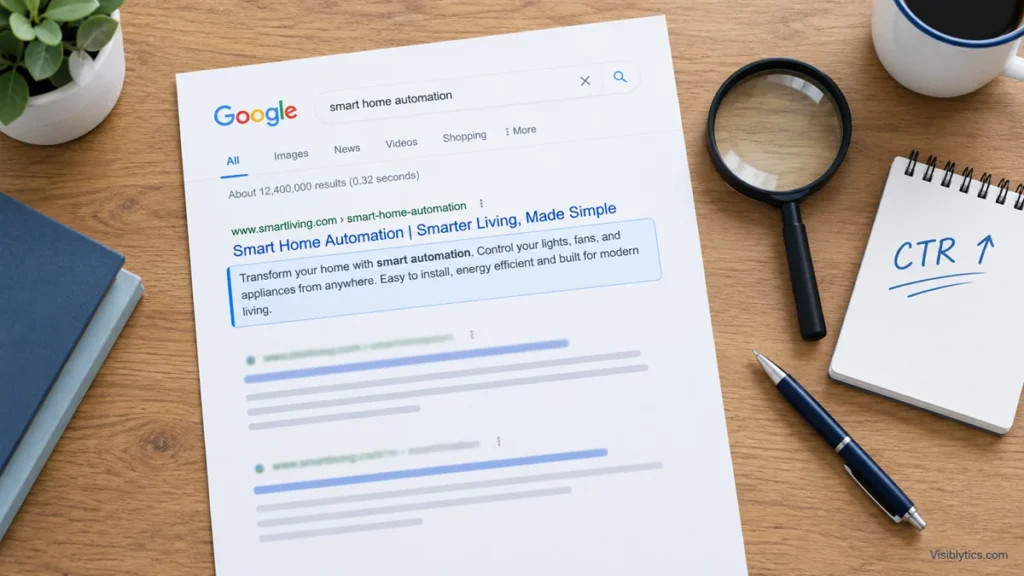
Meta descriptions do not directly affect your search rankings. Google has said this openly for years, and I have never seen a ranking change that I could tie to a meta description alone. But that is not the full story, and if you stop reading here you will make the wrong call about whether to bother writing them. Meta descriptions affect SEO indirectly, through click-through rate, through how your listing looks next to competitors, and through the small signals that add up over time. That indirect effect is real enough that I still write a custom one for every important page I work on.
I have been doing on-page SEO for a while now, and this exact question comes up in almost every client kickoff call. People have heard two conflicting things: “Google doesn’t use meta descriptions for ranking” and “meta descriptions are important for SEO.” Both statements are true at the same time, and the confusion usually comes from mixing up direct ranking factors with things that influence rankings in a roundabout way. Let me walk through this properly.
What a Meta Description Actually Is
A meta description is the short block of HTML that sits inside your page’s <head> tag and summarizes what the page is about. It looks something like this in the code:
<meta name="description" content="Your summary goes here, usually 150-160 characters.">Users never see this on the page itself. It only shows up in two places that matter: the search results snippet under your title tag, and sometimes when someone shares your link on social media, where it feeds the preview text. It is not a heading, it is not part of your body content, and Google has confirmed it plays no role in matching your page to a query the way your title tag or your H1 does.
That last part is where the “meta descriptions don’t matter” idea comes from. And on a purely technical level, it’s accurate.
Do Meta Descriptions Affect SEO Rankings Directly? No, and Google Has Said So
Google has stated plainly that it does not use the description meta tag as part of its ranking algorithm. This has been confirmed in their own developer documentation and repeated by Google’s search advocates on multiple occasions. If you’re asking specifically whether writing a keyword-stuffed meta description will push your page up the rankings, the answer is no. It won’t. Google’s crawlers read your description, but they don’t score it the way they score your title tag, your headings, or the content on the page.
I want to be direct about this because a lot of older SEO advice still treats meta descriptions like a ranking lever you can pull. It isn’t one. If you write “best plumber Chicago plumber near me Chicago plumbing services” into your description tag hoping it moves you up three spots, it won’t do anything except make your listing look spammy and less clickable. Worse, Google will often just rewrite it anyway.
So Why Do People Keep Saying Meta Descriptions Affect SEO?
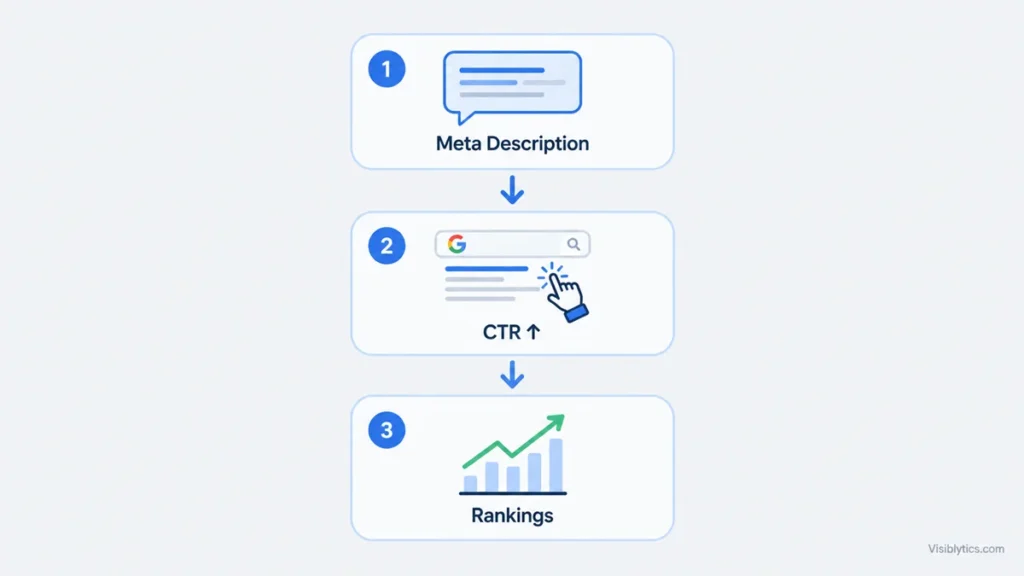
This is where the nuance lives, and it’s the part that gets lost in a lot of shorter articles on this topic. The question “do meta descriptions affect SEO” has two honest answers depending on what you mean by “affect.” Directly, as a ranking input, no. Indirectly, through user behavior, yes, and this indirect path is why professionals still treat meta descriptions as a real part of on-page SEO work.
Here’s the mechanism. Your meta description shapes whether someone clicks your result over the one above or below it in the search results. A higher click-through rate at a given position tends to correlate with better performance signals for that page. Google has never fully confirmed CTR as a direct ranking factor in the way title relevance is, but there’s enough evidence from Google’s own patents, from third-party testing, and from what search quality engineers have said in interviews to treat engagement as something the algorithm cares about over time. So the chain looks like this: better meta description leads to better click-through rate, better click-through rate is one of many signals that can support better rankings, and that’s the honest, indirect way meta descriptions affect SEO outcomes without being a ranking factor themselves.
I’ve tested this on a handful of client sites. On one B2B services site, we rewrote meta descriptions across 40 pages that were ranking on page one but getting weak clicks. We added specific numbers, a clear benefit statement, and a soft call to action to each one. Over the following six weeks, average CTR on those pages went up by roughly a third, and rankings on about a dozen of them improved slightly. I can’t prove the meta description rewrite alone caused the ranking bump, because we also fixed some internal linking at the same time. But the CTR jump was clean, and it happened right after the change went live.
Google Rewrites Meta Descriptions Constantly, and That Changes the Calculation
If you’re still deciding whether meta descriptions affect SEO enough to be worth your time, you need to know this: Google rewrites the majority of them anyway. Studies looking at this over the years have put the rewrite rate somewhere between 60% and 70% of the time, depending on the query and device. Google pulls a different snippet from your page content when it thinks that will match the searcher’s query better than what you wrote.
This isn’t Google being difficult. It’s Google trying to match the snippet to the specific words someone typed. If someone searches a long-tail phrase and your written description doesn’t contain those words, Google will often grab a sentence from your body content instead, because that sentence happens to include the exact phrase the user searched.
What this means practically: writing a meta description is not a guarantee of what shows up in the SERP. But it’s still worth doing, for two reasons. First, when Google does use your version, and it still does close to a third of the time, you get to control the pitch. Second, even when Google ignores your meta tag, having one still gives Google a clean, human-written fallback description to reference, and an empty meta description tends to correlate with lower-quality auto-generated snippets pulled from awkward parts of your page.
How I Write Meta Descriptions That Actually Help
Since meta descriptions affect SEO through clicks rather than through matching algorithms, the writing approach should be closer to ad copy than to keyword placement. Here’s what I actually do on client pages.
I keep it between 150 and 160 characters, because anything past that gets truncated on most devices and ends mid-sentence, which looks unfinished and hurts trust. I lead with the actual benefit or answer, not with a generic description of the page. I include the primary keyword once, naturally, mostly because it gets bolded in the SERP and draws the eye, not because I think it moves rankings. I write a different description for every single page. Duplicate meta descriptions across a site are one of the most common issues I flag in audits, and Google Search Console will flag them too under “Duplicate, without user-selected canonical” adjacent issues in some cases.
I also try to leave a small gap of curiosity rather than explaining the entire page in the snippet. If someone already knows the full answer from the snippet, they have less reason to click through. And I always write in active voice with a light call to action, something like “see how” or “compare options,” rather than a passive summary sentence.
If I’m short on time across a large site, I’ll run pages through a meta description generator to get a fast first draft, then edit it by hand so it doesn’t read like every other AI-written snippet in the results page. I do the same thing with a SERP snippet previewer before publishing, just to check the pixel width and make sure nothing gets cut off awkwardly on mobile.
Common Mistakes That Waste the SEO Value You Could Get From Meta Descriptions
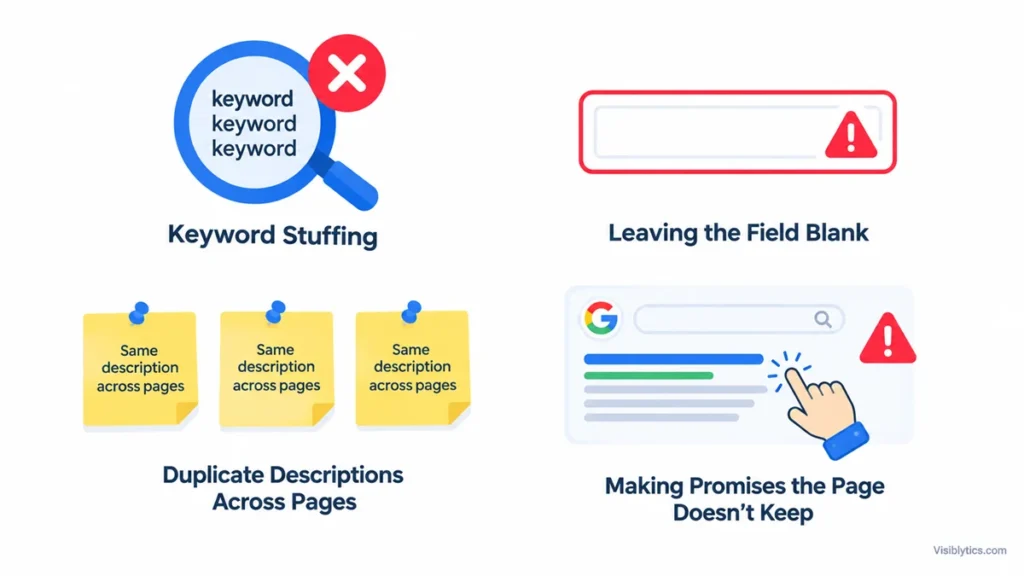
Keyword stuffing is the big one. Cramming the same phrase in three times doesn’t help rankings and it reads badly enough to lower your click-through rate, which undoes the one real benefit meta descriptions provide.
Leaving the field blank is another. When you don’t write one, Google pulls a snippet from wherever on the page it thinks is relevant, and that’s often an awkward mid-sentence chunk that doesn’t sell the click at all.
Writing the same description across a category of pages is common on ecommerce and local business sites, and it’s a mistake I fix constantly. If ten product pages all say “Shop our wide selection of quality products at great prices,” none of them stand out, and Google is more likely to treat them as thin, near-duplicate content on the whole page level, which is a real issue beyond just the tag itself.
Making promises the page doesn’t deliver on is the last one, and it’s sneaky because it can work short-term. A misleading description might get the click, but if the visitor bounces immediately because the page doesn’t match what was promised, that behavior pattern isn’t good for your site over time.
Meta Descriptions vs Meta Titles: Which One Actually Moves the Needle
Your title tag matters more for rankings than your meta description does, and it’s not close. Google uses your title tag as a direct relevance signal, weighting the words in it when deciding what your page is about and matching it to search queries. Your meta description doesn’t get that same treatment. So if you only have time to fix one thing on a page, fix the title tag first.
That said, they work as a pair in the SERP. A strong title gets someone to notice your result, and a strong description gets them to actually click it over the other nine blue links on the page. I usually write both together for exactly this reason, because a title that promises something and a description that fails to back it up wastes the click opportunity. I keep a meta title generator bookmarked for quick brainstorming on titles too, for the same reason I use one for descriptions: speed on the first draft, then a manual pass to make it sound like a person wrote it.
My Honest Answer: So Do Meta Descriptions Affect SEO or Not?
Here’s where I land after doing this for a living. Meta descriptions do not affect SEO rankings directly, and anyone telling you otherwise is either working from outdated information or overselling the tactic. But meta descriptions affect SEO outcomes indirectly, through click-through rate, through how your brand looks next to competitors in a crowded results page, and through giving Google a clean fallback when it doesn’t rewrite your snippet.
If your goal is to game the algorithm with keywords in a tag nobody reads on the page itself, skip it, it won’t work. If your goal is to get more of the people who already find your page in Google to actually click through, write a good one for every page that matters. That’s the entire debate, once you strip away the confusion between “ranking factor” and “thing that influences rankings.”
If you’re auditing a whole site and want to know where your on-page basics stand beyond just meta descriptions, that’s the kind of gap analysis I usually run early in an on-page SEO engagement, since title tags, headings, and descriptions tend to have the same problems clustered on the same pages.
❓ Frequently Asked Questions
Do meta descriptions affect SEO rankings directly?
No. Google has confirmed the meta description tag is not used as a ranking signal.
Do meta descriptions affect SEO indirectly?
Yes, mainly through click-through rate, which can influence how a page performs over time even though it isn’t a confirmed direct ranking factor on its own.
Why does Google rewrite my meta description?
Usually because your written version doesn’t contain the exact words someone searched for, so Google pulls a more relevant sentence straight from your page content instead.
Is it still worth writing meta descriptions in 2026?
Yes. Even with a rewrite rate of 60 to 70%, you control the snippet close to a third of the time, and a well-written one still gives search engines a clean fallback for the rest.
Do meta descriptions need to include the target keyword?
Not for ranking purposes, since Google doesn’t score the tag that way. But including it once is still worth doing, because matching keywords get bolded in the search results and that bolding tends to draw the eye and support click-through rate.
How long should a meta description be?
Aim for 150 to 160 characters. Google’s cutoff isn’t a fixed character count since it’s actually based on pixel width, so a description full of wide letters like “W” or “M” can get truncated earlier than one full of narrow letters like “i” or “l”. When in doubt, keep it on the shorter side.
What happens if I don’t write a meta description at all?
Google will auto-generate one by pulling a snippet from your page content, usually based on whatever text seems most relevant to the search query. This can work fine on well-structured pages, but on cluttered or poorly written pages it often produces an awkward, mid-sentence snippet that doesn’t sell the click.
Can a bad meta description hurt my SEO?
Not directly through the tag itself, but indirectly, yes. A vague, misleading, or duplicate description can suppress your click-through rate, and on ecommerce or local sites, near-identical descriptions across many pages can read as thin or templated content when search engines evaluate the page as a whole.
Do meta descriptions matter for AI search results and AI Overviews?
This is still developing, and I’d flag it as an area to watch rather than something settled. Early observations suggest AI-generated summaries in search often pull from body content and structured data rather than the meta description tag specifically, so writing clear, well-structured on-page content matters at least as much here as the meta tag does. I’d recommend checking Google’s own documentation for the latest guidance, since this behavior is likely to keep shifting.
Should every page on my site have a unique meta description?
Yes. Duplicate meta descriptions across multiple pages are one of the most common issues I flag in site audits, especially on ecommerce category pages and local business location pages. Search Console will often surface these as duplicate metadata issues, and they weaken the case for each page being distinct and worth ranking on its own.
Do meta descriptions affect SEO more for new websites than established ones?
I haven’t seen solid data confirming this either way, so treat it as my working observation rather than a proven fact: newer sites with less authority and fewer backlinks tend to rely more heavily on click-through rate to earn early visibility, so a strong meta description may carry a bit more relative weight for a new site simply because there are fewer other signals working in its favor yet.