Most SEO programs optimize pages. Knowledge Graph SEO optimizes entities. The shift sounds subtle but it changes almost every decision: what you build, what you measure, what counts as progress, and what you do when something is wrong.
A page can rank for a keyword without Google having any structured understanding of the entity behind it. An entity with strong knowledge graph presence will be accurately understood, correctly attributed, and confidently cited across search results, AI answers, and knowledge panels, regardless of whether any individual page is ranking. The two are not mutually exclusive, but they require different work, and most brands do only one of them.
This guide covers the practical implementation of Knowledge Graph SEO: the specific actions that move an entity from absent or ambiguous in Google’s knowledge graph to well-defined, well-connected, and confidently represented.
What Knowledge Graph SEO Actually Optimizes For
Traditional SEO optimizes for ranking signals: keywords, links, page speed, content relevance. Knowledge Graph SEO optimizes for entity signals: clarity, consistency, relationships, and corroboration.
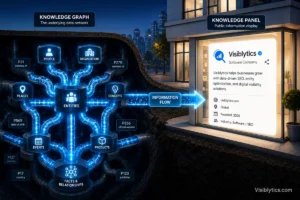
The outcome of traditional SEO is a ranked page. The outcome of Knowledge Graph SEO is a recognized entity: an organization or person that search engines can identify unambiguously, describe accurately, connect to the right topical network, and represent with confidence across all search surfaces.
The distinction matters for measurement. You cannot directly check your knowledge graph ranking the way you can check page rankings. What you can observe are the downstream effects of knowledge graph strength:
- Branded searches return entity-aware results (knowledge panel, rich entity information in snippets)
- Your organization is correctly described in AI-generated answers about your topic area
- Content is correctly attributed to named authors in search results
- Your entity appears in related entity suggestions and knowledge panel sidebars for relevant topics
- Google correctly categorizes your entity in its topic taxonomy
If none of these are happening, knowledge graph presence is weak or absent. If they are happening accurately, knowledge graph work is producing results.
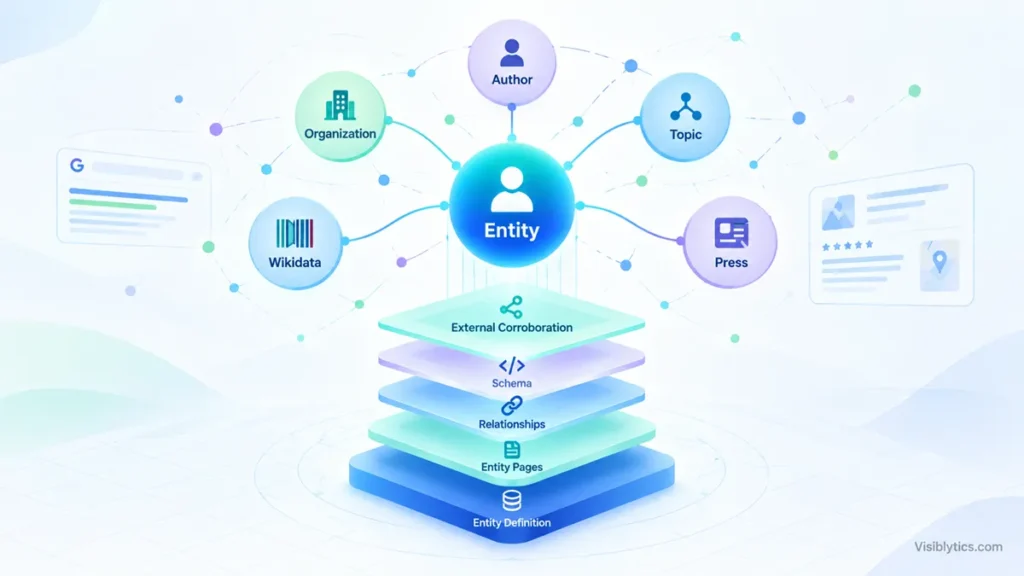
The Knowledge Graph SEO Stack
Knowledge Graph SEO builds in layers. Each layer depends on the one below it, and skipping a layer produces a structure that is visible but unstable.
Layer 5: External Corroboration
    (third-party mentions, Wikidata, press coverage, co-citations)
         ↑
Layer 4: Relationship Mapping
    (explicit entity connections via schema and content)
         ↑
Layer 3: Schema Implementation
    (machine-readable entity attributes and relationships)
         ↑
Layer 2: Entity Page Foundation
    (entity homepage, author pages, consistent naming)
         ↑
Layer 1: Entity Definition
    (exact name, type, description, founding date, key people)
Most brands that struggle with knowledge graph presence are missing Layer 1 or Layer 2 while trying to work at Layer 4 or 5. External corroboration from a press mention does very little for a brand with no entity homepage and no schema, because the knowledge graph has no stable anchor to attach the mention to. The stack has to be built from the bottom up.
Layer 1: Entity Definition
Before any technical implementation, the entity needs to be precisely defined. This is not a technical task. It is a strategic one: deciding exactly what the canonical version of every core attribute is.
Entity name. The exact official name as it should appear everywhere. Not a variant, not a domain name, not a tagline. “Visiblytics” not “Visiblytics.com” or “Visiblytics SEO.” This is the name that will go into schema, Wikidata, social profiles, and every piece of outreach material. Any variation from this exact name anywhere creates a disambiguation cost.
Entity type. What category does this entity belong to? For a business: organization type (ProfessionalService, SoftwareApplication, LocalBusiness, etc.). For a person: professional category (SEO specialist, researcher, author, etc.). The type determines which schema properties are most relevant and how search engines classify the entity.
Core description. One to two sentences, factual and neutral. Not a value proposition. A description. “Visiblytics is an SEO and search intelligence platform focused on AI Visibility, Entity SEO, and Knowledge Graph Optimization.” This sentence goes into schema, Wikidata, social profiles, and the entity homepage. It should be identical everywhere.
Founding date. Year at minimum. This disambiguates your entity from similarly-named entities founded at different times and provides a verifiable attribute that multiple sources can corroborate.
Key person connections. Who founded or leads the organization? These person-to-organization relationships are among the most important entity signals in the knowledge graph. They need to be named explicitly, not left to inference.
Document all of this before touching any technical implementation. It is the source of truth that every subsequent layer will reference.
Layer 2: Entity Page Foundation
Entity pages are the on-site anchors that knowledge graph systems use as the primary source of truth about your entity. The full guide to building entity pages is in the Entity SEO guide and the What Is an Entity Homepage guide. Here is what matters specifically for knowledge graph SEO.
Organization entity page. A single page that states all the Layer 1 attributes clearly in prose before schema makes them machine-readable. This page needs to be crawlable, indexable, and internally linked from other key pages on the site. It should not be the homepage unless the homepage is genuinely optimized for entity communication rather than conversion.
Person entity pages. Every person who publishes content on your site needs a complete author page: full name, current role, organizational affiliation, credentials, and a body of work section. The author page is the person entity homepage. Without it, content published under that person’s name has no verifiable entity anchor.
Naming consistency across the site. The entity name defined in Layer 1 should appear exactly the same way on every page that mentions the organization: the entity page, the homepage, the footer, the about page, and any content that names the organization. Inconsistency on your own site is the easiest knowledge graph problem to avoid and the one that causes the most confusion in practice.
Layer 3: Schema Implementation
Schema markup is the machine-readable layer that converts your entity page content into structured data that knowledge graph systems can process without inference. The Schema and Knowledge Graphs guide covers the full technical implementation. Here is the strategic overview for KG SEO purposes.
Organization schema on entity page and homepage:
{
  "@context": "https://schema.org",
  "@type": "ProfessionalService",
  "name": "Visiblytics",
  "url": "https://visiblytics.com",
  "logo": "https://visiblytics.com/wp-content/uploads/2026/07/cropped-visiblytics-favicon-512.png",
  "description": "An SEO and search intelligence platform focused on AI Visibility, Entity SEO, and Knowledge Graph Optimization.",
  "foundingDate": "2026",
  "founder": {
    "@type": "Person",
    "name": "Suraj Saini",
    "url": "https://visiblytics.com/about/"
  },
  "knowsAbout": ["Entity SEO", "AI Visibility", "Knowledge Graph Optimization", "LLM SEO"],
  "sameAs": [
    "https://www.linkedin.com/company/visiblytics",
    "https://www.wikidata.org/wiki/Q[your-Q-number]"
  ]
}
Person schema on every author page:
{
  "@context": "https://schema.org",
  "@type": "Person",
  "name": "Suraj Saini",
  "url": "https://visiblytics.com/about/",
  "jobTitle": "SEO Specialist and Founder",
  "worksFor": {
    "@type": "Organization",
    "name": "Visiblytics",
    "url": "https://visiblytics.com"
  },
  "knowsAbout": ["Entity SEO", "AI Visibility", "Knowledge Graph Optimization"],
  "sameAs": [
    "https://www.linkedin.com/in/suraj-saini-seo",
    "https://www.wikidata.org/wiki/Q[person-Q-number]"
  ]
}
Article schema on every piece of content:
Every article needs Article schema with an explicit author property referencing the author page URL. Without this, search engines have to infer the author relationship from the byline rather than reading it from structured data. The difference in entity attribution confidence is meaningful.
Use the Schema Markup Generator to build these without writing JSON-LD manually, and the Structured Data Testing Tool to validate them before publishing.
Layer 4: Relationship Mapping
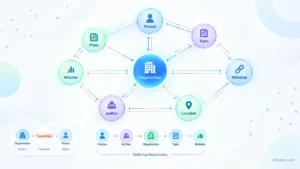
A knowledge graph is not a collection of isolated entity definitions. It is a network. Layer 4 is about making the connections between entities explicit both in schema and in content.
Person-to-organization relationships. The founder property in Organization schema and the worksFor property in Person schema create a bidirectional machine-readable connection. Both directions need to be stated: organization points to person, person points back to organization. A one-directional relationship is weaker than a bidirectional one.
Author-to-content relationships. Every article should link to its author page, and the author page should link to (or list) the author’s body of work. Article schema with the author property makes this machine-readable. Internal linking makes it crawlable. Both matter.
Topic-to-entity relationships. The knowsAbout property in Organization and Person schema explicitly connects your entity to topic areas. Content clusters that consistently cover a specific topic area create implicit topical relationships through co-occurrence. The combination of explicit schema and consistent content coverage builds the strongest topical entity signal.
sameAs relationships. The sameAs property in schema is what connects your on-site entity definition to your external profiles. Every platform where your entity has a presence should be listed in sameAs: LinkedIn, Wikidata, Twitter/X, and any other credible profiles. This is what allows knowledge graph systems to recognize that the entity on your site and the entity on each external platform are the same thing.
Layer 5: External Corroboration
External corroboration is the layer that converts self-asserted entity definition into knowledge-graph-verified entity recognition. It cannot be rushed and cannot be manufactured entirely. But it can be pursued deliberately.
Wikidata entry. A correctly structured Wikidata entry is the highest-priority external corroboration action for most businesses. It provides a structured, third-party-maintained, machine-readable entity definition that knowledge graph systems treat as independent verification. The Wikidata for SEO guide covers the full process.
Press coverage with entity attribution. Each mention in a credible publication that names your entity, describes what it does, and attributes expertise in your topic area is a corroboration signal. The entity briefing approach covered in the Digital PR guide ensures that coverage uses accurate, consistent entity information that maximizes its knowledge graph value.
Directory presences with consistent information. Industry directories, professional associations, and structured listing sites provide additional corroboration signals. Their individual weight is lower than press coverage or Wikidata, but their cumulative contribution to a consistent entity signal across many sources matters.
Co-citations with recognized entities. When credible publications place your entity in the same content as recognized leaders in your field, those co-citations build your entity’s network position in the knowledge graph. The full mechanics are in the Co-Citations guide.
How to Audit Your Current Knowledge Graph Presence
Before building, it helps to know where you currently stand. Here is a practical audit process.
Check 1: Branded search test. Search your exact entity name in Google. What appears? If you see a knowledge panel, your entity has reached a meaningful knowledge graph confidence threshold. If you see only blue links with no entity-aware features, your knowledge graph presence is weak or absent. Note the description Google uses for your entity in any rich snippets: does it match your authoritative description?
Check 2: Entity recognition test. Search “[your entity name] + [your topic area]” (e.g. “Visiblytics entity SEO”). Does Google associate your entity with your stated topic? Do your pages appear with author attribution in results? Entity recognition in topical contexts indicates your entity has been connected to your topic area in the knowledge graph.
Check 3: Author attribution test. Search the name of a key author from your site. Does Google show their content with author attribution? Does any author information appear in search snippets? Weak or absent author attribution indicates Person entity signals are incomplete.
Check 4: Wikidata check. Search your entity name on Wikidata.org. Does an entry exist? Is it complete and accurate? An absent or inaccurate Wikidata entry is one of the highest-priority fixes available.
Check 5: Schema validation. Run your entity homepage and key author pages through the Structured Data Testing Tool. Are the schema properties correct? Are there errors? Are the sameAs references complete?
Check 6: Consistency audit. Compare your entity name, description, and key attributes across your website, schema, LinkedIn, Twitter/X, and Wikidata. Every inconsistency is a knowledge graph disambiguation cost.
Measuring Knowledge Graph SEO Progress
Knowledge graph progress does not produce a single score. It produces observable changes across multiple signals over time.
Short-term indicators (weeks to months):
- Schema errors resolved in Search Console
- Structured data appearing correctly for entity pages
- Wikidata entry created and referenced in schema
Medium-term indicators (months):
- Author attribution appearing in search snippets
- Entity-aware results for branded searches
- Correct entity description in AI-generated answers about your brand
Long-term indicators (6+ months):
- Knowledge panel appearance for branded searches
- Entity appearing in related entity suggestions for relevant topic searches
- Consistent, accurate representation across AI systems when answering questions in your topic area
The Knowledge Graph Audit guide covers a more detailed measurement and gap-identification methodology.
Common Knowledge Graph SEO Mistakes
Optimizing pages without defining the entity. Adding schema markup to pages without first establishing a clear, consistent entity definition produces schema that points to an ambiguous entity. The schema is technically valid but strategically incomplete.
Building schema without external corroboration. Schema is self-asserted. It tells Google what you claim about your entity. Without Wikidata, press coverage, and consistent external profiles to corroborate those claims, the schema signals carry limited weight.
Treating Knowledge Graph SEO as a one-time project. Entity information changes: roles change, organizations pivot, URLs move. Schema that is never updated after changes becomes a source of conflicting signals rather than corroboration. Build entity maintenance into ongoing SEO operations.
Ignoring person entities. Organizations that invest in organization entity work while leaving their authors anonymous are building half the foundation. Author entity signals (Person schema, Wikidata, consistent credentials) are increasingly important for both content attribution and AI citation likelihood.
Measuring success only with rankings. A page can rank without strong knowledge graph presence, and strong knowledge graph presence can exist without any individual page ranking highly. Knowledge Graph SEO success needs its own measurement framework focused on entity recognition signals, not just keyword rankings.
❓ Frequently Asked Questions
What is Knowledge Graph SEO?
Knowledge Graph SEO is the practice of optimizing how your entity (your organization, your people, your brand) is defined, connected, and represented in knowledge graph systems used by search engines and AI tools. It differs from traditional SEO in that it optimizes entity signals (clarity, consistency, relationships, corroboration) rather than page signals (keywords, links, content relevance). The outcome is entity recognition rather than keyword rankings.
How long does it take to build knowledge graph presence?
The technical foundation (entity pages, schema, Wikidata) can be built in days to weeks and will begin influencing entity recognition relatively quickly. External corroboration (press coverage, directory presences, co-citations) builds over months. Full knowledge graph recognition, indicated by knowledge panels and accurate AI representation, typically takes several months of consistent entity work. I cannot give a verified universal timeline since it depends on your starting point, industry, and the strength of your corroboration signals.
Does schema markup directly create knowledge graph entries?
No. Schema markup makes your entity’s attributes and relationships explicitly machine-readable, which removes ambiguity and accelerates entity recognition. It does not directly create a knowledge graph entry. The knowledge graph entry develops as corroboration accumulates from multiple sources. Schema is a necessary input to that process, not a sufficient one.
What is the most important first step in Knowledge Graph SEO?
Define your entity precisely before doing anything technical. Decide on the exact entity name, type, description, and founding date that will appear everywhere. Without this definition, every technical action that follows is building on an inconsistent foundation. Entity definition is Layer 1 of the Knowledge Graph SEO stack for a reason: everything else depends on it being correct.
How is Knowledge Graph SEO different from traditional SEO?
Traditional SEO optimizes pages for keyword rankings. Knowledge Graph SEO optimizes entities for search engine and AI system understanding. Traditional SEO measures success with rankings and traffic. Knowledge Graph SEO measures success with entity recognition signals: knowledge panels, accurate AI representation, author attribution in search results, and entity co-occurrence in relevant topical contexts. Both are necessary for comprehensive search visibility in 2026.
Can small businesses do Knowledge Graph SEO?
Yes. The foundational layers of Knowledge Graph SEO (entity definition, entity pages, schema implementation) are achievable for any business regardless of size. The external corroboration layer takes more time for smaller businesses because earning press coverage and Wikidata entries requires a verifiable public track record. But the technical foundation work, which is where most businesses regardless of size are weakest, is fully achievable immediately.
Entity by Entity, Layer by Layer
Knowledge Graph SEO is not a campaign. It is a foundation that compounds over time. Each layer of the stack makes the next layer more effective: entity pages make schema meaningful, schema makes relationships explicit, relationships make external corroboration attributable, and external corroboration makes the whole structure confident enough for knowledge graphs to represent your entity publicly.
The brands that start building this foundation now will be the ones search engines and AI systems can represent accurately and confidently as the importance of entity understanding continues to grow.
For the foundational entity work that Knowledge Graph SEO builds on, the Entity SEO guide covers the complete framework. For the full knowledge graph structure and mechanics, the Knowledge Graph guide covers everything this guide assumes as background.