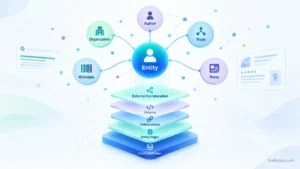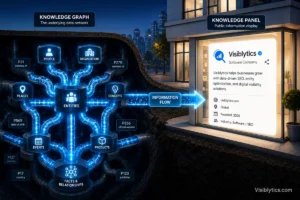
A knowledge graph without relationships is just a list of facts. What makes a knowledge graph powerful, and what makes it genuinely different from a traditional database, is the network of connections between entities. Those connections are what allow a search engine to answer “who founded the company that makes ChatGPT?” by traversing a chain of relationships rather than matching keywords. They are what allow an AI system to understand that your entity belongs in a specific topical context without reading every page on your site.
Building strong entity relationships in the knowledge graph is therefore not a secondary task to be done after the “real” entity work. It is the real entity work. A clearly defined entity with no connections to the broader knowledge graph is an isolated node. The same entity with well-mapped, well-corroborated relationships is a connected node that search engines and AI systems can reason from and navigate toward.
How Relationships Are Stored in Knowledge Graphs
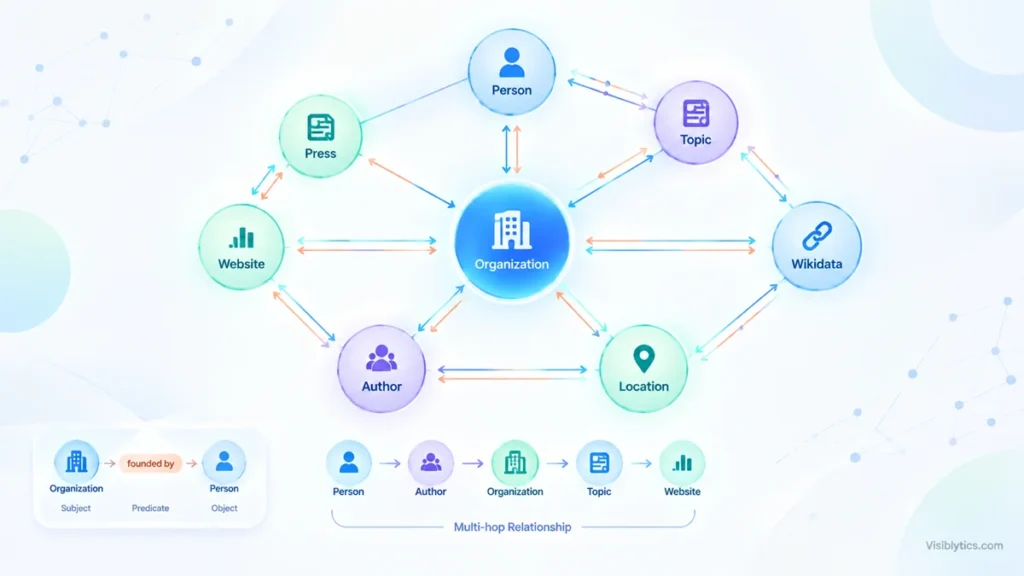
Knowledge graphs store relationships as triples: a subject, a predicate, and an object. Every relationship in a knowledge graph is expressed in this three-part format.
Subject          Predicate        Object
───────────────────────────────────────────
Suraj Saini  →  founded      →  Visiblytics
Visiblytics  →  publishes    →  Entity SEO content
OpenAI       →  created      →  ChatGPT
Steve Jobs   →  co-founded   →  Apple
The subject is the entity the statement is about. The predicate is the type of relationship. The object is the entity or value the relationship points to. Together, the three form a machine-readable statement of fact that a knowledge graph can store, query, and traverse.
This triple structure is what makes knowledge graphs navigable in ways that traditional databases are not. Starting from “Suraj Saini” and following the “founded” predicate reaches “Visiblytics.” Following “publishes” from “Visiblytics” reaches “Entity SEO content.” Following “covers topic” from “Entity SEO content” reaches “Knowledge Graph Optimization.” A multi-hop query can traverse this entire chain in a single operation.
The four relationship types (foundational, topical, professional, and organizational) are covered from the entity SEO perspective in the Entity Relationships guide. This guide focuses specifically on how those relationship types function within knowledge graph systems and what that means for how you build and express them.
Relationship Direction and Inverse Relationships
Every relationship in a knowledge graph has a direction. “Suraj Saini founded Visiblytics” is a different triple from “Visiblytics was founded by Suraj Saini,” even though they describe the same fact. In knowledge graph terms, these are two different predicates (founded vs foundedBy) traversing in opposite directions across the same edge.
Suraj Saini  →(founded)→     Visiblytics
Visiblytics  →(foundedBy)→   Suraj Saini
Many knowledge graph systems infer inverse relationships automatically. If a knowledge graph knows “Suraj Saini founded Visiblytics,” it can infer “Visiblytics was founded by Suraj Saini” without being told explicitly. However, inference is less reliable than explicit statement. The more directly both directions of a relationship are stated, the more confidently the knowledge graph stores both traversal paths.
In schema markup, this means implementing relationships in both directions where the vocabulary supports it:
- Organization schema includes
founderpointing to the Person entity - Person schema includes
worksForpointing back to the Organization entity - Article schema includes
authorpointing to the Person entity - Author page content links back to published articles
Each of these is implementing one direction of a bidirectional relationship. Together they give knowledge graph systems two independent statements confirming the same connection, which produces higher confidence than either statement alone.
Relationship Density and Entity Network Position
Not all entities in a knowledge graph have the same number of relationships. Some are densely connected to many other recognized entities. Others are sparsely connected or isolated. This difference in relationship density directly affects how useful an entity is to a knowledge graph system and how confidently that system can work with it.
A densely connected entity can be reached through many different traversal paths. If someone searches for “AI Visibility experts” and the knowledge graph can reach Visiblytics through multiple paths (via Entity SEO content, via connections to recognized tools in the space, via co-citations with established entities, via the founder’s person entity connections), the probability of the entity appearing in relevant results is higher than if it is reachable through only one path.
A sparsely connected entity is reachable only through limited paths, which means it appears less frequently in traversal-dependent search results and is more easily bypassed by entities with stronger network positions.
Building relationship density is therefore not just about having the right relationships. It is about having enough relationships, to enough recognized entities, across enough topical contexts, that your entity becomes genuinely integrated into the knowledge graph network rather than sitting at its periphery.
Practical relationship density targets for a new entity:
- At least one foundational relationship (organization-to-founder or person-to-employer) with both directions explicitly stated in schema
- At least two to three topical relationships connecting the entity to specific subject areas, expressed through both
knowsAboutin schema and sustained content coverage - At least one external relationship confirmed by an independent source (Wikidata entry linking to official profiles, press mention naming the entity in topical context)
- sameAs references connecting the entity to at least three verified external platforms
These are not guaranteed thresholds for knowledge graph inclusion. They are practical minimums for beginning to establish a connected presence rather than an isolated one.
How Knowledge Graphs Weight Different Relationship Types
Not all relationships carry equal weight in a knowledge graph. The strength of a relationship signal depends on three factors: the authority of the source stating it, the corroboration from other independent sources, and the specificity of the predicate.
Source authority. A relationship stated in Organization schema on your own entity homepage is a self-asserted signal. The same relationship stated in Wikidata is an independent, structured, third-party signal. The same relationship mentioned in a credible publication is an editorial corroboration signal. Each source type carries different weight. The highest-confidence relationships are those that appear across multiple source types: self-asserted in schema, corroborated in Wikidata, and confirmed in credible external coverage.
Corroboration depth. A relationship that appears in only one source has low corroboration. The same relationship appearing in schema, in Wikidata, and in a press mention has three independent corroborations. Knowledge graph systems increase confidence in a relationship with each independent corroboration, which is why the same relationship stated consistently across multiple surfaces is more valuable than many different relationships each stated only once.
Predicate specificity. A generic relationship (“is associated with”) is less informative than a specific one (“founded,” “is a type of,” “specializes in”). Knowledge graphs prefer specific predicates because they carry more semantic meaning and enable more precise traversal. Schema.org’s relationship vocabulary is built around specific predicates for this reason: founder, memberOf, worksFor, knowsAbout, about are all more specific and more useful than a generic “related to” relationship.
Relationship Types and Their Knowledge Graph Functions
Each category of entity relationship serves a distinct function in how a knowledge graph builds understanding of an entity. Here is how each type maps to specific knowledge graph outcomes.
Foundational relationships (founded, created, established).
These relationships place your entity in its origin context. They connect an organization to the people who created it and vice versa. In knowledge graph terms, they are some of the most-traversed relationships because queries about who is behind an entity are extremely common. A well-corroborated foundational relationship makes the entity reachable from the founder’s person entity and vice versa, doubling the entry points into your entity network.
Topical relationships (publishes about, specializes in, covers).
These relationships connect your entity to the subject areas it is associated with. In knowledge graph terms, they are what determine whether your entity appears in topical search results and topical AI answers. When a knowledge graph can traverse from “Entity SEO” to “Visiblytics” through a topical relationship, Visiblytics becomes a relevant node for any query involving Entity SEO. Building topical relationships requires both explicit schema (knowsAbout) and sustained content coverage that creates implicit associations through entity co-occurrence.
Professional relationships (works at, certified by, member of).
These relationships place person entities in their professional context. They connect individuals to organizations, credentials, and professional communities. In knowledge graph terms, they are what enable a search engine to answer “who are the SEO specialists at [organization]?” or “what credentials does this person have?” Strong professional relationships also transfer authority signals between entities: a person entity with strong recognition can lend credibility signals to the organization entity they are connected to.
Organizational relationships (owns, is a subsidiary of, is a type of).
These relationships place your entity in its industry and category context. The @type property in schema is one expression of this: declaring that your entity is a ProfessionalService rather than just an Organization is stating a categorical relationship. Category membership relationships are what allow knowledge graphs to answer category-level queries and to correctly classify your entity when disambiguating it from others.
Making Relationships Machine-Readable: The Schema Layer
Schema markup is the primary mechanism for making entity relationships explicitly machine-readable. The Schema and Knowledge Graphs guide covers the full technical implementation. Here is the relationship-specific layer.
Expressing foundational relationships:
{
  "@type": "Organization",
  "name": "Visiblytics",
  "founder": {
    "@type": "Person",
    "name": "Suraj Saini",
    "url": "https://visiblytics.com/about/"
  }
}
And the inverse on the person entity page:
{
  "@type": "Person",
  "name": "Suraj Saini",
  "worksFor": {
    "@type": "Organization",
    "name": "Visiblytics",
    "url": "https://visiblytics.com"
  }
}
Expressing topical relationships:
{
  "@type": "Person",
  "name": "Suraj Saini",
  "knowsAbout": [
    "Entity SEO",
    "Knowledge Graph Optimization",
    "AI Visibility",
    "LLM SEO"
  ]
}
Expressing categorical relationships:
{
  "@type": "ProfessionalService",
  "name": "Visiblytics",
  "additionalType": "https://www.wikidata.org/wiki/Q476068"
}
Expressing sameAs relationships (cross-platform identity):
{
  "@type": "Organization",
  "name": "Visiblytics",
  "sameAs": [
    "https://www.wikidata.org/wiki/Q[your-Q-number]",
    "https://www.linkedin.com/company/visiblytics",
    "https://twitter.com/visiblytics"
  ]
}
Each sameAs entry is a relationship statement: “the entity on this page and the entity at this URL are the same thing.” This is one of the most powerful relationship types for knowledge graph purposes because it allows knowledge graph systems to merge signals from multiple platforms into a single, coherent entity representation.
Relationship Gaps: What to Look For
Most entities that struggle with knowledge graph presence are not missing all relationships. They are missing specific relationship types that create critical gaps in their network connectivity.
Missing inverse relationships. The organization schema includes a founder, but the person’s author page has no worksFor pointing back. One direction of a relationship is present, the other is absent. Knowledge graph traversal from the person entity cannot reach the organization entity directly.
Missing topical relationships. The entity has foundational and categorical relationships but no topical connections. A knowledge graph can identify who the entity is but cannot connect it to any specific subject area. The entity is invisible for topic-based queries.
Missing corroboration for stated relationships. The schema states a relationship but no external source corroborates it. The knowledge graph has a self-asserted signal with no independent confirmation. The relationship is technically present but carries low confidence.
Broken sameAs references. A sameAs link points to a profile that no longer exists, uses a different entity name, or has been abandoned. The reference creates a dead end in the knowledge graph rather than a corroborated connection.
Relationship-attribute mismatch. The schema states that Suraj Saini founded Visiblytics, but the Wikidata entry for Visiblytics lists no founder, and the LinkedIn company page names no founder. The relationship is stated in one source but contradicted (by absence) in others. This is a corroboration gap that reduces relationship confidence.
Auditing Your Relationship Profile
Auditing relationship gaps requires checking both the schema layer and the external corroboration layer.
Schema relationship audit:
- Does Organization schema include
founderwith a URL pointing to the person entity page? - Does Person schema include
worksForwith a URL pointing to the organization entity page? - Does Person schema include
knowsAboutlisting specific topic areas? - Does Organization schema include
knowsAboutor equivalent topical signals? - Do all sameAs references point to active, consistently-named external profiles?
- Does Article schema include
authorwith a URL pointing to the author page?
External corroboration audit:
- Does the Wikidata entry state the same foundational relationships as the schema?
- Do LinkedIn profiles state the same organizational affiliations as the schema?
- Has at least one credible publication mentioned the entity in topical context?
- Are there co-citations connecting the entity to recognized peers in the topic area?
Relationship consistency audit:
- Do all sources that state a relationship use the same names for both entities in the relationship?
- Are relationships bidirectional across all sources that have them? (If LinkedIn shows the founder-to-company relationship, does the company page show the company-to-founder relationship?)
❓ Frequently Asked Questions
What is an entity relationship in a knowledge graph?
An entity relationship in a knowledge graph is a typed, directional connection between two entities, stored as a subject-predicate-object triple. For example: “Suraj Saini” (subject) “founded” (predicate) “Visiblytics” (object). Relationships are what allow knowledge graphs to answer multi-hop questions by traversing connections between entities rather than matching keywords in text.
How are knowledge graph relationships different from backlinks?
Backlinks are hyperlinks between web pages that contribute to traditional link authority signals. Knowledge graph relationships are semantic connections between entities that contribute to entity understanding and topical authority signals. A backlink says “this page points to that page.” A knowledge graph relationship says “this entity has a specific semantic connection to that entity.” They feed different systems and are built through different activities, though earning backlinks from topically relevant sources often generates co-citation signals that contribute to both.
How do I make entity relationships machine-readable?
Through schema markup. The founder and worksFor properties express foundational relationships. The knowsAbout property expresses topical relationships. The sameAs property expresses cross-platform identity relationships. The memberOf property expresses organizational membership relationships. Each schema property is a machine-readable predicate in the subject-predicate-object triple structure that knowledge graphs use to store relationships. The full schema implementation guide is at Schema and Knowledge Graphs.
Why do relationships need to be bidirectional?
Bidirectional relationships create two traversal paths instead of one. If only the organization-to-founder relationship is stated, a knowledge graph can navigate from the organization to the founder but may not be able to navigate from the founder back to the organization without inference. Stating both directions explicitly (Organization schema includes founder, Person schema includes worksFor) gives the knowledge graph two independent confirmations of the same connection and enables traversal in both directions with equal confidence.
How many entity relationships do I need?
There is no verified minimum for knowledge graph inclusion. The practical goal is sufficient relationship density to be genuinely connected to the knowledge graph network rather than isolated at its periphery. For most new entities, this means at least one well-corroborated foundational relationship, two to three topical relationships expressed in both schema and content, and sameAs connections to at least three verified external platforms. Building more relationships across more recognized entities over time strengthens network position progressively.
How do I know if my relationships are being recognized?
The most direct observable signals are: knowledge panel appearance showing related entities in the panel sidebar, accurate description of your entity’s topical area in AI-generated answers about your brand, and author attribution appearing correctly in search results for content from your site. These are downstream effects of knowledge graph relationship recognition. The Knowledge Graph Audit guide covers a more systematic methodology for evaluating relationship recognition.
Relationships Are What Make the Graph
A knowledge graph is not a collection of entity definitions. It is a network of connections. The entities are the nodes. The relationships are what make those nodes part of a graph rather than a list.
Every relationship you build, every connection you make explicit in schema, every corroboration you earn from an independent source, adds an edge to the network your entity belongs to. Each edge is another path through which search engines and AI systems can navigate to your entity from a related topic, person, or organization.
The entity work covered in the Entity SEO guide builds the nodes. The relationship work covered here builds the edges. Together they produce an entity that is not just defined but genuinely connected, and a connected entity is one that knowledge graph systems can work with confidently and AI systems can cite accurately.