
Your agency report is green. Impressions are up 40%, a dozen keywords moved onto page one, and the traffic chart slopes gently upward. Meanwhile the sales team is asking where the leads went. If you are six or more months into a retainer and the pipeline has not moved, the problem is almost never effort. It is what the effort is pointed at.
This article diagnoses why paid SEO stalls, shows which numbers actually indicate progress, and gives you a framework to audit your current provider before you decide to fire them or double down.
The SEO Plateau: Why Rankings and Traffic Stall Despite Monthly Retainers
The plateau has a recognizable shape. Months one to three produce visible activity: a technical cleanup, a batch of optimized pages, a first round of links. Reporting looks healthy. Then months four through eight flatten. Rankings hover, traffic grows slowly, and leads do not follow.
That shape usually means the program optimized for what is easy to measure rather than what is easy to monetize. Impressions, average position and total sessions all rise when you publish more pages or rank for broader, lower-intent queries. None of them requires a single qualified buyer to show up.
Before you diagnose failure, rule out the clock. Some programs are simply early, especially on domains with significant technical debt or low authority. Our month-by-month breakdown of how long SEO takes covers when 3-to-6 month compounding results should appear. If you are past that window and the leading indicators below are also flat, you are not looking at patience. You are looking at a structural problem.
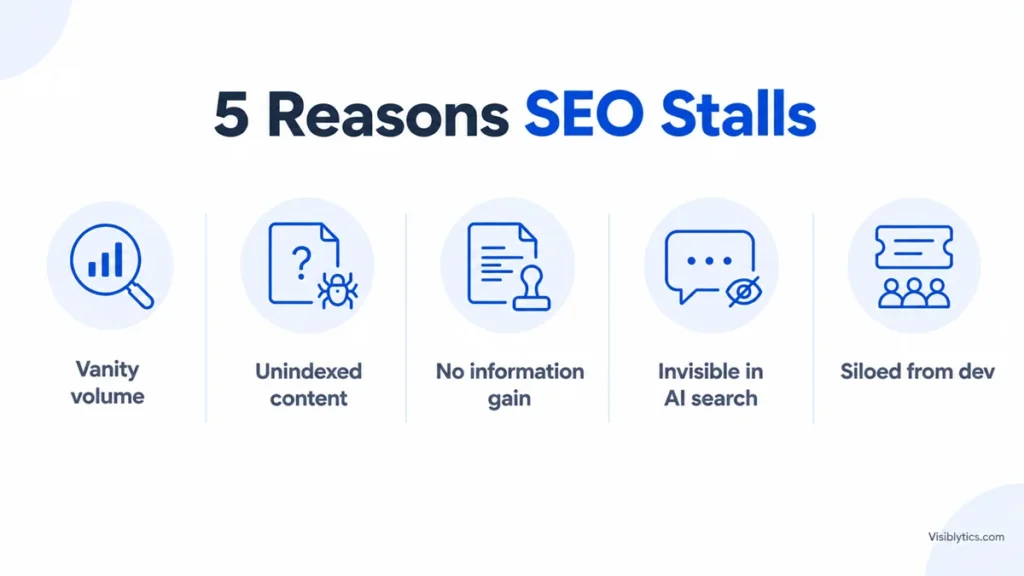
5 Reasons Your SEO Campaign Isn’t Producing Pipeline (Beyond “It Takes Time”)
Reason 1: Targeting Vanity Volume Instead of High-Intent Commercial Queries
The fastest way to make a keyword report look impressive is to chase volume. A page ranking #4 for a 12,000-searches-a-month informational term can generate more sessions than five commercial pages combined, and none of those visitors is evaluating a purchase.
Open Google Search Console, filter the Performance report to your top 50 queries by clicks, and tag each one: commercial (comparing, pricing, “hire”, “best”, “vs”), problem-aware, or informational. If fewer than a quarter of your clicks come from commercial and problem-aware queries, the program is feeding your blog, not your pipeline.
A second check: look at which pages receive organic landings that later convert in GA4. Often 3 to 5 pages produce nearly all organic leads while the retainer’s content effort goes elsewhere.
Cross-check in Ahrefs or Semrush: pull the organic keywords report, filter to positions 1-10, and sort by traffic. If the keywords driving most of that traffic carry no commercial modifier and a near-zero CPC, the report is flattering the campaign rather than describing buyers.
Reason 2: Technical Friction & Unindexed Content Bloat
Publishing 20 new pages a month means nothing if Google declines to index half of them. This is the most common hidden failure in content-heavy retainers.
In GSC’s Page Indexing report, compare the number of indexed URLs against the number of URLs you intend to rank. Large “Crawled – currently not indexed” or “Discovered – currently not indexed” buckets signal that Google is deprioritizing the site’s content, which can also drag down the pages that do rank.
Run a Screaming Frog crawl and check for the usual blockers: thin or near-duplicate pages, parameterized URLs, canonicals pointing to the wrong target, orphaned pages with no internal links, and slow templates (verify field data in PageSpeed Insights, not just the lab score). If the provider’s monthly report never mentions crawl or index status, nobody is watching it.
Reason 3: Generic Content Lacking Information Gain & Real E-E-A-T
If your articles can be rebuilt by summarizing the top five results, there is no reason for Google to rank yours above them, and no reason for an AI answer engine to cite it. Ranking systems increasingly reward content that adds something the existing results lack: original data, a proprietary framework, first-hand screenshots, a named practitioner’s judgment.
A quick test: take your best-performing target page and list what it says that the top three competing pages do not. If the list is empty, the page is a rewrite, not an asset. Pay attention to authorship too. Pages with no identifiable expert, no credentials and no evidence of real experience are weaker candidates for competitive commercial queries.
Also check what the budget can actually fund. If a $2,000 retainer delivers eight articles a month, that is $250 per article, or roughly one to two hours of work at $150-$250/hour, before any strategy, reporting or technical time. That is not enough for original research, expert input and real editing. Compare cost per asset against the hours it can fund before blaming the algorithm.
Reason 4: Zero Entity Optimization or AI Search Visibility
Search is no longer one engine. Buyers research in Google, Google’s AI Overviews, ChatGPT and Perplexity, often in the same session. A retainer built purely around ten blue links can show decent rankings while your brand is absent from the answers buyers actually read.
Check three things: whether your Organization schema is complete and consistent with your LinkedIn, Crunchbase and other profiles, whether your brand name is distinct enough for Google to disambiguate, and whether robots.txt accidentally blocks AI crawlers you want citing you. Then run ten category questions your buyers ask in ChatGPT and Perplexity and note whether you and your competitors appear. If competitors consistently do and you do not, traditional rank-tracking is hiding a real visibility gap.
Reason 5: Siloed SEO Without Developer or Product Alignment
Many stalled programs are not failing on strategy. They are failing on implementation. The SEO recommends fixing canonicals, restructuring templates, adding schema or improving INP, and the ticket sits in an engineering backlog for five months.
Ask for a list of every technical recommendation made in the last two quarters with its status: shipped, in progress, blocked, never ticketed. If most items are blocked or never ticketed, adding more SEO hours will not help. You need clearer acceptance criteria on tickets, an agreed sprint slot with engineering, and a provider comfortable working in Jira or Linear, not just in slide decks.
Verify shipped work yourself. Open Chrome DevTools on a template your provider says was fixed, inspect the rendered HTML for the canonical, robots meta tag and schema, then run the URL through GSC’s URL Inspection tool. “Shipped” in a status report and live in production are two different things.
Vanity Metrics vs. Revenue Indicators: What Healthy SEO Progress Actually Looks Like
Most reporting packages lean on the left column below. The right column is what indicates a program that will eventually pay for itself.
| Vanity metric | Why it misleads | Revenue indicator to track instead |
|---|---|---|
| Total impressions | Rises with any broad-term page, regardless of buyer intent | Impressions on commercial and problem-aware queries |
| Average position | Averages hundreds of irrelevant queries together | Position and clicks for your 20-30 money keywords |
| Total organic sessions | Includes brand searches and informational traffic | Organic sessions landing on commercial pages |
| Keywords ranking in top 10 | Counts low-volume or off-topic terms | Non-brand clicks to pages tied to a service or product |
| Domain rating / authority score | A third-party index, not a Google metric | Referring domains from relevant, editorially earned sources |
| Rank-tracker snapshots | Single location and device, often personalized | GSC data segmented by device and country |
Healthy progress looks like this, in rough order of appearance: more commercial URLs indexed, more queries entering positions 11-20, rising CTR on those queries, growth in non-brand clicks to commercial pages, then form fills, demo requests and pipeline attributable to organic. If the provider’s report stops at the first column, ask for the second.
How to Audit Your Current Agency or Freelancer Before Firing Them
Switching providers resets the clock. Before you do it, confirm the problem is the provider rather than the brief, access, or your own conversion setup. Use this table to score each area.
| Audit area | What to check | Healthy answer | Warning sign |
|---|---|---|---|
| Scope clarity | Is there an itemized monthly deliverables list? | Named outputs with dates | “Ongoing optimization” |
| Delivery | What shipped in the last 90 days (pages, fixes, links)? | Specific URLs and tickets you can verify | Activity descriptions with no URLs |
| Query targeting | Do top clicks come from commercial terms? | Majority commercial or problem-aware | Dominated by informational traffic |
| Indexation | Are target pages indexed? | Indexed share trending up | Growing “not indexed” buckets, never mentioned |
| Technical backlog | Status of recommended fixes | Most shipped or scheduled | Most blocked or never ticketed |
| Reporting | Do reports lead with revenue indicators? | Qualified sessions, conversions, pipeline | Impressions and rankings first |
| Attribution | Are organic conversions tracked in GA4 or CRM? | Verified events and source fields | No conversion tracking at all |
| Access and ownership | Do you control your GSC, GA4 and content files? | Full admin access | Provider-owned dashboards only |
| Seniority | Who personally edits pages and runs crawls? | Named practitioner you have met | Account manager relaying to unseen staff |
Score it honestly. Failures in scope, delivery and seniority point to a provider problem. Failures in technical backlog and attribution often point to an internal problem that a new vendor will inherit. If the picture is mixed and you cannot tell which side the fault lies on, an independent SEO audit from someone with no stake in the current engagement is the cleanest way to settle it before you spend another quarter’s budget.
The Turning Point: When to Transition from Ad-Hoc Fixes to a Structured Monthly Retainer
Not every SEO problem needs a retainer, and not every retainer needs replacing. Ad-hoc work is the right call when the issue is bounded: a migration, a one-time technical cleanup, a defined content refresh. A structured retainer makes sense when the work is continuous and compounding: keyword mapping that evolves, content shipped monthly, technical debt that regenerates every release, and authority built over quarters.
Signs you have outgrown ad-hoc fixes:
- You have fixed the biggest technical blockers, but results fade because nobody maintains them.
- You have more opportunities than hours: striking-distance pages, content gaps and entity work all competing for attention.
- You need one accountable owner connecting strategy to engineering and content, not three disconnected freelancers.
What the structure should look like: a documented baseline, an itemized monthly scope, a named senior practitioner, three leading indicators reviewed at day 90, and a scope checkpoint around month four. That is the difference between paying for activity and buying an ongoing SEO retainer that actually moves the needle.
As a benchmark, a senior-led retainer typically runs $1,500-$3,500 per month at $150-$250/hour, which funds roughly 10 to 20 hours of hands-on work. Agency retainers of $5,000 or more can be justified, but only when the scope of work shows who performs those hours. If you are paying in that range and cannot name the person editing your pages in Search Console each month, the issue is not SEO strategy. It is what the fee actually funds.
If your diagnosis points to implementation and focus rather than a fundamentally broken site, the fix is rarely more SEO. It is better-directed SEO, measured against pipeline instead of rankings.