
Choosing between an SEO agency and a freelance consultant is not just about comparing monthly fees. An agency may offer a full team, while a freelance consultant can provide direct access to senior expertise but which option delivers better value for your business?
The real difference lies in how your budget is spent, who makes the strategic decisions, and how quickly recommendations turn into measurable improvements. In this guide, we’ll compare agency and freelance SEO costs, uncover hidden expenses, and explore when a fractional senior SEO lead might be the better fit.
The Hiring Crossroads: Choosing Between Agency Clout and Consultant Agility
Two proposals sit in your inbox. The agency quotes $5,000/month with a pitch deck, a named account manager and a 12-month term. The freelance consultant quotes $3,000/month, replies to your email within the hour, and has no logo wall. Both promise “growth.” Only one of them will be touching your site’s code, content briefs and Search Console data every week, and the price tag alone won’t tell you which.
This is a decision about unit economics, not brand size. The question to answer before you sign anything: of every dollar in the retainer, how much buys senior hours on your specific site, and how much pays for overhead you never see?
Below, we break down the SEO agency vs freelancer cost question line by line: where an agency retainer is actually spent, what a solo consultant can and can’t deliver, and how the two compare on accountability, speed of implementation, communication load and cost-to-impact. We’ll also cover a third model, the fractional senior lead, which can fit growth-stage teams when neither extreme does.
Agency Economics 101: Where Your ,000/mo Actually Goes (Account Execs, Overhead & Junior Staff)
An agency is not overcharging by default. It is running a different cost structure, and that structure decides how many hours of senior thinking your $5,000 buys. A typical illustrative split for a mid-sized SEO agency retainer looks like this (these are directional ranges, not figures from any single agency’s books):
| Where the money goes | Share of retainer | Approx. monthly $ |
|---|---|---|
| Agency margin and profit | 15–25% | $750–$1,250 |
| Account management / project management | 10–20% | $500–$1,000 |
| Sales, leadership and general overhead (tools, office, HR) | 15–20% | $750–$1,000 |
| Hands-on execution (analysts, writers, junior SEOs) | 35–50% | $1,750–$2,500 |
| Senior strategist time on your account | 5–10% | $250–$500 |
Two things stand out. First, only roughly 40–60% of the fee reaches anyone who actually does the work, and the senior strategist you met in the sales call may be allocated a few hours a month. Second, the people doing execution are often junior. That is not inherently bad, since junior staff are cheaper and fine for reporting, link prospecting and on-page updates. It becomes a problem when diagnosis, such as why a template isn’t being indexed or which URLs to consolidate, is delegated to someone who has never seen that failure before.
Treat these shares as a template for questions, not a benchmark. Ask any agency you are evaluating to show its own split, and ask a consultant how their hours divide between strategy, implementation and admin. The SEO agency vs freelancer cost gap is rarely about the headline fee; it is about how much of that fee turns into hours on your site.
Four structural costs to ask any agency about:
- Markup on tooling. Ahrefs, Semrush and Screaming Frog licences are typically bundled into the fee. Ask whether your retainer is subsidising a stack you’d use at a fraction of capacity.
- Junior churn. If the analyst on your account leaves after 8 months, you pay for the re-learning of your site, because the context lived in their head.
- The reporting tax. Polished monthly decks take real hours. If a third of the account’s time produces a 40-slide PDF, that is a third of the budget not spent on fixes.
- Contract terms. A 12-month term with a long notice period locks in the scope you agreed on day one. Ask what happens to fees and deliverables if your priorities change in month four.
None of this makes agencies a bad choice. For multi-market, multi-language programmes that need a content team, a dev liaison and PR in one place, the overhead buys real coordination. The point is to know what you’re paying for. If your actual need is senior judgment on a focused set of problems, paying for a 12-person machine is expensive insurance you may not use.
Freelance SEO Consultant Reality: High Direct Access vs. Resource Constraints
A strong freelance consultant flips the agency ratio. In a freelance SEO consultant vs agency comparison, the first difference is who your money pays. With a typical rate of $150–$250/hr, or $2,500–$4,500/month on a retainer, most of what you pay is the consultant’s own time, roughly 10–30 senior hours a month at those rates, and that time is spent by the person who sold you the engagement. No account layer sits between your CTO’s Slack message and the person who can diagnose the crawl issue.
What that gets you:
- Direct senior judgment. The person who audits your Search Console data is the person who writes the fix list.
- Fast code-level conversations. A consultant with technical depth can review a pull request, a robots.txt change or a canonical setup the same day.
- Lower coordination cost. One person, one thread, no weekly status call to explain what happened last month.
What it costs you:
- Capacity ceiling. One person has a finite number of billable hours a month, and sales, admin and context-switching take a share of them. If you need 20 pages written, a migration managed and outreach run in the same month, something waits. Ask how many hours a month they bill and how many clients share them.
- Single point of failure. Illness, a full calendar or a career change stops the work. Ask any consultant what their continuity plan is.
- Narrow bench. A technical specialist may not also be your best content strategist or digital PR lead. Good ones say so and bring in vetted partners; weak ones stretch.
A freelancer is not automatically better value. Quality ranges from excellent to someone running a templated audit through a tool and sending the PDF. The advantage is that quality is easy to test in a way agency quality isn’t, because you can interview the person who’ll do the work rather than the person who sells it. To pressure-test a candidate or your current provider, an independent SEO audit gives you a neutral baseline to judge their plan against.
Head-to-Head Comparison Matrix: Agency vs. Freelancer vs. Fractional Lead
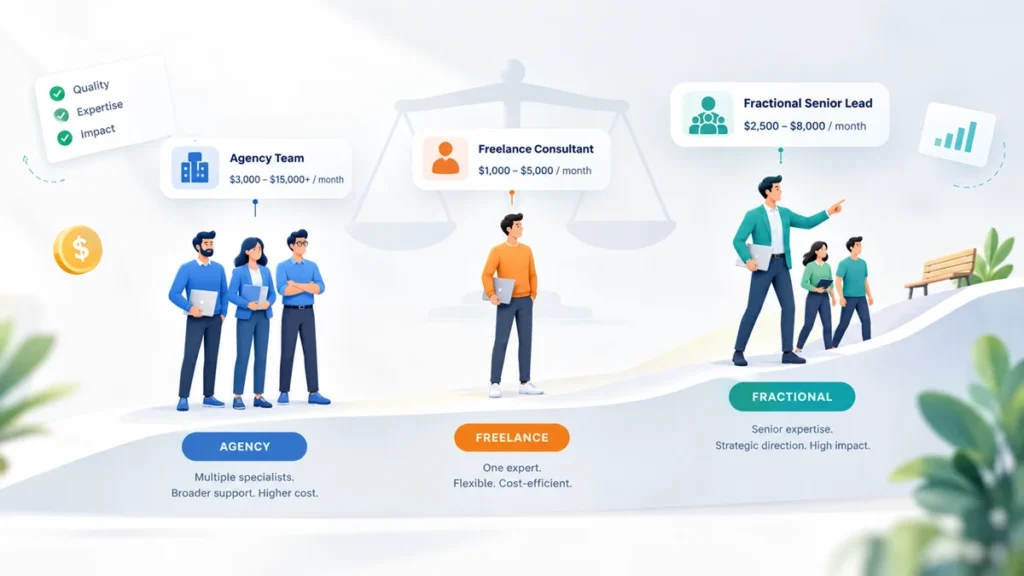
The fractional senior lead is a freelancer-level operator embedded on a defined weekly cadence, owning strategy and prioritisation, often directing a small bench of specialists for execution. It sits between the two models. The cost ranges in the table are illustrative, so test them against the quotes you actually receive.
| Dimension | Traditional agency | Solo freelance consultant | Fractional senior lead |
|---|---|---|---|
| Strategy ownership and accountability | Shared across account manager, strategist and team; accountability can diffuse | One named owner, fully accountable | One named owner, accountable for roadmap and outcomes |
| Speed of technical code implementation | Slow: ticket passes through account manager, then specialist, then your dev team | Fast: direct conversation with your developers | Fast: embedded in sprint rituals, reviews code and specs |
| Communication overhead and meeting fatigue | High: weekly calls, decks, multiple stakeholders | Low: one thread, async-friendly | Low to medium: set cadence, defined reporting |
| Capacity for multi-channel execution | High: content, links and dev support under one roof | Limited: bound by one person’s hours | Medium to high: lead plus vetted specialists |
| Typical monthly cost | $4,000–$10,000+ | $2,500–$4,500 | $3,000–$6,000 |
| True cost-to-impact ratio | Strong at scale; weaker for focused technical problems | Strong for focused, senior-level work; capped by capacity | Strong when strategy and prioritisation are the bottleneck |
| Key risk | Junior-heavy delivery, long contracts | Single point of failure, narrow bench | Needs a client who will implement; limited by scope agreed |
Read the cost-to-impact row carefully, because SEO consultant vs agency ROI is not decided by the cheapest option. Cost-to-impact is the share of your budget that turns into shipped, measurable changes. In a hypothetical comparison, a $3,000 engagement where 80% of hours are senior and focused on fixes can out-deliver a $7,000 one where 35% reaches execution. The reverse is true when the scope is large enough that no one person can deliver it.
Run that arithmetic on the two proposals from the start of this article. Using the illustrative split above, roughly 40–60% of the agency’s $5,000 reaches hands-on or senior work: about $2,000–$3,000. If 80% of the consultant’s $3,000 is senior time on your site, that is about $2,400. The dollars reaching your site are in a similar range; what differs is what they buy. The agency’s dollars buy more hours at a lower blended rate, spread across several people. The consultant’s buy fewer hours at a higher rate, all from one person. Neither is wrong. The right choice depends on whether your next ten priorities are decisions or tasks, which we come back to below.
Five questions to put to any provider, agency or freelancer, before you sign:
- Who diagnoses my site? Ask for the name of the person who will read your Search Console data and write the fix list, and how many hours a month they will spend on your account.
- Can I speak to that person before signing? At an agency, the person in the sales call may not be the person doing the work. A consultant should be happy to talk through your site on a first call.
- What ships in the first 30 days? Ask for changes made to your site, not a report about it.
- What happens at exit? Confirm who owns the documentation, tracking access and working files, and what notice period applies.
- What do you do when the work needs a skill you don’t have? An agency should explain how it staffs the gap. A consultant should name the partners they bring in and who manages them.
Which Model Fits Your Stage? (Seed/Bootstrapped vs. Growth-Stage vs. Enterprise)
Seed or bootstrapped (under $3,000/month for organic). An agency’s overhead will consume too much of this budget. A freelancer, or a few paid audit hours plus founder-led execution, gets more done. For example, a bootstrapped SaaS company with one developer and no content owner might buy a few audit hours, ship the highest-impact fixes itself and revisit a retainer once organic starts producing demos. If you are still deciding how to split spend between channels, our SEO vs. PPC comparison covers how to allocate budget across paid and organic before you commit to a retainer.
Growth stage ($3,000–$10,000/month). This is where the choice matters most. You usually have a development team, a content owner and a pipeline target, but not an in-house SEO leader. For example, a Series A team with two developers and a content lead but no SEO owner is buying direction and prioritisation first and execution capacity second. A fractional senior lead, or a freelancer with a vetted bench, fits when the bottleneck is strategy, prioritisation and technical direction. An agency fits when the bottleneck is volume of execution across several workstreams.
Enterprise ($10,000+/month). Multi-market sites, large content operations and compliance requirements justify agency structure. For example, a multi-market ecommerce site with separate regional teams needs coordination that no single person can provide. Even here, a senior independent advisor can be worth adding to hold the agency accountable to outcomes, because senior judgment, not headcount, is the scarce input.
A useful test: list your next ten SEO priorities. If most are decisions (what to fix first, what to consolidate, what to stop doing), you need senior time. If most are tasks (write 30 pages, build 50 links, fix 400 titles), you need capacity.
Why Growth Brands Are Switching to Fractional Senior SEO Retainers
The case for a fractional senior model at growth stage rests on one idea: the expensive part of SEO is not labour, it is judgment applied to the right problem at the right time. A fractional lead gives you a named senior owner, a fixed weekly rhythm and the option to scale execution up or down without renegotiating a 12-month agency contract.
In practice, a well-run fractional engagement has a simple rhythm. Each week: a prioritisation session, a review of open developer tickets and pull requests, and a pass through Search Console for new problems. Each month: a re-ranking of the roadmap against pipeline results, with specialists brought in only for the work that needs them. The senior owner stays accountable for what gets done first, and your developers and content team always know the next priority.
That is the model behind our senior freelance SEO retainer: direct access to the person doing the work, sprint-based priorities tied to pipeline rather than activity, and no account-management layer between your team and the fixes. Founder-led context is covered on the about page.
If you are not sure which model you need, start with a diagnosis rather than a retainer. A focused SEO audit shows how much of your problem is decisions and how much is volume, and that tells you whether to hire an agency, a freelancer or a fractional lead.