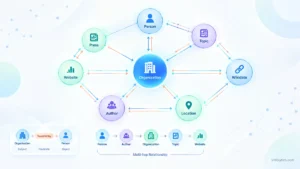
Schema markup and knowledge graphs are two different layers of the same system. Schema is what you write. The knowledge graph is what gets built from it, combined with everything else a search engine knows about your entity.
This guide maps the relationship between the two: which schema types correspond to which knowledge graph components, what each property actually does at the knowledge graph level, and where schema alone is insufficient and corroboration from other sources becomes necessary.
This is not a schema syntax guide. The Schema Markup Generator handles syntax, and the Structured Data Testing Tool validates it. This guide is about what schema does inside a knowledge graph system once it has been correctly implemented.
The Core Relationship: Schema as Knowledge Graph Input
A knowledge graph stores entities, attributes, and relationships. Schema markup is one of the primary inputs that knowledge graph systems use to extract all three.
Schema Markup
    ↓ processed by crawler
Entity identified (@type, name)
    ↓
Attributes extracted (foundingDate, description, location)
    ↓
Relationships mapped (founder, worksFor, sameAs, about)
    ↓
Knowledge Graph Entry built or updated
What schema does that prose cannot: it removes inference. When a crawler reads a page, it can infer from natural language that a person named Suraj Saini founded Visiblytics. When it reads Organization schema with a founder property pointing to a Person entity URL, it does not need to infer anything. The relationship is explicitly declared in a format the knowledge graph system is built to process.
The difference between an inferred signal and an explicitly declared one is confidence. Knowledge graph systems that have to infer relationships store them with lower confidence than those that have explicit declarations. Lower confidence means less stable representation, slower knowledge panel development, and higher susceptibility to being overridden by conflicting signals.
Schema Types and Their Knowledge Graph Roles
Each schema type maps to a specific type of entity or component in the knowledge graph. Here is how the most relevant types function.
Organization (and subtypes)
Knowledge graph role: Defines a non-person entity: a company, institution, brand, or structured group.
Why the subtype matters: Using ProfessionalService instead of the generic Organization sends a more specific categorical signal. Knowledge graph systems use the @type value to classify entities. A more specific type produces a more precise classification, which affects how the entity appears in category-level queries and how it is disambiguated from similarly-named entities of different types.
The properties that do the most knowledge graph work:
name: The primary identifier. Every knowledge graph lookup starts here. This value must be identical to the entity name used everywhere else: Wikidata, LinkedIn, social profiles, third-party mentions. Any variation is a disambiguation cost.
founder: Creates a directional relationship from the organization entity to a person entity. This is one of the most-traversed relationship types in knowledge graphs because “who is behind this?” is among the most common entity queries. Requires a nested Person object with a URL pointing to the person’s entity page.
foundingDate: A verifiable, timestamp-able attribute. Useful for disambiguation (two entities with similar names founded in different years are distinguishable). Should match Wikidata and any other source that states a founding date.
knowsAbout: Explicitly connects the organization to topic areas. This is the schema property most directly responsible for topical entity association: it tells the knowledge graph system which subject areas this organization is authoritative on without requiring the inference to be made from content co-occurrence alone.
sameAs: The cross-platform identity declaration. Each value in the sameAs array is a statement: “this entity and the entity at that URL are the same thing.” This is what allows knowledge graph systems to merge signals from your website, your LinkedIn profile, your Wikidata entry, and your Twitter/X profile into a single, coherent entity representation. Without sameAs, those signals exist in parallel but unconnected.
Person
Knowledge graph role: Defines an individual human entity with professional context.
Why it matters for knowledge graphs: Person entities are the connective tissue of professional knowledge graphs. They link organizations to their founders, content to its authors, expertise to specific topic areas. A well-defined person entity dramatically increases the traversability of the entire entity network around your brand.
The properties that do the most knowledge graph work:
jobTitle: States the person’s current professional role. Should match LinkedIn exactly. Mismatches between schema and LinkedIn on job title are one of the most common reconciliation triggers.
worksFor: Creates the inverse of the founder relationship: from the person entity back to the organization entity. Requires a nested Organization object with a URL. Without this, the relationship is only declared in one direction in machine-readable form, which means knowledge graph traversal from the person to the organization requires inference.
knowsAbout: Connects the person entity to specific topic areas. This is what allows an AI system to match a query about “who are the experts in Entity SEO” to a specific person entity rather than just to content that discusses Entity SEO. The more specific and consistent the knowsAbout values are, the stronger the topical entity association.
hasCredential: Creates a verifiable relationship between the person entity and a credentialing organization. Maximally effective when the credential object includes a URL pointing to the issuing organization, which creates a traversable relationship from the person entity to a recognized institutional entity.
sameAs: Same function as in Organization schema: connecting the on-site person entity definition to external profiles. LinkedIn, Wikidata, Twitter/X. Each sameAs value allows knowledge graph systems to merge signals from that platform into the person entity representation.
Article (and subtypes)
Knowledge graph role: Connects content to the entities that produced it and the topics it covers.
Why it matters for knowledge graphs: Article schema is what makes the authorship relationship machine-readable. Without it, a crawler has to infer from the byline and surrounding markup that a specific person wrote a specific piece of content. With it, the author property explicitly creates a relationship between the article entity and the person entity that wrote it.
The properties that do the most knowledge graph work:
author: The most important property in Article schema for knowledge graph purposes. Requires a nested Person object with a URL pointing to the author’s entity page. This creates a machine-readable content-to-author relationship that knowledge graph systems use for both attribution (this content belongs to this entity) and topical authority (this entity publishes on this topic).
about: Explicitly states the topic entity the article covers. Where knowsAbout on a Person or Organization entity is a standing topical claim, about on an Article entity is a specific content-to-topic relationship. Together they create a coherent signal: this entity (Organization/Person) knows about this topic, and here is a piece of content that demonstrates it.
publisher: Creates a relationship from the article entity to the publishing organization entity. Requires a nested Organization object with name and URL. This closes the attribution loop: article → author (Person entity) and article → publisher (Organization entity).
datePublished: A timestamp that allows knowledge graph systems to track content recency and build a timeline for an entity’s content production. Useful for demonstrating consistent, ongoing contribution to a topic area rather than one-off publication.
BreadcrumbList
Knowledge graph role: Declares site hierarchy and topical clustering structure.
This schema type is underused for knowledge graph purposes. Beyond its traditional role in generating breadcrumb rich results, BreadcrumbList explicitly states the hierarchical relationship between pages, which knowledge graph systems can use to infer topical clustering. An article on entity relationships that has a breadcrumb declaring it belongs to the Entity SEO section is providing a machine-readable signal that this content is part of a topical cluster, not an isolated page.
ItemList and HowTo
Knowledge graph role: Declares content type and structure for direct extraction.
These types matter less for entity knowledge graph building and more for content extraction by AI retrieval systems. An article marked up with HowTo schema is explicitly declaring its content as instructional and structured for step-by-step extraction. An ItemList is declaring a ranked or enumerated set of items. Both make specific content types more easily extracted by AI systems when they are retrieving sources to inform generated answers.
Where Schema Is Sufficient and Where It Is Not
Schema markup is necessary for knowledge graph entity building. It is not sufficient. Understanding the boundary is what prevents wasted effort.
What schema alone can do:
Make entity attributes explicitly machine-readable, removing the need for inference. Declare directional relationships between entities in a format knowledge graph systems process natively. Connect on-site entity definitions to external profiles via sameAs. Create content-to-author attribution in a machine-readable format.
What schema alone cannot do:
Corroborate the entity from independent sources. A knowledge graph that has only schema-based signals has only self-asserted signals. No amount of schema markup can replace the confidence produced by a Wikidata entry, a Wikipedia article, or a credible press mention stating the same attributes independently.
Guarantee knowledge graph inclusion. Schema increases the probability of entity recognition and the accuracy of the entity representation. It does not trigger automatic inclusion. The knowledge graph makes inclusion decisions based on the totality of signals, not just schema.
Override high-authority conflicting signals. If Wikidata states a different founding date than your schema, the knowledge graph has to reconcile the conflict. Schema is a high-authority self-asserted source, but it does not automatically override Wikidata, which is an independent third-party source. Resolving the conflict requires correcting whichever source has the wrong date.
The practical boundary:
Schema handles the machine-readable declaration layer. External corroboration (Wikidata, press coverage, directory presences, co-citations) handles the independent verification layer. Both are required for strong knowledge graph presence. The Wikidata for SEO guide covers the most accessible external corroboration action. The Digital PR guide covers earning press-based corroboration.
Schema Properties Mapped to Knowledge Graph Functions
A reference table connecting specific schema properties to what they do at the knowledge graph level:
| Schema Property | Entity Type | Knowledge Graph Function |
|---|---|---|
@type | All | Entity classification and category placement |
name | All | Primary entity identifier |
description | All | Entity summary attribute |
url | All | Canonical entity URL anchor |
foundingDate | Organization | Disambiguating timestamp attribute |
founder | Organization | Org-to-person foundational relationship |
worksFor | Person | Person-to-org foundational relationship (inverse of founder) |
jobTitle | Person | Professional role attribute |
knowsAbout | Person, Organization | Topical entity association |
hasCredential | Person | Person-to-credentialing-org relationship |
memberOf | Person, Organization | Membership/affiliation relationship |
sameAs | All | Cross-platform identity corroboration |
author | Article | Content-to-person attribution relationship |
publisher | Article | Content-to-organization attribution relationship |
about | Article | Content-to-topic relationship |
datePublished | Article | Content timestamp |
breadcrumb | WebPage | Hierarchical site structure declaration |
The Schema Maintenance Requirement
Schema that is implemented once and never updated becomes a source of entity conflict rather than corroboration over time. Every time an entity attribute changes, the schema needs to change at the same time.
The most common schema maintenance failures:
A person’s job title changes but their author page schema still states the old title. The schema and their LinkedIn now conflict. A reconciliation process has to decide which version is authoritative.
The organization URL changes but schema on author pages still references the old URL. The worksFor relationship now points to a dead or redirected URL. Knowledge graph traversal from the person entity to the organization entity fails or produces low-confidence results.
A new sameAs profile is created but never added to schema. The new platform’s signals exist in parallel with the on-site entity definition but are not explicitly connected to it. Knowledge graph systems have to infer the connection rather than reading it from structured data.
The fix is procedural: any time an entity changes, updating schema is part of the same task as updating the content, not a separate later task. The Entity Consistency guide covers the full maintenance discipline.
❓ Frequently Asked Questions
Does schema directly create a knowledge graph entry?
No. Schema makes your entity’s attributes and relationships machine-readable, which accelerates entity recognition and increases confidence in the entity representation. The knowledge graph entry itself develops as the system accumulates sufficient corroborated signals from multiple sources. Schema is a necessary input to that process, not a direct trigger.
Which schema type should I use for my organization?
Use the most specific type that accurately describes your organization. ProfessionalService for consulting and agency businesses. SoftwareApplication for software products. LocalBusiness for businesses with a physical location that serves local customers. EducationalOrganization for training or education providers. More specific types produce more precise entity classification and stronger disambiguating signals than the generic Organization type.
Does every page on my site need schema?
Not every page needs entity-focused schema, but every page that is important for entity attribution does. Your entity homepage and author pages need Organization and Person schema. Every article needs Article schema with author and publisher properties. Other pages (product pages, service pages, contact pages) benefit from relevant schema types but are lower priority for knowledge graph entity building specifically.
What happens if my schema contradicts my Wikidata entry?
You have a high-priority conflict between two relatively high-authority sources. The knowledge graph has to decide which version to trust. The fix is to identify which source has the incorrect information, correct it, and ensure both sources now agree. Do not try to resolve the conflict by only updating one source while leaving the other incorrect. The Entity Reconciliation guide covers the resolution process in detail.
How long does schema take to affect knowledge graph signals?
Schema is processed when search engines crawl your pages, which can happen within days for frequently crawled sites. The effect on knowledge graph signals is progressive rather than immediate: the schema provides input to the knowledge graph system, but the system builds confidence incrementally as it accumulates corroborating signals from other sources. Schema implementation accelerates the process; it does not produce instant results.
Schema Is the Declaration. The Knowledge Graph Is the Record.
Think of schema as a formal declaration: “this entity has these attributes and these relationships.” The knowledge graph is the record that gets built from that declaration plus everything else the system knows about the entity.
A declaration without corroboration is an unverified claim. A declaration that matches what Wikidata says, what credible publications say, and what external profiles say is a corroborated fact. The knowledge graph treats the two very differently.
Schema does the first part: it makes the declaration explicit, machine-readable, and structured. Everything else in the entity authority stack (Wikidata, press coverage, co-citations, consistent profiles) does the second part: corroborates the declaration until it becomes a fact the knowledge graph stores with confidence.
For the full knowledge graph structure and how these signals combine, the Knowledge Graph guide covers the complete picture. For how to audit whether your schema is producing the right knowledge graph signals, the Knowledge Graph Audit guide covers the methodology.