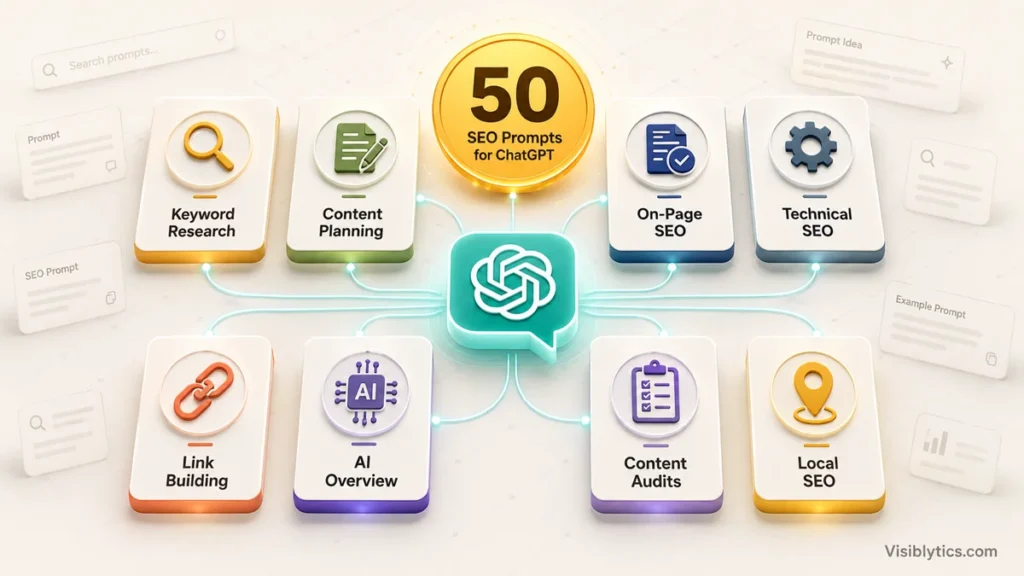
The most useful ChatGPT prompts for SEO are the ones that give the model a role, a specific SEO task, and a clear output format, not open-ended requests like “help with my SEO.” Below are 50 prompts I actually use, grouped into eight categories that map to a real SEO workflow: keyword research, content planning, on-page SEO, technical SEO, link building, AI answer optimization, content audits, and local SEO. Copy the ones relevant to what you are working on this week rather than trying to use all 50 at once.
Why Most SEO Prompts Fail Before You Even Run Them
A prompt fails when it asks ChatGPT to guess at context it doesn’t have. If you type “write SEO content about running shoes,” the model has no idea who your audience is, what intent you are targeting, or what format you need, so it defaults to generic, safe output. Every prompt below works because it specifies three things: the role you want ChatGPT to take, the exact input data or topic, and the output format. Swap in your own details wherever you see brackets.
Keyword Research and Search Intent (7 prompts)
Keyword research prompts should do more than generate a word list. A good one also tells you the intent behind each term, how to structure content for it, and where the model might be guessing instead of knowing.
- “Act as an SEO strategist with deep experience in [your industry]. My business sells [describe product or service] to [describe buyer persona]. Generate 20 seed keywords this buyer would search at different stages of their journey (awareness, consideration, decision). Label each by intent, and flag any keyword where you are inferring intent rather than being confident about it.”
- “Generate a table of 15 long-tail keywords related to [seed keyword]. Columns: keyword, search intent, estimated competition (low/medium/high based on how specific the phrase is), and a working blog title for each. Sort the table so the lowest-competition, highest-intent-match keywords appear first.”
- “Explain the search intent behind ‘[keyword]’ in detail: what does the searcher already know, what are they trying to decide or accomplish, and what would make them abandon a page that ranks for this term. Then recommend the content format that satisfies that intent.”
- “Here is a real support ticket, review, or customer question: [paste actual customer language]. Turn this into 10 SEO question targets phrased the way this customer actually talks, not generic FAQ phrasing.”
- “List 10 seasonal keyword variations for [topic]. For each, note the approximate month the search volume likely peaks and whether the content should be evergreen with a seasonal refresh or a standalone seasonal page.”
- “Here are my top 5 competitors and one sentence on each of their positioning: [list them]. Based on their positioning, not just their likely traffic, what seed keywords are they probably targeting that I am not? Explain your reasoning for each.”
- “Group these keywords into topic clusters based on shared intent, not just shared words: [paste keyword list]. Suggest a pillar topic per cluster, and flag any keyword that could plausibly belong to two clusters, since that is a cannibalization risk I need to resolve manually.”
Content Planning and Outlines (7 prompts)
Once you know the keyword and intent, the bottleneck is usually structure. These prompts turn a topic into an outline that reflects what a page actually needs to cover, not a generic five-section template.
- “Act as a content strategist. For the target keyword ‘[keyword]’, build a detailed outline with H2 and H3 headings. Base the structure on what a searcher needs answered in order, not just topic breadth. For each H2, write one sentence stating the specific question it answers, so I can check the outline against real search intent before writing.”
- “Generate 10 blog post ideas for a [industry] blog targeting [specific audience segment, not just ‘general audience’]. For each idea, note the funnel stage it targets and one reason a generic version of this topic tends to underperform.”
- “Suggest 5 content formats for the topic [topic] (guide, comparison, case study, checklist, tool/calculator). For each, give a genuine reason tied to how people actually search this topic, not a generic description of the format itself.”
- “Act as a content strategist. Build a 4-week content calendar for the topic cluster [list keywords]. Sequence pillar content before supporting content, and explain why each supporting piece should publish before or after the pillar rather than just listing dates.”
- “Here is my current article: [paste content]. Here is a summary of what the top 3 ranking competitors cover for ‘[keyword]’: [paste competitor summaries]. Identify specific subtopics they cover that I do not, ranked by how likely each gap is hurting my ranking, not just listed in the order you found them.”
- “Write 5 alternative angles for a piece on [topic] that go beyond the generic take most articles use. For each angle, explain specifically what makes it different from the standard approach, not just a different headline for the same content.”
- “Here is a list of my existing pages with titles and URLs: [paste list]. Suggest an internal linking plan for a new article about [topic]: which existing pages should link to it, which anchor text to use, and whether any existing page should be updated to link to this new one rather than the other way around.”
On-Page SEO (7 prompts)
On-page prompts are the fastest to run and the easiest to test, since you can compare the output directly against what is currently live on the page.
- “Write 5 title tag options under 60 characters for a page about [topic], including the keyword ‘[keyword]’. Make each option meaningfully different in angle (direct/keyword-led, benefit-led, curiosity-led, number-led, question-led), not five small rewordings of the same sentence.”
- “Write 3 meta description options under 155 characters for a page about [topic]. Each should use a different angle (benefit-led, curiosity-led, direct-answer-led) and include the keyword ‘[keyword]’ naturally, not forced at the start of every option.”
- “Suggest 3 SEO-friendly URL slug options based on the title ‘[title]’ and primary keyword ‘[keyword]’. Explain the tradeoff between the shortest option and the most descriptive option, since that decision depends on my site’s existing URL conventions.”
- “Rewrite this introduction so the first two to three sentences directly answer the core query, before any scene-setting or background: [paste intro]. Keep everything below the direct answer, do not delete it, just move it after.”
- “Generate 3 CTA variations for a [product/service] page encouraging [specific action]. Each should target a different buyer hesitation (price concern, trust concern, timing concern) rather than three generic phrasings of the same push.”
- “Review this paragraph for keyword stuffing: [paste paragraph]. First, tell me exactly how many times the keyword appears and whether the phrasing reads as natural or forced. Then rewrite it so the keyword appears no more than twice, without losing any factual detail from the original.”
- “Suggest 8 semantically related terms for an article about [topic], based on what a topically authoritative page on this subject would naturally reference. Group them by whether they belong in the intro, body, or FAQ section.”
Technical SEO (7 prompts)
ChatGPT cannot crawl your site, so these prompts only work well when you paste in real data from Search Console, a crawl export, or your own audit notes rather than asking it to guess at problems it cannot see.
- “Here is a summary of my crawl data: [paste data]. Identify the most critical issues (broken links, duplicate content, redirect loops, thin pages), rank them by likely SEO impact rather than by how many there are, and recommend the top 5 fixes with the specific pages affected.”
- “Here is my Core Web Vitals report: [paste data]. For each metric that is failing, explain the most common causes in plain language, then tell me which one is most likely the root cause given these specific numbers, not a generic list of possible causes.”
- “I have a canonicalization issue where multiple URLs serve the same content. Here is the situation: [describe URLs and how they differ]. Walk me through the fix step by step, including which URL should be canonical and why, based on the details I gave you.”
- “Here is my current site page hierarchy: [describe or paste sitemap]. Suggest an internal linking structure to improve crawl efficiency, specifically identifying any pages that currently have zero or only one internal link pointing to them.”
- “Here is my traffic trend data for the last 90 days: [paste data]. List the 3 most plausible causes for this pattern, ranked by likelihood given the shape of the drop or spike, and tell me what additional data I would need to confirm the top cause.”
- “Write a robots.txt file that blocks [specific paths] while allowing full crawl access to the rest of the site. After the file, explain what each rule does in plain language so I can verify it matches what I actually intended to block.”
- “Here is my list of redirects: [paste redirect list]. Identify any redirect chains longer than one hop and any redirect loops. For each chain, tell me which single redirect I should update to point directly to the final destination.”
Link Building and Outreach (6 prompts)
AI will not build links for you, but it can speed up the research and writing that surrounds outreach, which is usually the slowest part of the process, as long as you keep it grounded in real sites and real data.
- “Suggest 10 specific types of websites (not generic categories like ‘blogs’) that would realistically link to content about [topic], based on genuine topical relevance rather than domain authority alone. For each type, note what kind of content on my site would actually earn that link.”
- “Here is what I know about a target site: [paste details about their content focus and audience]. Write a short, personalized outreach email pitching a guest post about [topic], referencing something specific about their existing content, not a generic compliment.”
- “Here is a competitor’s backlink profile summary: [paste data]. Identify link building opportunities this suggests for my site, but only ones grounded in the actual data provided, and separately note any opportunity that would require more information to confirm.”
- “Write 3 follow-up email variations for an outreach pitch that received no response after one week. Make each meaningfully different in approach (adding new value, shortening the ask, offering an alternative), not just a lighter rephrasing of the same message.”
- “Suggest 5 linkable asset ideas (original data, a free tool, an in-depth guide) for the topic [topic]. For each, explain specifically what would make someone want to cite it rather than just describing the format.”
- “Rewrite this outreach email to sound less templated: [paste email]. Point out which specific phrases read as mass-outreach boilerplate before rewriting, then make it sound like it was written after actually reading the recipient’s site.”
AI Answer and AI Overview Optimization (6 prompts)
Zero-click search results and AI Overviews reward content structured for direct extraction, which is a different skill than writing for a traditional ranking, and the prompts need to reflect that difference explicitly.
- “Rewrite this paragraph as a 40 to 60 word direct answer targeting the query ‘[query]’: [paste paragraph]. Lead with the answer itself, no context-setting first. Then write a separate one-sentence transition so this direct answer does not feel abrupt when it sits inside the full article.”
- “Here is what currently appears in the SERP for ‘[keyword]’: [describe features, e.g. featured snippet as a numbered list, People Also Ask, AI Overview]. Tell me the exact structure (word count, format, heading placement) needed to realistically compete for the featured snippet specifically, not just general advice on ‘being comprehensive.'”
- “Here are real customer questions I have collected: [paste actual questions from support tickets, reviews, or forums]. Turn these into an FAQ section for [topic], keeping the original phrasing where it is already how people naturally ask, and only cleaning up wording that would look unprofessional as-is.”
- “Here is my article: [paste article]. Summarize it into a single, quotable paragraph that an AI Overview could realistically extract as a complete, standalone answer, and tell me if any claim in that summary needs a citation or source to be trustworthy on its own.”
- “Based on this page content: [paste content or describe the page], suggest which schema markup types genuinely apply (FAQ, HowTo, Product, Review). Do not suggest a schema type just because the content loosely resembles it; only recommend one if the content actually meets that schema’s real requirements.”
- “Rewrite this list so each item uses clear, parallel phrasing and could stand alone as a complete answer if extracted individually: [paste list]. Flag any item that cannot realistically stand alone without the surrounding context.”
Content Audits and Updates (5 prompts)
Older content often loses rankings quietly. These prompts help triage what to fix first instead of rewriting everything at once, which is usually the more expensive and less effective option.
- “Here is my published content on [topic]: [paste content]. Here is the current query cluster for this topic: [paste queries]. Score coverage of each query from 1 to 5. For anything below 3, give me the single highest-impact edit rather than a long list of minor suggestions.”
- “This page used to rank for ‘[keyword]’ but has dropped. Here is the content: [paste it]. Based on the text alone, what is the most likely reason, and separately, what would you need to see (like ranking history or a competitor comparison) to be more confident in that diagnosis?”
- “Here is a note on what has changed in the industry: [describe the change]. Given this article: [paste article], identify which specific sections are now outdated and which claims, if any, are flatly incorrect versus just stale.”
- “Rewrite this section to replace generic statements with specific, current examples: [paste section]. For each generic claim you replace, tell me what kind of real example or data point I should insert, since you should not invent a specific statistic or case study yourself.”
- “Compare this article against these top 3 ranking pages for ‘[keyword]’: [paste article and competitor summaries]. List what they cover that mine does not, then separately list anything mine covers that they are missing, since that is content I should be careful not to cut.”
Local SEO (5 prompts)
Local SEO prompts work best when you feed ChatGPT real location and business details rather than asking it to invent local knowledge it does not actually have.
- “Act as a local SEO strategist. Suggest an outline for a service page targeting ‘[service] in [city]’. Include a section addressing a genuinely local concern (permits, climate, local regulations, typical local pricing) rather than generic service copy with the city name inserted.”
- “Write a Google Business Profile description for [business type] in [location], highlighting [specific real differentiator, not a generic claim like ‘trusted service’]. Keep it under 750 characters and avoid superlatives I have not substantiated.”
- “Suggest 10 local keyword variations for [service] that include neighborhood or city-level modifiers real residents would use, not just ‘[service] + city name.’ Note which ones sound like how locals actually talk versus which ones are just template variations.”
- “Draft 3 review response templates for [business type]: positive, neutral, and negative. Each should reference something specific to the type of complaint or praise typical for this business type, not a generic thank-you or apology.”
- “Write a locally relevant FAQ section for a [business type] page serving [city/region]. Base the questions on genuinely local concerns (parking, local regulations, service area boundaries), not a generic FAQ template with the city name swapped in.”
How to Get More Out of These Prompts
The output quality depends entirely on what you feed in, not on finding a “magic” prompt. Three habits make the biggest difference. First, always paste in real data (your actual content, real crawl exports, real traffic numbers) instead of asking ChatGPT to work from a vague description, since a model without your real numbers is just guessing in a confident tone. Second, treat the first output as a draft, not a final answer. If it is 80 percent right, tell it exactly what to change rather than regenerating from scratch. Third, keep a running document of the prompts that consistently work for your niche, since a prompt that performs well for ecommerce content will not necessarily work the same way for a SaaS blog.
How to Verify These Prompts Are Actually Helping Your SEO
Running a prompt and liking the output is not the same as confirming it improved anything. Before publishing on-page changes generated from these prompts, I run the new title tags and headings through a heading tag analyzer to make sure the structure is still logical and not just keyword-heavy. For internal linking suggestions from prompt 7 and 14, an internal link analyzer shows whether the links ChatGPT suggested actually fit into your existing site structure or would create orphaned pages. And since it is easy to lose track of which prompts you have run and what still needs doing across a big SEO push, I keep an SEO checklist generator output next to my prompt list so nothing gets generated and then forgotten.
Common Mistakes When Using ChatGPT for SEO
The biggest one is publishing AI output without checking it against your actual site data. ChatGPT does not know your current rankings, your existing content, or your real crawl errors unless you give it that information directly, so any prompt run without real input is closer to a guess than an audit. The second mistake is using the same generic prompt for every single task and wondering why the output feels repetitive across a site. Different pages need different angles, and a prompt library only stays useful if you keep refining it. The third mistake is skipping human review entirely on technical recommendations, since a plausible-sounding fix for something like a canonicalization issue can still be wrong for your specific setup.
❓ Frequently Asked Questions
Is ChatGPT enough for a full SEO strategy?
No. ChatGPT is strong at generating ideas, structuring content, and speeding up repetitive writing tasks, but it cannot crawl your site, pull real ranking data, or replace tools like Google Search Console and a proper technical audit. Use it alongside real data, not instead of it.
How do I make ChatGPT SEO prompts more specific to my niche?
Always include your actual business details, audience, and examples in the prompt rather than leaving them generic. A prompt that says “write about running shoes” produces far weaker output than one that specifies the brand’s price point, target runner type, and what makes the product different.
Can these prompts work with Claude or Gemini instead of ChatGPT?
Yes. The prompt structure, role, real data, and output format, works across most major AI models. Output quality and tone may vary slightly between models, but the underlying prompt logic does not need to change.
How often should I update my SEO prompt library?
Review it every few months. Search engine features change, AI Overviews continue to shift how content needs to be structured, and prompts that worked a year ago may need adjusting to reflect current SERP behavior.