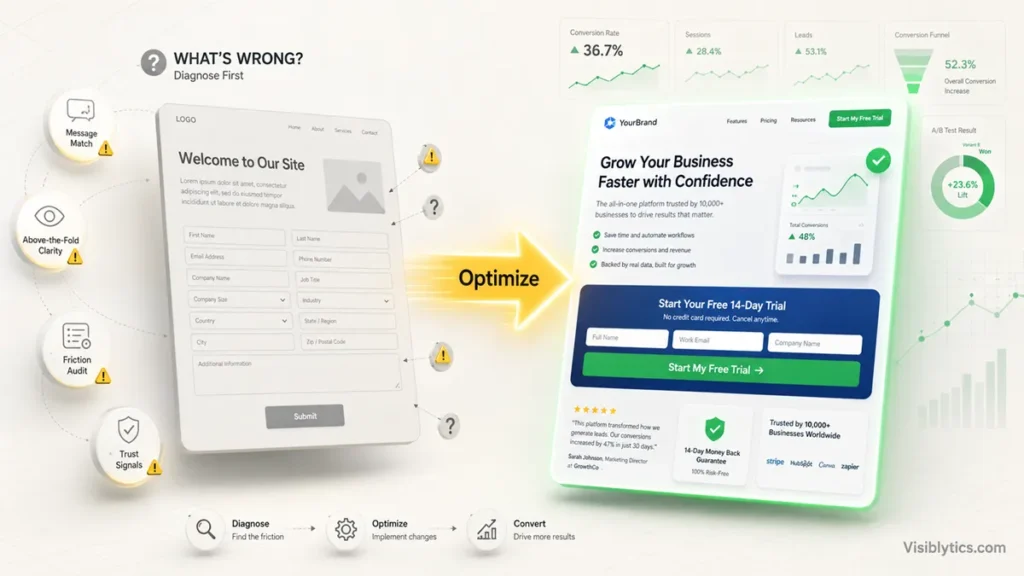
Most guides on this topic are actually about writing new landing page copy from scratch, not optimizing a page that’s already live and underperforming. Real landing page optimization starts with diagnosis: figuring out where visitors are dropping off, whether the page actually matches what brought them there, and what specifically is causing hesitation before you touch a single word. The prompts below are split into two jobs that most articles blend together by mistake: diagnosing what’s wrong with an existing page, and then fixing the specific problem you find, not just regenerating generic marketing copy and hoping it converts better.
What Landing Page Optimization Actually Means
Landing page optimization is the process of identifying and fixing the specific reasons visitors leave a page without converting, then testing whether the fix actually improves results. It is not the same as landing page copywriting, which is about producing the first version of the page. Optimization assumes a page already exists and already has some data behind it, even if that data is just your own read of where it feels weak.
The mistake I see constantly is people pasting “write me a high-converting landing page” into ChatGPT and treating the output as an optimization. That produces a generic template dressed up in your product details. Real optimization means telling the AI what is actually happening on your page right now, in as much detail as you have, and asking it to diagnose before it drafts anything new.
Diagnostic Prompts (Run These Before You Rewrite Anything)
1. The message match audit
Act as a conversion rate optimization specialist. Here is the ad, email, or search result snippet that brings traffic to this page: [paste ad copy or snippet]. Here is the landing page it links to: [paste landing page copy]. Identify any mismatch between the promise made before the click and what the page actually delivers, specifically in the headline and first two sentences. Rate the message match on a scale of 1 to 5 and explain what is causing the gap.Message mismatch is one of the most common, and most invisible, reasons a landing page underperforms. Visitors click expecting one thing, land on a page that leads with something else, and bounce before reading further. Nobody catches this by staring at the page alone, since it only shows up when you compare it against what actually drove the click.
2. The above-the-fold clarity audit
Here is the visible content above the fold on my landing page, before any scrolling: [paste headline, subheadline, and any visible copy]. A first-time visitor has about 5 seconds to understand what this page offers, who it's for, and what to do next. Tell me honestly whether all three of those are clear from this content alone. If any is missing or unclear, tell me specifically which one and why.This forces the model to evaluate clarity the way a real skimming visitor would, rather than praising the copy for being well-written in general, which is the failure mode of most generic “review my landing page” prompts.
3. The friction and objection audit
Here is my landing page copy and form: [paste content and form field list]. Based on this offer and audience, list the top 3 objections or hesitations a visitor would likely have before converting. For each objection, tell me whether the current page addresses it, ignores it, or makes it worse, and where on the page that happens.Every landing page has unaddressed objections, whether it is price, trust, time commitment, or complexity. This prompt surfaces them by category instead of giving you vague feedback like “add more trust signals,” which tells you nothing about which objection is actually the priority.
4. The trust signal gap check
Here is my landing page: [paste content]. List what trust signals are currently present (testimonials, reviews, certifications, guarantees, media mentions) and which ones are absent. Based on the offer type [describe: high-ticket, low-ticket, first-time buyer, repeat buyer], tell me which missing trust signal is most likely to be costing conversions, not just which ones are generically nice to have.Not every trust signal matters equally for every offer. A guarantee matters more for a high-ticket, unfamiliar brand than for a low-cost, well-known one. This prompt asks for prioritization instead of a generic checklist.
Fix Prompts (Use After You Know What’s Actually Wrong)
5. The headline rewrite prompt
Act as a conversion copywriter. My current headline is: [paste headline]. Diagnosis from the message match audit: [paste what you found wrong, e.g. 'headline is feature-led but the ad promised a specific outcome']. Write 5 headline alternatives that specifically fix this gap, each testing a different angle: outcome-led, audience-led, urgency-led, specificity-led, and question-led. Keep each under 12 words.Feeding in the actual diagnosis, not just “write me headlines,” is what makes the output usable instead of generic. Five headlines with no clear reasoning behind each just becomes five more options to guess between.
6. The objection-handling copy block
Here is the top unaddressed objection identified: [paste objection from prompt 3, e.g. 'visitors are unsure if this works for their specific use case']. Write a short copy block, 2 to 3 sentences, that directly addresses this objection without being defensive or over-explaining. Place it where it would naturally appear in the page flow: right after the headline, mid-page, or right before the CTA, and tell me which placement you recommend and why.This targets the actual objection you found instead of adding generic reassurance copy everywhere, which usually just adds length without fixing anything.
7. The feature-to-benefit translation prompt
Here is a list of my product or service features: [paste features]. For each one, write the actual outcome or benefit a visitor cares about, not a rephrased version of the feature. Format as 'Feature: [feature] leads to [specific outcome for the visitor], which means [why that outcome matters to them].' If a feature genuinely has no clear visitor-facing benefit, say so instead of forcing one.The instruction to admit when a feature has no real benefit is important. AI will otherwise invent a benefit for every feature you give it, even minor ones, which dilutes the page with filler instead of focusing on what actually moves the needle.
8. The CTA specificity prompt
My current CTA button says: [paste current CTA text]. Here is what actually happens after someone clicks it: [describe, e.g. 'they get a free trial, no credit card required']. Write 4 alternative CTA options that are more specific about what happens next, rather than generic phrases like 'submit' or 'learn more.' Rank them by how much friction each one removes.Vague CTAs create hesitation because the visitor doesn’t know what committing actually means. Specificity, “Start My Free 14-Day Trial” instead of “Submit,” reduces that uncertainty directly.
9. The form-field reduction prompt
Here is my current form: [list every field]. For each field, tell me whether it is essential to qualify or serve the lead, nice to have for later segmentation, or unnecessary friction that could be removed or made optional. Base this on the offer type: [describe, e.g. 'free ebook download' vs 'enterprise demo request'].Every additional form field lowers completion rates, but not every field is equally removable. This prompt forces a judgment call per field instead of a blanket “reduce your form fields” suggestion that doesn’t tell you which ones actually matter for your specific offer.
SEO-Side Prompts for Organic Landing Pages
If your landing page needs to rank organically, not just convert paid or email traffic, a few additional things matter that pure conversion copywriting prompts ignore. If you’re mapping the target query cluster for this page before writing anything, the same fan-out and intent-classification approach covered in prompts for search query optimization applies directly here, since a landing page trying to rank organically still needs to satisfy the full intent behind the keyword, not just the exact phrase.
10. The SEO landing page title and heading prompt
Write a title tag under 60 characters and an H1 for a landing page targeting the keyword '[keyword]'. The H1 should match the keyword's intent closely enough to satisfy search relevance, but the page's actual conversion headline can differ from the H1 if that serves the visitor better. Explain whether you recommend the H1 and the visual headline being identical or different for this specific case.Search-optimized landing pages sometimes need an H1 that matches search intent precisely, while the visually prominent headline just below it can be more conversion-focused. Treating these as the same thing, which most prompts do, ignores that tension.
11. The scannable structure prompt
Here is my current landing page copy: [paste content]. Restructure it using clear H2 and H3 headings so both search engines and skimming visitors can scan it quickly. Keep all existing claims and data intact, just reorganize the structure, and tell me if any section currently has no clear heading it could sit under, since that usually means the section is unfocused.Long-form landing pages built for both SEO and conversion need a scannable hierarchy, and asking the model to flag sections with no clear heading is a fast way to catch parts of the page that are trying to do too many things at once.
How to Verify These Fixes Actually Help
A rewritten headline or a restructured page is a hypothesis, not a guaranteed improvement, until you test it. Before publishing structural changes, I run the new heading hierarchy through a heading tag analyzer to confirm the H1 through H3 structure is logical and not accidentally skipping levels, which can happen when you reorganize a page quickly. For the SEO-facing title tag on organic landing pages, a meta title generator helps confirm length and keyword placement before it goes live.
Common Mistakes to Avoid
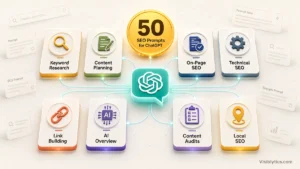
The biggest one is skipping diagnosis entirely and asking ChatGPT to just “write a better landing page.” Without feeding it the actual current copy, actual traffic source, and actual objections, you get a generic template that has no real connection to why your specific page underperforms. The second mistake is testing everything at once. If you rewrite the headline, the CTA, and the form all in the same release, you have no way to know which change actually mattered when performance shifts. The third mistake is treating AI output as final. A rewritten objection-handling paragraph can sound persuasive and still be factually wrong about your product if you didn’t give the model accurate details, so always fact-check before publishing. If you’re building a broader ChatGPT workflow beyond just landing pages, the same role-plus-real-data approach carries over into keyword research, technical audits, and link building, covered in 50 smart SEO prompts for ChatGPT.
❓ Frequently Asked Questions
Can ChatGPT actually tell me why my landing page is underperforming?
Not on its own. ChatGPT cannot see your analytics, heatmaps, or actual visitor behavior. What it can do well is analyze the copy itself for clarity, message match, and unaddressed objections when you paste in real context, like the ad that drove the click or the actual form fields. Pair its analysis with real data from your analytics tool for a full picture.
Should my SEO landing page and my paid traffic landing page use the same prompts?
The diagnostic prompts work for both, but the fix prompts differ slightly. A paid landing page can be pure conversion copy since it doesn’t need to rank. An organic landing page needs the added heading structure and keyword alignment covered in the SEO-side prompts, without sacrificing the conversion elements underneath.
How many changes should I test at once on a landing page?
Generally one meaningful change at a time, especially if you are running a formal A/B test. If you are making several fixes at once without formal testing, at minimum track what changed and when, so a later performance shift can be traced back to a specific edit rather than several at once.
Do these prompts work for a homepage instead of a dedicated landing page?
Partially. A homepage usually serves multiple audiences and goals, so the message match and above-the-fold clarity prompts still apply, but the single-CTA, single-objection focus of a landing page doesn’t translate directly. Homepages need broader prompts that account for multiple visitor intents at once.
How long should I wait before judging whether a landing page change worked?
It depends on your traffic volume, not a fixed number of days. You need enough conversions in both the before and after period for the difference to be statistically meaningful, not just a lucky or unlucky week. For a lower-traffic page, that can mean waiting several weeks or running a longer formal A/B test rather than eyeballing a few days of data.
Should a landing page target one keyword or several?
One primary keyword and intent per page is the safer approach, especially for a dedicated landing page rather than a broad homepage. Trying to rank the same page for several meaningfully different keywords usually waters down the message match for all of them, since the page can’t lead with a single clear promise if it’s trying to satisfy multiple distinct searches at once.
If I can only make one change to an underperforming landing page, what should it be?
Fix the message match first. A headline or CTA rewrite cannot save a page if visitors arrive expecting something the page doesn’t actually deliver, since that mismatch causes people to leave before they even read your improved copy. Diagnose that gap before spending time on anything else.