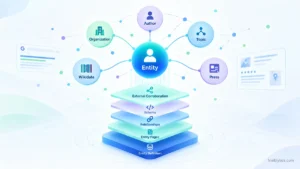
This guide is for someone who has read enough about knowledge graphs to understand why they matter and is now ready to actually build. It treats the process as a project with phases, deliverables, and decision points rather than a list of tactics, because building knowledge graph presence is genuinely sequential: Phase 2 only works if Phase 1 is done correctly, and rushing ahead produces work that has to be redone.
Estimated total timeline for a new entity starting from zero: two to four weeks for the technical foundation, several months for external corroboration to accumulate. The technical work is fast. The recognition is not.
Before You Start: The Decision That Affects Everything
Before touching a single piece of schema or creating a Wikidata entry, one decision has to be made and documented: what is the canonical version of every core entity attribute?
This means writing down, in a single reference document:
- The exact entity name (the precise string that will appear in every schema
nameproperty, every Wikidata label, every social profile, every directory listing, and every piece of outreach material) - The exact entity type (what schema
@typevalue applies) - The exact founding date (year minimum, full date if known)
- The exact one-to-two sentence description in neutral, factual language
- The exact names of all founders or key people associated with the entity
- The canonical URL of the primary entity homepage
This document becomes the source of truth for everything that follows. Every inconsistency introduced downstream, every variation in how the entity name is written, every description that deviates from the canonical one, is a disambiguation cost that will slow knowledge graph recognition.
If this document already exists (because the brand has been operating consistently for years with clean entity signals), the audit in Phase 1 will confirm it. If it does not exist, creating it is the first deliverable of this project.
Phase 1: Foundation Audit (Days 1 to 3)
Before building anything new, understand what already exists and what state it is in. Building on top of inconsistent existing signals produces a messy entity representation that is harder to improve than one built from scratch.
What to audit:
Search your entity name in Google. Note what appears. Is there a knowledge panel? If yes, what does it show, and does it match the canonical entity record you just documented? If no, is the entity name showing any entity-aware signals (rich snippets with author attribution, entity-associated descriptions)?
Search your entity name on Wikidata. Does an entry exist? If yes, is it accurate and complete? If no, note this as a Phase 2 deliverable.
Run your entity homepage and key author pages through the Structured Data Testing Tool. Document every error and every missing property.
Search your entity name on LinkedIn, Twitter/X, and any other platforms where a profile exists. Note every variation in how the entity is named or described that differs from the canonical record.
What this phase produces:
A gap list: every place where the current entity signals diverge from the canonical record, ordered by source authority (own site and schema first, Wikidata second, social profiles third, directories fourth).
Decision point before Phase 2:
Is the canonical entity record correct and complete? If anything in the audit reveals that the canonical record itself is wrong (incorrect founding date, wrong person attribution, outdated description), fix the canonical record before proceeding. Phase 2 will propagate whatever is in that record across all surfaces. Propagating wrong information is worse than propagating nothing.
Phase 2: Entity Homepage and Schema (Days 3 to 7)
This phase builds the on-site technical foundation. Everything in this phase is within your direct control and can be completed quickly. It is also the phase that most brands have done partially but rarely completely.
Deliverable 1: Entity homepage.
A single page on your website that states all canonical entity attributes clearly in prose before schema makes them machine-readable. The What Is an Entity Homepage guide covers what this page needs to contain. The test for “done”: a person who reads only this page and nothing else on your site should know exactly who the entity is, what it does, who is behind it, when it was founded, and where it can be found externally.
Deliverable 2: Organization schema on entity homepage.
Complete Organization (or appropriate subtype) schema covering: name, url, logo, description, foundingDate, founder (with nested Person object and URL), knowsAbout, and sameAs. The sameAs array should reference every external profile the entity has, even if those profiles have not been updated yet. The Schema and Knowledge Graphs guide covers which properties do the most knowledge graph work.
The sameAs array should reference all active, verified external profiles the entity has (such as Crunchbase, LinkedIn, Wikidata and X). Do not add dummy or placeholder URLs; once your Wikidata entry is verified and assigned a Q number in Phase 3, you will append that live URL to your sameAs array..
Deliverable 3: Author pages and Person schema.
A complete author page for every person who publishes content under your brand, with Person schema covering: name, url, jobTitle, worksFor (with nested Organization object and URL), knowsAbout, hasCredential (for any verifiable certifications), and sameAs. The author page needs a body of work section listing notable published content.
Deliverable 4: Article schema on all published content.
Every article on the site needs Article schema with author (URL pointing to author page), publisher (Organization with name and URL), datePublished, and about (the primary topic entity). This is often the most time-consuming deliverable because it requires updating existing content in bulk. Prioritize the most-visited and most-linked articles first.
Test for Phase 2 complete:
Run entity homepage, all author pages, and a sample of five articles through the Structured Data Testing Tool. Zero errors. All required properties present. sameAs references all pointing to real, active external profiles.
Phase 3: Wikidata Entry (Days 7 to 10)
Wikidata is the highest-priority external corroboration action in this entire project. It provides an independent, structured, third-party entity record that knowledge graph systems treat as authoritative, and it is directly referenceable from your schema via sameAs.
Note: Because Wikidata administrators require independent verifiability, ensure your entity has verifiable public records or press mentions to cite as references before submission, preventing the entry from being flagged for deletion.
The Wikidata for SEO guide covers the full creation process step by step. Here is what matters specifically from a knowledge graph building perspective.
Create the organization entry first, then the person entry.
The organization entry establishes the entity anchor. The person entry (for the founder or key author) connects to it. Creating them in this order means the person entry can reference the organization Q number in its employer property.
Every statement needs a reference.
Statements without references are more vulnerable to removal by Wikidata editors and carry less corroboration weight. For each statement (founding date, official website, founder, industry), add a reference pointing to a verifiable source: your official website, a business registry, or a credible publication.
Update schema sameAs immediately after creating the entry.
Once the Wikidata entry has a Q number, add the full Wikidata URL to both your Organization schema sameAs and your Person schema sameAs. This creates the machine-readable connection between your on-site entity definition and the Wikidata entry.
Test for Phase 3 complete:
The Wikidata entry exists, has a Q number, contains accurate attributes with references, and the Q number URL appears in the sameAs array of the relevant schema blocks. Validate schema again to confirm the new sameAs values are correct.
Phase 4: External Profile Consistency (Days 10 to 14)
This phase ensures every external platform where the entity has a presence reflects the canonical entity record exactly. It is unglamorous work. It is also the phase that most brands skip, which is why so many entities have strong on-site signals and weak knowledge graph presence.
Priority order for updating:
- LinkedIn (company page and founder personal profile): highest weight among social platforms for professional entity signals
- Twitter/X profile
- Google Business Profile (if applicable for local entities)
- Any industry-specific directories with established authority in your space
- General directories
For each profile, check and correct:
Entity name (exact canonical name, no variations). Description (matches or is consistent with canonical description). Founding date where applicable. Founder/team attribution. Website URL (canonical URL, not a variant).
The consistency test:
Take the canonical entity record document from the pre-project step and compare it against each profile systematically. Any field that does not match exactly is an inconsistency to fix. This is not about making everything identical word-for-word (different platforms have different character limits and formats). It is about ensuring the factual claims are consistent: same name, same founding year, same categorical description, same key people.
Phase 5: Initial External Corroboration (Ongoing from Week 3)
Phases 1 through 4 build the self-asserted layer: what your entity says about itself across your site, your schema, your Wikidata entry, and your social profiles. Phase 5 builds the independent verification layer: what other credible sources say about your entity.
This phase does not have a completion date. It is ongoing. But it has a starting point: the moment the technical foundation is stable (Phases 2 through 4 complete), begin pursuing external corroboration signals.
Starting actions, in priority order:
Get at least one quality press mention that names the entity correctly, attributes expertise in the stated topic area, and appears in a publication credible in that space. Use the entity briefing approach covered in the Digital PR guide to ensure the mention uses accurate, consistent entity information. One well-attributed mention from a credible publication is worth more for knowledge graph corroboration than ten mentions from low-authority directories.
Pursue co-citations with recognized entities in your topic area. When your entity appears in the same content as established players in your field, in topically relevant context, those co-citations build network position in the knowledge graph. The Co-Citations guide covers this deliberately.
Build topical authority through consistent content. Each article published under a named author entity, with correct Article schema, contributes to the topical relationship between the author entity and the topic area. A consistent body of work in a specific subject area over time builds the topical entity associations that increase knowledge graph network position.
How to Know the Project Is Working
Knowledge graph progress is not visible in a single dashboard. It shows up across multiple signals over several months. Here is what to watch and when to expect it.
Weeks 2 to 4 (after Phase 2 complete):
Structured data appearing correctly in Google Search Console rich results reports. Schema errors resolved. This confirms the technical layer is working.
Months 1 to 3:
Author attribution beginning to appear in search snippets. Correct entity description in AI-generated answers when asking directly about your brand. These are early signs of entity recognition.
Months 3 to 6+:
Knowledge panel appearance (if entity signals are strong enough to cross the confidence threshold). Entity appearing in related entity suggestions for topic-relevant searches. Consistent, accurate representation across AI systems when answering questions in your topic area.
If none of these signals appear after six months of consistent work across all phases, the most likely causes are: external corroboration is insufficient (Phase 5 needs more investment), entity signals are still inconsistent somewhere (requires a consistency audit), or the entity is in a highly competitive topic area where the knowledge graph threshold is harder to reach.
The Knowledge Graph Audit guide provides the diagnostic methodology for identifying which layer is the problem when progress stalls.
Why This Process Stalls (And How to Diagnose It)
In practice, knowledge graph presence projects stall most often at the same point: between Phase 4 and Phase 5. The technical foundation is in place. Wikidata exists. Profiles are consistent. But external corroboration is not accumulating, and the entity stays invisible to the knowledge graph because the self-asserted signals have nothing to corroborate them from outside.
This is where the work stops being technical and starts being reputational. You cannot build external corroboration through schema or consistency checks. It requires getting covered, getting cited, and getting co-cited. That is a PR and content program, not a technical SEO program.
The brands that build strong knowledge graph presence are the ones that treat Phase 5 as an ongoing, properly resourced program, not as a task to complete and close. Every piece of credible external coverage, every Wikidata reference, every co-citation with a recognized entity, compounds. The compounding takes time. Starting it as early as possible in the process is the most important decision you can make about timeline.
For the full entity SEO foundation this project builds on, the Entity SEO guide covers the underlying concepts. For measuring the results of this project over time, the Knowledge Graph Audit guide covers the methodology.