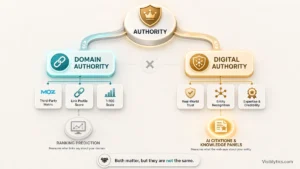
Most Digital PR programs are evaluated on links and traffic. That is a legitimate way to measure PR for traditional SEO purposes. But for digital authority and AI visibility, the more important measure is entity corroboration: did this coverage produce a mention that names your entity clearly, attributes your expertise correctly, and appears in a source that search engines and AI systems treat as credible?
A link from a high-DA site that uses only your URL, without naming you or describing what you do, is almost worthless for entity authority. A mention in a mid-tier industry publication that says “Suraj Saini, founder of Visiblytics, specializes in AI Visibility and Entity SEO” is doing something no amount of on-site work can replicate: it is providing independent, editorial verification that your entity exists, operates in this space, and has something worth citing.
That gap between how most PR programs are run and what entity authority actually requires is what this guide addresses.
What Digital PR Actually Produces for Entity Authority
Digital PR is the practice of earning coverage, mentions, and citations from online publications, journalists, bloggers, and industry sources through proactive outreach and the creation of newsworthy content or commentary. It is distinct from traditional PR in that it operates primarily in digital channels and its outputs are measured in online mentions, links, and visibility rather than broadcast or print coverage.
The key word is earning. Digital PR is not paying for placement (that is advertising), not writing your own guest post without editorial involvement (that is content marketing), and not issuing a press release and hoping someone runs it (that is publicity). Digital PR is the practice of creating something genuinely worth covering and putting it in front of people who cover things like it.
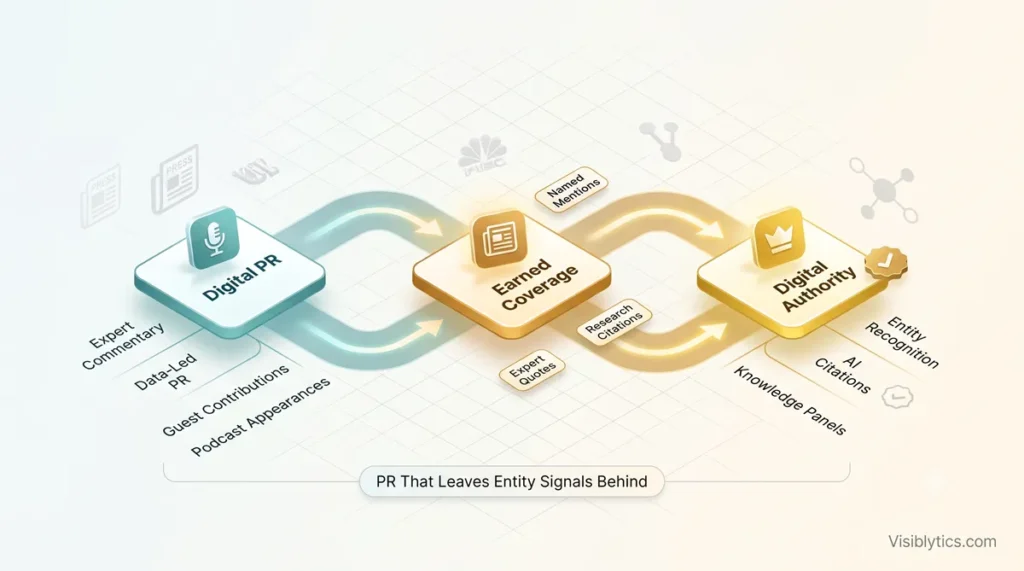
The outputs that matter for digital authority are:
- Named entity mentions. Coverage that names your brand or your personal name explicitly and describes what you do in your area of expertise
- Attributed expert commentary. Being quoted as an expert source on a topic, with your name and affiliation included
- Research citations. Your original data or research being cited by other publications as a source
- Third-party descriptions of your expertise. A publication describing you as “a specialist in Entity SEO” or “an AI Visibility researcher” based on their editorial judgment, not your own description
Each of these is a corroboration signal. Each one tells a search engine or AI system: here is an independent source that has verified this entity exists, operates in this space, and has something worth citing.
Why Digital PR Produces Entity Authority Signals
The connection between Digital PR and entity authority comes down to how knowledge graphs and AI systems build confidence in entity representations.
As covered in the Digital Authority guide, entity authority requires external corroboration: independent sources confirming what your entity claims about itself. Your own website, your own schema, and your own social profiles are self-asserted signals. They tell the system what you say about yourself. What search engines and AI systems need before they will represent your entity confidently is confirmation from sources outside your own domain.
Digital PR is the primary mechanism through which that external confirmation is produced at meaningful scale. Every time a credible publication mentions your entity by name, attributes expertise to you in your stated topic area, or cites your original research, it is generating a corroboration signal that your self-asserted entity data cannot produce on its own.
This is why the Entity Authority Signals guide places trusted publication mentions at the third tier of the source authority hierarchy, above social profiles and directories and below only Wikipedia and Wikidata. A feature in a recognized industry publication is one of the highest-authority external corroboration signals available to most businesses.
The secondary effect is equally important: Digital PR coverage from credible sources feeds the recognition component of the Visiblytics Digital Authority Framework, the layer where self-declared expertise becomes externally-validated authority. No amount of schema markup or entity page work produces recognition. Digital PR does.
Types of Digital PR That Build Entity Authority
Not all Digital PR activities produce equal entity authority signals. Here is how the main types map to entity corroboration value.
Data-Led PR
Data-led PR is the creation of original research, surveys, or data analysis specifically designed to generate press coverage. A survey of 500 professionals about their AI Visibility challenges, an analysis of how often different brands are cited by ChatGPT in a specific topic area, or a benchmark report on schema adoption rates across an industry: all of these are newsworthy data assets that publications will cite by attributing the research to your entity.
Data-led PR produces the strongest entity authority signals of any PR type because it generates research citations: a publication citing “according to research by Visiblytics” or “a study by Suraj Saini found that…” is creating a corroboration signal that simultaneously names the entity, attributes expertise, and provides an independent verification of your position as a source in your field. Original research as a dedicated authority strategy is covered in more depth in the Original Research as an Authority Strategy guide.
Expert Commentary
Expert commentary PR is the practice of pitching journalists and writers with relevant expertise when they are covering a story in your topic area. This can be proactive (reaching out when you identify a story where your perspective adds value) or reactive (responding to journalist queries through platforms like HARO, Terkel, or Qwoted when they are looking for sources).
Expert commentary produces attributed quotes: “according to Suraj Saini, Founder and Lead Search Architect at Visiblytics…” These are high-value entity signals because they name both the person entity and the organization entity, attribute a professional role, and appear in a publication that the journalist’s audience trusts. The entity briefing matters enormously here: the name, title, and organization attribution that appears in the published quote is exactly the entity information that knowledge graph systems extract from that coverage.
Newsjacking and Reactive PR
Newsjacking is the practice of inserting your expert perspective into a breaking or trending story relevant to your area of expertise. When a major AI system announces a new feature, when Google updates its search algorithm, when a significant study about online search behavior is published: these are opportunities to reach out to journalists covering the story with a relevant, expert take.
Newsjacking produces shorter mentions but in high-velocity news coverage that search engines crawl and index quickly. The entity authority value comes from being consistently associated with major stories in your topic area: over time, a pattern of expert mentions in breaking news creates a strong topical association between your entity and that subject area.
Guest Contributions
Guest contributions are articles, analysis, or research published under your byline on third-party publications. This is distinct from sponsored content or advertorial: editorial guest contributions involve a publication choosing to run your content because it meets their editorial standards, not because you paid them to.
Guest contributions are valuable because they produce entity-attributed content on domains with their own established authority. Every published byline creates a person entity mention (your name), an organization entity mention (Visiblytics), a professional role attribution (your title), and topical association (the subject of the piece). When that byline is accompanied by a consistent bio that matches your entity homepage, the corroboration value multiplies.
Podcast Appearances and Interview Coverage
Being interviewed on podcasts, appearing in video content, and being featured in expert roundups all produce entity mentions that function similarly to press coverage for entity authority purposes. A podcast description that names you as “Suraj Saini, founder of Visiblytics and specialist in AI Visibility” is naming your person entity, your organization entity, and your topical expertise in a format that search engines can index and knowledge graph systems can extract.
The Entity Briefing Document
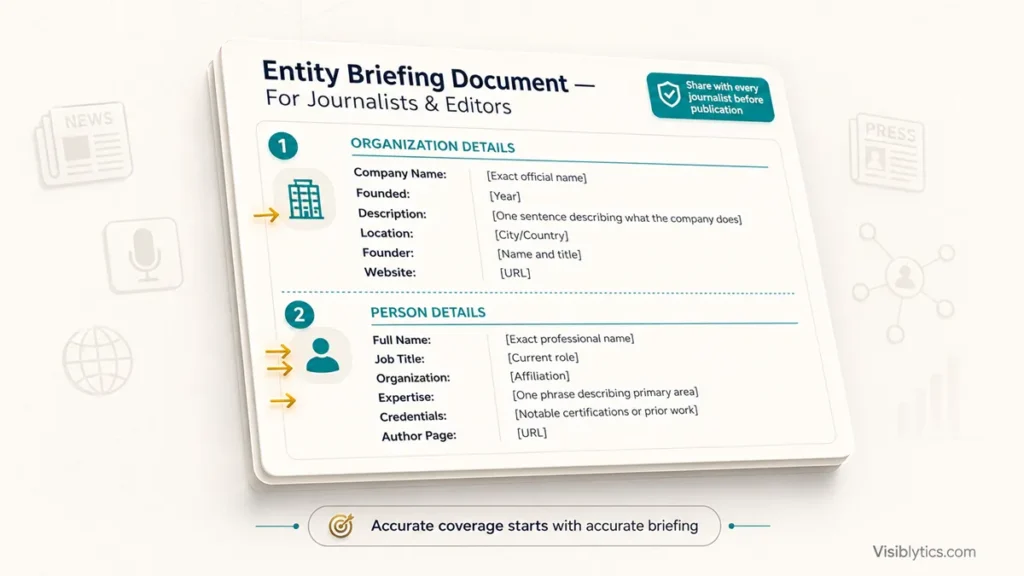
The single most practical improvement I recommend for any Digital PR program is creating and using an entity briefing document. Most PR programs do not do this, and the result is coverage that generates brand awareness but weak entity corroboration.
An entity briefing document is a short background document you share with every journalist, podcast host, or editor before they publish anything involving your entity. It contains exactly the information that needs to appear in the coverage for it to produce strong entity signals:
For an organization entity:
- Exact company name (the version to use, not variations)
- Founding year
- One-sentence description of what the company does
- Location or primary market
- Founder name and title
- Company website URL
For a person entity:
- Full name exactly as it appears everywhere professionally
- Current job title
- Current organizational affiliation
- Primary area of expertise in one phrase
- Credentials worth mentioning (certifications, notable prior work)
- Professional website or author page URL
When a journalist uses this information in their coverage, the resulting mention contains the structured entity data that knowledge graph systems can extract and use as corroboration. When they write it from memory or their own notes, the resulting mention may use a variant name, omit the founding date, describe your expertise inaccurately, or attribute you to the wrong organization. All of these are entity signal failures that the entity briefing prevents.
Sharing an entity briefing document is a professional practice that most journalists and editors appreciate. It reduces their research burden and ensures accuracy. Frame it as a “quick background doc for accuracy” rather than a PR asset.
Choosing Publications for Entity Authority
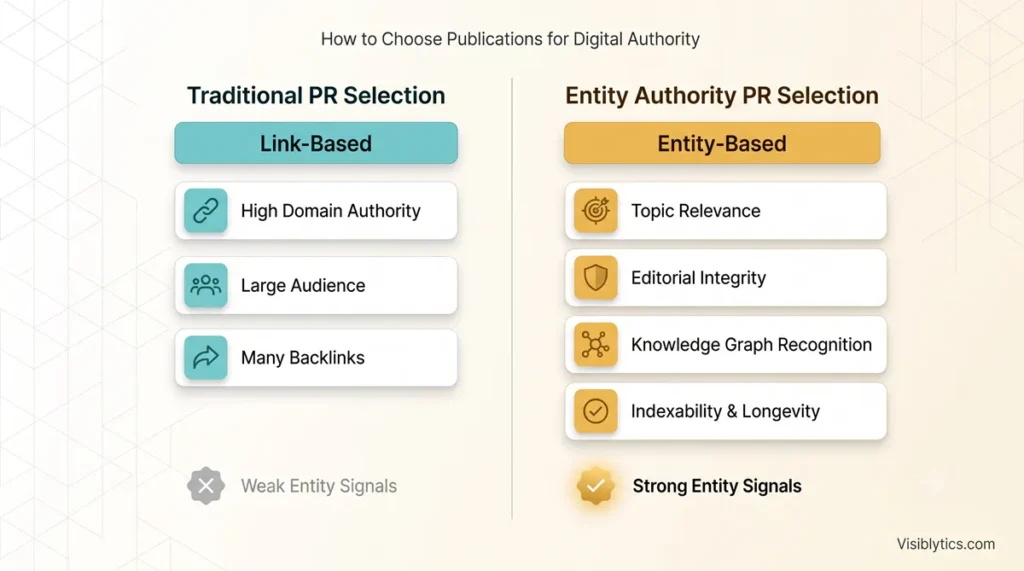
For traditional link-based PR, publication selection is driven primarily by Domain Authority. For entity authority PR, the selection criteria are different and include factors that DA does not capture.
Topic relevance. A mention in a publication that covers your exact topic area produces stronger topical entity association than a mention in a high-DA publication outside your field. A Visiblytics mention in an SEO-focused publication is more valuable for entity authority in the SEO and AI Visibility space than a mention in a general tech publication with a higher DA score.
Knowledge graph recognition. Some publications are more deeply represented in knowledge graphs and AI training data than others. A mention in a publication that AI systems already treat as an authoritative source on your topic produces stronger entity corroboration than a mention in a publication that AI systems have weak signals about. You cannot know this with certainty, but established, long-running publications with editorial standards are generally safer bets than newer or less recognized outlets.
Editorial integrity. Publications that maintain genuine editorial standards produce corroboration signals that carry more weight than those where coverage can be easily influenced or purchased. A mention earned through genuine newsworthiness in an editorially rigorous publication is a stronger entity signal than placed content in a publication with weak editorial standards.
Indexability and crawlability. A mention only has entity corroboration value if search engines can crawl and index it. Check that any publication you target has content that is publicly accessible, not behind a paywall that blocks crawlers, and regularly indexed.
Longevity. A mention in a publication that has been online for ten years and is likely to remain accessible is more durable as an entity signal than a mention in a newer or less stable outlet. Entity authority is built from signals that persist over time.
Unlinked Mentions and Entity Authority
One of the most consistently overlooked aspects of Digital PR for entity authority is that links are not required for a mention to produce entity corroboration value.
A publication that names your brand, describes your expertise, and attributes a relevant professional role is generating an entity signal regardless of whether that name is hyperlinked to your website. Search engines can identify entity mentions in unlinked text through Named Entity Recognition, and AI systems draw on that information for entity corroboration.
This matters for two practical reasons. First, many publications have policies against linking to external sites in editorial content, particularly for expert quotes or commentary. Chasing a link from these publications is often futile. Chasing the mention is not. Second, it means that brand mentions earned through social media, podcast transcripts, YouTube descriptions, and other formats that do not typically carry hyperlinks still contribute to entity authority when they name the entity clearly and attribute expertise correctly.
The practical implication: when evaluating the success of a Digital PR effort, count quality mentions as a success metric alongside links. A mention in a recognized publication that uses your correct entity name and attributes your expertise is a win for digital authority whether or not it carries a link.
How to Measure Digital PR for Entity Authority
Traditional PR measurement focuses on reach, impressions, and link acquisition. Measuring Digital PR for entity authority requires a different set of signals.
Named entity mentions. Track how many publications mention your brand name and your personal name in your correct professional context. Count both linked and unlinked mentions.
Expertise attribution accuracy. When you are covered, does the coverage describe your expertise correctly? “Suraj Saini, an AI Visibility specialist” is an accurate entity attribution. “Suraj, an SEO guy” is not. Track the quality of attribution, not just the quantity of mentions.
Topic co-occurrence. Are your mentions appearing alongside other recognized entities in your topic area? Co-occurrence with credible entities in your space strengthens topical entity association.
Knowledge panel changes. If your entity develops a knowledge panel or if an existing panel updates its information, it is often a lagging indicator that your external corroboration signals have strengthened. Monitor your branded search results for knowledge panel appearance and accuracy.
AI citation monitoring. Ask AI systems questions relevant to your area of expertise and check whether your entity is cited accurately. This is a direct measure of how well your entity authority signals are translating into AI visibility outcomes.
Consistent source authority. Are your mentions coming from publications that are themselves recognized as credible in your topic area? A single mention in a top-tier publication in your space may produce more entity authority than ten mentions in lower-authority outlets.
Common Digital PR Mistakes That Weaken Entity Authority
Pitching without an entity briefing. Allowing journalists to describe your entity from memory or their own notes produces inconsistent attribution that weakens entity signals. Always provide a structured briefing.
Targeting links over mentions. Prioritizing high-DA link targets over topically relevant, high-authority-in-context targets optimizes for Domain Authority rather than entity authority. Both have value but they are different programs.
Accepting inaccurate coverage without correction. A press mention that uses the wrong company name, attributes you to the wrong organization, or describes your expertise inaccurately is an entity conflict, not a win. Requesting corrections is worth the effort.
Ignoring the entity attribution in the coverage. When evaluating whether a piece of coverage is worth pursuing or celebrating, check not just the publication’s authority but whether the resulting coverage will name your entity correctly, attribute your expertise accurately, and appear alongside relevant topical context. A mention that misses all three of these is a weaker entity signal than one that hits all three.
Running PR as a one-time campaign. Entity authority from PR is cumulative. A single press campaign produces a cluster of signals. A consistent, ongoing PR presence that produces regular mentions across credible sources over months and years produces compounding entity authority. Plan for continuity, not campaigns.
Not connecting PR efforts to entity foundation work. PR coverage that points to a website with no Organization schema, no entity homepage, and no named author pages wastes some of its corroboration value because the search engine cannot easily match the external mention to a clearly defined entity on your site. Do the entity foundation work before scaling PR efforts.
Entity Checklist for Digital PR
Before any PR activity:
- Entity homepage complete with accurate Organization and Person schema
- Entity briefing document prepared with exact name, title, affiliation, description, founding date, and URL
- All social profiles use exact same entity name as the briefing document
- Wikidata entry exists and is accurate (so journalists can find correct information independently)
During outreach:
- Entity briefing shared with every journalist, editor, or host before publication
- Target publications evaluated for topic relevance and editorial integrity, not just DA
- Expert commentary pitches include exact professional attribution in the proposed quote
After coverage:
- Coverage checked for accurate entity name, title, and expertise attribution
- Corrections requested for any inaccurate entity information
- Mention tracked regardless of whether a link was included
- AI citation monitoring to check whether coverage is influencing entity representation in AI answers
❓ Frequently Asked Questions
What is Digital PR?
Digital PR is the practice of earning coverage, mentions, and citations from online publications, journalists, and industry sources through proactive outreach and the creation of newsworthy content or commentary. For digital authority purposes, the most valuable outputs are named entity mentions, attributed expert quotes, research citations, and third-party descriptions of your expertise that appear in publications search engines and AI systems treat as credible.
How is Digital PR different from traditional PR?
Traditional PR focuses primarily on broadcast and print media, with success measured in impressions and brand awareness. Digital PR operates in online channels and its outputs are measurable in mentions, links, and indexed content. For entity authority specifically, digital PR is more useful because its outputs are crawlable, indexable, and directly processable by the knowledge graph and AI systems that build entity representations.
Do unlinked mentions help with digital authority?
Yes. Search engines can identify entity mentions in unlinked text through Named Entity Recognition, and AI systems draw on unlinked mentions as entity corroboration signals. A named entity mention in a credible publication produces entity authority value regardless of whether it carries a hyperlink. This makes Digital PR valuable even in publications that have strict no-external-links policies in editorial content.
How many PR mentions do I need to build entity authority?
There is no verified minimum number. Entity authority from PR is cumulative and depends on the authority of the sources, the accuracy of the entity attribution, and the topical relevance of the coverage. A consistent pattern of accurate mentions in credible, topically relevant sources over time is more valuable than a burst of coverage in lower-relevance outlets. Quality and consistency matter more than quantity.
What is the entity briefing document?
An entity briefing document is a short background document shared with journalists, editors, and hosts before they publish anything involving your entity. It contains the exact entity information that should appear in coverage: official name, founding year, one-sentence description, founder name and title, and website URL. It ensures that coverage uses accurate entity information rather than inferred or remembered details, which directly improves the entity authority value of the resulting mention.
How does Digital PR connect to AI visibility?
AI systems build entity representations from external corroboration signals, and Digital PR is the primary mechanism through which those signals are generated at scale. When a credible publication names your entity, attributes your expertise, and cites your research, it is providing the kind of independent verification that AI systems use when deciding whether to represent an entity accurately and whether to cite it in generated answers. The full connection between entity signals and AI visibility is covered in the AI Visibility guide.
PR That Leaves Entity Signals Behind
The most useful reframe for Digital PR in the context of digital authority is to evaluate every PR activity not just by whether it generates coverage, but by whether that coverage leaves entity signals behind.
A press mention that names your entity correctly, attributes your expertise accurately, and appears in a publication that search engines and AI systems treat as credible is doing double work: it builds brand awareness with a human audience and it builds entity corroboration with machine systems simultaneously. A press mention that uses the wrong name, omits your affiliation, or appears in a publication with no topical credibility in your space does less of both.
The entity briefing, the publication selection criteria, the measurement framework, and the attention to attribution accuracy covered in this guide are all in service of the same goal: making sure that every piece of Digital PR coverage leaves the strongest possible entity signal behind, not just the widest possible brand impression.
For the broader framework of how PR fits into digital authority, the Digital Authority guide covers the complete picture. For how original research specifically drives PR and entity authority together, the Original Research as an Authority Strategy guide covers that in depth.