Original research is the single most effective long-term investment available for building digital authority, and I say that with a specific meaning in mind. Not content that summarizes what others have found. Not an opinion piece that draws conclusions from third-party data. Original research means data, findings, or analysis that does not exist anywhere else because you produced it: your survey, your benchmark, your experiment, your dataset.
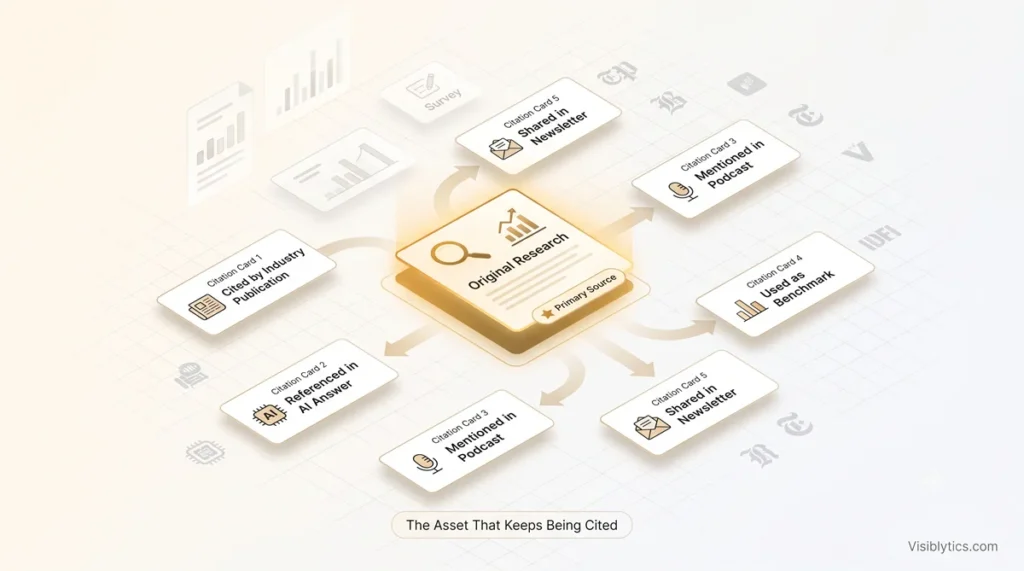
The reason original research occupies a different tier from other authority-building activities is what it does for your entity’s citability. When your content restates what others have already said, an AI system or journalist has no specific reason to cite you rather than the more prominent source you drew from. When your content contains data or findings that exist nowhere else, any source that wants to reference those findings has only one option: cite you. That citability is what makes original research compound over time in a way that most content does not.
Why Original Research Builds Authority Differently
Most content that brands publish is derivative. It explains, synthesizes, and adds perspective to knowledge that already exists in the world. That content has value: it helps audiences understand topics, it demonstrates expertise, and it contributes to topical authority signals. But it does not make your entity the primary source for anything.
Original research changes that relationship. When you publish a survey of 300 SEO professionals about their AI Visibility challenges, you become the primary source for findings from that survey. When you benchmark how often different brands are cited by ChatGPT for specific topic queries, you become the primary source for those benchmarks. When you test how schema markup affects AI citation rates across a sample of websites, you become the primary source for that data.
Primary sources get cited. Secondary sources that restate primary sources do not get cited when a better option exists. This is the structural reason original research compounds: every citation of your research is simultaneously a brand mention, an entity corroboration signal, and a topical authority reinforcement. The same piece of research can generate citations for months or years after publication, each one adding to the cumulative entity authority signal.
For AI systems specifically, this dynamic is particularly direct. As covered in the LLM SEO guide, AI systems favor content that gives them something unique to cite. A piece of content that contains proprietary data gives an AI system a specific, citable fact that it cannot find anywhere else. That uniqueness is what drives AI citation selection in favor of original sources over derivative ones.
Types of Original Research Worth Producing
Not all research formats produce equal authority outcomes. Here are the types that consistently generate citations, entity mentions, and lasting topical authority.
Surveys and Industry Reports
Surveys are the most accessible form of original research for most businesses. A structured survey of professionals, customers, or target audience members on a topic relevant to your area of expertise produces quantitative findings that are inherently citable.
What makes a survey worth citing: a meaningful sample size, a clearly defined audience, honest methodology disclosure, and findings that reveal something non-obvious. A survey that confirms what everyone already assumed generates polite interest. A survey that surfaces a counterintuitive finding, a significant trend, or a clear gap between belief and practice generates coverage.
The entity authority value of a well-executed survey: the report becomes a citable asset that journalists, bloggers, and researchers reference with attribution. Each citation typically names the publishing entity and often links to the report. The report also becomes a reason for publishers to cover your brand, generating the kind of editorial coverage that produces entity corroboration signals through the mechanisms covered in the Digital PR guide.
Benchmark Studies
Benchmark studies measure how something performs across a defined set of examples, establishing a quantitative baseline. In the SEO and AI Visibility space, this could mean measuring schema adoption rates across a sample of websites in a given industry, testing how often different entity types appear in AI-generated answers for a topic category, or tracking AI citation frequency for brands across different levels of entity SEO implementation.
Benchmarks are particularly valuable for authority building because they establish a measurement framework that others want to reference. Once your benchmark exists, anyone writing about the topic has an interest in citing it for comparison. The benchmark becomes the reference point in ongoing conversations, compounding citation value over time as the topic evolves.
Original Analysis of Public Data
Original analysis applies your expertise to publicly available data to produce insights that did not exist before your analysis. This could mean analyzing search query data to identify patterns in how people ask AI systems questions, examining public filings to surface trends in how companies are describing their AI capabilities, or analyzing content from a large sample of websites to identify patterns in entity SEO implementation.
The research outputs a dataset or analysis that is unique, even though the underlying data was public, because your methodology and interpretation are yours. This form of research is lower in participant-acquisition cost than surveys and often produces findings that are more directly relevant to specific business applications.
Case Studies with Quantified Outcomes
Case studies are original research when they document real implementations with honest, specific measurements. A case study showing that implementing Organization schema and building a Wikidata entry for a client produced a knowledge panel within a defined timeframe, with specific before-and-after measurements, is primary evidence for claims that other practitioners in your field want to reference.
The distinction between a case study as marketing material and a case study as original research is specificity and honesty. Marketing case studies emphasize positive outcomes and minimize complexity. Research case studies document methodology, include unexpected findings, acknowledge limitations, and provide enough detail that a reader could learn from them regardless of which direction the results went.
Original Frameworks and Methodologies
A proprietary framework, when it is genuinely your own synthesis of how something works, constitutes a form of original intellectual contribution. The Visiblytics Digital Authority Framework (Identity, Expertise, Recognition, Trust, Authority, Visibility) is an example: it is a structured way of thinking about something that did not exist in that form before it was articulated. Others who find it useful will cite it with attribution.
Frameworks generate the most durable citation authority of any content type because they become the vocabulary through which a topic is discussed. When your framework becomes the standard way of explaining something, every discussion of that topic is an opportunity for attribution. The tradeoff is that frameworks require genuine synthesis and are difficult to fake: a restatement of existing frameworks is not original.
Designing Research for Maximum Authority Impact
The authority value of original research depends not just on the findings but on how the research is designed, structured, and attributed. Here is what I focus on when designing a research project specifically for authority outcomes.
Define a Citable Finding Before You Start
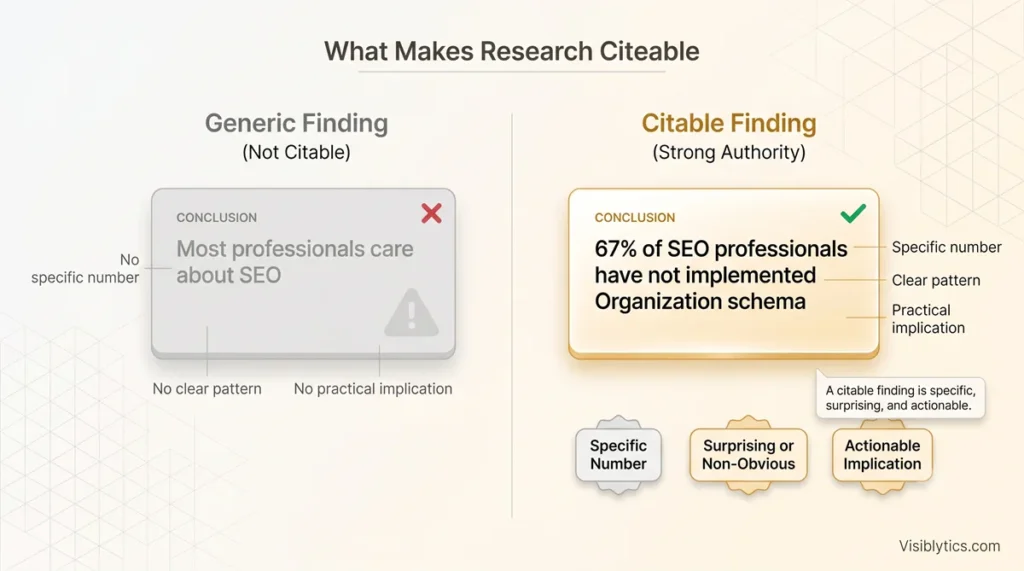
The most citeable research produces a finding that is surprising, specific, and actionable. Before running a survey, write down the headline finding you expect to find and the headline finding that would surprise you. Design your methodology to surface either. Research designed around a predetermined conclusion tends to produce confirmatory, unsurprising findings that are not citable. Research designed to find what is actually true tends to produce findings that are.
A citable finding has these characteristics: it is expressed as a specific number or clear pattern, it is non-obvious (not just confirmation of widespread assumption), and it has practical implications for people in the field. “67% of SEO professionals have not implemented Organization schema” is citable. “Most SEO professionals care about entity SEO” is not.
Make Entity Attribution Explicit in the Research Itself
Every research output needs clear, repeated entity attribution: the name of the publishing organization and the name of the lead researcher appear consistently throughout the report, in the methodology section, in the findings, in the summary, and in the downloadable assets.
This sounds obvious but is frequently neglected. Many research reports are published with a company logo but no named researcher, or with a named researcher but no clear organizational attribution. Both reduce the entity corroboration value of citations because the citation cannot fully attribute both the person entity and the organization entity.
The research citation format you want to produce: “According to research published by Visiblytics, conducted by Suraj Saini…” That format names both entities and attributes specific expertise. Design the research outputs to make that format easy to use.
Include Methodology Transparency
Credible research discloses methodology: sample size, audience definition, data collection method, fielding period, and any relevant limitations. Methodology transparency is not just an ethical practice. It is an authority signal. Research that shows its work is more citable than research that hides its methodology, because the reader can evaluate the validity of the findings.
For AI systems specifically, methodology transparency is increasingly important. AI systems that retrieve research as a source for answers are extracting facts from that research. A fact supported by a disclosed methodology is more trustworthy than one that appears without methodological context. The transparency is itself a trust signal.
Structure Findings for Extractability
AI systems extract specific facts from research to use in generated answers. Research that is structured for extractability produces facts that AI systems can lift and cite directly without requiring inference or paraphrasing.
Extractable research structure: specific numbered findings (“Finding 1: 73% of surveyed brands…”), clearly labeled data tables with source attribution in each table, a summary section that restates key findings in plain language, and a key findings callout box that lists the most citable facts in one place.
Non-extractable research structure: findings buried in paragraphs, data presented only in charts without plain-text accompaniment, and conclusions that require reading the full document to understand.
Structure for the reader who reads everything and the AI system that extracts one fact.
Publish with Article Schema and Named Authorship
Research reports need Article schema (or more specifically, ScholarlyArticle schema where applicable) that explicitly attributes the research to a named author entity and a publishing organization entity. The schema should include: author name with URL, organization name with URL, publication date, and description of the research topic.
Without this machine-readable attribution, a search engine encountering your research has to infer who produced it from prose context. With it, the authorship is explicit and unambiguous. Every citation your research generates is then more reliably attributed to your entity in knowledge graph systems.
Distribution: Making Research Findable and Citable
Original research that is not distributed is original research that no one cites. The distribution strategy for authority-building research is different from the distribution strategy for content marketing.
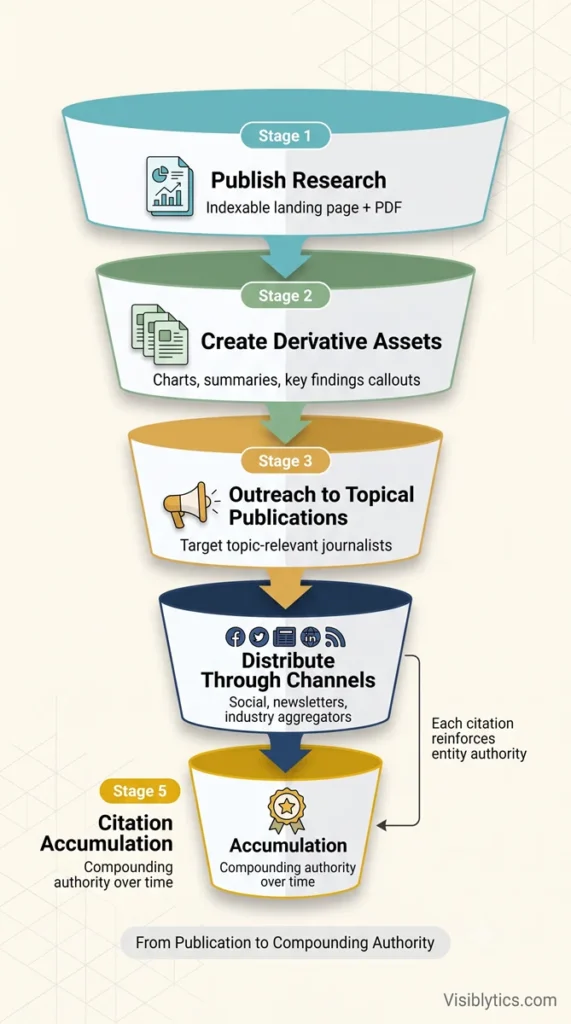
Lead with the citable finding, not the report. The most common distribution mistake is releasing a long-format research report and expecting journalists to read it before covering it. Lead with the single most citable finding in your outreach: “Our survey of 300 SEO professionals found that 67% have not implemented Organization schema. Full report available.” That is the hook. The report is the source.
Target publications that cover your topic area, not just high-DA outlets. As discussed in the Digital PR guide, topical relevance matters more than raw domain authority for entity corroboration. Pitch research to journalists and editors who cover your specific topic area, where a finding in that area is genuinely newsworthy to their audience.
Provide a structured briefing alongside the research. The entity briefing document described in the Digital PR guide applies directly to research distribution. Give journalists the exact citation language you want them to use: the research name, the publishing entity, the lead researcher name and title. Make accurate attribution the path of least resistance.
Publish a standalone landing page, not just a PDF. Research published as an indexable web page is more likely to be found, crawled, and cited than research published only as a downloadable PDF. Publish a full summary on an indexable page, with the PDF available as a supplement. The page should carry all relevant schema markup and authorship attribution.
Create derivative content assets from the research. Charts, key findings callouts, and short-form summaries that can be shared on social platforms and in industry newsletters extend the reach of the research without diluting the primary asset. Each derivative asset should credit the original research with entity attribution.
Submit findings to industry aggregators and research databases. Many industries have research aggregators, newsletters, or communities that compile and share original research. Getting your research listed in these channels expands distribution to audiences that specifically seek out original data.
How Research Compounds Authority Over Time
One of the most valuable properties of original research as an authority strategy is that its authority value compounds rather than decays.
Most content marketing has a traffic curve: high initial traffic after publication, rapid decay as the content moves down search results or out of social feeds. Original research has a different curve: modest initial coverage, followed by sustained citation accumulation as the findings are referenced repeatedly in subsequent articles, reports, and conversations about the topic.
A benchmark study published in year one becomes the comparison point for a follow-up study in year two. The follow-up study references the original, producing a new citation and reinforcing the entity’s position as the ongoing source for that benchmark. After three years of annual benchmark studies, the entity is established as the definitive source for that data, with compounding citation authority that no single piece of non-research content can match.
Running research as an annual or recurring program rather than a one-off project is the most efficient way to build this compounding effect. Each subsequent edition references previous editions, creating a chain of citations that reinforces entity authority with each publication cycle.
Common Mistakes in Research-Based Authority Building
Publishing derivative “research” that synthesizes others’ data. Aggregating statistics from multiple sources into a listicle and calling it research does not make your entity a primary source for any of those findings. If every number in your report was first published elsewhere, the report is secondary content. Primary sources get cited. Aggregators do not.
Neglecting entity attribution in the research assets. A research report that names the company in the header but not in the body text, with no named researcher, with no schema markup, generates citations that may name the company name but often lose the researcher attribution and sometimes lose both. Explicit, repeated, machine-readable attribution is essential.
Designing research to confirm existing beliefs. Surveys designed to produce a specific predetermined finding produce unsurprising results that are not citable. The most citable research reveals something that practitioners in the field did not already know or believe.
Publishing once and moving on. A single research publication generates an initial spike of citations. A research program that publishes annually, with each edition referencing previous editions, generates compounding authority. The research infrastructure (survey panel, methodology, publication format) built for the first edition makes each subsequent edition progressively cheaper to produce.
Not connecting research to the entity’s topical positioning. Research on a topic adjacent to your core area of expertise generates citations for that adjacent area, not for the area where your entity wants to be recognized as authoritative. Research should reinforce the topical association between your entity and your stated area of expertise, not scatter authority across unrelated subjects.
Publishing without distribution infrastructure. Research published with no outreach plan, no journalist contacts, and no entity briefing document reaches only the audience that finds it organically. For a new or low-authority entity, organic discovery alone will not generate meaningful citations. Distribution effort proportional to the research investment is necessary.
Original Research Checklist
Research design:
- Citable finding defined before data collection begins
- Methodology transparent and disclosed in the published output
- Sample size sufficient for the claims being made
- Findings expressed as specific, numbered, extractable facts
Attribution and schema:
- Lead researcher named explicitly throughout the report
- Publishing organization named consistently with exact entity name
- Article or ScholarlyArticle schema implemented with author and organization attribution
- Publication date included
Publication:
- Research published on an indexable web page, not only as a PDF
- Key findings summarized in plain text on the page (not only in charts)
- PDF available as supplement with entity attribution in the document itself
Distribution:
- Entity briefing document prepared before outreach begins
- Outreach targeted to topically relevant publications, not only high-DA outlets
- Single most citable finding identified for use in outreach pitches
- Derivative content assets created for social and newsletter distribution
Long-term program:
- Follow-up research or annual edition planned at publication
- Research landing page maintained and updated as findings are cited
❓ Frequently Asked Questions
What counts as original research for authority building?
Original research is data, analysis, or findings that do not exist anywhere else because you produced them. This includes surveys with a defined audience, benchmark studies measuring performance across a sample, original analysis of public data using your methodology, case studies with specific quantified outcomes, and proprietary frameworks that synthesize knowledge in a new way. Content that summarizes, synthesizes, or draws conclusions from data first published by others is secondary content, not original research.
How large does a survey sample need to be?
There is no universal minimum, and the right sample size depends on the question being asked and the population being studied. As a practical guide for industry surveys in SEO and digital marketing contexts, 100 to 200 qualified respondents typically produces findings that journalists and practitioners will treat as meaningful. Larger samples (300 to 500) produce findings that are more defensible against methodological criticism and more frequently cited by larger publications. I would be cautious about publishing surveys with fewer than 50 respondents as primary research, as the sample size is too small to support most generalizations.
How does original research help AI citations specifically?
AI systems that retrieve content to inform generated answers favor sources that contain unique, citable facts. A piece of content that restates commonly known information gives an AI system no specific reason to cite it over a more prominent source covering the same ground. A piece of content that contains findings from your original research gives the AI system a specific, unique fact that can only be attributed to you. That uniqueness drives citation selection. The connection between content uniqueness and AI citation is covered in the LLM SEO guide.
Does original research need to be published in academic journals?
No. For digital authority in business and professional contexts, publishing original research on your own website with a clear methodology, transparent attribution, and appropriate schema markup is sufficient. Academic journal publication adds credibility in academic contexts and can produce additional citations from academic sources, but it is not required for the entity authority and AI visibility outcomes this guide covers.
How long does it take for research citations to build authority?
Citations accumulate over time rather than arriving in a single burst. Initial coverage from outreach may generate citations in the first weeks after publication. Organic discovery by researchers and journalists who encounter the research through search adds citations over subsequent months. Follow-up coverage of the research findings generates additional citations. A well-designed research report in a relevant topic area can generate citations for two to three years or more after publication. The cumulative authority impact is therefore substantially larger than what the initial publication generates.
Should I run research every year or only occasionally?
Running original research as an annual program produces significantly more compounding authority than one-off publications. Each annual edition references previous editions (producing an internal citation chain), updates findings that journalists and researchers already know to look for, and establishes your entity as the ongoing source for that benchmark or data point. The infrastructure built for the first edition (survey panel, distribution contacts, publication template) makes each subsequent edition progressively more efficient to produce.
The Asset That Keeps Being Cited
Most content marketing produces diminishing returns over time. Original research produces compounding returns. The survey published this year becomes the benchmark that next year’s survey updates. The framework articulated this month becomes the vocabulary through which a topic is discussed for years. The case study documented today becomes the evidence cited by practitioners next year.
The initial investment in original research is higher than in derivative content. The methodology requires care, the data collection requires resources, and the distribution requires active effort. But the authority outcomes, the citation accumulation, the entity corroboration signals, the AI citation probability, and the topical authority reinforcement, compound in ways that make it the highest-return authority investment available over a two to three year horizon.
For how research connects to the PR mechanics that distribute it and generate coverage, the Digital PR guide covers the full distribution process. For the broader digital authority framework that original research feeds into, the Digital Authority guide covers where research fits among the other authority-building disciplines.