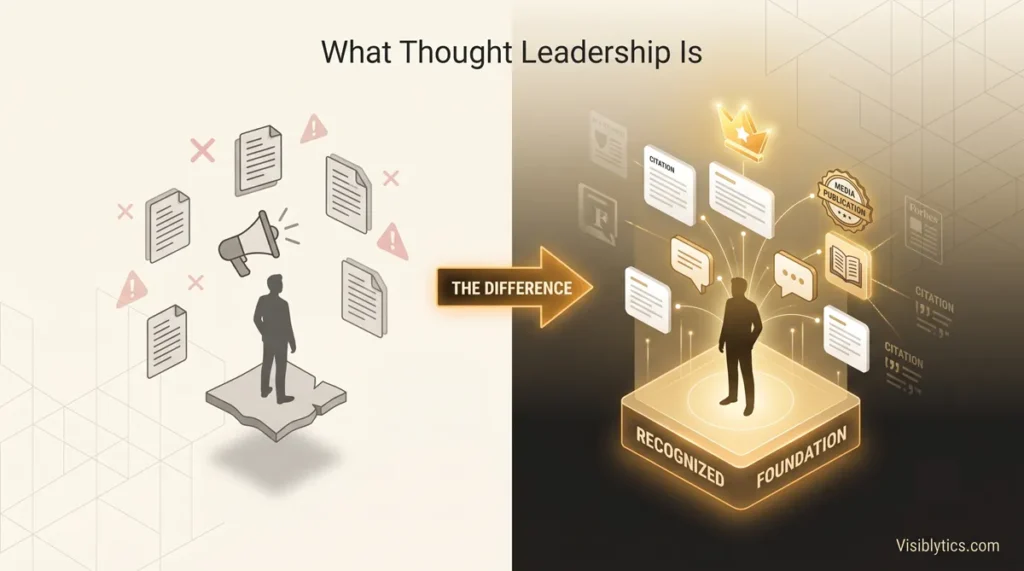
Thought leadership is one of the most misused terms in professional marketing, which is why defining it precisely matters before discussing how to build it. Genuine thought leadership is the outcome of consistently publishing original, substantive perspectives on a specific subject area in a way that other credible sources engage with, reference, build on, and debate. It is not a content format. It is not a LinkedIn strategy. It is not something you declare about yourself. It is a recognition status that others confer on you because your thinking is consistently worth paying attention to.
The reason thought leadership belongs in a discussion of digital authority is that when it is genuine, it produces exactly the kind of external recognition signals that knowledge graphs and AI systems weight most heavily: independent, editorial acknowledgment from recognized sources that your entity has something original and credible to contribute on a specific subject.
What Thought Leadership Is Not
Before defining what thought leadership is, it helps to clear away what it is not, because the misconceptions are pervasive and they lead to programs that produce activity without authority.
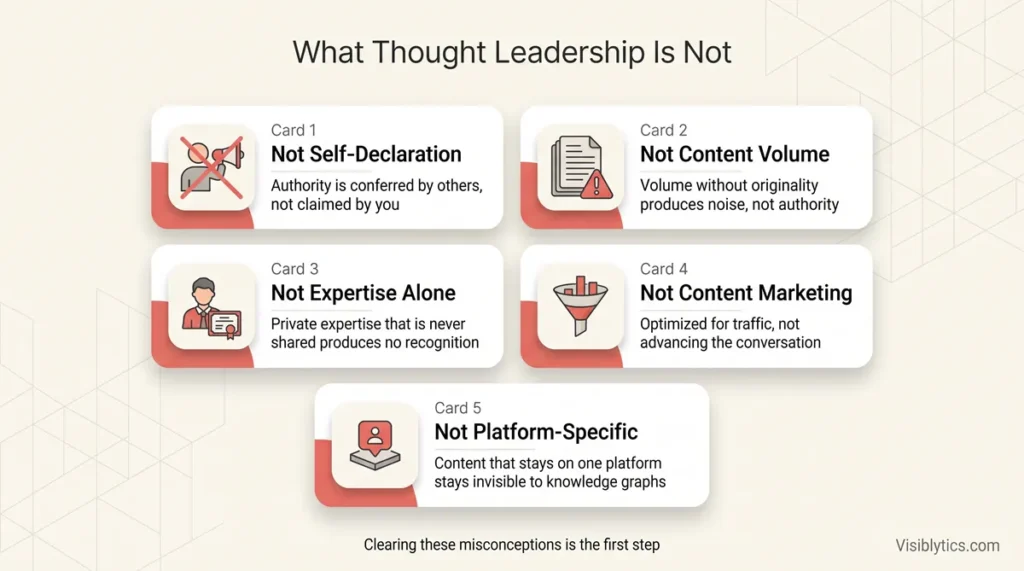
Thought leadership is not self-declaration. Describing yourself as a thought leader in your bio, your LinkedIn headline, or your website copy produces no authority signal. Authority is conferred by others, not claimed by you. A page that says “Suraj Saini is a thought leader in AI Visibility” is marketing copy. A publication that says “Suraj Saini is one of the clearer voices on AI Visibility” is an editorial judgment. Only the second one is an authority signal.
Thought leadership is not content volume. Publishing fifteen articles a month on LinkedIn does not make someone a thought leader. Volume without originality, without depth, and without external engagement produces noise, not authority. The question is not how much you publish but whether what you publish produces a response worth noticing from sources worth being noticed by.
Thought leadership is not expertise alone. A person can have deep, genuine expertise on a subject and have almost no thought leadership recognition. Expertise becomes thought leadership when it is consistently made public in a form that others engage with and reference. Private expertise that is never shared, cited, or debated produces no external recognition signals.
Thought leadership is not the same as content marketing. Content marketing is designed primarily to attract and convert an audience. It is evaluated by traffic, leads, and conversions. Thought leadership is designed to advance a field, define a conversation, or change how practitioners think about a topic. The best thought leadership often does both, but when content is optimized only for traffic without advancing anything, it is content marketing, not thought leadership.
Thought leadership is not platform-specific. Publishing original perspectives exclusively on one platform, with no distribution into publications, no citations from peers, and no engagement from credible external sources, produces audience engagement on that platform but limited entity authority signals outside it. Platform-native content that stays on the platform stays invisible to the knowledge graph and AI systems that build entity representations.
What Thought Leadership Actually Is
Thought leadership is the consistent public demonstration of original perspective and genuine expertise on a specific subject, in a form and through channels that produce credible external engagement and citation.
The key elements in that definition:
Consistent. Thought leadership is not a one-off publication. It is a sustained pattern of contribution over time. A single well-received article makes someone a good writer. A sustained pattern of well-received, original contributions to a specific conversation makes someone a recognized voice in that conversation.
Original perspective. Summarizing what others have said, even skillfully, is not thought leadership. A thought leader is not a curator of existing ideas. They are a contributor of new ones: new frameworks, new data, new interpretations, new challenges to conventional wisdom. The originality is what makes the contribution worth citing.
Genuine expertise. Original perspective without grounding in genuine expertise produces provocative content that does not hold up under scrutiny. The most durable thought leadership comes from people who have done the work and are sharing what they have actually learned, not what they have read about others learning.
Specific subject. Thought leadership on everything is thought leadership on nothing. A recognized voice in one specific conversation produces stronger entity authority signals than a moderately interesting voice across many conversations. Specificity is what creates the topical entity association that search engines and AI systems use to connect an expert to a subject area.
Credible external engagement. This is the element that separates thought leadership from good writing. When other recognized practitioners respond to, cite, debate, or build on your perspective, that is external engagement. When publications feature your perspective as worth presenting to their audience, that is editorial recognition. These external responses are the signals that convert private expertise into public authority.
Why Thought Leadership Produces Entity Authority Signals
The connection between thought leadership and entity authority runs through the recognition layer of the Digital Authority framework. Recognition is what converts self-declared expertise into externally-validated authority, and thought leadership is one of the primary mechanisms through which recognition accumulates.
When a practitioner consistently publishes original perspectives on a specific topic:
Other practitioners begin referencing their work. Each reference is an independent acknowledgment that this entity has produced something worth citing. Over time, a pattern of such references builds a topical entity association between the person and the subject.
Publications begin seeking their commentary. An editor who contacts a practitioner for expert comment on a relevant story has made an editorial judgment that this practitioner is a credible, recognized voice on this topic. The resulting coverage produces the kind of attributed expert mention that search engines and AI systems treat as high-authority entity corroboration.
Their name becomes associated with specific positions or frameworks in their field. When other people in a field use your framework, reference your research, or cite your perspective as representative of a position, your entity becomes associated with that framework or position in the structured knowledge that AI systems draw from.
The practical authority outcome: an AI system asked about experts in Entity SEO will draw on the pattern of external citations, attributed mentions, and independent acknowledgments that thought leadership produces. A practitioner who has consistently advanced the conversation on Entity SEO, whose work has been cited by other practitioners, and whose perspective has been featured in relevant publications is far more likely to appear in that answer than one whose expertise exists only in their own content.
Types of Thought Leadership Content
Not all content formats produce equal thought leadership signals. Here is how the main types map to authority outcomes.
Original frameworks and models. A new framework for understanding a topic, a model for approaching a problem, or a methodology that practitioners in the field adopt and reference is the highest-authority thought leadership content. The Visiblytics Digital Authority Framework is an example at a small scale: it provides a vocabulary and structure for thinking about digital authority that others can reference. Frameworks are citable, quotable, and durable in a way that general articles are not.
Original data and research. Research findings give others something specific to cite. As covered in the Original Research guide, data that does not exist elsewhere makes your entity the primary source for that information. Research is the most reliable thought leadership format for producing formal citations.
Contrarian positions. Taking a well-reasoned position that challenges conventional wisdom in a specific field produces more engagement and more citation than agreeing with what most practitioners already believe. The engagement is not guaranteed to be positive, but debate and disagreement are signs of thought leadership impact. A position that no one responds to has not advanced the conversation.
Deep synthesis. Bringing together insights from multiple sources into a new, coherent perspective that is more useful than any of the individual sources alone is original contribution even without new data. The synthesis is the original work. This format works best when the synthesis produces a genuinely new conclusion, not just a summary.
Case documentation with honest analysis. Documenting what you actually tried, what happened, what you expected versus what you found, and what you concluded is thought leadership when the documentation is honest and specific enough that other practitioners can learn from it. Case documentation works as thought leadership when it reveals something genuinely instructive, not when it is a success story designed for marketing purposes.
Predictive analysis. Publishing well-reasoned predictions about where a field is heading, with specific evidence and clear reasoning, is thought leadership when those predictions prove accurate or when they advance the conversation about what might happen. The key is specific, reasoned prediction, not vague trend observation.
Building a Thought Leadership Program
Genuine thought leadership is not manufactured. It emerges from genuine expertise applied consistently and publicly to a specific subject. But it can be developed deliberately rather than waiting for recognition to arrive organically. Here is how I think about building it.
Define your specific territory. Thought leadership on a broad subject like “SEO” is nearly impossible to achieve at a meaningful level because the conversation is too large and too many recognized voices already occupy it. Thought leadership on a specific subset (Entity SEO, AI Visibility, knowledge graph optimization) is achievable because the territory is narrow enough that a sustained, original contribution can actually advance the conversation.
Develop a consistent point of view. The practitioners who become recognized voices in a field are usually associated with a specific perspective, not just general knowledge. What do you believe about your subject area that is non-obvious, defensible, and worth arguing? What conventional wisdom do you think is wrong or incomplete? A consistent, distinctive point of view is what makes thought leadership recognizable over time.
Publish for contribution, not for traffic. The question to ask before publishing is not “will this get traffic?” but “does this add something to the conversation that is not already there?” Traffic is a measure of audience reach. Thought leadership is a measure of contribution to the field. The best thought leadership often does both, but optimizing for traffic alone produces content that does not advance anything.
Engage with the conversation, not just publish into it. Thought leadership is not a broadcast. It is a contribution to an ongoing conversation. Responding to others’ arguments, building on others’ frameworks, and publicly engaging with disagreements are all part of how thought leadership develops. A practitioner who only publishes and never engages remains a publisher, not a voice.
Distribute beyond your own channels. Original perspectives that stay on your own website or social profiles accumulate audience engagement but limited entity authority signals. The goal is to get original perspectives into channels that produce external citation: publications, podcasts, conference presentations, academic references. Each channel that carries your perspective outside your own domain is a potential source of entity corroboration.
Build toward signature contributions. The thought leaders who develop the strongest entity authority are usually associated with one or two signature contributions: a framework, a piece of research, a concept that becomes vocabulary in their field. Work deliberately toward what your signature contribution might be. Not every article needs to be that contribution, but having a direction toward it focuses the ongoing work.
Thought Leadership vs Content Marketing
The distinction between thought leadership and content marketing is worth being precise about, because conflating them leads to programs that produce one while expecting the outcomes of the other.
| Content Marketing | Thought Leadership |
|---|---|
| Designed to attract and convert an audience | Designed to advance a field or conversation |
| Measured by traffic, leads, conversions | Measured by external citations, recognition, engagement from peers |
| Optimized for search intent | Optimized for contribution and originality |
| Can be produced at volume | Quality over volume |
| Success = audience growth | Success = field influence |
| Entity signal: topical content exists | Entity signal: external recognition of expertise |
Content marketing and thought leadership are not mutually exclusive. The best content strategies produce content that attracts audiences AND advances conversations. But they require different evaluation frameworks, and a content program evaluated only on traffic metrics will systematically underproduce thought leadership, because the content that performs best on traffic metrics is often the content that confirms what readers already believe rather than challenging or advancing their thinking.
For entity authority purposes, the signals that matter most come from the thought leadership column: external citations, recognition from peers, and editorial acknowledgment from credible sources. These are what build the recognition layer of the authority stack. Content marketing builds the topical content layer but does not consistently produce the external recognition signals on its own.
How to Measure Thought Leadership Authority
Thought leadership does not produce a single score, but its development produces observable signals.
External citations of your work. When other practitioners, publications, or researchers cite a specific article, framework, or finding of yours, that is a thought leadership signal. Track citations of specific pieces over time. A piece that continues to be cited months or years after publication is functioning as thought leadership.
Unsolicited media requests. When journalists contact you for commentary on a topic in your area rather than you pitching them, it indicates that you are recognized as a source worth seeking out. Tracking how often inbound media requests occur and their quality over time is a useful thought leadership signal.
Peer engagement and response. When recognized practitioners in your field respond to, debate, or build on your published perspectives, that is evidence that your contribution is being taken seriously as an input to the field’s conversation. The quality and recognition level of who engages matters as much as the volume.
Framework or concept adoption. When other practitioners begin using your frameworks, terminology, or models to describe their own work, your thinking is becoming part of the field’s vocabulary. This is the highest thought leadership signal: it means your contribution is structurally influencing how the field thinks.
Speaking invitations. Being invited to speak at recognized industry events indicates that organizers judge your perspective as worth presenting to their audience. The caliber of events and their selectiveness as filters matters more than the number of appearances.
AI citation accuracy on your subject. Asking AI systems questions in your stated area of expertise and checking whether your name and perspectives appear accurately is a direct measure of whether your thought leadership is producing entity authority at the machine level.
Common Thought Leadership Mistakes
Self-declaration without substance. Calling yourself a thought leader in any professional context (bio, headlines, social profiles) without the external recognition to support it is the most common mistake and the one that produces the most negative signal. Let others declare it. Your job is to do the work that earns it.
Publishing at volume without advancing anything. High-frequency publishing that summarizes, curates, or slightly reframes what others have already said produces audience exposure but no thought leadership signals. Volume without originality is noise.
Staying on owned channels only. Publishing exclusively on your own website and social profiles without actively pursuing distribution into third-party publications, podcasts, and events severely limits the external citation potential of your work. Thought leadership that never reaches channels outside your own domain rarely produces the entity corroboration signals that build authority.
Avoiding positions to avoid disagreement. Content that is calibrated to offend no one and challenge nothing produces no debate, no engagement, and no thought leadership recognition. The positions that advance a field are usually specific enough to be disagreeable to someone. Thought leadership requires the willingness to hold and defend a specific point of view.
Building a following without building authority. A large social media following and strong thought leadership authority are positively correlated but not the same thing. Optimizing for follower count produces audience growth. Optimizing for contribution to the field produces authority. The former is more immediately measurable. The latter is more durable and more directly connected to entity authority outcomes.
Abandoning a subject before authority accumulates. Thought leadership takes time. Practitioners who pivot to a different subject area before recognition has accumulated in the first one reset the clock. Sustained contribution to a specific conversation over years is what produces the compounding authority effect. Jumping between subject areas prevents that accumulation.
❓ Frequently Asked Questions
What is thought leadership in SEO and digital authority?
Thought leadership is the consistent public demonstration of original perspective and genuine expertise on a specific subject in a way that produces credible external engagement and citation. For digital authority purposes, it matters because genuine thought leadership produces the external recognition signals (citations, expert mentions, peer engagement, editorial acknowledgment) that search engines and AI systems treat as evidence that an entity is a credible, recognized source in their stated area of expertise.
How is thought leadership different from content marketing?
Content marketing is designed to attract and convert an audience and is measured by traffic, leads, and conversions. Thought leadership is designed to advance a field or conversation and is measured by external citations, peer recognition, and editorial acknowledgment. The best content programs produce both, but they require different evaluation frameworks. Content that performs well on traffic metrics often confirms what readers already believe. Thought leadership often challenges or advances it.
Can thought leadership be planned or does it happen organically?
It can be developed deliberately, though genuine thought leadership cannot be manufactured. Deliberate development involves: defining a specific territory narrow enough to be advanced by sustained contribution, developing a consistent and distinctive point of view, publishing for contribution rather than traffic, distributing beyond owned channels, and building toward signature contributions. What cannot be manufactured is the external recognition. That is conferred by others based on whether the contribution is genuinely worth engaging with.
How long does it take to develop thought leadership recognition?
There is no verified timeline, and I would be cautious of anyone who states one with confidence. It depends on the narrowness of the territory, the originality of the contribution, the quality of the distribution channels, and how actively the practitioner engages with the broader conversation. In my observation, meaningful external recognition in a specific niche typically accumulates over one to three years of consistent, original contribution. Recognition in broader topic areas takes longer. A single well-placed, highly original contribution can accelerate the process significantly.
Does thought leadership on social media count for entity authority?
Partially. Social media thought leadership that stays on the platform produces audience engagement signals but limited entity authority signals for knowledge graph and AI systems, because platform-native content is less likely to generate the kind of indexed, attributed citations that feed entity corroboration. Social media thought leadership produces the strongest authority outcomes when it generates engagement that spills into third-party publications, when others cite the social content in articles or reports, or when it builds the reputation that leads to external opportunities like speaking invitations and media requests.
What is the difference between being an expert and being a thought leader?
Expertise is the knowledge. Thought leadership is what happens when expertise is consistently applied publicly in a way that others find worth engaging with and referencing. A person can have deep expertise without any thought leadership recognition if they never share it publicly, or if what they share does not advance the conversation. A thought leader is an expert who has converted private knowledge into public contribution that has been recognized as such by external, credible sources.
Recognition Cannot Be Manufactured, But It Can Be Earned Faster
Thought leadership is the slowest-building component of the digital authority stack. There are no technical shortcuts for it, no schema markup that signals it, no tool that produces it. It accumulates through the sustained, visible application of genuine expertise over time, in the eyes of people and institutions whose judgment carries weight.
What makes it worth the investment is precisely its resistance to shortcutting. Domain Authority can be acquired through link schemes. Social followings can be inflated. But the citation pattern, the peer engagement, and the editorial recognition that constitute genuine thought leadership are hard to fake at scale and durable over time in a way that manufactured signals are not.
For how thought leadership connects to the broader digital authority framework, the Digital Authority guide covers where recognition fits among the other authority-building disciplines. For how to build the author entity foundation that makes thought leadership contributions attributable to a specific person, the Author Authority guide covers that groundwork.