E-E-A-T (Experience, Expertise, Authoritativeness, and Trustworthiness) is most commonly discussed as a Google ranking framework: a set of quality signals that determine how well a page performs in organic search. That framing is accurate but incomplete. E-E-A-T is also a description of the same entity-level signals that determine how confidently search engines and AI systems can represent your brand, cite your content, and include you in AI-generated answers.
The practical consequence: building E-E-A-T is not just an SEO exercise. It is entity authority work. Every signal that demonstrates E-E-A-T to Google also demonstrates entity trustworthiness to the knowledge graph systems that feed ChatGPT, Gemini, Claude, and Perplexity. The two disciplines are the same work, viewed from two different angles.
This guide is specifically about that connection: how E-E-A-T maps to entity signals, how each component feeds into AI visibility, and how to build E-E-A-T in a way that produces both ranking improvements and durable entity authority.
If you are looking for the complete guide to E-E-A-T as an SEO ranking framework, including the 2026 core update data and YMYL content requirements, that guide is at E-E-A-T in SEO: The Complete Guide (2026).
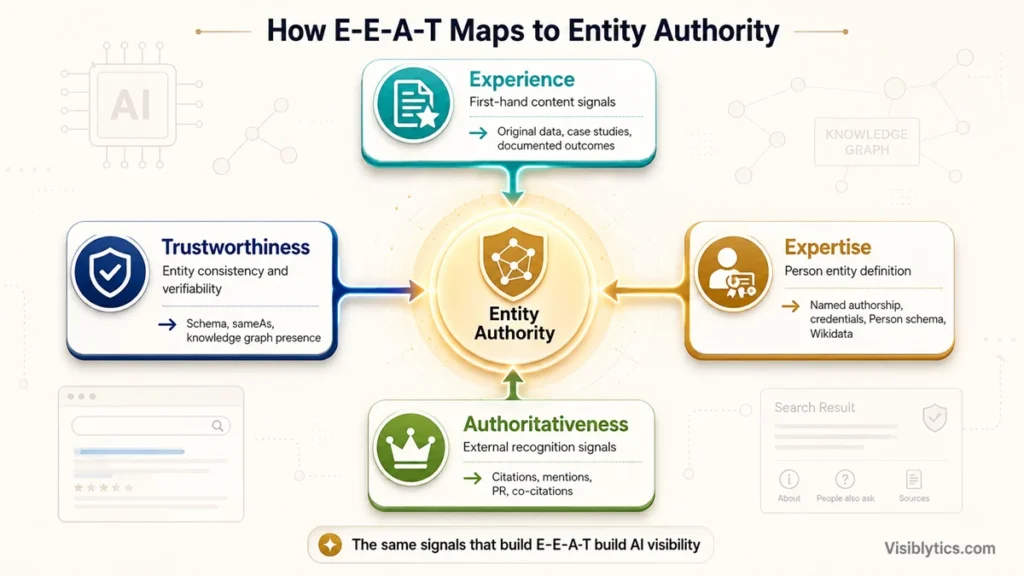
How E-E-A-T Maps to Entity Authority
The four components of E-E-A-T map almost exactly to the components of entity-level authority. This is not a coincidence. E-E-A-T was designed to describe the signals that make a source trustworthy to a sophisticated reader. Entity authority describes the signals that make an entity trustworthy to a sophisticated machine. The underlying criteria are the same.
E-E-A-T Component      → Entity Authority Equivalent
─────────────────────────────────────────────────────
Experience             → First-hand content signals
                         (case studies, original data,
                          documented real-world outcomes)

Expertise              → Person entity definition
                         (named authorship, credentials,
                          Person schema, Wikidata)

Authoritativeness      → External recognition signals
                         (citations, mentions, PR,
                          co-citations with known entities)

Trustworthiness        → Entity consistency and verifiability
                         (schema, sameAs, knowledge graph
                          presence, consistent external signals)
The implication is direct: building E-E-A-T through entity SEO work produces both outcomes simultaneously. Implementing Person schema with verified credentials improves Expertise signals for Google’s ranking systems and improves person entity verifiability for AI citation systems. Earning attributed expert mentions improves Authoritativeness for rankings and builds external corroboration for entity authority. Entity consistency work improves Trustworthiness for search quality raters and reduces entity disambiguation conflicts in knowledge graphs.
The rest of this guide goes through each component in detail, with specific attention to the entity and AI visibility dimension that the standard SEO treatment of E-E-A-T typically underemphasizes.
Experience: First-Hand Signals at the Content and Entity Level
Experience is the newest addition to the framework, added by Google in December 2022. It asks whether the content creator has genuine, first-hand involvement with the subject they are writing about. Did they use the tool? Implement the strategy? Work in the field? Visit the place?
For rankings, experience is evaluated at the content level: does this piece of content contain specific observations, original data, or documented outcomes that could only come from genuine involvement?
For entity authority, experience operates at the entity level: does this entity have a track record of demonstrated, real-world engagement with its stated area of expertise? Is that track record visible and attributable?
How experience feeds entity authority:
A case study that documents real campaign results with specific metrics is not just an experience signal for rankings. It is a topical authority corroboration signal for the entity that produced it. An AI system asked about Entity SEO practitioners and their results is looking for exactly this kind of verifiable, attributed, real-world evidence.
Original data produced from genuine first-hand work (survey results, experiment outcomes, client case data) is the content type that AI systems are most likely to cite, precisely because it is unique, attributable, and cannot be found anywhere else. As covered in the Original Research guide, data that does not exist elsewhere makes your entity the primary citable source for those findings.
Building experience signals at the entity level:
The entity needs a body of work, not just a single piece. A consistent pattern of content that reflects genuine first-hand engagement with a specific topic area builds the entity-level experience signal. One case study is a signal. Ten case studies from real client work, consistently attributed to the same entity over time, builds a track record.
Attribution is critical. Experience signals that are not attributed to a named entity produce no entity authority value. Content that reflects first-hand experience but is published anonymously demonstrates that the experience exists but provides no entity corroboration. Named authorship connecting the content to a defined person entity is what converts experience content into entity authority.
Expertise: The Entity Verification Layer
Expertise is about depth and accuracy of knowledge in a stated subject area. For rankings, expertise is evaluated through author credentials, content accuracy, and the sophistication of analysis. For entity authority, expertise is the person entity definition layer: is there a clearly defined, verifiable person entity whose stated expertise in a specific domain is supported by external evidence?
This is where E-E-A-T and entity SEO converge most directly. The same work that demonstrates expertise to Google’s ranking systems is the work that builds person entity authority for AI citation systems.
The entity expertise stack:
A person entity’s expertise is built from layered signals that work from the inside out:
Person Schema (on your site)
    ↓ Makes expertise machine-readable
Author Page with credentials (on your site)
    ↓ Makes expertise human-readable and attributable
External professional profiles (LinkedIn, Wikidata)
    ↓ Provides third-party corroboration
Guest contributions in credible publications
    ↓ Provides editorial validation
Expert mentions and cited work
    ↓ Provides peer recognition
Each layer is necessary. Person schema without an author page is machine-readable but not human-readable. An author page without external corroboration is self-declared rather than verified. External corroboration without schema means the expertise exists but is not explicitly machine-readable. The full stack is what produces both strong E-E-A-T expertise signals for rankings and strong person entity authority for AI citation systems.
The knowsAbout property and topical expertise:
One schema property that deserves specific attention for expertise-entity alignment is knowsAbout in Person schema. This property explicitly connects a person entity to specific topic areas. An author page with knowsAbout: ["Entity SEO", "AI Visibility", "Knowledge Graph Optimization"] tells both search engines and AI systems explicitly which topic areas this person entity is recognized as expert in.
This is a direct bridge between E-E-A-T expertise signals and entity topical authority. The Entity Attributes guide covers knowsAbout and the other Person schema properties that build this connection in detail.
Credentials as entity corroboration:
Professional credentials (Google certifications, Semrush certifications, industry qualifications) function as both expertise signals for E-E-A-T and verification signals for entity authority. A credential issued by a recognized organization creates a verifiable relationship between the person entity and that organization. The hasCredential property in Person schema makes this relationship machine-readable.
Importantly, credentials are most effective when they link to the issuing organization. A schema entry that says "hasCredential": "Google Analytics Certification" with a URL pointing to the Google certification program creates a verifiable entity relationship. One that says "certified in analytics" with no specifics is an unverifiable claim.
Authoritativeness: External Recognition as Entity Corroboration
Authoritativeness is the external dimension of E-E-A-T. While experience and expertise can be demonstrated on your own site, authoritativeness requires signals that originate elsewhere. For rankings, this means backlinks from credible sources, brand mentions in authoritative contexts, and recognition from the relevant professional community. For entity authority, it means exactly the same thing: independent, credible, third-party corroboration that your entity is recognized in its stated domain.
This is the clearest overlap between E-E-A-T and entity authority. The signals that build authoritativeness for rankings are the same signals that build external corroboration for entity authority. Each is building the same underlying thing: independent evidence that your entity has genuine standing in a specific knowledge domain.
How authoritativeness feeds knowledge graph position:
When authoritative publications in your field cite your research, quote your expert commentary, or feature your entity in topical coverage, those mentions are doing two jobs simultaneously. They are producing authoritativeness signals for Google’s quality evaluation systems. And they are producing entity corroboration signals for the knowledge graph: an independent, credible source has acknowledged that this entity exists and is relevant to this topic.
The co-citation dimension of authoritativeness is particularly important for entity authority. When credible publications place your entity alongside recognized leaders in your field, those co-citations build your entity’s network position in the knowledge graph, connecting you to the entities that AI systems already treat as authoritative in your space. Co-citations are covered in depth in the Co-Citations guide.
Digital PR as the primary authoritativeness building mechanism:
The most systematic way to build authoritativeness as an entity signal is through Digital PR: proactive outreach that generates editorial coverage, expert mentions, and attributed citations in credible publications. The Digital PR guide covers the mechanics of Digital PR specifically for entity authority building, including the entity briefing document that ensures coverage produces maximum entity corroboration value.
The topical relevance requirement:
Authoritativeness is topic-specific. A brand recognized as authoritative in SEO is not automatically authoritative in finance. Entity authority is similarly topical: co-citations with recognized SEO entities produce topical authority in SEO, not in adjacent domains. Both E-E-A-T and entity authority build in specific topical networks, not generically.
This is why focused publication within your core expertise area is essential for both ranking performance and entity authority. Scattered publication across unrelated topics dilutes the topical signal from every piece of coverage you earn.
Trustworthiness: Entity Verifiability as the Foundation Layer
Trustworthiness is the most important component in Google’s own E-E-A-T framework. The Search Quality Rater Guidelines state that an untrustworthy page has low E-E-A-T regardless of its expertise or authority. For entity authority, trust is equally foundational: an entity that cannot be independently verified cannot be represented with confidence, regardless of how much recognition it has earned.
The connection between E-E-A-T trustworthiness and entity verifiability is the most structural overlap in this comparison. The signals that build trust for Google’s quality evaluation systems are almost identical to the signals that build verifiability for entity authority systems.
Trust signals that are simultaneously entity verifiability signals:
Consistent entity information across all sources. A brand that uses the same name, the same description, and the same professional attributions across its website, schema, social profiles, and external mentions is both a trustworthiness signal for E-E-A-T (consistent, reliable source) and an entity consistency signal for knowledge graphs (clearly identified, unambiguous entity). Inconsistency harms both. The Entity Consistency guide covers this in full.
Schema markup with accurate, verifiable attributes. Organization and Person schema that accurately reflects the entity’s actual attributes (founding date, location, professional role, credentials) is both a structured data trust signal for search systems and a machine-readable entity definition for knowledge graph systems. Schema that is technically valid but factually inaccurate harms both.
Transparent contact information and organizational identity. A website where the organization behind it is clearly identified, with real contact information and an About page that names real people, is a trust signal for E-E-A-T and an entity presence signal for knowledge graphs. Anonymous or opaque sites have weaker trust signals and weaker entity definition.
Wikidata and Wikipedia presence. Both are treated as high-authority trust corroboration sources. For E-E-A-T, they represent independent third-party validation of an entity’s existence and claims. For entity authority, they are among the highest-authority external corroboration sources available for knowledge graph systems.
sameAs references connecting on-site entity definition to external profiles. A website that explicitly connects its entity definition (via schema sameAs) to its LinkedIn profile, its Wikidata entry, and other verified external presences is providing both a trust signal (this entity has verifiable external presence) and an entity corroboration signal (these external profiles are confirmed to represent the same entity as this website).
E-E-A-T, Entity Authority, and AI Citation Systems
The most important practical reason to understand how E-E-A-T maps to entity authority is AI citations. When an AI system like ChatGPT, Gemini, Claude, or Perplexity selects sources to cite in a generated answer, it is evaluating a set of signals that maps very closely to E-E-A-T:
AI Citation Evaluation         E-E-A-T Equivalent
───────────────────────────────────────────────────
Is this content attributable    Experience + Expertise
to a verified, credible author?

Does this source have           Authoritativeness
external corroboration?

Is this entity consistently     Trustworthiness
represented and verifiable?

Does this content contain       Experience
something uniquely citable?
The practical implication: building E-E-A-T through entity SEO work directly improves AI citation likelihood. An author with strong Person schema, verifiable credentials, and a track record of recognized work in their topic area is a stronger AI citation candidate than an anonymous source, regardless of the content quality. An entity with consistent signals across its website, schema, Wikidata, and external profiles is easier for an AI system to represent with confidence and more likely to be cited accurately.
This is why the Digital Authority framework covers E-E-A-T as one of its core building blocks: E-E-A-T work and entity authority work are largely the same activities, producing results in both the traditional search ranking system and the AI citation system simultaneously. The LLM SEO guide covers the specific content-level signals that AI retrieval systems evaluate, which overlap significantly with E-E-A-T content signals.
Building E-E-A-T as Entity Authority: A Practical Framework
Rather than approaching E-E-A-T as a checklist of on-page optimizations, building it as entity authority work produces more durable outcomes because it builds in the external corroboration layer that pure on-site optimization cannot achieve.
Step 1: Define and structure your entity first. Before building E-E-A-T signals, your entity needs to be clearly defined. This means your entity homepage, your Person schema with the right properties, your Wikidata entry, and consistent professional profiles. This is the entity foundation that all subsequent E-E-A-T signals attach to. The Entity SEO guide and the Entity Homepage guide cover this foundation.
Step 2: Build Experience signals through attributable original work. Produce original research, case studies, and documented outcomes that can only come from genuine first-hand engagement with your subject area. Ensure every piece is explicitly attributed to your named entity through bylines, author pages, and Article schema. Experience signals that are not attributed to a defined entity produce no entity authority value.
Step 3: Establish Expertise through person entity completeness. Build complete author pages with credentials, Person schema with knowsAbout and hasCredential properties, Wikidata entries, and consistent external professional profiles. Ensure every piece of content carries a byline linking to a complete author page. The Author Authority guide covers the full person entity development program.
Step 4: Earn Authoritativeness through external corroboration. Pursue Digital PR, expert commentary opportunities, guest contributions, and speaking appearances that produce named entity mentions in credible external publications. Structure every outreach with an entity briefing document that ensures coverage uses accurate, consistent entity information. The Digital PR guide covers the mechanics.
Step 5: Maintain Trustworthiness through entity consistency. Keep all entity signals consistent across your site, schema, external profiles, and Wikidata. Update schema immediately after any entity change. Run quarterly consistency audits. The Entity Consistency guide covers the full maintenance program.
Common E-E-A-T Mistakes from an Entity Authority Perspective
Building E-E-A-T signals on-site without building external corroboration. An author page with impressive credentials and complete Person schema is a strong self-asserted signal. Without external corroboration from independent sources, it remains self-asserted. E-E-A-T Authoritativeness and entity authority both require third-party signals that your on-site work cannot produce.
Publishing experience signals without entity attribution. A case study that demonstrates genuine first-hand expertise but is published anonymously or under a generic byline produces experience signals that cannot be attributed to any entity. The content demonstrates the experience exists but does not connect it to a verifiable entity that AI systems can cite.
Treating E-E-A-T as a checklist rather than a reputation. E-E-A-T is the outcome of genuine expertise, authentic recognition, and consistent trustworthiness over time. Optimizing surface signals (adding author boxes, adding credentials to bios, getting a few links) without the underlying substance produces signals that may temporarily improve rankings but do not build durable entity authority or AI citation credibility.
Ignoring topical consistency. Publishing across many unrelated topics dilutes both E-E-A-T topical authority and entity topical association. Search systems and AI citation systems both respond to consistent topical focus. An entity that is consistently associated with Entity SEO and AI Visibility across its content, its author mentions, and its external citations develops a strong topical entity network. One that covers many unrelated subjects develops no strong topical network anywhere.
Not connecting E-E-A-T work to entity schema. Author credentials, organizational attributes, and professional relationships that are visible in prose and on author pages but never reflected in structured data leave those signals in a form that requires machine inference rather than explicit declaration. Schema is what converts visible E-E-A-T signals into explicit, machine-readable entity definitions that AI systems can use without inference.
❓ Frequently Asked Questions
How is E-E-A-T different when viewed through the entity authority lens?
The traditional E-E-A-T framing focuses on signals that affect Google search rankings: author credentials, content accuracy, external links. The entity authority framing focuses on the same signals as inputs to knowledge graph representation and AI citation systems. The signals are largely the same but the outcomes addressed are different: rankings versus AI visibility and entity recognition. Building E-E-A-T as entity authority work produces both outcomes simultaneously.
Does strong E-E-A-T guarantee AI citations?
No. Strong E-E-A-T signals improve AI citation likelihood by making your entity more verifiable, more corroborated, and more confidently represented in the knowledge systems AI tools draw from. But no combination of signals guarantees citation in any specific AI-generated answer, since AI systems are not deterministic and their citation selection is not publicly documented in detail.
Which E-E-A-T component matters most for AI visibility?
Trustworthiness is foundational for both rankings and AI visibility: an entity that cannot be verified or that has inconsistent signals is a low-confidence citation candidate regardless of its expertise or recognition. For AI citations specifically, Expertise (person entity completeness) and Authoritativeness (external corroboration) are the components that most directly drive citation selection. The full AI citation signal set is covered in the LLM SEO guide.
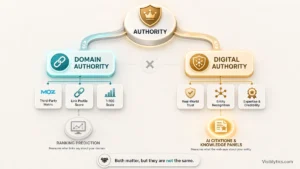
How does E-E-A-T relate to the Digital Authority framework?
E-E-A-T and Digital Authority describe the same underlying reality from different perspectives. E-E-a-T is Google’s framework for evaluating content quality. Digital Authority is the entity-level framework for building the cumulative trust, expertise, and recognition that E-E-A-T signals attempt to measure. Building Digital Authority through entity SEO work is the most systematic way to improve E-E-A-T signals because it builds the external corroboration layer that pure on-site optimization cannot produce. The full Digital Authority framework is at /digital-authority/.
Is E-E-A-T only for YMYL content?
No. E-E-A-T standards apply to all content, though the threshold is highest for YMYL (Your Money or Your Life) topics like health, finance, and legal content. For entity authority and AI visibility purposes, E-E-A-T signals matter for any topic area where AI systems are constructing answers from multiple sources and evaluating the trustworthiness of those sources.
Where can I learn about E-E-A-T as an SEO ranking framework specifically?
The complete guide to E-E-A-T as a traditional SEO ranking framework, including the 2026 core update data, YMYL content requirements, and practical audit checklists, is at E-E-A-T in SEO: The Complete Guide (2026).
E-E-A-T Is Entity Authority With a Different Name
The most useful reframe from this guide is simple: when Google asks whether your content demonstrates Experience, Expertise, Authoritativeness, and Trustworthiness, it is asking the same questions that AI citation systems ask when evaluating whether your entity is worth citing.
Is there genuine first-hand involvement here? Is there a verifiable, credentialed expert behind this content? Has this entity been independently recognized by sources outside its own domain? Can the entity be consistently identified and verified?
These are not ranking questions and entity authority questions. They are one set of questions. Building E-E-A-T through entity SEO work (defining your entity, structuring your credentials, earning external recognition, and maintaining consistent signals) produces a source that performs well in both traditional search rankings and AI citation systems.
For the full entity SEO foundation that E-E-A-T work builds on, the Entity SEO guide covers the complete framework. For the broader Digital Authority program that connects E-E-A-T to knowledge graphs, knowledge panels, and AI visibility outcomes, the Digital Authority guide covers the complete picture.