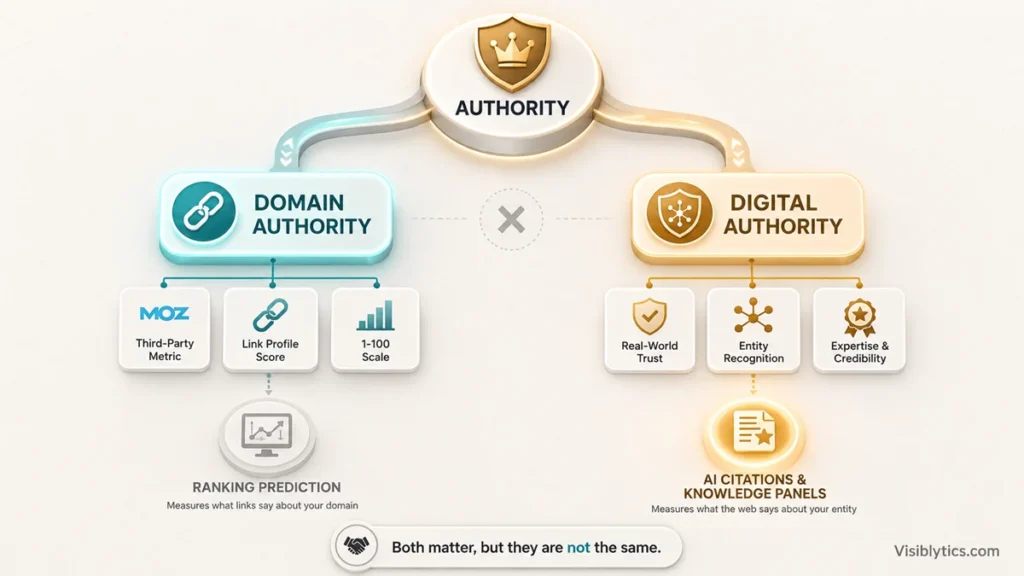
Digital Authority and Domain Authority are not two names for the same thing. Domain Authority is a third-party metric created by Moz that estimates how well a website might rank in search results based primarily on its link profile. Digital Authority is the real-world cumulative trust, expertise, and recognition that an entity has built across the web. One is a score produced by a tool. The other is a property of how your entity is understood and trusted by search engines, AI systems, and the people who use them.
Confusing the two is one of the most expensive strategic errors in modern SEO, because it leads to optimizing for a proxy while neglecting the thing the proxy is supposed to approximate.
What Is Domain Authority?
Domain Authority (DA) is a proprietary metric developed by Moz, first introduced around 2010, that predicts how likely a domain is to rank in search engine results pages. It runs on a logarithmic scale from 1 to 100, with higher scores indicating a stronger predicted ranking ability.
Domain Authority is calculated primarily from link data: the number of domains linking to your site, the quality and authority of those linking domains, and the overall link profile structure. Moz’s tool crawls the web, processes backlink data, and produces a score. Ahrefs has a similar metric called Domain Rating (DR). Semrush has Authority Score. None of these are Google metrics. None of them are used directly by Google as ranking inputs. They are third-party estimates of how a domain’s link profile compares to others in Moz’s or Ahrefs’s or Semrush’s own index.
This matters because it means Domain Authority scores can change when the tool provider updates their algorithm, when their crawl discovers new links or loses old ones, or when their index changes, entirely independently of anything that has changed on your site or in how Google actually treats your domain.
Domain Authority is useful as a rough comparative benchmark. If your site has a DA of 20 and a competitor has a DA of 60, that gap reflects a real difference in link profile strength that is worth knowing about. Where Domain Authority breaks down is when it is treated as a goal in itself, or when it is assumed to measure the same thing as trust, expertise, or entity recognition.
What Is Digital Authority?
Digital Authority is the cumulative trust, expertise, recognition, and credibility that an entity has built across the web. It is not produced by any single tool. It is not a score. It is a property of how search engines, AI systems, and informed humans perceive and represent your entity.
The full definition and the five components that build it (Expertise, Experience, Recognition, Trust, and Relationships) are covered in the Digital Authority guide. This article focuses specifically on how Digital Authority differs from Domain Authority and what the practical consequences of that difference are.
The core distinction is this: Domain Authority measures what links say about your domain. Digital Authority measures what the sum of all available signals says about your entity. Links are one input to Digital Authority. They are not the whole of it, and for many of the outcomes that matter most in 2026 (AI citations, knowledge panel presence, entity recognition, topical authority attribution), links are not even the most important input.
The Full Comparison
The Digital Authority guide introduces the core comparison table. Here it is expanded with the practical implications of each row.
| Dimension | Domain Authority | Digital Authority |
|---|---|---|
| What it is | Third-party metric | Real-world entity reputation |
| Who produces it | Moz, Ahrefs, Semrush | Built across the web over time |
| What it measures | Link profile strength | Trust, expertise, recognition, relationships |
| Unit of measurement | Website (domain) | Entity (person, brand, organization) |
| Scale | 1 to 100 | No single scale |
| Primary input | Backlinks | Entity signals across many source types |
| What it predicts | Ranking likelihood in traditional search | Visibility across search, AI citations, and knowledge graphs |
| How it changes | With tool algorithm updates and link acquisition | Compounds with genuine credibility building |
| Can it be gamed? | Yes, in the short term through link schemes | Very difficult at scale, degrades when artificial |
| Affected by AI systems? | Minimally | Directly |
| Measured by | A tool query | No single measurement |
The dimension that matters most for 2026 is the last two rows. Domain Authority has essentially no direct relationship to how AI systems like ChatGPT, Gemini, Claude, and Perplexity decide which sources to cite. A site with a DA of 80 built on low-quality links from irrelevant domains, with anonymous content and no entity clarity, is not a source an AI system will cite with confidence. A site with a DA of 25 but a clearly defined entity, named authorship with verifiable credentials, original expertise, and corroboration from credible independent sources is a far stronger AI citation candidate.
How Domain Authority Became Over-Relied Upon
To understand why Domain Authority is so frequently confused with real authority, it helps to understand how it became the dominant SEO metric in the first place.
In the early years of Google, PageRank was the primary public signal of a page’s importance, derived from the number and quality of links pointing to it. When Google stopped publicly updating PageRank scores in 2016, SEOs needed a substitute metric to communicate link profile strength to clients and to evaluate potential link opportunities. Moz’s Domain Authority filled that gap. It was accessible, it correlated reasonably well with rankings in traditional search, and it gave a single number that was easy to report.
The problem is that correlation with rankings in traditional search is not the same as measuring trust, expertise, or entity recognition. And as search has evolved, the correlation between link-based metrics and actual search performance has weakened, particularly for entity-level signals and AI-powered surfaces where link profiles are largely irrelevant to citation selection.
The result is an industry that spent fifteen years optimizing for a proxy, building elaborate link acquisition programs, and measuring success in DA points, while the actual signals that determine authority at the entity level (entity clarity, named expertise, corroboration from credible sources, topical consistency) were treated as secondary concerns.
Where the Two Diverge Most Sharply
Understanding where Domain Authority and Digital Authority produce different outcomes is the most practical part of this comparison. Here are the scenarios where the divergence is clearest.
AI Citations
When an AI system constructs an answer and decides which sources to cite, it evaluates entity trust, author credibility, topical authority, and structured knowledge signals. Domain Authority is not part of that evaluation. I am not aware of any public documentation from OpenAI, Google, Anthropic, or Perplexity that suggests their citation systems use Moz DA or any equivalent metric as an input.
A site with DA 70 and anonymous content will be passed over in favor of a DA 30 site with a named expert author, clear entity schema, original research, and corroboration from independent sources. In the AI citation context, Digital Authority is what matters. Domain Authority is irrelevant.
Knowledge Panel Eligibility
Knowledge panels are built from knowledge graph signals: entity clarity, attribute consistency, external corroboration, and relationship mapping. A high Domain Authority score does not move you closer to a knowledge panel. A well-defined entity with consistent signals across authoritative sources does.
I have seen sites with DA scores above 60 that have no knowledge panel at all, because their entity signals are weak, their authors are anonymous, and their content is not attributed to a recognizable entity. And I have seen smaller sites with DA scores below 30 that have knowledge panels for their founders because those founders have clear person entities, verifiable credentials, and consistent external representation.
Topical Authority for Specific Queries
Traditional search rankings are influenced by Domain Authority as a signal of overall domain strength. But topical authority for specific queries is increasingly driven by entity-level signals: who published this content, what is their recognized expertise, how consistently have they covered this topic, what do independent sources say about their expertise in this area?
A high DA site that publishes broadly across many unrelated topics does not automatically have strong topical authority for any specific subject. A lower DA site with a clearly defined expert entity and a deep, consistent body of work on a specific topic can outperform it for queries in that topic area, particularly in AI-generated answers and entity-aware search features.
Link Building vs Authority Building
The most fundamental practical divergence is in what the two concepts suggest you should do to improve them. Improving Domain Authority means acquiring backlinks from high-DA domains. Improving Digital Authority means building genuine expertise, earning recognition from credible sources, establishing entity clarity, and developing the kind of consistent, verifiable presence that both humans and machines find trustworthy.
These are not the same activities. Link building can improve DA without improving Digital Authority at all: a set of links from irrelevant high-DA domains improves the metric without producing any increase in entity trust, topical recognition, or AI citation likelihood. Digital authority building (original research, named authorship, entity pages, Wikidata presence, genuine PR) can improve AI visibility and entity recognition significantly without producing any measurable DA increase.
Where Domain Authority Is Still Useful
I want to be precise here rather than dismiss Domain Authority entirely, because it remains a useful signal in specific contexts.
Benchmarking link profiles. When evaluating the relative link strength of your domain versus a competitor’s, DA provides a reasonable rough comparison. It is not precise, it is not directly tied to Google’s evaluation, but it is a useful indicator of relative link profile development.
Evaluating link opportunities. When considering whether to pursue a link from a potential partner site, DA is a reasonable filter. A DA of 10 from an irrelevant domain is unlikely to move the needle for traditional search rankings. A DA of 50 from a domain in your topic area is worth more consideration. This is not the only evaluation criterion, but it is a useful starting point.
Communicating with non-technical stakeholders. DA is a single number that clients and executives understand. For reporting and communication purposes, it remains a reasonable shorthand for “here is roughly how the link profile compares to where it was six months ago.”
What DA is not useful for: predicting AI citation likelihood, evaluating entity recognition strength, assessing knowledge panel eligibility, or measuring whether your content is likely to be trusted and cited by search engines and AI systems on the basis of expertise and credibility.
The Practical Implication: Two Separate Programs
The clearest practical takeaway from this distinction is that Digital Authority and Domain Authority require different programs to build, and conflating them causes both programs to underperform.
A link building program focused on DA improvement should be evaluated by: domain diversity, relevance of linking domains, anchor text distribution, and movement in traditional search rankings for target keywords. It is a legitimate SEO investment with legitimate metrics.
A Digital Authority building program should be evaluated by: entity recognition signals (knowledge panel presence, branded search appearance, consistent external representation), AI citation frequency and accuracy, named authorship attribution in third-party mentions, Wikidata and knowledge graph representation, and topical authority in AI-generated answers for your area of expertise.
Running both in parallel is the right approach for most businesses. Where businesses go wrong is running only the link building program while expecting it to produce Digital Authority outcomes, then wondering why their AI visibility is weak despite a strong DA score.
A Real-World Scenario
Consider two SEO consultants launching personal brand websites simultaneously.
Consultant A pursues an aggressive link building program. After twelve months, their site has a DA of 38. They have links from a variety of domains, some relevant, some not. Their About page is generic marketing copy. Their content has no named author. They have no schema markup. They have no Wikidata entry. No publications have mentioned them by name.
Consultant B focuses on Digital Authority. After twelve months, their site has a DA of 18. But they have a complete Person schema on their author page, a Wikidata entry connecting them to their area of expertise, six guest articles in recognized SEO publications citing them by name, a consistent bio across all professional platforms, and a pillar content series that has been referenced by three other credible sites. One publication described them as “a specialist in Entity SEO.”
When someone asks ChatGPT “who are the leading practitioners in Entity SEO,” Consultant B is far more likely to appear than Consultant A. When Google assembles a knowledge panel for an Entity SEO search, Consultant B’s entity signals are far stronger candidates than Consultant A’s.
Consultant A has a higher DA. Consultant B has higher Digital Authority. These are different things with different outcomes.
Common Mistakes
Chasing DA as a proxy for authority. Acquiring links specifically to improve a DA score, without regard for whether those links build genuine entity recognition or topical corroboration, is optimizing for a metric rather than for the outcome the metric is supposed to represent.
Reporting DA to stakeholders as a measure of trust or credibility. DA measures link profile strength. It does not measure trust or credibility. Presenting it as such to clients or leadership creates misaligned expectations about what the SEO program is achieving.
Ignoring Digital Authority signals because they do not appear in a DA report. Entity pages, schema markup, Wikidata entries, named authorship, and expert recognition do not move a DA score. They do move AI citation likelihood, entity confidence, and knowledge panel eligibility. If none of these activities appear in your SEO program, you are building half the foundation.
Assuming high DA means strong AI visibility. A high DA score is a useful traditional SEO asset. It is not a predictor of AI citation performance. If your goal includes AI visibility, a separate program building the entity and authority signals that AI systems evaluate is necessary.
❓ Frequently Asked Questions
Is Domain Authority a Google metric?
No. Domain Authority is a proprietary metric created by Moz. Google has never publicly endorsed or used Domain Authority as a ranking input. Ahrefs has Domain Rating and Semrush has Authority Score, all of which are different third-party approximations of link profile strength. None of them are produced by or used by Google directly.
Can a site with low Domain Authority rank well in Google?
Yes, particularly for lower-competition queries, niche topics, and queries where topical relevance and entity authority outweigh raw link profile strength. A site with DA 20 and deep, genuine expertise on a specific topic can outrank a DA 60 site that covers the topic superficially or whose content is poorly attributed.
Does improving Domain Authority improve Digital Authority?
Partially, in specific circumstances. Earning links from genuinely credible, relevant sources in your field is also a Digital Authority activity because those links often come with mentions, brand references, and topical co-occurrence signals that build entity recognition. But acquiring links purely for DA improvement, from irrelevant or low-quality sources, does not improve Digital Authority and may actually dilute entity signals by associating your domain with unrelated topical contexts.
Does Digital Authority affect traditional search rankings?
Indirectly, yes. The entity clarity, topical consistency, and named expertise that build Digital Authority also improve how search engines understand and classify your content for relevant queries. This can translate to ranking improvements, particularly for entity-aware queries and for searches where the credibility of the source is a meaningful factor. It does not replace link authority for competitive head terms, but it increasingly matters for the queries that drive meaningful business outcomes.
Which should I focus on, Domain Authority or Digital Authority?
Both serve different purposes and are not mutually exclusive. Traditional search rankings still benefit from a healthy link profile, and DA remains a useful benchmark for link development. AI citations, knowledge panel eligibility, and entity-level search visibility require Digital Authority work. The right answer for most businesses is a program that builds both, with explicit goals and metrics for each rather than assuming one produces the other.
How do I measure Digital Authority if there is no single score?
Digital Authority is assessed across multiple signals rather than a single number. The practical indicators to track: whether a knowledge panel exists for your entity and how accurate it is, how frequently and accurately AI systems represent your brand in relevant answers, whether your entity is correctly represented in Wikidata, how consistently named authorship appears in third-party mentions of your content, and whether credible publications reference your entity in the context of your stated area of expertise. None of these produce a single score, but together they give a clear picture of where Digital Authority is strong and where it needs development.
The Metric and the Thing It Measures Are Not the Same
Domain Authority is a useful tool. It is not the goal. The goal, for any entity operating in an environment where AI systems handle a growing share of information retrieval, is genuine Digital Authority: the kind of trust, expertise, recognition, and consistent presence that both search engines and AI systems can verify independently of any metric a third-party tool produces.
Improving Domain Authority is worth doing as part of a comprehensive search strategy. Confusing it with Digital Authority is worth stopping.
The full framework for building genuine Digital Authority is in the Digital Authority guide. For how entity-level authority signals specifically feed into search and AI visibility, the Entity Authority Signals guide covers that in detail.