ChatGPT does not copy and paste text from other websites, so it cannot plagiarize in the traditional sense of lifting someone else’s exact words. The real risk is different and more subtle: on well-covered topics, ChatGPT tends to produce generic phrasing and structure that closely resembles what dozens of other articles already say, which can read as unoriginal even without a single copied sentence. Avoiding this isn’t about running your draft through a checker after the fact. It’s about how you prompt in the first place, grounding the output in real, specific input instead of letting the model default to the average version of what’s already been written on the topic.
Plagiarism, Duplicate Content, and AI Detection Are Three Different Problems
These three terms get used interchangeably in most guides on this topic, but they describe different risks, and confusing them leads to fixing the wrong thing. Plagiarism is presenting someone else’s specific words or ideas as your own without attribution. Duplicate content is a technical SEO issue where multiple pages, yours or someone else’s, contain substantially similar text, which can confuse search engines about which version to rank. AI detection is a separate question entirely: whether a piece of text matches the statistical patterns of machine-generated writing, which has nothing to do with whether it was copied from anywhere.
A ChatGPT draft can score as “likely AI-generated” by a detection tool while containing zero plagiarized text, and it can also be completely undetectable as AI while still being generic enough to count as thin, unoriginal content in Google’s eyes. Treating all three as the same problem, and running one plagiarism checker as if that solves everything, misses the actual issue most people run into, which is generic phrasing, not copied phrasing.
Why ChatGPT Defaults to Generic, Unoriginal-Sounding Content
ChatGPT generates the statistically most likely next words based on patterns across its training data, so when a topic has been covered extensively online, the model’s default output naturally converges toward the same common phrasing, structure, and examples that dominate that training data. This isn’t the model copying a specific source. It’s the model producing the average of everything it has seen, which on a heavily covered topic can end up sounding suspiciously close to the most common existing articles simply because that phrasing was the most statistically reinforced pattern available.
This is also why obscure or narrow topics carry more risk, not less. When a topic has only a handful of existing sources, the model has fewer patterns to average across, so its output can end up closely mirroring the structure and specific points of those few sources, which is closer to what Google’s guidelines describe as scraping or stitching content together than to genuinely original writing.
Best Practice Prompts to Keep ChatGPT Output Genuinely Original
1. The grounding prompt
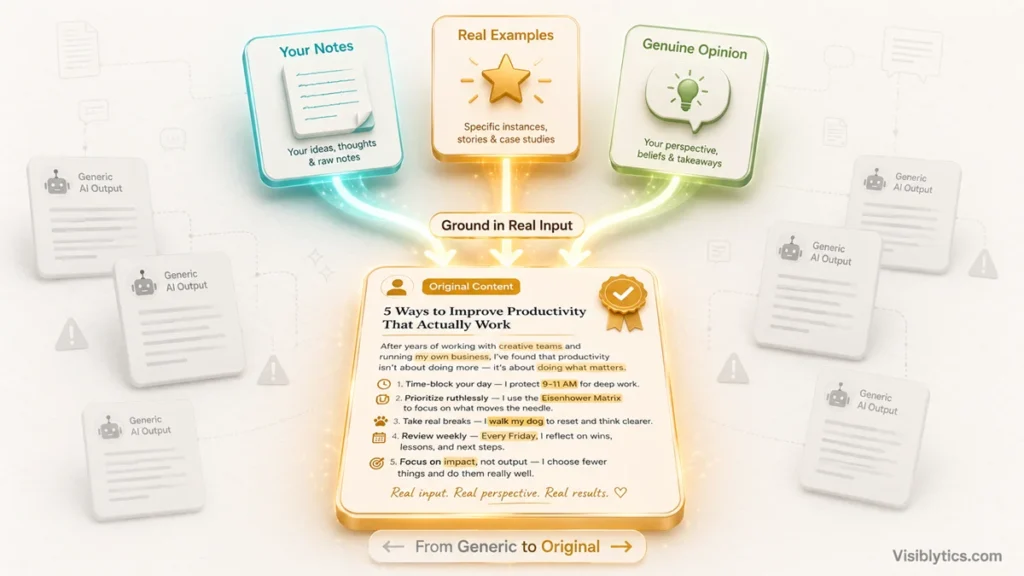
I'm writing an article about [topic]. Here is my own knowledge and take on this: [paste your actual notes, experience, or opinion on the topic, even rough and unstructured]. Use this as the foundation for the article rather than generating generic information about the topic. Where you need to fill a gap I haven't covered, flag it clearly as [GAP: needs my input] rather than inventing generic filler.Feeding in real, specific input before asking for a draft is the single most effective way to avoid generic output, since it gives the model something concrete to work from instead of defaulting to the average of everything else written on the topic.
2. The original angle prompt
Here are the main points covered by existing top-ranking articles on '[topic]': [paste a brief summary of what's already out there]. Based on my actual notes: [paste your notes], identify what genuinely different angle, structure, or insight I can bring that isn't just a rewording of the common approach. Do not suggest an angle you can't actually support with the input I've given you.This forces a real differentiation strategy grounded in what you actually know, rather than a superficial rewording of the same points everyone else makes, which is what produces content that reads as unoriginal even when no sentence is technically copied.
3. The paraphrase-freeness check
Here is a paragraph I've drafted: [paste paragraph]. Tell me if any sentence here closely mirrors a common, generic way this topic is typically explained across many articles, rather than reflecting a specific, original point. Flag anything that reads as a standard explanation rather than something grounded in the input I gave you.Running your own draft back through this check surfaces the sentences most likely to read as generic, the ones an AI detector or a human editor would flag as filler, before you publish rather than after.
4. The claim and citation audit
Go through this draft: [paste draft], and list every specific fact, statistic, or claim that isn't something I told you directly. For each one, tell me whether it needs a citation to a real source, and whether presenting it without attribution would count as passing off someone else's research or data as an original finding.This directly addresses the actual plagiarism risk in AI-assisted writing: presenting a fact or statistic pulled from the model’s training data as if it were your own original research, without acknowledging where the underlying information came from.
5. The human-insight injection prompt
Here is a section of the draft that currently reads generically: [paste section]. I have this specific experience or example to add: [paste your real example, data point, or opinion]. Rewrite the section to lead with this specific input rather than the generic explanation, keeping the factual structure intact.Specific, real detail, an actual example, a genuine opinion, a real number from your own data, is what separates original content from a competent summary of the topic. This prompt forces that detail into the sections that currently lack it, rather than leaving them as generic filler.
How to Verify Before Publishing
Prompting carefully reduces the risk significantly, but a final check before publishing is still worth doing, especially for anything going out under your name or your brand’s. Running the finished draft through a reputable plagiarism checker catches the rare case of accidental verbatim overlap with an existing source, which can happen even with careful prompting if a topic has very few authoritative sources to draw from. Separately, reading the piece aloud yourself is still the fastest way to catch generic-sounding sections that a plagiarism checker won’t flag, since those sentences aren’t copied from anywhere, they’re just forgettable.
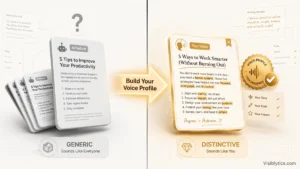
If you’re building a broader ChatGPT writing process rather than a one-off article, the voice profile approach in prompts for content writing addresses this same root problem from a different angle, keeping your writing distinct from generic AI output by grounding it in your actual voice rather than a topic description. And the claim-verification step here pairs directly with the fact-checking stage covered in prompts for blog posts, since both are really the same underlying discipline: don’t let the model state something as fact that you haven’t actually verified.
Common Mistakes to Avoid
The biggest mistake is treating a plagiarism checker as the only safeguard needed. A clean plagiarism score tells you the text isn’t copied verbatim from an indexed source, but it says nothing about whether the content is genuinely useful or original in substance, which is what actually matters for both readers and search rankings. The second mistake is writing on a narrow, thinly covered topic without giving the model your own real knowledge to work from, since that’s exactly the scenario where AI output ends up mirroring the handful of existing sources too closely. The third mistake is presenting AI-surfaced facts and statistics as original findings without checking whether they need attribution, which is the most direct path to an actual plagiarism problem, not just an SEO one.
❓ Frequently Asked Questions
Does Google penalize content just for being written with ChatGPT?
No. Google has stated it does not penalize content based on how it was produced, only on whether the content is helpful, original, and satisfies the searcher’s needs. Generic, low-effort AI content underperforms because it’s generic and low-effort, not because an AI wrote a first draft of it.
Can ChatGPT accidentally reproduce someone else’s exact sentences?
It’s uncommon but not impossible, particularly for highly quoted phrases, well-known definitions, or topics with very few existing sources. This is exactly why a final plagiarism check before publishing is worth doing even when you’ve prompted carefully throughout the drafting process.
What’s the difference between paraphrasing and plagiarizing with AI?
Genuine paraphrasing restates someone else’s idea in meaningfully different structure and wording while adding your own framing or analysis. Simply asking AI to swap synonyms in someone else’s article and republishing it as your own is much closer to plagiarism, since the structure, argument, and specific points still belong to the original source.
Should I disclose that an article was written with ChatGPT’s help?
This depends on your platform’s policies, your industry’s standards, and your own values around transparency, rather than a technical SEO requirement. What matters most for both trust and search performance is that the content is accurate and genuinely useful, regardless of what tools assisted in drafting it.
Is it safe to ask ChatGPT to rewrite a competitor’s article?
Rewriting a competitor’s article closely, even with different wording, to closely track their structure and specific points, raises real originality concerns, since the underlying research, argument, and organization still came from them. Use competitor content to understand what’s already covered and identify gaps, not as a template to reword.
How do I know if my AI-assisted content is actually original enough to publish?
Ask whether the piece contains something a reader couldn’t get from five other articles on the same topic, a specific example, a real data point, a genuine opinion, a structure built around an actual gap you identified. If the honest answer is no, the content needs more of your own input before it’s ready, regardless of what a plagiarism checker says about it.