

Search engines no longer read content the way a keyword-matching algorithm does. They read it the way a researcher does: identifying the real-world people, organizations, places, and things a piece of content is about, not just the words it contains. Named Entity Recognition is the process that makes this possible.
NER is a natural language processing technique that scans text, identifies meaningful real-world references, and classifies them by type. When Google reads a page about a marketing consultant based in London who founded a SaaS company, NER is what tells it: there is a PERSON here, an ORGANIZATION here, and a LOCATION here, and here is how they relate. That recognition is the first step toward entity-level understanding, knowledge graph inclusion, and AI citation.
This guide covers how NER works, what entity types it identifies, how it differs from keyword matching, and what it means practically for the way you write and structure content.
What Is Named Entity Recognition?
Named Entity Recognition is a subtask of natural language processing (NLP) that identifies and classifies named entities within text into predefined categories such as person, organization, location, product, date, and more.
The term comes from computational linguistics, where it was developed to help machines extract structured information from unstructured text. Search engines adopted NER as part of their broader shift from document retrieval (finding pages that contain matching words) to entity understanding (identifying what a page is actually about).
Before NER, a search engine reading the sentence “Steve Jobs co-founded Apple in Cupertino in 1976” would process it as a sequence of words. With NER, it processes it as a structured fact: PERSON (Steve Jobs) has relationship (co-founded) with ORGANIZATION (Apple) at LOCATION (Cupertino) in DATE (1976). The same sentence becomes machine-readable structured data.
For content creators, this distinction matters because it changes what optimization means. You are no longer writing for keyword density. You are writing to give NER systems enough context to correctly identify, classify, and connect the entities your content is about.
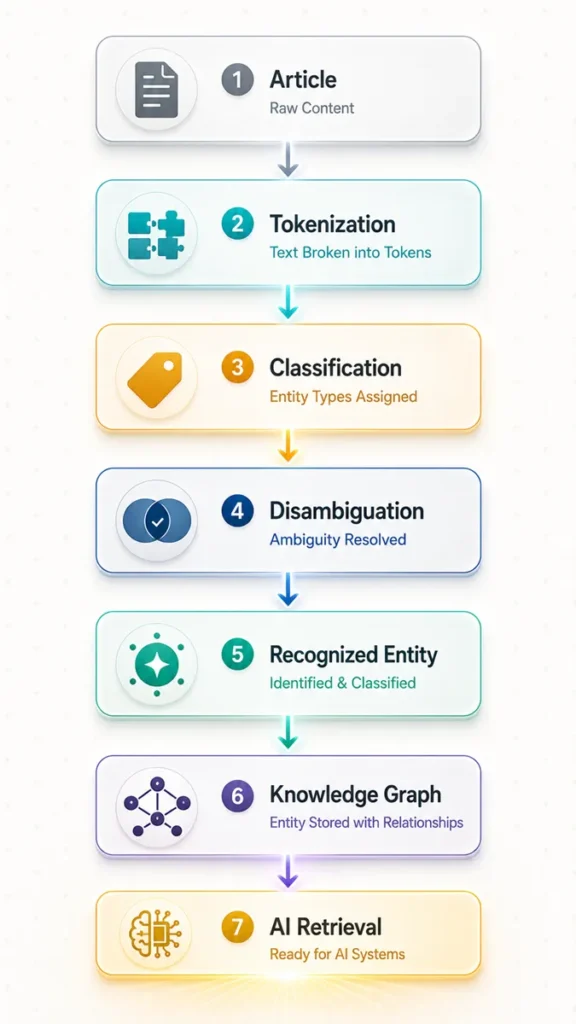
How NER Works — The 3-Step Process
NER systems process text through a sequence of operations. Understanding each step helps you understand why certain content choices produce clearer entity signals than others.
Step 1: Tokenization
Before a system can identify entities, it must break text into units it can analyze. Tokenization is the process of splitting a body of text into individual tokens: typically words, punctuation marks, and meaningful sub-units.
A sentence like “Visiblytics was founded by Suraj Saini in 2026” becomes a sequence of tokens: [Visiblytics] [was] [founded] [by] [Suraj] [Saini] [in] [2026]. Each token is now individually addressable by the NER model.
Tokenization also handles edge cases: hyphenated words, possessives, abbreviations, and compound terms. “New York-based” might tokenize differently from “New York based” depending on the system. This is why consistent, clean writing (avoiding unusual hyphenation or unconventional compound constructions around entity names) produces more reliable NER output.
Step 2: Classification
Once text is tokenized, the NER model classifies sequences of tokens as named entities and assigns each a category label. This is where the system decides: is “Suraj Saini” a PERSON? Is “Visiblytics” an ORGANIZATION? Is “2026” a DATE?
Modern NER models are trained on large annotated datasets and use contextual patterns to make these classifications. They look at surrounding words, sentence structure, capitalization, and positional cues. The word “Apple” in “Apple released a new product” is classified differently from “apple” in “the apple tree in the garden.” Context determines classification.
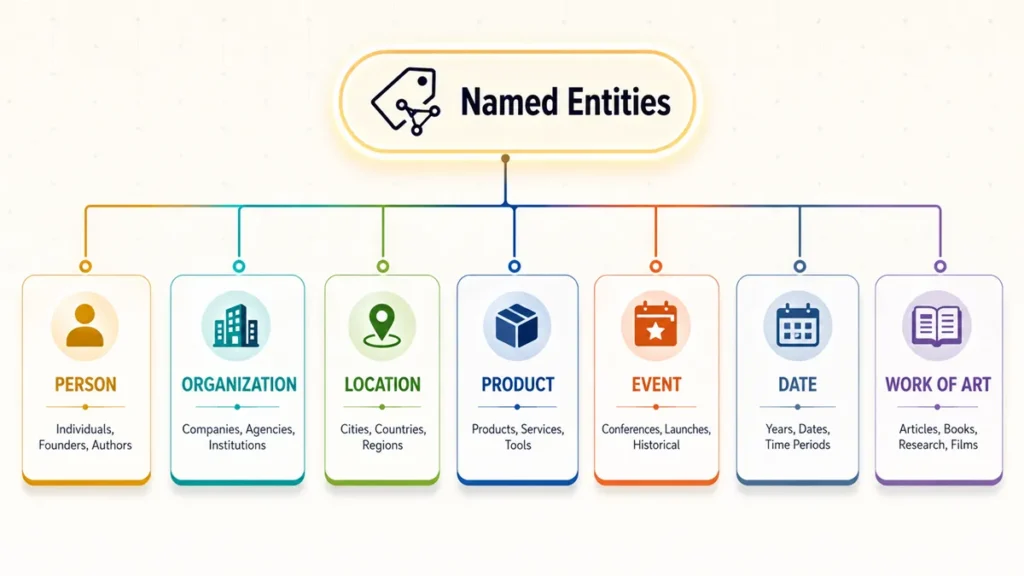
Standard entity type labels used across most NER systems include:
- PERSON — named individuals (founders, authors, public figures, employees)
- ORGANIZATION (ORG) — companies, agencies, institutions, government bodies
- GEOPOLITICAL ENTITY (GPE) — countries, cities, states, regions
- LOCATION (LOC) — physical locations that are not GPEs (mountains, rivers, buildings)
- PRODUCT — named products and services
- EVENT — named events (conferences, product launches, historical events)
- DATE / TIME — specific dates, years, time references
- WORK OF ART — titles of books, articles, films, research papers
- LAW — named laws, regulations, legal documents
- QUANTITY / MONEY / PERCENT — numerical measurements and values
The classification step is where most content-level errors occur. If an entity name is ambiguous, inconsistently capitalized, or lacks surrounding context, the model may misclassify it, or fail to classify it at all.
Step 3: Disambiguation
Classification tells the system what type of entity something is. Disambiguation tells it which specific entity it is.
“Apple” could be the technology company, a record label, or a piece of fruit. “Jordan” could be a country, a person’s surname, or a river. Disambiguation is the process of resolving these ambiguities using contextual signals: the other entities mentioned nearby, the topic of the surrounding content, and the relationship between entities on the page.
Disambiguation connects directly to how search engines build knowledge graph entries and resolve entity identity across sources. A full treatment of disambiguation mechanics lives in the dedicated guide at /resources/how-search-engines-disambiguate-entities/. What matters here is that NER’s disambiguation step is where content clarity (or lack of it) has the most direct impact on whether your entity is correctly identified.
Entity Types Search Engines Recognize
The entity type categories listed above are not arbitrary classifications. Each type is treated differently by search engines and feeds into different parts of the knowledge graph.
PERSON entities feed into knowledge graph nodes for individuals. A correctly identified PERSON entity on your content contributes to the recognition layer for that individual, which is relevant to author attribution, expert citation, and knowledge panel eligibility. Person entities benefit from clear full-name introductions, consistent naming across a site, and supporting context (role, organization, location) in close proximity to the name.
ORGANIZATION entities feed into company and brand knowledge graph nodes. For a business trying to build entity recognition, being correctly identified as an ORGANIZATION (rather than having its name treated as an unclassified proper noun) is a foundational step. Schema markup on the organization’s entity homepage reinforces what NER detects in content. For more on how entities connect to knowledge graph nodes, see the Knowledge Graph guide.
GPE and LOCATION entities help search engines understand geographic relevance and relationships. A consultant “based in Mumbai” gives NER a GPE signal that connects a PERSON entity to a location, a relationship that can surface in local and regional entity contexts.
PRODUCT entities are particularly important for businesses. When a product name is consistently identified as a PRODUCT entity across multiple authoritative sources, it builds a distinct entity record separate from the parent organization, each with its own attributes and relationships.
EVENT entities build temporal and relational context. Being mentioned in connection with a recognized EVENT (a named industry conference, a published report, a product launch) creates relationship signals between entities that NER captures and knowledge graphs store.
DATE entities provide temporal grounding. When a founding date, publication date, or event date appears consistently alongside the correct ORGANIZATION or PERSON entity, it reinforces attribute accuracy, which matters for knowledge panel data and AI retrieval accuracy.
WORK OF ART entities (particularly research papers, reports, books, and articles) are an underutilized entity type. When your organization publishes original research that is correctly identified as a WORK OF ART entity and attributed to your ORGANIZATION or PERSON entity, it creates a citation and recognition signal that contributes to authority building.
NER vs Keyword Matching — Why It Changes Everything
To understand why NER matters for content strategy, it helps to see exactly how the same content is processed differently under each approach.
Consider this sentence: “Rahul Mehta, founder of CloudStack Solutions, spoke at SaaS Summit India 2024 about enterprise data migration.”
Under keyword matching, a search engine extracts the following signals: the words “Rahul”, “Mehta”, “founder”, “CloudStack”, “Solutions”, “spoke”, “SaaS”, “Summit”, “India”, “2024”, “enterprise”, “data”, “migration”. It notes their frequency, proximity, and co-occurrence with other words on the page. The page may rank for “enterprise data migration” or “SaaS India” depending on how well those keywords match a query.
Under NER-based processing, the same sentence produces: PERSON (Rahul Mehta) → relationship (founder of) → ORGANIZATION (CloudStack Solutions) → EVENT (SaaS Summit India 2024) → TOPIC (enterprise data migration). The system now knows a specific person with a specific role at a specific company participated in a specific named event and spoke about a specific topic. Every element is structured, typed, and relational.
The practical consequence is significant. Keyword matching rewards repetition of target terms. NER rewards clarity of entity definition, relationship specificity, and contextual consistency. A page that mentions “Rahul Mehta” five times without ever clarifying his role or organization gives NER less to work with than a page that mentions him twice with full context.
For a detailed comparison of keyword-first and entity-first optimization approaches, the Entity SEO guide covers the Keywords vs Entities distinction in full.
How NER Affects Your Content Writing
NER processing has direct, practical implications for how content should be structured, not just at the page level, but across an entire site.
Introduce entities completely on first mention
When a person, organization, or product appears in content for the first time, introduce it with enough context for NER to classify and disambiguate it correctly. “James Walker, Chief Marketing Officer at Meridian Group, a B2B SaaS company headquartered in Bangalore” gives NER a PERSON, a role, an ORGANIZATION, a category, and a GPE in a single sentence. “James Walker said…” gives it almost nothing.
This is especially important for less well-known entities (those without strong existing knowledge graph entries). Established entities like Google or Elon Musk carry enough contextual weight that NER systems will classify them correctly even with minimal surrounding context. Newer or smaller entities need explicit introductory context to be correctly identified.
Use the entity’s canonical name consistently
NER systems learn to associate entity names across a site and across the web. Inconsistent naming, such as “Visiblytics”, “Visiblytics.com”, “the Visiblytics team”, and “Visiblytics Agency” used interchangeably, creates disambiguation friction. The system must work harder to confirm these references all point to the same entity, and may fail to consolidate them.
Choose one canonical form of each entity name and use it consistently. For person entities, this typically means full name on first mention and last name only (or full name again) in subsequent mentions, never a nickname or truncated version that does not appear on authoritative external sources.
Avoid pronoun overload
After introducing an entity clearly, content writers often switch entirely to pronouns (“he”, “they”, “it”, “the company”) for the remainder of a section. While this reads naturally to humans, it reduces the density of direct entity signals that NER can extract.
Reintroduce entity names periodically, particularly at the start of new sections or when the subject shifts. “The company launched its first product in 2021” gives NER less than “Meridian Group launched its first product in 2021”, even if both sentences follow a clear introduction.
Place supporting context near entity names
NER uses a contextual window around each token to make classification decisions. The words immediately surrounding an entity name carry significant weight. “award-winning author Sarah Chen” gives NER a role signal next to a PERSON name. “Sarah Chen attended the event” provides no classification support at all.
Attributes like job titles, organizational affiliations, locations, and dates are most useful when they appear in close proximity to the entity name, not three paragraphs later.
Understand the connection to entity salience
How prominently and frequently an entity features within a piece of content affects how strongly NER associates that content with the entity. This concept, entity salience, determines whether a page is seen as being primarily about an entity or merely mentioning it in passing. Our dedicated guide on Entity Salience covers this in depth.
Connecting to entity relationships
NER does not just identify isolated entities. It captures the relationships between them. “Priya Nair founded DataBridge in 2019” gives NER a PERSON, an ORGANIZATION, a relationship type (founded), and a DATE. These relationship signals feed directly into knowledge graph relationship layers. For a full guide to how entity relationships are structured and made machine-readable, see Entity Relationships Explained.
NER Tools — How to See What Search Engines See
Several tools allow you to run NER analysis on your own content and see how machines are reading it. Using these tools before publishing, or when auditing existing pages, gives you a direct view of whether your entity signals are coming through clearly.
Google Natural Language API Demo
Google’s Natural Language API includes a public demo at cloud.google.com/natural-language that lets you paste text and see the entities it identifies, their types, their salience scores, and their Wikipedia or Knowledge Graph links (where applicable). This is the closest available approximation of how Google’s own systems read content. Pay attention to which entities are identified, whether they are being classified correctly, and whether they are linking to the right knowledge graph entries.
spaCy
spaCy is an open-source Python NLP library widely used for NER analysis. It supports multiple trained models and allows you to process text programmatically and visualize entity labels inline. For those comfortable with basic Python, spaCy’s displacy visualizer produces annotated output that shows exactly which tokens are being classified as which entity types. This is particularly useful for bulk content auditing.
Dandelion API
Dandelion offers a text annotation API with an entity extraction endpoint that identifies entities, links them to DBpedia and Wikipedia entries, and returns confidence scores. The free tier allows for meaningful testing. Unlike the Google API demo, Dandelion’s output explicitly shows entity linking, so you can see whether “Apple” in your content is being linked to the technology company or left unresolved.
MeaningCloud
MeaningCloud offers a Named Entity Recognition API and dashboard interface that classifies entities, identifies relationships between them, and returns structured output. It is useful for understanding how entity relationships within a piece of content are being read, not just which individual entities are present.
How to use these tools for a content audit
Paste each key page or article into one of these tools and work through the following questions: Are all the entities you intended to signal being identified? Are they being classified as the correct type? Are ambiguous entity names being resolved correctly? Are there entities you did not intend to foreground that are appearing with high salience? The answers tell you where your content needs clearer entity context, more consistent naming, or better introductory framing.
Common NER Mistakes in Content
Most NER-related content problems are not the result of technical errors. They are the result of writing habits that made sense in a keyword era but work against entity clarity.
Inconsistent entity naming across a site. Using “Jane Smith”, “J. Smith”, “Jane”, and “the founder” interchangeably across different pages of a site fragments the entity signal. Each variation requires the NER system to expend effort confirming these references are the same entity — effort that should not be necessary. Standardize entity names across all content.
Introducing entities without context. Starting a section with “She founded the company in 2018 after leaving her previous role” gives NER nothing to classify. The PERSON entity name is absent, the ORGANIZATION entity name is absent, and the DATE has no entity anchor. Every entity needs a named, contextual introduction before pronouns and shorthand references can be used.
Ambiguous entity names without disambiguation support. If your brand name, founder name, or product name is shared with other well-known entities, your content needs to provide additional context to help NER resolve the ambiguity correctly. “Apex — the cloud infrastructure platform founded in 2020” disambiguates “Apex” in a way that “Apex provides scalable solutions” does not.
Clustering entity mentions at the top and ignoring them later. Some content introduces entities clearly in an opening paragraph then abandons them entirely in favor of generic references. NER reads the entire document, not just the opening. Entity signals should be distributed across the content, with names reintroduced at natural points rather than concentrated in one section.
Treating NER as a one-time concern. Entity recognition signals accumulate over time and across a content ecosystem. A single well-optimized article is less powerful than a consistent, site-wide approach to entity naming and contextualization. Content audits for NER clarity should be part of ongoing content maintenance, not a one-time exercise.
Over-optimizing with entity-stuffing. Adding entity names at unnatural frequencies to increase NER signal is counterproductive. Modern NER models are trained on natural text and can distinguish between organic entity mentions and forced repetition. Write for clarity and natural reading. Entity signals follow from clear, well-structured content, not from mechanical name insertion.
NER Content Checklist
Use this checklist before publishing any content where entity recognition matters.
Entity introduction
- Every key entity (person, organization, product, location) is introduced by its full canonical name on first mention
- Supporting context (role, organization, location, date) appears in close proximity to the entity name on first mention
- Ambiguous entity names include disambiguation context in the introductory sentence
Naming consistency
- One canonical form of each entity name is used throughout the content
- The canonical name matches the form used on the entity’s homepage, Wikipedia page, and key external profiles
- Nicknames, abbreviations, and informal references are avoided for primary entity signals
Pronoun and shorthand discipline
- Entity names are reintroduced at the start of new sections rather than relying solely on pronouns
- “The company”, “the founder”, “the platform” are used sparingly and only after recent named introduction
- Long sections do not pass more than three consecutive paragraphs without a named entity reference
Relationship clarity
- Relationships between entities (founded, works at, located in, published by) are stated explicitly in text, not just implied
- Date entities appear in proximity to the PERSON or ORGANIZATION they describe
NER tool verification
- Content has been tested in at least one NER tool (Google NL API, spaCy, Dandelion, or MeaningCloud)
- All intended entities are being identified and classified correctly
- No unintended entities are appearing with high salience scores
- Ambiguous names are resolving to the correct knowledge graph entries
❓ Frequently Asked Questions
What is Named Entity Recognition in simple terms?
Named Entity Recognition is the process machines use to read text and identify real-world things (people, companies, places, dates, products) rather than just processing individual words. When a search engine reads your content, NER is what lets it understand that “Sarah Chen” is a person, “Meridian Group” is an organization, and “Mumbai” is a city, and that these three are connected by a specific relationship.
Do all search engines use NER?
All major search engines (Google, Bing, and the underlying systems powering AI search tools like Perplexity and ChatGPT’s browsing mode) use some form of named entity recognition or entity extraction. The specific models and classification systems differ, but the fundamental process of identifying and typing named entities from text is a standard component of modern search and NLP infrastructure.
Does NER affect rankings directly?
NER does not produce a ranking signal in the way that backlinks or page speed do. Its effect is indirect but foundational. NER determines whether search engines correctly identify what your content is about at the entity level. Correct entity identification feeds into knowledge graph entries, entity authority signals, topical relevance, and AI citation eligibility, all of which influence visibility across search and AI systems.
How is NER different from keyword density?
Keyword density measures how often a specific word or phrase appears in content relative to total word count. NER is not concerned with frequency. It is concerned with identification and classification. A single clear, contextually rich introduction of an entity gives NER more to work with than ten uncontextualized mentions of the same name. NER rewards clarity and context; keyword optimization rewards repetition.
Can NER misidentify entities in my content?
Yes. NER systems make classification errors, particularly with: ambiguous names that match multiple known entities, names that are common words in other contexts (product names that are also dictionary words), very new entities without established training data, and poorly contextualized introductions. Using NER tools to test your content before publishing is the most practical way to catch and correct misidentification.
How do I know if search engines are recognizing the right entities on my page?
The Google Natural Language API demo (cloud.google.com/natural-language) is the most direct way to check. Paste your page content and review the entity list it returns. Confirm that your intended entities appear, that they are classified correctly by type, and that those with knowledge graph entries are linking to the right records. Entities that are misclassified or unlinked may need clearer introductory context or more consistent naming.
Does NER only apply to written text?
NER operates on text. For video and audio content, transcripts are what NER systems process — not the audio itself, in most cases. For images, alt text and surrounding page text provide the NER-processable signals. Structured data (schema markup) operates alongside NER rather than replacing it — schema tells search engines what something is directly, while NER infers entity identity from natural language. Both layers reinforce each other.
Conclusion
Named Entity Recognition is not an optimization layer you add to content after writing it. It is a lens that should shape how content is written from the start: how entities are introduced, how consistently they are named, how clearly their relationships are stated, and how well the text provides the contextual signals that NER systems depend on to classify correctly.
Search engines and AI systems are getting better at entity-level understanding with every model update. Content that is already written for entity clarity is already positioned for that direction. Content that is written purely for keyword density has to be retrofitted, and retrofit is always slower than getting it right the first time.
For the full foundation of entity-level optimization, the Entity SEO guide is the right next step.