
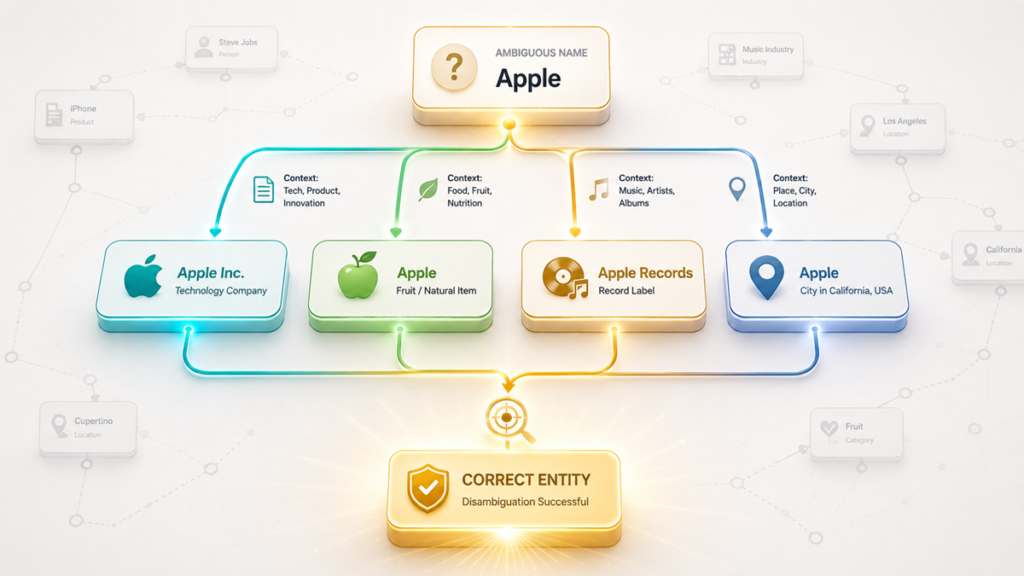
Disambiguation is the process search engines use to determine which specific entity an ambiguous name refers to. Not just what type of thing it is (NER handles that), but which one. When a search engine encounters the name “Mercury”, it must decide: the planet, the car brand, the Roman god, the record label, or the musician. Disambiguation is how it makes that decision, and the signals you provide in your content and across your web presence determine whether it gets it right.
For most well-known entities, disambiguation happens invisibly and reliably. For newer brands, less prominent individuals, and businesses whose names share space with other known entities, disambiguation is where entity recognition can break down, with consequences that range from incorrect knowledge panel data to AI systems citing the wrong entity entirely.
This guide covers how disambiguation works, why so many entity names create ambiguity, the full stack of signals search engines use to resolve it, and what you can do to make correct disambiguation reliable.
What Is Entity Disambiguation?
Entity disambiguation is the process of resolving an ambiguous entity reference to a specific, unique entity record. It answers the question: of all the entities in the world that share this name or description, which one does this reference mean?
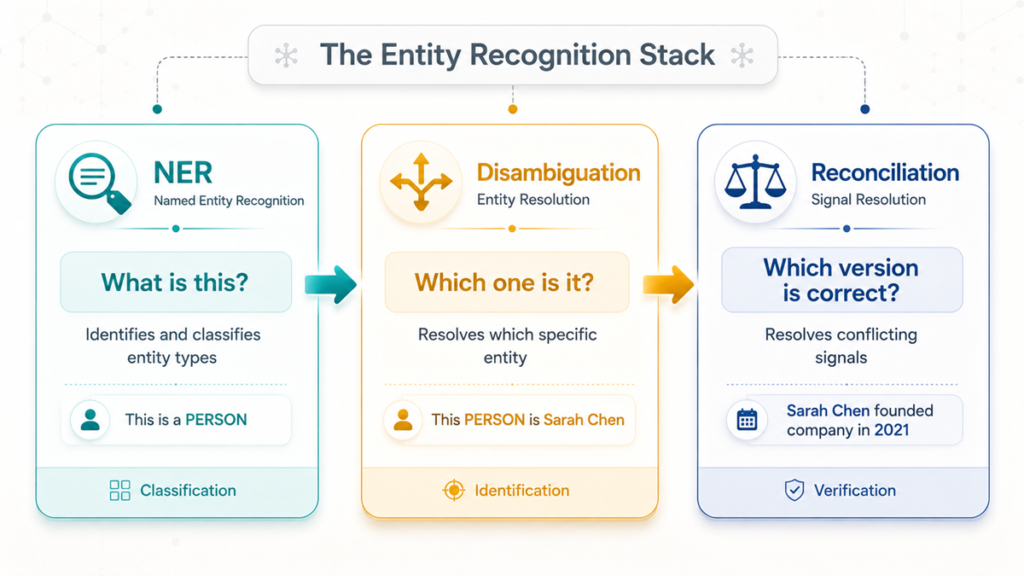
Disambiguation is a distinct step from entity identification. Named Entity Recognition identifies that a term is an entity and classifies it by type: PERSON, ORGANIZATION, LOCATION, and so on. Disambiguation then resolves which specific person, organization, or location is being referenced. For a full explanation of how NER works and where disambiguation fits within it, see Named Entity Recognition: How Search Engines Identify Entities.
Disambiguation is also distinct from entity reconciliation. Reconciliation is the process of resolving conflicting signals about the same entity across different sources, when search engines must determine whether two different descriptions refer to the same entity. Disambiguation resolves which entity a name refers to when multiple distinct entities could be the answer. The two processes overlap but address different problems. For a full treatment of reconciliation mechanics, see How Entity Reconciliation Works in Search Engines and AI Systems.
A simple example illustrates the core disambiguation challenge. The word “Apple” appears in a sentence. Is it:
- Apple Inc.: the technology company
- Apple Records: the record label founded by The Beatles
- An apple: the fruit
- Apple Bank: the financial institution
- Apple (TV series): a cancelled television project
Each is a legitimate entity with its own knowledge graph entry (or absence of one). The text surrounding “Apple” (what else is mentioned, what the page is about, what the domain context suggests) is what allows a search engine to select the correct one. That surrounding information is what disambiguation operates on.
Why So Many Entity Names Are Ambiguous
Ambiguity is not an edge case in entity naming. It is the norm. The reasons are structural.
Common surnames are shared by many individuals. “James Wilson” is a PERSON entity, but there are thousands of people named James Wilson, including a footballer, a historical American politician, a character from the television series House, and countless private individuals. Every time search engines encounter “James Wilson” in content, they must determine which one.
Generic brand names are shared across industries. A company named “Apex”, “Summit”, “Meridian”, “Clarity”, or “Horizon” is operating in a naming space shared with dozens or hundreds of other businesses across different industries and geographies. Each business believes its name is distinctive. From a search engine’s perspective, they are all competing entity candidates for the same string.
Geographic names overlap with personal and brand names. “Jordan” is a country, a river, a very common surname, and one of the most recognizable athlete names in history. “Florence” is a city, a common given name, and a band. “Georgia” is a US state, a country, and a given name. Geographic entity names create disambiguation challenges for any person or brand that shares them.
Entity names change over time. When a company rebrands, a person changes their name, or a product is renamed, the old name does not immediately disappear from the web. Search engines must maintain and update their disambiguation models to correctly map old references to new entity records, and during the transition, ambiguity increases.
New entities share names with established ones. A startup named “Titan” enters a naming space that may already contain a well-established company, a satellite, a moon of Saturn, and a Marvel character. The established entity has a strong existing knowledge graph presence. The new entity’s disambiguation signals must be clear enough to establish a distinct record.
Understanding which category your entity name falls into tells you how much disambiguation work your content and external presence need to do.
Entity name types by disambiguation difficulty
Unique or highly distinctive names (names with no significant competing entities) require minimal disambiguation support. The name itself is sufficient for reliable identification in most contexts. These are the easiest entities to establish.
Profession-qualified names (common names that become distinct when paired with a consistent role or industry context) require clear, consistent qualification. “Sarah Chen, UX researcher” is more disambiguable than “Sarah Chen” alone, provided that qualification appears consistently across your entity’s web presence.
Industry-shared names (names used by multiple businesses in the same or adjacent industries) require strong co-entity signals and schema specificity. If your brand name is also used by a competitor in a different market, the geographic and industry context signals in your content must be unambiguous.
Names shared with famous entities (where your entity shares a name with a significantly more prominent entity in the knowledge graph) require the most deliberate disambiguation strategy. Search engines will default to the stronger entity signal in the absence of clear differentiating context. This is the hardest category to navigate and the one where disambiguation failures are most common.
How Search Engines Disambiguate: The Context Signal Stack
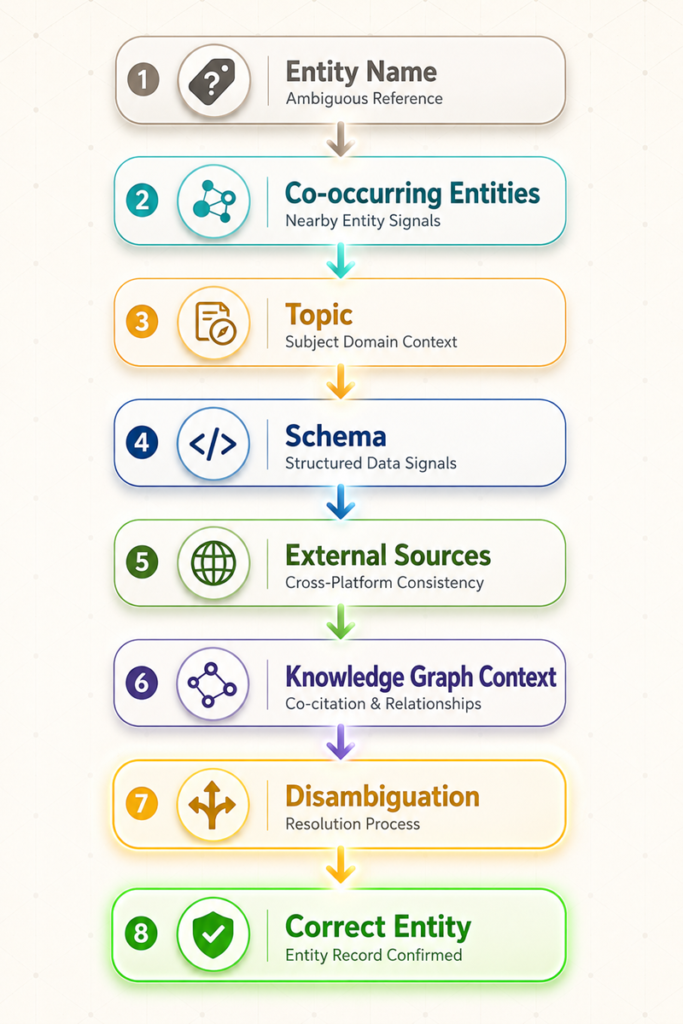
Search engines do not disambiguate from a single signal. They weight a stack of contextual inputs simultaneously. Understanding each signal tells you where to invest your optimization effort.
1. Co-occurring entities on the page
The other entities mentioned on the same page, and in close proximity to the ambiguous name, are among the strongest disambiguation signals available. If a page mentions “Apple” alongside “Tim Cook”, “iPhone”, “Cupertino”, and “App Store”, the co-occurring entities remove all meaningful ambiguity. The technology company is the only candidate.
For content writers, this means that the entities you choose to mention alongside your brand, your founders, or your products actively shape how search engines resolve your entity’s identity. Mentioning your industry, your location, your key products, and your organizational relationships in close proximity to your entity name gives disambiguation systems a rich co-entity context to work from.
2. Topical context and subject matter
The overall topic of a page (determined by its primary subject matter, heading structure, and the semantic field of its vocabulary) provides a broad disambiguation frame. A page whose topical context is clearly within the technology industry gives “Apple” a strong prior toward the technology company before any other signal is evaluated.
Topical coherence matters here. A page that clearly and consistently occupies a specific subject domain gives search engines a reliable topical context within which to resolve entity ambiguity. A page that mixes unrelated topics, and therefore has an unclear topical signature, provides weaker disambiguation context.
3. Schema markup: @type and sameAs
Schema markup is one of the strongest explicit disambiguation signals website owners can provide because it directly communicates entity type and identity in a machine-readable format. The @type property tells search engines explicitly what kind of entity something is. The sameAs property tells them exactly which knowledge graph record it corresponds to, linking your entity to its Wikidata entry, Wikipedia page, LinkedIn profile, or other authoritative external record.
A well-structured Organization schema block on your entity homepage that includes @type: "Organization", name, foundingDate, location, and sameAs links to authoritative external profiles removes disambiguation ambiguity at the structured data level, independently of what the surrounding text signals. Schema and NER reinforce each other: schema says what you are explicitly, NER infers it from text, and when they agree, the disambiguation confidence is high.
4. External source consistency
How your entity name appears across external sources (the exact form used, the consistent industry and role context, the geographic qualifiers) feeds into disambiguation as a cross-source signal. If your brand is consistently referred to as “Visiblytics” in the context of “AI visibility” and “entity SEO” across multiple independent sources, that consistency reinforces a specific entity identity.
Inconsistency across external sources (different name forms, different industry descriptions, different location references) introduces noise into the disambiguation model. Search engines must work harder to confirm that these varying references all point to the same entity, and during that resolution process, disambiguation confidence decreases.
5. Knowledge graph co-citations
Within knowledge graphs, entities that frequently appear together in reliable sources build co-citation relationships. These relationships inform disambiguation. If your entity’s name has been consistently co-cited alongside a set of unambiguous entities (a named industry event, a recognized publication, a well-established organization) those co-citations provide a disambiguation anchor. Your entity becomes associated with a specific network of other entities, making it distinguishable from other entities that share your name but occupy different networks.
6. Anchor text and link context
When external pages link to your entity using specific anchor text (your brand name, your founder’s name, a product name) the surrounding text of those links provides a disambiguation signal. A link with anchor text “Visiblytics” embedded in a paragraph about entity SEO services tells search engines something specific about what Visiblytics is and what context it belongs to. That link context contributes to the disambiguation model for your entity.
This is one reason why the quality and relevance context of external links matters beyond simple authority. A link from a topically relevant source with contextually appropriate surrounding text is a richer disambiguation signal than a decontextualized link from an unrelated directory.
7. Domain and URL context
The domain from which content originates provides a prior for entity disambiguation. Content published on your own domain (your entity homepage, your about page, your author pages) carries an implicit “this content is about this entity” signal. Search engines weight on-domain entity descriptions as intentional self-identification, which means that what you say about yourself on your own domain is a primary input into your disambiguation model.
URL structure also contributes. A page at visiblytics.com/about/ that contains consistent entity descriptions is a stronger self-identification signal than the same content buried in an unstructured URL.
What Happens When Disambiguation Fails
Disambiguation failures are not always obvious from the outside, but their effects on entity visibility can be significant and persistent.
Wrong knowledge graph association. If search engines consistently associate your entity name with a different entity record (a more prominent business that shares your name, a historical figure with your founder’s name) your entity’s attributes, relationships, and content may be attributed to the wrong record. Data you intended to build for your entity ends up strengthening someone else’s.
Incorrect knowledge panel data. Knowledge panels draw their information from the entity record a panel corresponds to. If disambiguation places your entity under the wrong record, or fails to establish a distinct record entirely, the panel may display incorrect information (the wrong founding date, the wrong description, the wrong associated people) sourced from the entity your name was confused with.
AI citation of the wrong entity. AI systems that retrieve information to answer queries use entity disambiguation as part of their source selection. If your entity name resolves to the wrong entity in the AI system’s knowledge base, queries that should surface your content may instead surface information about a different entity. The more ambiguous your entity name, the higher this risk.
Split entity signals. In some disambiguation failure cases, search engines do not associate your entity with a wrong record. They fail to consolidate your entity into any single record. Different references to your entity are treated as separate, unconnected mentions rather than as signals pointing to a single entity. This splits your entity authority across multiple incomplete records, none of which accumulates enough signal to trigger recognition, panel eligibility, or AI citation.
Topical authority confusion. If your entity is being disambiguated inconsistently (sometimes correctly associated with your industry, sometimes associated with a different entity in a different field) the topical authority signals your content generates may be distributed across multiple entity contexts rather than concentrated in the one that matters.
A scenario walkthrough
Consider a UX research consultancy named “Clarity Design” based in Pune. There is also a well-established software product called Clarity, a design agency called Clarity Creative based in London, and several other businesses using Clarity as a brand element.
Without strong disambiguation signals, a search engine encountering “Clarity Design” in content must evaluate multiple candidates. If the content provides no co-entity context (no mention of Pune, no mention of the consultancy’s services, no schema markup, no consistent external profile presence), the disambiguation model defaults to the strongest existing entity signal for “Clarity”, which is not the Pune consultancy.
The consultancy’s content generates entity signals, but those signals either attach to the wrong entity record or fail to accumulate into a distinct new record. The entity remains effectively invisible at the knowledge graph level despite producing content.
Add clear disambiguation support: consistent “Clarity Design, a UX research consultancy based in Pune” introductions, Organization schema with sameAs links, consistent external profile presence under the same name and description, and co-entity mentions of recognizable Pune industry context. The disambiguation model then has enough to establish and maintain a distinct entity record.
How to Support Correct Disambiguation in Your Content
Content is the primary surface on which disambiguation signals are generated. The following practices directly improve disambiguation reliability.
Qualify entity names on every significant first mention. Every time your entity name appears in content (especially on pages that are not your core entity pages) introduce it with qualifying context. “Clarity Design, a UX research consultancy based in Pune” on the first mention of every article gives NER and disambiguation systems a consistent contextual frame. Do not assume that disambiguation context established on one page carries over to all other pages automatically.
Place co-entity signals in close proximity to your entity name. The entities you mention alongside your own entity name (your industry category, your location, your founders, your key clients if public, your industry events) are co-entity disambiguation signals. Make sure these appear near your entity name, particularly in introductory sections, rather than spread across unrelated parts of the page.
Maintain topical coherence across your content. Content that consistently occupies a defined topical space reinforces the topical disambiguation context for your entity. A site whose content is clearly and consistently about UX research strengthens the disambiguation signal for a UX research entity. A site whose content spans unrelated topics provides a weaker topical frame.
Use schema markup explicitly. Include Organization or Person schema on your entity homepage with @type, name, description, foundingDate (for organizations), location, and sameAs links to your authoritative external profiles. This is the most direct disambiguation signal available to you. Schema does not replace textual disambiguation signals. It reinforces them at the structured data level.
Avoid name variations within the same content ecosystem. If your canonical entity name is “Clarity Design”, every page on your site should use exactly that form as the primary entity reference. “Clarity”, “Clarity Design Studio”, “CD”, and “the Clarity team” create naming variation that complicates disambiguation. Reserve shorthand and informal references for contexts where the entity has already been firmly established within the same piece of content.
How to Support Correct Disambiguation Across External Sources
Disambiguation is not a single-site problem. Search engines build their disambiguation models from signals across the entire web. What your external profiles say about you, and how consistently they say it, is as important as what your own site says.
Use a consistent canonical name across all external profiles. Your name on LinkedIn, Crunchbase, Wikipedia (if applicable), industry directories, press mentions, and any other external source should match your canonical entity name exactly. Variations (even minor ones like abbreviations, punctuation differences, or reordered words) create disambiguation friction.
Include consistent industry and location context in external profiles. Your LinkedIn company page, your Crunchbase entry, your industry directory listings, and your press release boilerplates should all describe your entity in the same terms: same industry category, same location format, same founding description. This consistency gives search engines a coherent cross-source signal to work with.
Establish a Wikidata entry if your entity meets notability thresholds. Wikidata is a structured, machine-readable knowledge base that feeds directly into Google’s and other search engines’ entity disambiguation systems. A Wikidata entry with accurate instance of, country, industry, official website, and sameAs properties provides a stable, authoritative disambiguation anchor that is specifically designed to be machine-readable.
Use your entity homepage as the primary disambiguation anchor. Your entity homepage (the page on your own domain that serves as the definitive source of record for your entity) is the starting point for disambiguation. It should contain your canonical entity name, your entity type description, your key attributes, and your sameAs links to external profiles. For a full breakdown of what an entity homepage must contain and how to structure it, see What Is an Entity Homepage?.
Monitor anchor text in external links. When other sites link to you, the anchor text they use and the surrounding paragraph context contribute to your disambiguation model. Encourage accurate, consistent anchor text where you have influence: in partnership mentions, guest contributions, and press coverage. A link that says “Clarity Design, the Pune-based UX consultancy” is a richer disambiguation signal than a link that says “this company” or “click here”.
Correct conflicting external descriptions promptly. If an external source describes your entity incorrectly (wrong location, wrong founding date, wrong industry, wrong name form) that conflicting signal creates disambiguation noise. Prioritize correcting the highest-authority sources first: Wikipedia, Wikidata, major industry publications, and directories that are frequently crawled and cited.
Disambiguation Checklist
Use this checklist to audit your entity’s disambiguation signal strength across both your own content and your external presence.
Content-level disambiguation
- Entity name is introduced with qualifying context (type, industry, location) on first mention in every article and page
- Co-entity signals (industry category, location, key relationships) appear in close proximity to the entity name in introductory sections
- One canonical name form is used consistently across all on-site content
- Name variations, abbreviations, and informal shorthand are avoided as primary entity references
- Content maintains consistent topical coherence that reinforces the entity’s subject domain
Schema markup
- Entity homepage includes Organization or Person schema with @type, name, description, and foundingDate
- sameAs properties link to all authoritative external profiles (LinkedIn, Wikidata, Wikipedia, Crunchbase where applicable)
- Schema @type matches the entity’s actual type consistently across all pages that include it
External source consistency
- Canonical entity name is identical across LinkedIn, Crunchbase, Wikidata, Wikipedia, and key directories
- Industry and location descriptions are consistent in form across all external profiles
- Wikidata entry exists (if entity meets notability threshold) with accurate structured properties
- Conflicting external descriptions have been identified and correction requests submitted
- External links to your entity use accurate, contextually appropriate anchor text where possible
❓ Frequently Asked Questions
What is entity disambiguation in simple terms?
Disambiguation is how search engines decide which specific entity a name refers to when multiple entities could be the answer. If your brand name is “Titan”, disambiguation is the process that determines whether content mentioning “Titan” is about your business or about something else that shares the name. The contextual signals in and around that content are what drive the decision.
Is disambiguation the same as entity reconciliation?
No. Disambiguation resolves which entity a name refers to when multiple candidates exist. Reconciliation resolves whether two different descriptions or records refer to the same entity. For example, whether “CloudStack Solutions” and “CloudStack” in different sources are the same company or different ones. Both processes contribute to entity clarity, but they address different problems. For a full treatment of reconciliation, see How Entity Reconciliation Works in Search Engines and AI Systems.
Does my entity name need to be completely unique to be disambiguated correctly?
No. A unique name makes disambiguation easier, but it is not a requirement. Many successfully disambiguated entities share names with other entities. What matters is whether your entity has consistent, clear, cross-source signals that allow search engines to build a distinct entity record for it. Strong co-entity signals, schema markup, external profile consistency, and a well-structured entity homepage can support reliable disambiguation even for entities with common or shared names.
How do I know if my entity is being disambiguated incorrectly?
Several indicators suggest a disambiguation problem: your brand name returns knowledge panel results for a different entity, AI systems describe your organization with incorrect attributes when queried, searches for your entity name consistently surface a different entity above you, or your entity has no knowledge graph presence despite sustained content production. Running your entity name through Google’s Natural Language API and checking which knowledge graph entry it links to (if any) is a direct way to test current disambiguation status.
Does disambiguation affect AI search results specifically?
Yes, and significantly. AI systems that generate answers from retrieved content use entity disambiguation to identify which sources are about which entities. If your entity is being confused with another in the AI system’s knowledge base, queries that should surface your content may instead pull information from a different entity’s sources. As AI search surfaces become more prominent, disambiguation accuracy has a direct effect on whether your entity is cited correctly, or cited at all.
How long does it take for disambiguation signals to take effect?
There is no fixed timeline. Disambiguation model updates depend on recrawl frequency, the strength and consistency of new signals, and how entrenched the existing disambiguation model is for your entity name. For entities with weak or no existing knowledge graph presence, consistent signals across multiple authoritative sources can begin to produce results within weeks to a few months. For entities where a strong conflicting disambiguation exists (where another entity with the same name dominates) establishing a distinct record takes longer and requires more deliberate, sustained signal building.
Can disambiguation problems be caused by my own content?
Yes. Inconsistent entity naming across your own site (using different name forms, mixing formal and informal references without clear introductions, allowing old brand names to persist on live pages) creates internal disambiguation noise. Search engines building a model of your entity from your own domain encounter conflicting signals and produce a less confident disambiguation result. Consistent, canonical naming across your entire content ecosystem is as important as signals from external sources.
Conclusion
Disambiguation is not something that happens to your entity. It is something search engines do with the signals you provide. Every piece of content your entity publishes, every external profile it maintains, every schema block it deploys, and every external link it earns contributes to the disambiguation model that determines whether search engines and AI systems correctly identify which entity you are.
Entities with clear, consistent, cross-source disambiguation signals get recognized reliably. Entities with ambiguous names and inconsistent signals get confused with other entities, fail to accumulate authority into a single record, or remain invisible at the knowledge graph level despite sustained effort.
The foundation for all of this is a coherent entity SEO strategy. The Entity SEO guide covers the full framework. Disambiguation sits within it as one critical component of building an entity that search engines and AI systems can consistently find, identify, and trust.