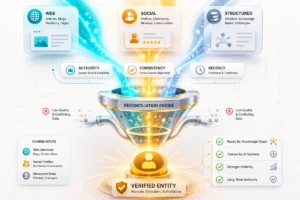
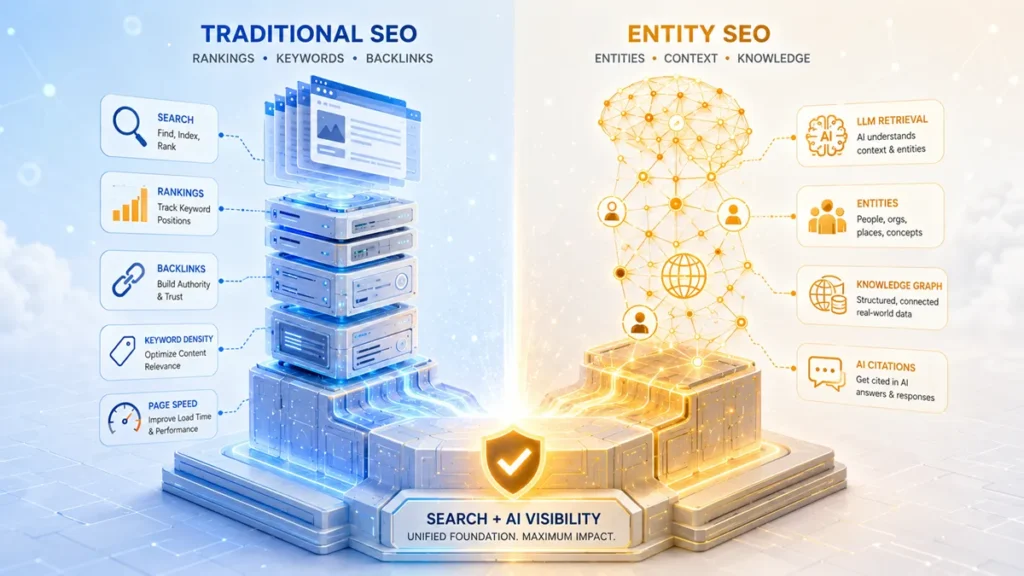
Entity SEO and traditional SEO are not competing disciplines. Entity SEO is a deeper layer of optimization that sits beneath keyword strategy and content optimization, addressing how search engines and AI systems understand what your content is actually about rather than just what words it contains. Understanding the difference changes how you approach nearly every SEO decision.
The Core Difference in One Sentence
Traditional SEO optimizes for the words on a page. Entity SEO optimizes for the real-world thing a page is about.
That sounds like a subtle distinction. In practice it changes what you build, what you measure, and what makes your site visible in a world where AI systems handle a growing share of how people find information. A site that has done only traditional SEO can rank well in 2026 and still be entirely invisible to ChatGPT, Gemini, Claude, and Perplexity. A site that has done entity work alongside its keyword work is positioned for both.
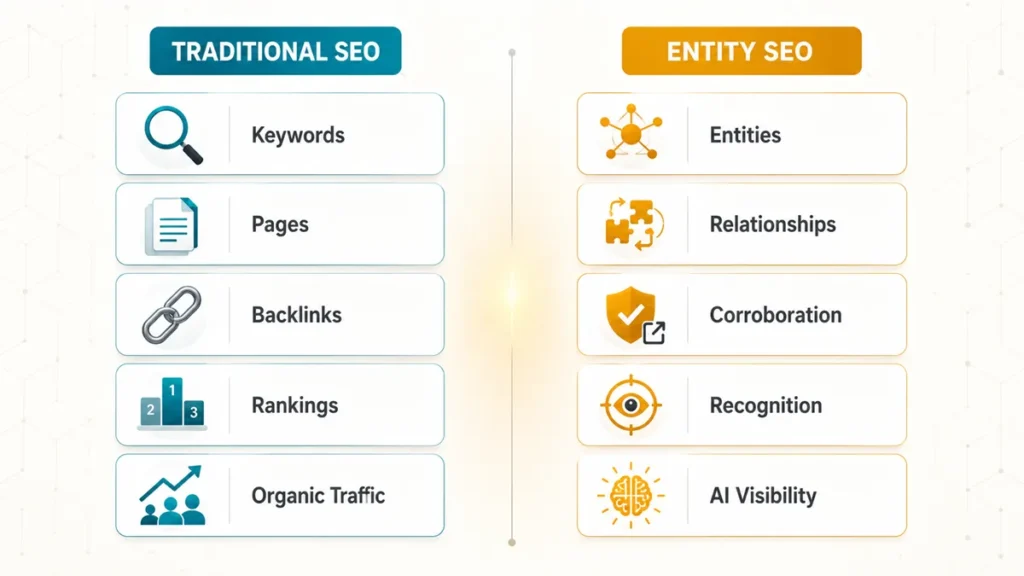
What Traditional SEO Optimizes For
Traditional SEO is built around the assumption that search engines match queries to pages by analyzing the words they contain. Under this model, the job is to:
- Find the keywords people type when looking for what you offer
- Include those keywords in the right places on the right pages
- Build enough backlinks that your pages carry more authority than competing pages
- Structure your site so crawlers can reach and index every page efficiently
This model produced real results for two decades and still does. Google’s core algorithm has always considered relevance (does this page contain what the query is looking for?) and authority (do other sites consider this page trustworthy?). Keywords and links are the primary signals for both.
The limitation is that this model treats your site as a collection of pages, each optimized for a set of queries. It does not address whether search engines understand who you are, what your brand represents, or how your content relates to a broader network of real-world entities. That gap did not matter much when search was purely about rankings and clicks. It matters enormously when AI systems are constructing answers from structured knowledge rather than returning ranked lists of pages.
What Entity SEO Optimizes For
Entity SEO operates at the level of real-world things rather than words. It is built around the understanding that modern search engines and AI systems represent the world as a network of entities (people, organizations, places, products, concepts) connected through relationships, not as a collection of documents matched to queries.
Under this model, the job is to:
- Define your entity clearly so search engines can identify who or what you are without ambiguity
- Establish the attributes of your entity (what you do, when you were founded, who is behind it)
- Build explicit relationships between your entity and other recognized entities
- Corroborate your entity across independent, trusted sources
- Make all of the above machine-readable through structured data
The immediate goal is not simply a ranking. The goal is to create a clearly defined and well-connected entity representation in the structured knowledge search engines and AI systems use to construct answers, surface relevant results, and decide who to cite.
As covered in the Entity SEO guide, entity definition is the foundation layer of the entire AI Visibility framework. Without it, every other optimization effort produces pages that search engines can index but cannot fully understand or confidently attribute.
Side-by-Side: How Each Approach Handles the Same Situation
The clearest way to understand the difference is to see how each approach handles the same real-world scenario.
Situation: A freelance SEO specialist launches a website offering SEO services and publishes guides on Entity SEO, Knowledge Graphs, and AI Visibility.
Traditional SEO approach:
- Research keywords: “freelance SEO specialist,” “entity SEO guide,” “knowledge graph optimization”
- Write pages targeting those keywords with appropriate density in titles, headings, and body text
- Build backlinks to the service pages and guides from relevant sites
- Optimize page speed, fix crawl errors, submit sitemap
- Track rankings and organic traffic
Entity SEO approach:
- Define the organization entity: name it consistently, state what it does in one sentence, record the founding year, name the founder
- Define the person entity: name the founder consistently, state their professional role, list their credentials, link to verified external profiles
- Implement Organization and Person schema markup with sameAs references pointing to LinkedIn, Twitter/X, and a Wikidata entry
- Build the relationship between the person entity and the organization entity explicitly in schema and in content
- Create an entity homepage that functions as a machine-readable source of record
- Publish content with named authorship attributed to a verified person entity
What each produces: The traditional approach produces pages that can rank for “freelance SEO specialist” if the keyword optimization and link building are done well.
The entity approach produces a recognized entity that search engines can confidently represent, that AI systems can cite by name, and that knowledge graphs can connect to other recognized entities in the SEO and search intelligence space.
A site that has done only the traditional approach may rank well and never appear in an AI-generated answer when someone asks “who are the leading experts in AI Visibility?” A site that has done the entity work is a candidate for that answer because the AI system has enough structured, corroborated information to identify and cite it with confidence.
Where They Measure Success Differently
This is where the practical divergence between the two approaches becomes most visible.
Traditional SEO measures:
- Keyword rankings (position 1–10 for target terms)
- Organic traffic volume
- Click-through rate from search results
- Backlink count and domain authority metrics
- Impressions and clicks in Google Search Console
Entity SEO measures:
- Entity recognition (does a branded search show entity-aware results, a knowledge panel, or structured entity information?)
- AI citations (does your brand appear by name in AI-generated answers about your area of expertise?)
- Knowledge graph presence (is your entity represented in Wikidata or verifiable in structured knowledge sources?)
- Author attribution (is content correctly attributed to your named entity across AI retrieval?)
- Mention quality (are credible, independent sources referencing your entity in professional context?)
Neither set of metrics is wrong. They measure different things. Traditional SEO metrics tell you how your pages are performing in ranked search. Entity SEO metrics tell you how your entity is being understood and represented across both ranked search and AI-powered surfaces.
A brand can have strong traditional SEO metrics and weak entity metrics. It will rank in traditional search but be absent from AI answers. A brand can have strong entity metrics and underdeveloped traditional SEO. It may be cited in AI answers but miss out on keyword-driven organic traffic. The brands that perform best across both surfaces are the ones doing both.
How Search Engines Process Each Type of Signal
Understanding why entity signals matter requires a brief look at how search engines actually process them, because it explains why keyword optimization alone is increasingly insufficient.
How traditional SEO signals are processed:
When a crawler visits your page, it reads the text, identifies the most prominent terms, and uses those terms alongside the page’s link profile to assess relevance and authority for related queries. This process is fundamentally text-matching, even though modern algorithms like BERT and MUM have made that matching far more sophisticated than it once was.
How entity signals are processed:
When a crawler visits your page, it also attempts named entity recognition: identifying the specific real-world things your page is about. It cross-references those entities against its knowledge graph to verify their attributes and relationships. It looks for consistency between what your page claims about an entity and what independent sources say about the same entity. And it uses that structured knowledge to build a representation of your entity that can be used across many different queries and surfaces, not just the ones your keywords target.
The practical implication: keyword optimization tells a search engine what your page is about in text terms. Entity optimization tells it what your page is about in knowledge terms. Both signals contribute to how your content is understood and surfaced, but they operate at different levels of the system.
The Overlap: Where Both Approaches Do the Same Work
Entity SEO and traditional SEO are not opposed, and the best implementations of both share significant common ground.
Technical hygiene matters for both. A site that crawlers cannot reach efficiently cannot be indexed for keyword signals or entity signals. Page speed, crawl architecture, and indexability are foundational for both approaches.
Content quality matters for both. Thin, low-effort content does not rank for keywords and does not give search engines meaningful entity signals. Genuinely useful, well-researched content serves both purposes.
External recognition matters for both. Backlinks are the traditional SEO signal for authority. Brand mentions, citations, and third-party references are the entity SEO signal for recognition. In practice, a link from a credible site often carries both: it contributes to your link profile and it is a corroboration signal for your entity. The difference is that entity SEO also counts unlinked mentions, which traditional SEO largely ignores.
Internal linking matters for both. Traditional SEO uses internal links to pass authority between pages. Entity SEO uses internal links to make relationships between entities explicit: your author page linked from your articles, your organization page linked from your author page, your topic cluster pages linked to each other.
The practical consequence: a brand that has invested in genuine, high-quality traditional SEO is already most of the way to a strong entity foundation. The additional work that entity SEO requires is primarily structural (entity pages, schema markup, sameAs references, Wikidata) rather than starting from zero.
Where They Diverge Most Sharply
These are the areas where optimizing for only one approach will leave visible gaps.
Author identity. Traditional SEO does not require named authorship. Many high-ranking pages have no identified author at all. Entity SEO treats anonymous content as a significant weakness because it cannot be attributed to a verifiable person entity. In an AI citation context, anonymous content is a much weaker source than content attributed to a named, credible expert.
Entity pages. Traditional SEO has no equivalent of an entity homepage. An About page is typically treated as a conversion tool (convince the visitor you are credible) rather than a machine-readable source of record (give search engines structured facts about your entity). Entity SEO treats the About page as the most technically important non-content page on the site. The full guide to building an effective entity homepage is in our Entity Homepage guide..
Schema markup. Schema is a ranking signal in traditional SEO primarily for rich results (review stars, FAQ dropdowns, event listings). In entity SEO it serves a different purpose: making the relationships between entities explicitly machine-readable. Organization schema with sameAs references does almost nothing for rich results eligibility but does significant work for entity recognition and knowledge graph corroboration.
Unlinked mentions. Traditional SEO measures backlinks. A brand mention without a link is invisible to standard link analysis tools and is rarely pursued as a deliberate strategy. In entity SEO, an unlinked mention from a credible source is a genuine corroboration signal because it demonstrates that an independent, recognized source acknowledges your entity’s existence in a professional context. The entity recognition system is not limited to anchor text and URLs.
AI citations. Traditional SEO has no concept equivalent to AI citation. There is no traditional SEO tactic that specifically addresses whether your brand gets named in a ChatGPT or Gemini answer. Entity SEO, combined with LLM SEO (covered at /llm-seo/), directly addresses this. A well-structured entity with strong knowledge graph presence and clearly attributed, well-organized content is a far stronger AI citation candidate than an anonymous collection of keyword-optimized pages.
A Practical Transition: How to Add Entity SEO to What You Are Already Doing
If you have an existing site with traditional SEO already in place, you do not rebuild from scratch. You add the entity layer on top of what already works.
Step 1: Audit your entity clarity. Search your own brand name in Google. Do the results show a consistent, clear entity, or is there ambiguity about what Visiblytics (or your brand) actually is? Check if your brand name is used consistently across your homepage, About page, social profiles, and any third-party mentions. Inconsistencies here are the first thing to resolve.
Step 2: Build or improve your entity homepage. Whether that is your About page or your homepage, make sure it contains the six factual elements covered in the entity homepage guide: entity name, entity type, what you do, who is behind it, when you were established, and where you can be found externally.
Step 3: Implement Organization and Person schema. This is the most direct conversion of traditional SEO work into entity signals. Organization schema on your homepage and Person schema on your author pages costs relatively little time to implement and does significant work for entity recognition. Use the Schema Markup Generator to build it and the Structured Data Testing Tool to validate it.
Step 4: Add named authorship to your content. If your articles currently have no author or a generic “Admin” attribution, update them with a real named author linked to a proper author page with Person schema. This is one of the single highest-impact entity SEO changes available for a site that has otherwise done good traditional SEO work.
Step 5: Create a Wikidata entry. Wikidata is the most accessible independent, structured knowledge source available to most businesses. A basic entry covering your organization’s name, type, founding date, founder, and website URL is achievable without meeting Wikipedia’s notability threshold, and it directly feeds the knowledge graph corroboration process.
Step 6: Keep doing traditional SEO. None of the above replaces keyword research, on-page optimization, technical hygiene, or link building. It adds a layer beneath them that makes all of that work more fully understood and attributed by search engines and AI systems.
❓ Frequently Asked Questions
Does Entity SEO replace keyword research?
No. Keyword research tells you what your audience is searching for and how to structure your content around those needs. Entity SEO tells search engines who is producing that content and what real-world thing the content is about. Both are necessary. A keyword-optimized page attributed to a well-defined entity is a stronger search signal than either alone.
Can a small site do Entity SEO?
Yes. In fact, small sites with clear topical focus and a named, credible expert behind them are often better entity SEO candidates than large sites with anonymous content across many topics. Entity clarity is about definition and consistency, not scale.
Does Entity SEO affect traditional rankings?
Indirectly, yes. A clearly defined entity with consistent signals and corroborated attributes is easier for a search engine to match confidently to relevant queries. Content attributed to a verified, expert entity carries more trust than the same content from an unverified source. These are not direct ranking factors in the way that backlinks are, but they influence how confidently a search engine represents your content across a wide range of queries.
How long before Entity SEO produces results?
The technical implementation (schema, entity pages, author attribution) can be done in days and will begin influencing entity recognition quickly. The external corroboration layer (Wikidata, third-party mentions, knowledge graph confidence) builds over months, similar to how domain authority accumulates through link building. There is no verified timeline I can give, and I would be cautious of any source that states one precisely.
The Bottom Line
Traditional SEO and Entity SEO answer different questions.
Traditional SEO answers: how do I get this page in front of people searching for this keyword?
Entity SEO answers: how do I make sure search engines and AI systems understand who I am, trust what I say, and have a reason to cite me by name?
Both questions matter in 2026. The brands investing in both will be more visible in traditional search and in AI-generated answers. The brands doing only one are leaving the other surface unaddressed.
The Entity SEO guide covers the full framework for building entity clarity from the ground up, including the Entity Building Roadmap from entity identification through to Knowledge Panel eligibility.
Moving from string-matching to entity-building is the fundamental shift of modern search architecture. If your Google Knowledge Panel is missing or search engines fail to connect your founder to your brand, our dedicated Entity SEO Services will establish your structured identity once and for all.