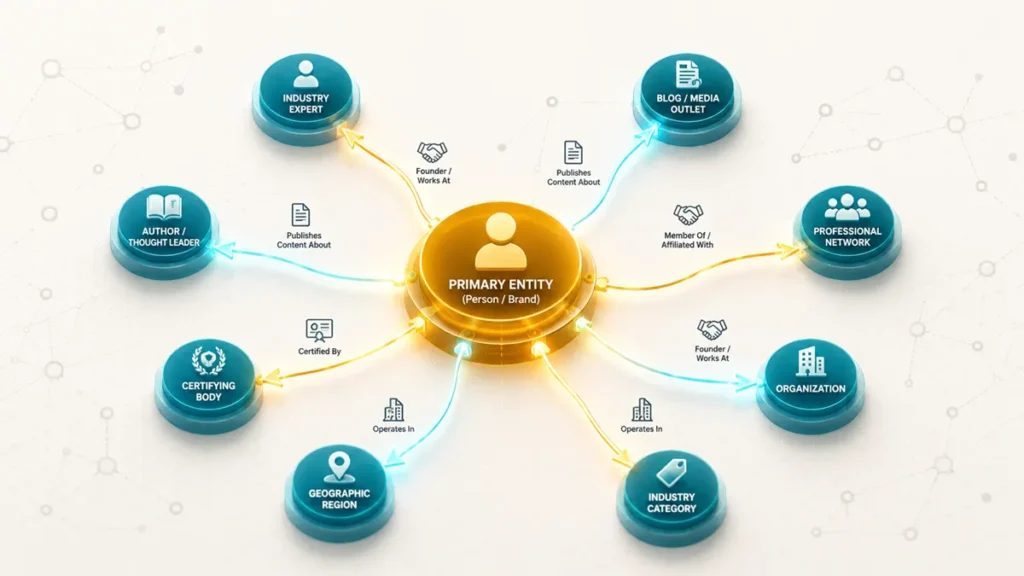
Entity relationships are the connections between real-world things that allow search engines and AI systems to reason across knowledge rather than simply retrieve individual facts. A relationship is what turns two isolated entity definitions into a network a machine can traverse, a name connected to an organization, an organization connected to a topic, a topic connected to an industry.
What Is an Entity Relationship?
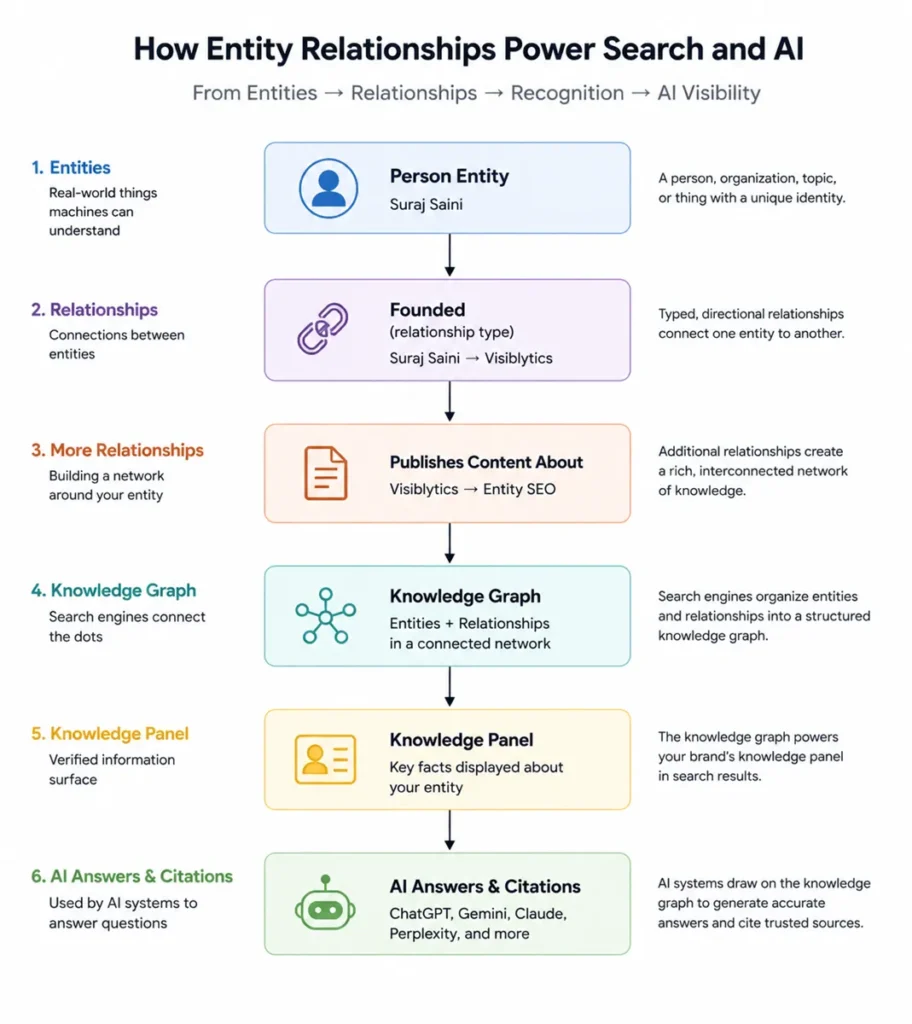
An entity relationship is a typed, directional connection between two entities. It is not a vague association. It has a specific type (founded, works at, created, owns, is a type of), a direction (from one entity to another), and ideally corroboration from more than one source.
The simplest example:
Suraj Saini
    ↓ Founded
Visiblytics
That arrow is a relationship. It has a type (Founded), a direction (from Suraj Saini to Visiblytics, not the reverse), and it can be stated explicitly in schema markup, demonstrated in content, and corroborated by independent sources.
Without this relationship, a search engine has two separate entity definitions: a person named Suraj Saini, and an organization named Visiblytics. With it, the system can reason across the connection: navigating from Suraj Saini reaches Visiblytics, and navigating from Visiblytics reaches Suraj Saini. It can answer “who founded Visiblytics?” and “what did Suraj Saini found?” from the same relationship, traversed in either direction.
This is the structural difference between a list of facts and a knowledge graph. As covered briefly in the Entity SEO guide and in more depth in the Knowledge Graph guide, knowledge graphs are built from entities connected through relationships. Entity relationships are the edges in that graph. Building them deliberately is what moves your entity from an isolated node to a connected, well-understood presence in the knowledge network.
Why Entity Relationships Matter for Search and AI
Entity relationships matter because they change what a search engine or AI system can do with what it knows about you. An entity without relationships is a dead end. An entity with well-built relationships is a traversable node in a network that AI systems can reason across when constructing answers.
For search engines: Relationships enable intent understanding. When someone searches “who runs Visiblytics,” a search engine with a correctly mapped founder relationship can answer that question directly, without keyword-matching a page that happens to contain both names. The answer comes from traversing the relationship, not from text analysis.
For knowledge panels: The attributes displayed in a knowledge panel are almost entirely relationship-derived. The founders listed, the products shown, the related entities displayed below the panel: each of these is a relationship rendered visibly. A brand with few mapped relationships will have a sparse or incomplete panel even if its entity definition is otherwise strong.
For AI citations: When ChatGPT, Gemini, Claude, or Perplexity constructs an answer involving your brand, it draws on structured knowledge that includes relationship data. An AI system asked “what does Visiblytics cover?” can answer by traversing the topical relationships between Visiblytics and Entity SEO, Knowledge Graphs, AI Visibility, and LLM SEO, if those relationships are clearly built. Without them, it has only whatever it can infer from unstructured text.
For topical authority: A brand connected through relationships to recognized topics, recognized organizations, and recognized people in its field carries more topical authority than the same brand as an isolated entity. Relationships are part of what tells AI systems that your expertise is genuine and contextually situated, not self-declared.
The Four Types of Entity Relationships
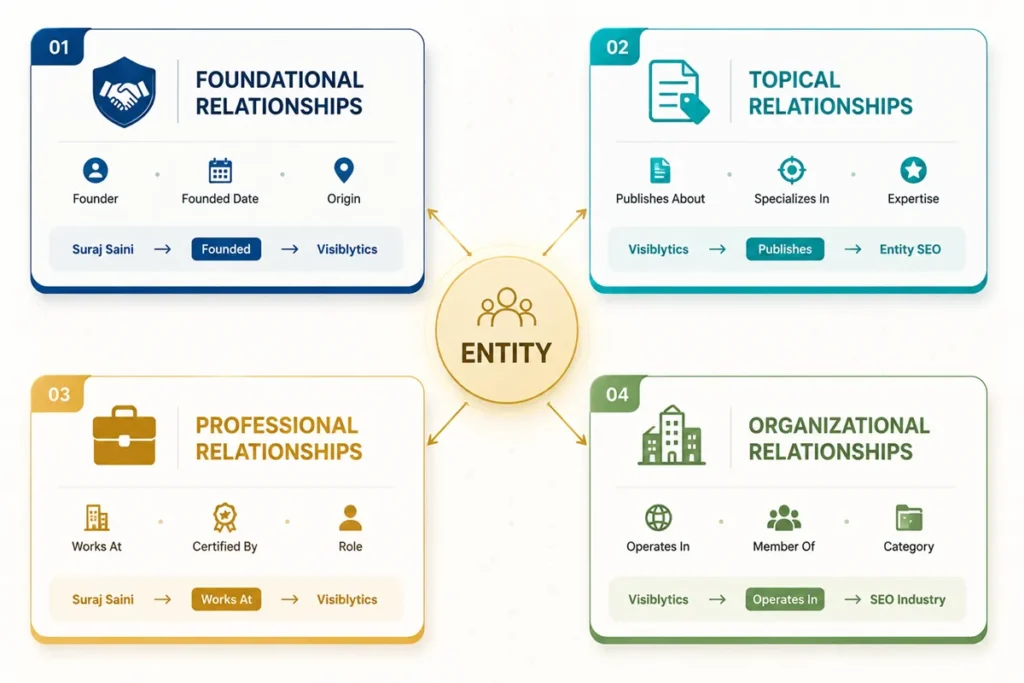
The Entity SEO guide introduces four relationship categories. This article goes deeper into each one: what they look like in practice, how to build them, and how to make them machine-readable.
1. Foundational Relationships
Foundational relationships define the origin and structure of an entity. They answer: who created this, who is responsible for it, and what is its formal status?
Examples:
Suraj Saini
    ↓ Founded
Visiblytics

Larry Page
    ↓ Co-Founded
  Google

Steve Jobs
    ↓ Co-Founded
  Apple
These are the relationships most directly corroborated by external sources (company registration records, press releases, official bios) and most likely to feed into a knowledge panel directly. They are also the relationships most commonly missing from schema markup, because founders assume the connection is obvious.
How to build foundational relationships:
- State the founding relationship explicitly in prose on your entity homepage (“Visiblytics was founded by Suraj Saini in 2026”)
- Include the
founderproperty in your Organization schema, with a nested Person entity - Ensure the founder’s author page includes
worksForpointing back to the organization - Match the founding relationship in your LinkedIn company page, Wikidata entry, and any directory profiles
In practice, relationships that appear consistently across multiple independent sources are generally much easier for search engines and AI systems to trust than relationships that exist only on your own website.
2. Topical Relationships
Topical relationships connect an entity to the subjects it is associated with. They answer: what does this entity know about, publish on, or specialize in?
Examples:
Visiblytics  → Publishes Content About  Entity SEO
Visiblytics  → Publishes Content About  AI Visibility
Suraj Saini  → Specializes In  Knowledge Graph Optimization
Topical relationships are built primarily through content: sustained, deep coverage of a specific subject area creates an association between your entity and that topic in the systems that process your content. A single article about Entity SEO does not create a strong topical relationship. A pillar page, a cluster of supporting articles, original research, and external citations all pointing to your entity in the context of Entity SEO do.
This is why topical authority and entity relationships are inseparable. Topical authority is the accumulated strength of your topical relationships. You cannot claim a topical relationship through assertion. You build it through consistent, recognized contribution to the topic.
How to build topical relationships:
- Publish content clusters that demonstrate depth on your core subjects
- Use Article schema with
aboutproperty pointing to the topic entity - Earn mentions from other credible sources in the context of your topic (a link or reference that says “Visiblytics on Entity SEO” is a topical relationship signal)
- Internal linking that explicitly connects your organization entity page to your topic cluster pages
3. Professional Relationships
Professional relationships connect people to the organisations they work with, the roles they hold, the subjects they are known for, the content they create, and the expertise they demonstrate. These relationships help search engines and AI systems understand not only who someone is, but also what they are recognised for.
Examples:
Suraj Saini
    ↓ Works At
 Visiblytics


Sundar Pichai
     ↓ CEO Of
   Google

Tim Berners-Lee
      ↓ Invented
World Wide Web

Linus Torvalds
      ↓ Created
    Linux
Professional relationships are the primary relationships that build person-entity authority. They are what allow an AI system to answer “who is Suraj Saini?” with a description that includes role, organization, and credentials rather than just a name. They are also what allow the system to connect a piece of content to a verified expert entity rather than treating it as anonymously produced.
How to build professional relationships:
- Author pages with
jobTitle,worksFor, andalumniOf(for education) in Person schema - Credential listings that link to the issuing organizations (Google, Semrush) so the certification relationship is traversable
- A LinkedIn profile that matches exactly: same name, same title, same organization, same description as your entity homepage
- Consistent bio language across every platform where you appear as an author
4. Organizational Relationships
Organizational relationships connect an entity to the broader ecosystem it operates within: industry categories, parent organizations, subsidiary brands, partner organizations, and membership bodies.
Examples:
Visiblytics  → Operates In  SEO Industry
Visiblytics  → Is A  Search Intelligence Platform
Google       → Owns  YouTube
Apple        → Makes  iPhone
These relationships place your entity within a category and context that search engines use for disambiguation and for surfacing your entity in category-relevant queries. An entity that is clearly placed within a recognized industry category is easier to surface when a user asks a category-level question (“what are the best AI Visibility platforms?”) than one that is floating without category context.
How to build organizational relationships:
- Include industry category in your Organization schema (
@typeshould be specific: use “ProfessionalService” or a more specific type rather than just “Organization” where applicable) - List relevant industry associations or memberships, with links to those organizations
- Use
memberOfin schema where applicable - Ensure your Wikidata entry categorizes your entity correctly within recognized industry taxonomies
Relationship Directionality: Why It Matters
Every relationship has a direction. “Suraj Saini founded Visiblytics” is a different statement from “Visiblytics was founded by Suraj Saini,” even though they describe the same fact. In knowledge graph terms, these are traversals in opposite directions across the same edge.
Suraj Saini  →(founded)→  Visiblytics
Visiblytics  →(foundedBy)→  Suraj Saini
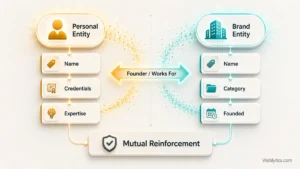
Some schema properties are directional by design. The founder property on Organization schema points from the organization to the person. The worksFor property on Person schema points from the person to the organization. Together they create a bidirectional relationship that a machine can traverse in either direction.
The practical importance: if you implement founder on your Organization schema but not worksFor on your Person schema, the relationship is only explicitly stated in one direction. A search engine traversing from your organization to your founder will find the connection. One traversing from your founder to your organization has to infer it. Inference is weaker than explicit statement. Build relationships explicitly in both directions where schema supports it.
Search engines don’t just store facts—they store directional relationships that can be traversed from either entity. Building reciprocal relationships where appropriate reduces ambiguity and increases confidence.
How to Make Relationships Machine-Readable
Well-written prose about your entity and its relationships is useful. Machine-readable structured data about those same relationships is what knowledge graph systems can act on directly. Here is how the four relationship types map to specific schema properties.
Foundational relationships in schema:
{
  "@type": "Organization",
  "name": "Visiblytics",
  "founder": {
    "@type": "Person",
    "name": "Suraj Saini",
    "url": "https://visiblytics.com/about/suraj-saini/"
  },
  "foundingDate": "2026"
}
And on the person’s page, the reciprocal:
{
  "@type": "Person",
  "name": "Suraj Saini",
  "worksFor": {
    "@type": "Organization",
    "name": "Visiblytics",
    "url": "https://visiblytics.com"
  }
}
Topical relationships in schema:
{
  "@type": "Article",
  "name": "Entity SEO: The Complete Guide",
  "about": {
    "@type": "Thing",
    "name": "Entity SEO"
  },
  "author": {
    "@type": "Person",
    "name": "Suraj Saini",
    "url": "https://visiblytics.com/about/suraj-saini/"
  }
}
Professional relationships in schema:
{
  "@type": "Person",
  "name": "Suraj Saini",
  "url": "https://visiblytics.com/about/suraj-saini/",
  "jobTitle": "Founder, Lead Search Architect & Web Systems Engineer",
  "worksFor": {
    "@type": "Organization",
    "name": "Visiblytics"
    "url": "https://visiblytics.com"
  },
  "hasCredential": {
    "@type": "EducationalOccupationalCredential",
    "name": "Google Analytics Certification",
    "credentialCategory": "certification"
  }
}
Organizational relationships via sameAs and industry type:
{
  "@type": "ProfessionalService",
  "name": "Visiblytics",
  "sameAs": [
    "https://www.linkedin.com/company/visiblytics",
    "https://www.crunchbase.com/organization/visiblytics",
    "https://x.com/Visiblytics"
  ]
}
Use the Schema Markup Generator to build these without writing JSON-LD by hand, and the Structured Data Testing Tool to validate them before publishing.
How Relationships Are Discovered and Corroborated
Stating a relationship in schema is the starting point. Having it corroborated independently is what turns a self-asserted claim into a knowledge graph-level fact.
Search engines discover entity relationships from three layers, in increasing order of trust:
Layer 1: Your own site. Schema markup, prose statements (“Visiblytics was founded by Suraj Saini”), internal links between entity pages. This is where you state the relationship. It is necessary but not sufficient for knowledge graph inclusion.
Layer 2: Consistent external profiles. Your LinkedIn company page naming the same founder. Your author bio on a third-party publication naming the same organization. A Wikidata entry with the same founding relationship. These are independent sources that corroborate what your site claims. Each one increases the confidence a knowledge graph system has in the relationship.
Layer 3: Organic third-party mentions. A publication covering your brand that names your founder. A podcast that describes you as the Founder and Lead Search Architect at Visiblytics. An industry directory that lists your company with consistent attributes. These are the strongest corroboration signals because they are neither self-asserted nor profile-managed. They are independent acknowledgments of the relationship.
The practical implication: a relationship that exists only in your schema has one signal. The same relationship corroborated in your Wikidata entry, your LinkedIn profile, and a third-party article has four signals from three independent source types. Knowledge graph systems weight the latter significantly more heavily.
Common Entity Relationship Mistakes
Stating relationships in prose only. Writing “Suraj Saini is the founder of Visiblytics” on your About page gives a human reader the relationship clearly. It gives a crawler an inferential signal. Adding founder in schema gives the crawler an explicit, machine-readable statement of the same relationship. Both are useful. Only schema gives it in the format knowledge graph systems are built to process directly.
Building relationships in only one direction. Implementing founder on Organization schema but not worksFor on Person schema leaves the relationship one-directional in machine-readable form. Build both directions where schema supports it.
Inconsistent naming across relationship sources. If your Organization schema says “Visiblytics” but your LinkedIn company page says “Visiblytics SEO” and your Wikidata entry says “visiblytics.com,” the knowledge graph system encounters three versions of what should be the same entity. It has to decide whether these are the same entity or three different ones. Every inconsistency is a disambiguation cost that weakens relationship confidence.
No external corroboration. A relationship that exists only on your own site is an unverified claim. It is useful as a starting point but it is not a knowledge graph-strength signal until it appears in at least one independent source. Pursuing Wikidata entries, consistent external profiles, and genuine third-party mentions is the work of turning self-asserted relationships into corroborated ones.
Treating relationships as a one-time setup. When your entity changes (new role, new focus, new partnership), the relationships need to be updated across every source that states them. Stale relationships create conflicts between what your current site says and what older external sources say, which introduces disambiguation problems over time.
Missing the topical relationship layer. Most brands focus on foundational relationships (founder, organization) and neglect topical relationships. A brand that has clearly established “Visiblytics → publishes content about → Entity SEO” through sustained, recognized content production is far more likely to be surfaced by an AI system for Entity SEO queries than one that has only defined its organizational structure.
Entity Relationships and AI Visibility
The connection between entity relationships and AI Visibility is direct. AI systems like ChatGPT, Gemini, Claude, and Perplexity do not retrieve keyword matches. They retrieve entities and reason across the relationships between them.
When a user asks “who are the leading voices in Entity SEO?” the system does not match that query to pages containing those words. It looks for person entities that have a recognized, corroborated topical relationship with Entity SEO, cross-referenced against trust signals that confirm those people are credible sources on the topic.
A brand with well-built entity relationships is a node the system can reach through multiple traversal paths. One with weak or missing relationships is a dead end: the system may know the entity exists but cannot connect it to the context the query requires.
This is why entity relationships are Stage 4 in the Entity SEO Building Roadmap: they come after entity identification, entity homepage, and schema implementation, because relationships need a stable, well-defined entity to attach to. And they feed directly into knowledge graph recognition (Stage 6) and knowledge panel eligibility (Stage 7) because both depend on the system having confident, corroborated relationships to work from.
The full chain from entity relationships to AI Visibility is covered in the AI Visibility guide.
Entity Relationship Checklist
Before moving to the next stage of entity building, verify each of these is in place:
Foundational relationships:
- Founding relationship stated in prose on entity homepage
founderproperty in Organization schema with nested Person entityworksForproperty in Person schema pointing back to Organization- Founding relationship corroborated in at least one external source (LinkedIn, Wikidata, directory)
Topical relationships:
- Topic cluster published demonstrating depth on core subject area
aboutproperty in Article schema naming the topic entity- At least one external source connecting your entity to your topic in professional context
Professional relationships:
jobTitleandworksForin Person schema- Credentials listed with links to issuing organizations
- LinkedIn profile matches schema: same name, title, organization
Organizational relationships:
- Specific
@typeused in Organization schema (not generic “Organization” where a more specific type applies) - Industry category clearly stated in prose and schema
sameAsreferences pointing to all active external profiles
Corroboration:
- Every significant relationship appears in at least one source outside your own domain
- Entity name is identical across every source that states any relationship
- Relationships are current and reflect the entity’s actual status
❓ Frequently Asked Questions
What is an entity relationship in SEO?
An entity relationship is a typed, directional connection between two entities that search engines and AI systems use to understand how real-world things are connected. Examples include founding relationships (person founded organization), topical relationships (brand publishes content about topic), and professional relationships (person works at organization). Relationships are what turn isolated entity definitions into a traversable knowledge network.
How do I build entity relationships for my website?
Start with your most foundational relationship: the connection between your organization entity and the person or people behind it. State it explicitly in prose on your entity homepage, implement it in Organization and Person schema, and corroborate it in at least one external source (LinkedIn, Wikidata, a directory profile). Then build topical relationships through sustained, deep content on your core subjects, and professional relationships through complete, consistent author pages.
Does schema markup create entity relationships?
Schema markup makes relationships explicitly machine-readable, which is significantly more reliable than having a search engine infer them from prose. But schema alone is not sufficient for knowledge graph-level relationship confidence. Corroboration from independent external sources is what elevates a schema-stated relationship to a knowledge graph-strength signal.
How many entity relationships do I need?
There is no verified minimum. The goal is not quantity but clarity and corroboration. A small number of well-stated, well-corroborated relationships (foundational, topical, professional) is more valuable than many weakly stated, unverified ones. Focus on the relationships that are most directly relevant to how search engines and AI systems should understand your entity, and build those fully before expanding.
Do entity relationships affect AI citations?
Yes. AI systems reason across entity relationships when constructing answers. A brand with well-built, corroborated relationships to recognized topics, people, and organizations in its field is a more useful and more citable source than the same brand as an isolated entity. Relationship building is one of the most direct inputs to AI citation likelihood for entities that have already established their basic entity definition.