A personal entity and a brand entity are two different things search engines and AI systems can recognize, and most businesses need to think about both rather than choosing one. A personal entity is built around an individual, a founder, an author, a consultant, someone with a name search engines can attach expertise and credibility to. A brand entity is built around an organization, a company name that exists independently of any one person, even when that company was started by someone specific. The two aren’t competing strategies. They’re separate optimization targets that often need to work together, and treating them as interchangeable is where most entity-building effort goes to waste.
This confusion comes up most often with founders and small agencies. Someone builds out their company’s schema, gets the About page sorted, and assumes the entity work is done. Then they wonder why their own name doesn’t show up cleanly when someone searches it, or why an AI system describing their company can’t seem to connect them to it personally. That’s usually because person-entity signals and organization-entity signals are genuinely separate things, built through different channels, and one doesn’t automatically produce the other.
What Is a Personal Entity vs a Brand Entity?
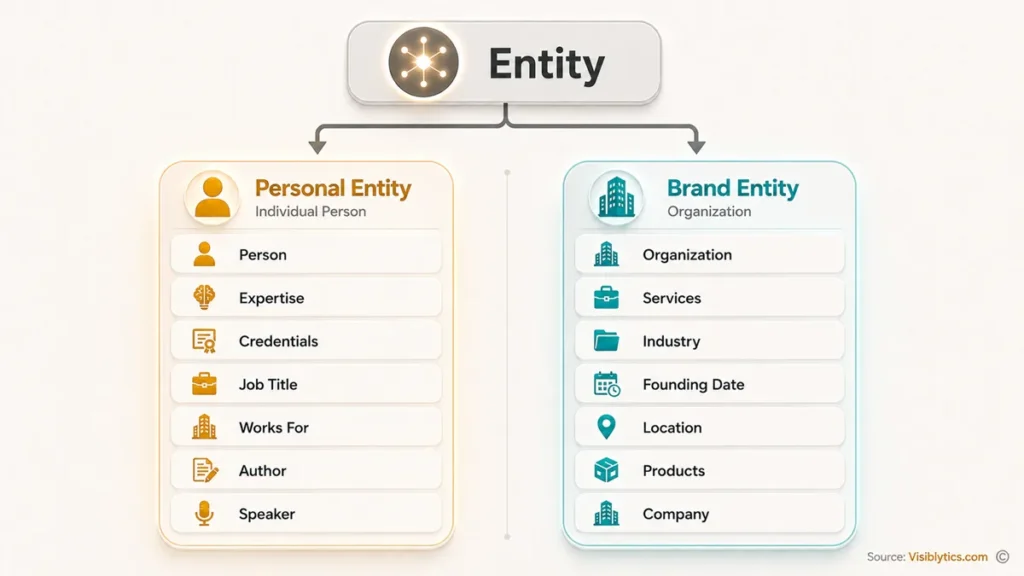
A personal entity is a real individual that search engines and AI systems can identify as a distinct, unique person with associated expertise, credentials, and a body of work. A brand entity is an organization, recognized as its own distinct thing with attributes like founding date, location, and category, regardless of who currently runs it. Both get the same basic entity treatment under the hood, meaning both can have schema, both can accumulate attributes and relationships, and both can be cross-referenced against external sources. What differs is what kind of attributes and relationships actually apply.
A personal entity’s core attributes look like job title, employer, areas of expertise, and credentials. A brand entity’s core attributes look like founding date, industry category, location, and the products or services it offers. The specific schema properties for each entity type are covered in detail in Entity Attributes Explained, so this article won’t repeat that breakdown. What matters for this article is the strategic layer above it: which entity type you’re actually building, and why that choice changes your approach.
Why the Distinction Matters for SEO and AI Visibility
The distinction matters because search engines and AI systems evaluate person entities and organization entities on different criteria, and conflating the two means you end up optimizing for the wrong signals. If you want your name to show up correctly when someone searches it, or when an AI system is asked about you specifically, that requires person-entity signals. If you want your company to be recognized as a stable, credible organization independent of any single employee, that requires brand-entity signals. Neither one substitutes for the other.
This becomes especially visible with disambiguation. A common name with no distinct entity signals will get lost among other people who share it, and an organization with a generic or overlapping name faces the same problem at the company level. The fixes are entity-type specific. Disambiguating a person usually means consistent credentials, a clear professional history, and qualifying context on first mention. Disambiguating a brand usually means consistent category descriptions, a stable founding story, and a clean schema record. They share the same underlying logic but not the same tactics.
It also matters for longevity. A brand entity, once established, tends to be more durable than a personal one. Companies outlast individual roles. If a founder leaves or a key employee moves on, a well-built brand entity keeps its standing, while a personal entity tied to that individual moves with them. This is worth thinking through early, particularly for agencies or consultancies where the founder’s name and the company’s name are closely linked.
Signals That Matter More for Person Entities
Person entities are built through a combination of consistent identity, demonstrated expertise, documented professional relationships, verifiable credentials, and sustained authorship across trusted sources. A person’s authority comes from things like published work under a consistent name, speaking engagements, credentials that can be verified, and a professional history that holds together across platforms. Person schema properties like jobTitle, worksFor, knowsAbout, and hasCredential exist specifically to make these claims machine-readable, and they are covered in full in Entity Attributes Explained.
What makes the biggest difference for person entities specifically is consistency of authorship over time. A single guest post or one well-optimized author bio rarely moves the needle. A name that shows up consistently across a body of work, with a stable professional description and matching credentials on every platform, is what actually builds recognition. This is closely tied to the worksFor and founder relationship types covered separately, since a person’s professional relationships are often the strongest corroborating signal available for who they are.
Person entities are also more sensitive to disambiguation risk than brand entities tend to be, simply because personal names repeat far more often than company names do. A common first and last name combination needs more deliberate qualifying context (job title, employer, location, area of expertise stated clearly on first mention) than most organization names require.
Signals That Matter More for Brand Entities
Brand entities are built primarily through category clarity, consistent organizational attributes, and corroboration across business-specific sources like directories, press, and structured profiles, more than through individual credentials. An organization doesn’t have a professional history or credentials in the way a person does. What it has instead is a category (what kind of business it is), a founding story, a consistent description of what it does, and a presence across the kinds of sources that specifically validate businesses: Google Business Profile, Crunchbase, industry directories, and press coverage relevant to its sector.
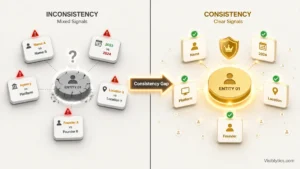
Organization schema properties like foundingDate, @type, location, and sameAs carry more functional weight for brand entities than the equivalent properties do for individuals, mainly because there’s no professional history to lean on instead. If your Organization schema and your external listings disagree on something as basic as founding date or industry category, that inconsistency tends to cost more for a brand entity than a similar inconsistency would cost a person, since the organization has fewer other signals to fall back on. The full guide to maintaining consistent entity signals is at Entity Consistency.
Brand entities generally benefit more from broad, distributed corroboration across multiple trusted sources, whereas person entities often rely more heavily on expertise, authorship, and professional identity. A company showing up consistently across review platforms, partner sites, and trade press builds a kind of cumulative presence that’s harder to fake and harder to lose than any single mention. A person can sometimes build recognition through a handful of strong, well-placed credentials. A brand generally needs broader, more distributed corroboration to reach the same level of trust.
When to Prioritize the Person, the Brand, or Both
You should prioritize the person entity when the business is genuinely built around an individual’s expertise and reputation, like a solo consultant, an author, or a personal-brand-led practice, and prioritize the brand entity when the business needs to function and be trusted independently of any one person, like a multi-employee agency, a product company, or anything intended to scale or eventually change hands. Most founder-led businesses, especially in their early stages, actually need both running in parallel, just with different weight depending on the stage of the business.
A solo consultant whose entire value proposition is “work with me specifically” should weight personal entity work heavily, since the person is the product. A growing agency with multiple team members, even one with a well-known founder, generally needs the brand entity to carry most of the long-term weight, since clients are increasingly trusting the organization rather than any single person within it. It is more useful to treat this as a question of ratio than a binary decision. Early-stage and personality-led businesses skew toward the person. Maturing, team-based, or product-led businesses skew toward the brand.
It’s also worth separating “which one are you building” from “which one are you optimizing for a specific query.” If someone is specifically searching your name, that’s a person-entity query regardless of how big your company has become. If someone is searching for a service category you operate in, that’s a brand-entity query even if your name is well known. Both can and should be developed even when one clearly carries more long-term weight than the other.
Common Business Models
The right ratio between person-entity and brand-entity effort isn’t the same for everyone, and it tracks fairly predictably with business model. Rather than treating this as a vague judgment call, it helps to think in rough percentages.
A freelancer sits at roughly 90% person, 10% brand. The individual is the entire value proposition, and there’s usually no meaningful organization to build separately from them. A consultant sits closer to 70% person, 30% brand. There’s typically still a company wrapper, maybe a website, a registered business name, light schema, but clients are hiring the person, not the firm, so the brand layer stays supporting rather than primary.
An agency flips the weighting to roughly 40% person, 60% brand. The founder’s name may still carry credibility, especially early on, but the business depends on being trusted independently of any single employee, since clients need confidence the work continues even as the team changes. A SaaS or product company goes further still, landing around 20% person, 80% brand. The product and the organization need to stand on their own, and an over-reliance on a founder’s personal entity can actually become a liability if a system reads the company as too dependent on one individual.
These aren’t fixed rules, and a business can shift across categories as it matures, an early-stage consultant who builds a team starts moving from the consultant ratio toward the agency ratio over time. But as a starting point, this gives a much more concrete answer to “where should I put my effort” than treating person and brand as an undifferentiated blend.
How Person and Brand Entities Reinforce Each Other
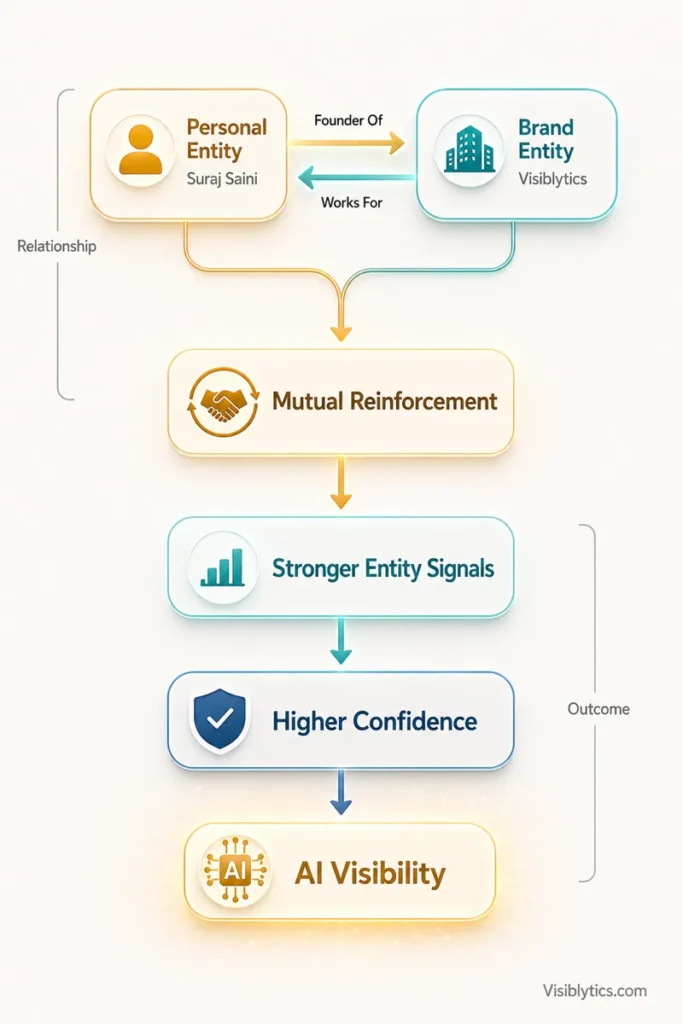
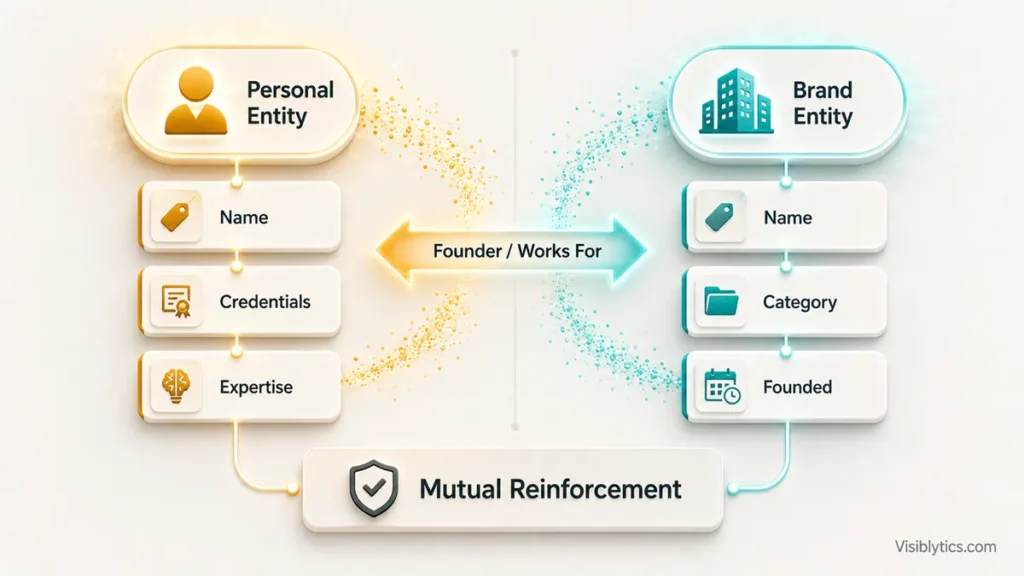
Person entities and brand entities strengthen each other through documented relationships, where a founder’s credibility lends authority to the company and the company’s recognition lends credibility back to the founder, but only when that relationship is made explicit and machine-readable rather than left implied. This works in both directions. A well-established founder gives a new company an immediate credibility boost. A well-established company gives an individual employee or founder a stronger professional identity than they’d have standing alone.
The mechanism for this is largely the founder and worksFor schema properties connecting the two entities directly, alongside consistent mentions of the relationship across both the person’s profiles and the organization’s. If your About page mentions the founder but the founder’s own LinkedIn or personal site doesn’t clearly state the relationship back, that’s a weaker, one-directional signal than having both sides confirm it. The schema mechanics and the three-layer corroboration model behind this kind of relationship signal are covered in Entity Relationships Explained.
This reinforcement effect is also why a poorly maintained personal entity can quietly drag down a brand entity, and the reverse. If a founder’s bio is inconsistent across platforms, or if old, outdated descriptions of the company are still circulating, the contradiction doesn’t stay contained to one entity. It creates ambiguity that affects both records, since search engines and AI systems are actively trying to reconcile the two as connected.
Common Mistakes
Assuming organization entity work covers the founder automatically. A polished company website with no consistent founder profile elsewhere leaves the personal entity essentially unbuilt, even if the brand entity is strong.
Building the personal brand and never connecting it to the company. Consultants with excellent personal recognition can have a company that barely registers as a distinct entity, because the relationship between the two was never made explicit in schema or in consistent cross-mentions.
Using the same schema approach for both entity types. Person and Organization schema have different required properties for good reason. Treating a person like a thinly modified organization, or vice versa, produces incomplete or oddly shaped entity data either way.
Letting the personal entity outlive its usefulness without adjusting strategy. As a business grows past its founder-led stage, continuing to weight personal entity signals as heavily as brand entity signals can actually slow the brand’s ability to stand on its own.
Ignoring disambiguation differences between the two. A common personal name needs different disambiguation handling than a generic-sounding brand name, and applying one approach to both problems tends to under-serve whichever one doesn’t fit it well.
Checklist: Building Both Entity Types Correctly
Person entity
- Person schema present with consistent
name,jobTitle,worksFor, andknowsAbout - Credentials verifiable and consistent across platforms
- Professional history holds together across bio, LinkedIn, and any author profiles
Brand entity
- Organization schema present with consistent
name,foundingDate,@type, andlocation - Category and description match across website, directories, and Google Business Profile
- External corroboration exists from business-specific sources, not just personal mentions
Relationship between the two
founderandworksForproperties connect the two entities explicitly- The relationship is confirmed on both sides, the organization’s site and the individual’s own profiles
- Mentions of the relationship are consistent in wording and dates across sources
Ongoing fit
- Strategy periodically reassessed as the business moves from founder-led to team-led, if applicable
- Disambiguation handling reviewed separately for the person’s name and the brand’s name
❓ Frequently Asked Questions
Do I need both a personal entity and a brand entity?
In most cases, yes, particularly if you’re a founder, consultant, or anyone whose name is closely tied to a business. The exact balance depends on your business model. A solo practice leans more heavily on the personal entity, while a larger or product-led company leans more on the brand entity, but very few businesses can fully ignore one in favor of the other.
Which one should I build first if I’m just starting out?
If you’re a solo founder or consultant, building the personal entity first usually makes sense, since the business has limited independent recognition in its early stages anyway. As the business grows and accumulates its own track record, shift more effort toward the brand entity so it can eventually stand independently. The goal isn’t to choose one forever. It’s to shift the balance as the business matures, allowing the brand to become increasingly independent while maintaining the founder’s professional authority.
Can a strong personal entity hurt my brand entity?
Not inherently, but it can create an imbalance if the brand never develops independent signals of its own. If every piece of trust in the business runs through one person’s name, the brand entity stays underdeveloped, which becomes a real risk if that person ever leaves or the business needs to scale past them.
How does this affect knowledge panels?
Person entities and organization entities follow different paths toward knowledge panel eligibility, since the signals search engines check differ between the two, much like the optimization signals do. That’s a big enough topic to deserve its own dedicated treatment at Personal vs Brand Knowledge Panels.
Does a rebrand affect the personal entity too?
It can, particularly if the founder’s name was closely tied to the previous brand name in public mentions and schema. This kind of cross-entity conflict is one of the more common triggers for entity reconciliation, covered in full in How Entity Reconciliation Works in Search Engines and AI Systems.
Is it possible to have a strong brand entity with an anonymous or low-profile founder?
Yes. Plenty of well-recognized brand entities exist with founders who maintain little to no personal entity presence at all. The brand entity doesn’t require a strong personal entity behind it, it just means the organization needs to carry its own corroboration and attributes without leaning on an individual’s credibility to fill the gap.
What’s the most common sign that someone has confused the two entity types?
The clearest sign is when someone applies Organization schema properties to themselves, or Person schema properties to their company, usually because they’re treating “entity” as one general concept rather than two distinct types with different attributes and different paths to recognition.
Where to Go From Here
If you haven’t yet, it’s worth reading Entity SEO for the broader picture of how entity components work together, and Entity Attributes Explained for the specific schema properties that apply to each entity type. Entity Relationships Explained covers the mechanics of connecting a person entity to a brand entity in detail, which is the part of this article most worth digging deeper into if you’re managing both at once. For the authority layer that applies to both entity types, Entity Authority Signals Explained covers how search engines and AI systems verify and trust entities. And for how these entity signals connect to the broader visibility picture, the AI Visibility guide and Digital Authority guide cover what happens once your entity foundation is in place.