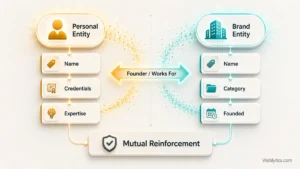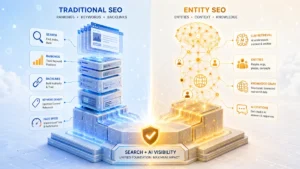
Entity attributes are the properties that define what an entity is, what it does, and how it is distinguished from every other entity in a knowledge graph. They are the factual building blocks that search engines store against your entity record and that AI systems draw on when constructing answers about you. Getting them right, expressing them consistently, and making them machine-readable is one of the most direct things you can do to improve how your brand is understood and represented across search and AI.
What Are Entity Attributes?
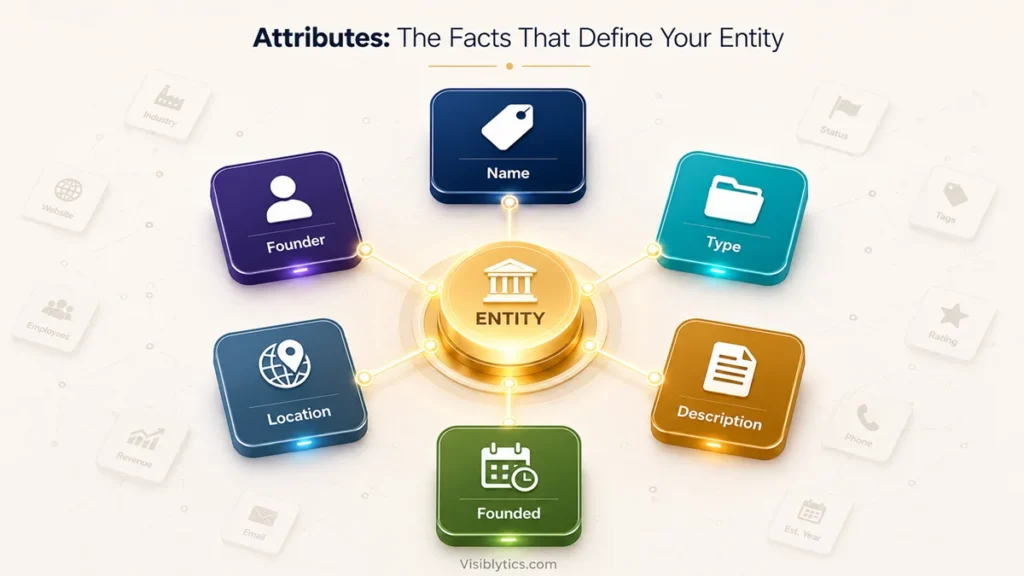
Entity attributes are the specific, factual properties attached to an entity in a knowledge graph. They answer the question: what do we know about this thing?
Every entity type has a different set of relevant attributes. For a person, attributes include name, profession, employer, credentials, and date of birth. For an organization, they include name, industry, founding date, founder, headquarters location, and products or services offered. For a product, they include name, manufacturer, category, release date, and specifications.
Attributes are distinct from relationships. A relationship connects two entities to each other (Suraj Saini founded Visiblytics). An attribute describes a property of a single entity (Visiblytics was founded in 2026). The distinction matters because they are stored differently in knowledge graphs, expressed differently in schema markup, and optimized differently in content. Entity relationships are covered in their own dedicated guide. This article focuses entirely on attributes.
Think of it this way:
Entity: Visiblytics
    ↓ Attributes
Name: Visiblytics
Type: SEO and Search Intelligence Platform
Founded: 2026
Location: India
Focus: AI Visibility, Entity SEO, Technical SEO
Each of those lines is an attribute. Together they form a structured description that a search engine can store, verify, and use to answer questions about your entity without needing to re-read your website every time.
Why Entity Attributes Matter
Entity attributes matter because they are what search engines and AI systems actually store and retrieve about your entity. A search engine does not store a copy of your website in its knowledge graph. It extracts and stores structured facts about the entities it encounters.
When someone searches your brand name, the information that appears in a knowledge panel is drawn from your entity’s attributes as stored in the knowledge graph. When AI systems answer questions about your brand, they rely on a combination of retrieved web content, structured knowledge sources, and previously learned information. Well-defined entity attributes help ensure those systems represent your brand accurately and consistently.
This has two practical consequences.
First, if your attributes are inaccurate or missing from the knowledge graph, your entity will be represented incorrectly or incompletely in search results and AI answers, regardless of how good your website content is.
Second, if your attributes are inconsistent across sources, the knowledge graph reconciliation process has to resolve the conflict before it can store a confident version. Inconsistent attributes directly reduce entity confidence, which affects everything from knowledge panel eligibility to AI citation likelihood. The full mechanics of how that conflict resolution works are in the Entity Reconciliation guide.
The Core Attribute Types
Different schema.org types support different attribute sets. The most relevant for most businesses are Organization attributes and Person attributes. Understanding which attributes matter for your entity type is the starting point for getting them right.
Organization Attributes
These are the attributes that define a business, platform, agency, nonprofit, or other organizational entity.
Name. The exact, official name of the organization as it should be recognized everywhere. Not a tagline or a descriptor. The name. “Visiblytics” not “Visiblytics: AI Visibility Platform.” The name attribute is the single most important attribute because it is the primary identifier used for entity matching across all sources. A name that varies across sources creates a disambiguation problem before any other attribute can be evaluated.
Type/Category. The classification of what kind of organization this is. In schema.org terms this is expressed through the @type property: Organization, LocalBusiness, ProfessionalService, SoftwareApplication, EducationalOrganization, and so on. The more specific your type, the more precisely the search engine can classify your entity. “ProfessionalService” is more informative than “Organization.” Getting your type right is one of the simplest, highest-impact attribute optimizations available.
Founding date. The date the organization was established. This attribute serves two purposes: it helps disambiguate your entity from others with similar names (two companies named “Clarity Agency” founded in different years are distinguishable entities), and it provides a verifiable fact that search engines can cross-reference across sources to build entity confidence.
Description. A concise, factual statement of what the organization does. Not a tagline. Not a value proposition. A description. “Visiblytics is an SEO and search intelligence platform focused on AI Visibility, Entity SEO, and Technical SEO.” Plain, factual, extractable. This attribute is what feeds the description line in a knowledge panel and what AI systems use when summarizing your organization.
Location. The geographic presence of the organization: country, region, and city where relevant. For local businesses, this is a high-priority attribute. For global or remote-first businesses, country-level is typically sufficient.
URL. The canonical URL of the organization’s primary web presence. This is the anchor that connects your knowledge graph entity to your website.
Founder. The person or people who established the organization. This is technically a relationship (it connects the organization entity to a person entity) but it is expressed as an attribute of the organization in schema.org. It is covered here because it is one of the most commonly missing attributes in Organization schema.
Products or services. What the organization offers. In schema terms this is expressed through hasOfferCatalog, makesOffer, or more specific product/service types depending on your business model. This attribute category is what connects your organization entity to the topical areas it operates in.
Person Attributes
These are the attributes that define an individual as a recognized entity.
Full name. The exact name the person uses professionally and consistently. Middle initials, suffixes, and name variations all create disambiguation challenges. The name stated in your Person schema should match exactly what appears in your bylines, your LinkedIn profile, your author bio, and any third-party mentions.
Job title. The current professional role. “SEO Specialist,” “Founder,” “Content Strategist.” This attribute changes over time, which means it requires maintenance. Stale job titles across sources are one of the most common person entity attribute conflicts.
Employer/Organization. The organization the person is currently affiliated with. Expressed as worksFor in schema.org. This creates the bidirectional relationship between the person entity and the organization entity covered in the entity relationships guide.
Area of expertise/Knowledge about. The topics the person is recognized as knowledgeable about. Expressed as knowsAbout in schema.org. This attribute directly supports topical authority signals and is one of the ways AI systems connect a person entity to the subject areas they are credible sources for.
Credentials. Educational qualifications, professional certifications, and formal recognitions. Expressed as hasCredential with a nested EducationalOccupationalCredential type. Named credentials with links to issuing organizations are stronger attribute signals than generic claims of expertise.
Same-as references. Links to verified external profiles where this person entity has a presence: LinkedIn, Twitter/X, Google Scholar where applicable, industry directory profiles. The sameAs property is what tells the knowledge graph that the Suraj Saini on this website and the Suraj Saini on LinkedIn are the same person entity.
How Attributes Are Discovered and Stored
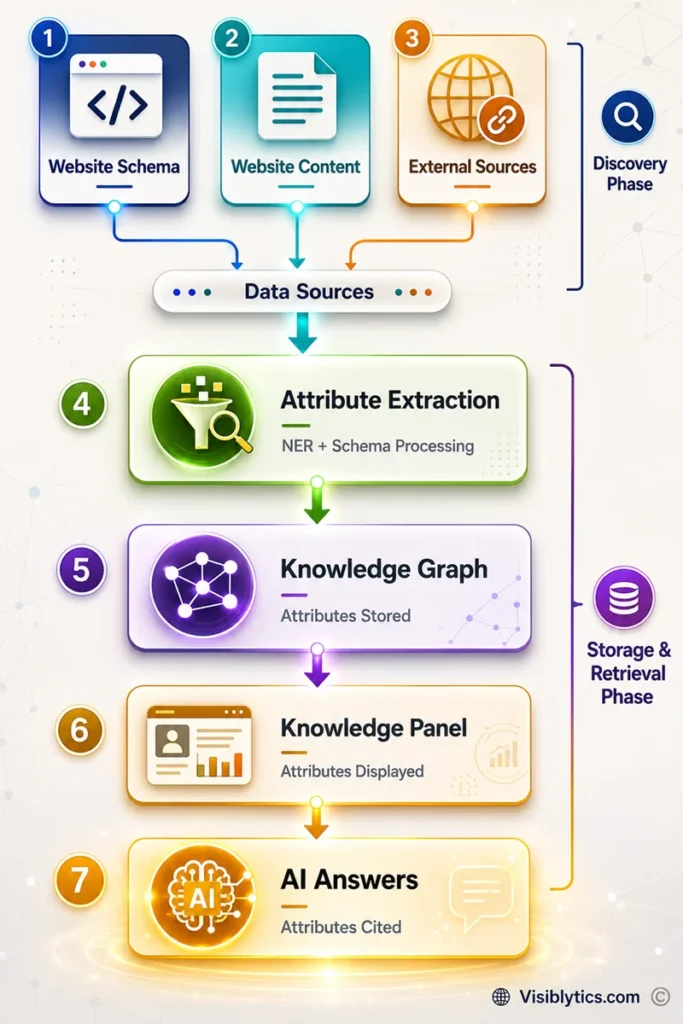
Search engines discover entity attributes through three primary channels, and understanding each one is what makes attribute optimization actionable rather than theoretical.
Channel 1: Structured data on your pages. Schema markup is the most direct, most reliable channel for attribute communication. When your entity homepage includes Organization schema with name, foundingDate, description, founder, and sameAs, you are explicitly telling a search engine what your attributes are in the exact format it is built to process. No inference required. This is why schema is the starting point for attribute optimization, not a finishing touch.
Channel 2: Prose on your pages. Search engines also extract attributes from natural language text. A sentence like “Visiblytics was founded by Suraj Saini in 2026 as an AI Visibility and Entity SEO platform based in India” contains five distinct attributes: organization name, founder name, founding year, category, and location. Named Entity Recognition (NER) identifies these, and they feed into the knowledge graph alongside or in corroboration of schema data. The NER guide covers this extraction process in detail.
Channel 3: External sources. Attributes that appear consistently across multiple independent sources carry significantly more confidence than those that appear only on your own site. A founding date stated in your schema, corroborated by your Wikidata entry, and mentioned in a credible publication is a high-confidence attribute. One that appears only in your schema is a low-confidence attribute that the knowledge graph stores provisionally until corroboration arrives.
This is why the attribute optimization process is not just about what you put on your own site. It is also about ensuring that the most important attributes appear consistently and accurately across every external source that references your entity.
Attribute Salience: Not All Attributes Are Equal
Not every attribute carries the same weight in how a search engine represents your entity. Attribute salience refers to how prominently and frequently an attribute appears in connection with your entity across all the sources the search engine has processed.
A founding date that appears in your schema, your Wikidata entry, two directory listings, and a press mention has high salience. A founding date that appears only in your schema has low salience.
A job title that appears in your schema, your LinkedIn profile, your author bio, and three guest articles has high salience. One that appears only on your About page has low salience.
High-salience attributes are more confidently stored, more consistently surfaced in knowledge panels, and more reliably used by AI systems when constructing answers. Building attribute salience means making sure your most important attributes appear consistently across multiple independent, credible sources, not just your own site.
Entity salience at the content level (how prominently an entity features within a piece of content) is a separate but related concept covered in the Entity Salience guide.
Expressing Attributes in Schema Markup
Schema markup is the most direct way to communicate entity attributes to search engines. Here is how the most important attributes map to specific schema.org properties for an Organization and a Person.
Organization schema with key attributes:
{
  "@context": "https://schema.org",
  "@type": "ProfessionalService",
  "name": "Visiblytics",
  "url": "https://visiblytics.com",
  "logo": "https://visiblytics.com/wp-content/uploads/2026/07/visiblytics-favicon-512.png",
  "description": "Visiblytics is an SEO and search intelligence platform focused on AI Visibility, Entity SEO, and Technical SEO.",
  "foundingDate": "2026",
  "foundingLocation": {
    "@type": "Place",
    "addressCountry": "IN"
  },
  "founder": {
    "@type": "Person",
    "name": "Suraj Saini",
    "url": "https://visiblytics.com/about/suraj-saini/"
  },
  "knowsAbout": [
    "AI Visibility",
    "Entity SEO",
    "Technical SEO",
    "Knowledge Graph Optimization",
    "Generative Engine Optimization (GEO)",
    "Semantic Search Systems",
    "Schema Markup Architecture",
    "Browser-Based Digital Tools",
    "Search Intelligence"
  ],
  "sameAs": [
    "https://www.linkedin.com/company/visiblytics/",
    "https://www.crunchbase.com/organization/visiblytics",
    "https://x.com/Visiblytics"
  ]
}
Person schema with key attributes:
{
  "@context": "https://schema.org",
  "@type": "Person",
  "name": "Suraj Saini",
  "url": "https://visiblytics.com/about/suraj-saini/",
  "jobTitle": "Founder, Lead Search Architect & Web Systems Engineer",
  "worksFor": {
    "@type": "Organization",
    "name": "Visiblytics",
    "url": "https://visiblytics.com"
  },
  "knowsAbout": [
    "Entity SEO",
    "AI Visibility",
    "Generative Engine Optimization (GEO)",
    "LLM SEO",
    "Technical SEO",
    "Knowledge Graph Optimization",
    "Semantic Search Architecture",
    "Structured Data & Schema.org Markup",
    "Web Systems Engineering",
    "Core Web Vitals & Page Speed Optimization",
    "Search Intelligence"
  ],
  "hasCredential": [
    {
      "@type": "EducationalOccupationalCredential",
      "name": "Google Analytics Certification",
      "credentialCategory": "certification"
    },
    {
      "@type": "EducationalOccupationalCredential",
      "name": "Semrush SEO Certification",
      "credentialCategory": "certification"
    }
  ],
  "sameAs": [
    "https://www.linkedin.com/in/suraj-saini-seo",
    "https://www.crunchbase.com/person/suraj-saini-d74e"
  ]
}
Every property used above is a real schema.org property. Use the Schema Markup Generator to build these without writing JSON-LD by hand, and the Structured Data Testing Tool to validate them before publishing.
Attribute Consistency: The Most Common Failure Point
The most common reason entity attributes fail to build knowledge graph confidence is not that they are missing. It is that they are inconsistent across sources.
Here is what inconsistency looks like in practice and what each inconsistency costs:
Name inconsistency. Your schema says “Visiblytics.” Your LinkedIn says “Visiblytics SEO.” Your Wikidata entry says “visiblytics.com.” The search engine now has three versions of your entity name from three separate sources and must run reconciliation before it can store a confident name attribute. Cost: delayed entity recognition, lower confidence score, potential disambiguation problems.
Founding date inconsistency. Your schema says 2026. A press mention from early in the year says 2025 because the site was in development. Your Wikidata entry has no date. Cost: conflicting attribute signals, reduced founding date confidence, harder disambiguation against similarly-named entities.
Job title inconsistency. Your author bio says “SEO Specialist.” Your LinkedIn says “Founder and SEO Consultant.” Your guest article bio says “AI Visibility Expert.” Three descriptions of the same person that share no common phrasing. Cost: lower person entity confidence, weaker professional relationship signals, reduced topical authority attribution.
Description inconsistency. Your About page describes Visiblytics as an “AI Visibility platform.” Your LinkedIn says “SEO agency.” Your Wikidata entry says “search intelligence tool.” Cost: conflicting category signals, confused entity type classification, harder knowledge panel population.
The entity consistency work that prevents these problems is covered in full in the Entity Consistency guide. The resolution process when inconsistencies already exist is covered in the Entity Reconciliation guide.
Attributes and Knowledge Panels
Knowledge panels are built almost entirely from entity attributes. Every piece of information displayed in a knowledge panel, the description, the founding date, the founder name, the location, the website link, the social profile links, maps to a specific attribute in the knowledge graph.
This is why attribute work is the most direct path to knowledge panel accuracy and completeness. A panel that shows the wrong founding date has a conflicting founding date attribute somewhere in the knowledge graph. A panel that shows no description has a missing or low-confidence description attribute. A panel that links to the wrong social profiles has sameAs attributes that point to incorrect or outdated profiles.
The Knowledge Panel guide covers panel eligibility and optimization in full. At the attribute level, the practical rule is: every attribute you want to appear correctly in a knowledge panel needs to be stated accurately in your schema, corroborated in at least one independent source, and consistent across all sources that reference it.
Attributes and AI Citations
When an AI system cites your brand in a generated answer, it is drawing on the attribute data it has access to for your entity. The description it uses, the professional role it attributes to you, the founding date it mentions, the expertise areas it associates with you: all of these come from entity attributes, either from training data, from live retrieval, or from structured knowledge sources like Wikidata.
Poorly defined or inconsistent attributes produce inaccurate AI representations. An AI system that has conflicting category attributes for your brand may describe you as an “SEO agency” in one answer and a “software platform” in another. One that has no knowsAbout attributes for your key person entity may fail to connect that person to their stated area of expertise in a citation.
Well-defined, consistent, high-salience attributes produce accurate, confident AI representations. This is one of the most direct connections between attribute-level entity work and the AI Visibility outcomes covered in the AI Visibility guide.
Common Attribute Mistakes
Using descriptive names instead of the official name. “Visiblytics AI Platform” as the name attribute instead of “Visiblytics.” The name attribute should be the entity’s official name only.
Leaving description as marketing copy. “We help brands unlock their search potential” is a marketing sentence, not a description attribute. “Visiblytics is an SEO and search intelligence platform focused on AI Visibility and Entity SEO” is a description. Factual. Extractable. Neutral.
Missing foundingDate. This is the single most commonly omitted Organization attribute. It requires one field in schema. It directly aids disambiguation. There is no good reason to leave it out.
Generic @type: Organization. Using the base Organization type when a more specific type applies (ProfessionalService, SoftwareApplication, LocalBusiness) misses a free disambiguation signal. Use the most specific applicable type.
No knowsAbout on Person schema. This property directly maps a person entity to the topics they are credible sources for. Omitting it leaves a gap between the person entity and the topical authority signals that AI systems use when deciding whether to cite them.
Outdated attributes not updated after changes. A job title that reflected your role two years ago, a description that predates a pivot, a location that references an old address. Every stale attribute is a signal conflict waiting to create a reconciliation problem.
sameAs pointing to incomplete or inconsistently-named profiles. A sameAs link to a LinkedIn profile where your company is named differently from your entity homepage creates a conflict rather than corroboration. Audit every profile before adding it to sameAs.
Entity Attributes Checklist
Organization attributes:
- Name: exact official name, identical across website, schema, social profiles, and Wikidata
- Type: most specific applicable
@typeused in schema - Description: one to two factual sentences, no marketing language
- foundingDate: year at minimum, full date if available
- foundingLocation: country at minimum
- founder: named with link to person entity page
- knowsAbout: key topic areas listed
- sameAs: all active external profiles linked, all using consistent entity name
- url: canonical URL of primary web presence
Person attributes:
- name: exact professional name, identical across all surfaces
- jobTitle: current role, matches LinkedIn and author bio exactly
- worksFor: current organization with URL
- knowsAbout: primary expertise areas listed
- hasCredential: named certifications with issuing organization
- sameAs: LinkedIn, Twitter/X, and any other active professional profiles
Consistency check:
- Every attribute above matches exactly across entity homepage, schema, Wikidata, and social profiles
- No profile carries a name variation, old job title, or outdated description
- Schema validated error-free using the Structured Data Testing Tool
❓ Frequently Asked Questions
What are entity attributes in SEO?
Entity attributes are the specific, factual properties attached to an entity in a knowledge graph: name, type, founding date, description, location, credentials, and similar facts. They are what search engines store against your entity record and what AI systems draw on when constructing answers about you. Attributes are distinct from relationships, which connect entities to each other rather than describing properties of a single entity.
How are entity attributes different from entity relationships?
Attributes describe properties of a single entity. Relationships connect two entities to each other. “Visiblytics was founded in 2026” is an attribute. “Suraj Saini founded Visiblytics” is a relationship. Both are important for entity SEO, but they are expressed differently in schema markup and optimized through different strategies. The full guide to relationships is at Entity Relationships.
Which entity attributes matter most for knowledge panels?
The attributes most consistently surfaced in knowledge panels are: name, description, founding date, founder (for organizations), job title and employer (for people), location, and sameAs profile links. These are the attributes to prioritize in schema and to ensure are consistent across all external sources. The full knowledge panel framework is covered in the Knowledge Panel guide.
How do I express entity attributes in schema markup?
Use Organization schema for business entities and Person schema for individual entities. The most important properties are name, @type, description, foundingDate, founder, knowsAbout, and sameAs for organizations, and name, jobTitle, worksFor, knowsAbout, hasCredential, and sameAs for people. Every property named in this guide is a real schema.org property. Use the Schema Markup Generator to build your schema and the Structured Data Testing Tool to validate it.
What is attribute salience?
Attribute salience refers to how prominently and frequently an attribute appears in connection with your entity across all sources. A founding date that appears in your schema, your Wikidata entry, and a press mention has high salience and is stored with high confidence. One that appears only in your schema has low salience. Building attribute salience means ensuring your most important attributes appear consistently across multiple independent, credible sources.
Do entity attributes affect AI citations?
Yes directly. AI systems draw on entity attribute data when constructing answers about your brand. The description they use, the expertise areas they associate with you, the founding date they mention: all come from entity attributes in training data, live retrieval, or structured knowledge sources. Well-defined, consistent attributes produce accurate AI representations. Inconsistent or missing attributes produce inaccurate or absent ones.
What happens if my attributes are inconsistent across sources?
Inconsistent attributes trigger the knowledge graph reconciliation process, where the search engine has to resolve the conflict before it can store a confident version of that attribute. During this process, entity confidence is lower, which can affect knowledge panel accuracy and AI citation reliability. The full reconciliation process is explained in the Entity Reconciliation guide. Preventing inconsistencies is covered in the Entity Consistency guide.
Attributes Are the Facts Your Entity Is Built From
Every other aspect of entity SEO depends on attributes being correct. Knowledge graph entries are built from them. Knowledge panels display them. AI systems cite them. Entity reconciliation resolves conflicts between them. Named entity recognition extracts them from your content.
Getting attributes right is not a finishing touch. It is the foundational work that makes every other layer of the Entity SEO framework produce accurate results.
Start with your entity homepage. State every attribute clearly and factually. Implement schema that makes those attributes machine-readable. Then ensure every external source that references your entity reflects the same attributes consistently. That discipline, maintained over time, is what builds the confident, well-defined entity that search engines and AI systems can represent and cite accurately.