
Entity salience is how prominently and centrally an entity features within a piece of content. It determines how confidently a search engine or AI system associates your content with a specific entity, and by extension, how reliably that content contributes to your entity’s authority on a given topic. Writing content that mentions an entity is not the same as writing content where that entity is the clear, unambiguous subject. The difference between the two is salience.
What Is Entity Salience?
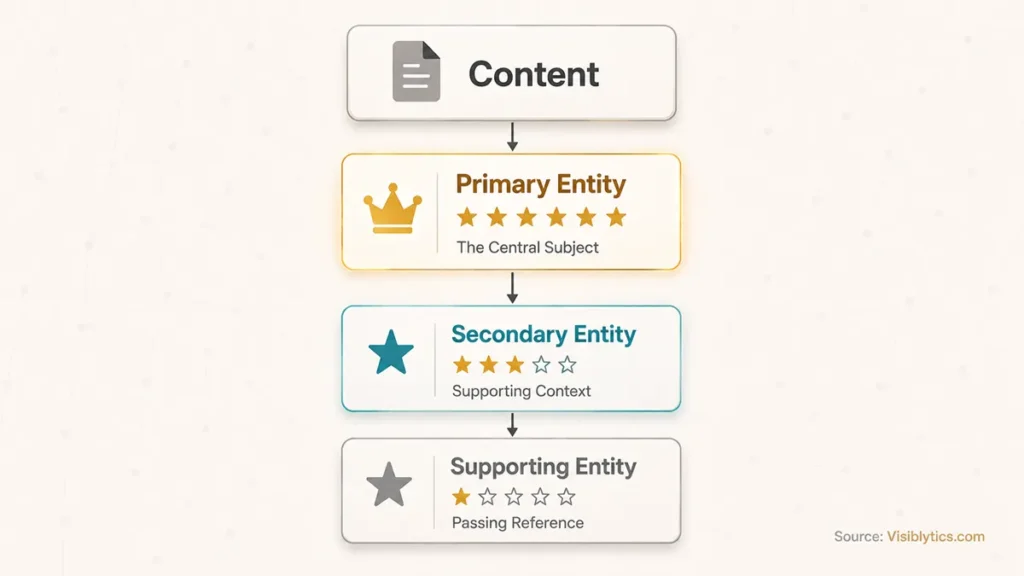
Entity salience is the degree to which an entity is the central, dominant subject of a piece of content rather than a passing reference. A search engine processing your content does not simply identify which entities are mentioned. It assesses how central each entity is to the content as a whole, and uses that assessment to determine how strongly to associate the content with each entity.
An article about Visiblytics that covers its founding, its services, its founder, and its area of expertise has high salience for the Visiblytics entity. An article about the SEO industry that mentions Visiblytics once in a list of tools has low salience for the Visiblytics entity. Both articles mention the entity. Only one strongly associates the content with it.
This matters for two connected reasons. First, high-salience content is more likely to be used as a source when a search engine or AI system needs information about your entity specifically. Second, high-salience content contributes more to your topical authority: it tells the system that this source is genuinely focused on this entity and this subject, not merely referencing it in passing.
Entity salience at the content level is distinct from attribute salience, which measures how frequently an entity attribute appears across multiple external sources. Attribute salience is covered in the Entity Attributes guide. This guide focuses entirely on content-level salience: how to make an entity the clear, dominant subject of a piece of content and why that matters for search and AI visibility.
How Search Engines Measure Entity Salience
Search engines assess entity salience through a combination of signals extracted during content processing. Understanding these signals is what makes salience optimization concrete rather than abstract.
Mention frequency. How many times does the entity appear in the content? An entity mentioned twelve times in a 1,500-word article has higher raw frequency than one mentioned twice. Frequency alone is not sufficient for high salience (repetition without substance is not the same as centrality), but extremely low frequency is a reliable indicator of low salience.
Mention position. Where in the content does the entity appear? An entity named in the title, the first paragraph, and the conclusion is positioned as the central subject. An entity that first appears in paragraph seven is positioned as a supporting reference. Search engines weight early mentions more heavily because position signals intent: a content creator introducing an entity at the start is signaling that this entity is what the content is about.
Heading prominence. Does the entity appear in H1, H2, or H3 tags? Structured markup signals to a search engine which concepts are topically central to the page. An entity named in the H1 is the declared subject of the page. An entity that appears only in body text is a detail within that subject.
Contextual depth. How much of the content is actually about the entity versus merely referencing it? An article that spends 800 words describing Visiblytics’s services, methodology, and founding has deep contextual coverage of that entity. An article that spends 800 words on industry trends and drops Visiblytics’s name once has no meaningful contextual depth for that entity.
Co-occurring entities. Which other entities appear alongside the primary entity? If content about Visiblytics consistently co-occurs with entities like Entity SEO, AI Visibility, Suraj Saini, and Knowledge Graph Optimization, those co-occurrences reinforce the topical associations the search engine builds around the Visiblytics entity. The company the entity keeps in content matters.
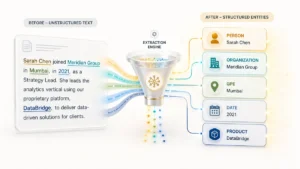
Named Entity Recognition confidence. As covered in the Named Entity Recognition guide, NER systems identify and classify entities in text. High salience content gives NER systems a clear, unambiguous signal: this content is about this entity. Low salience content produces a weaker, more ambiguous NER output that is harder to use confidently for entity association.
Primary Entity Salience vs Secondary Entity Salience
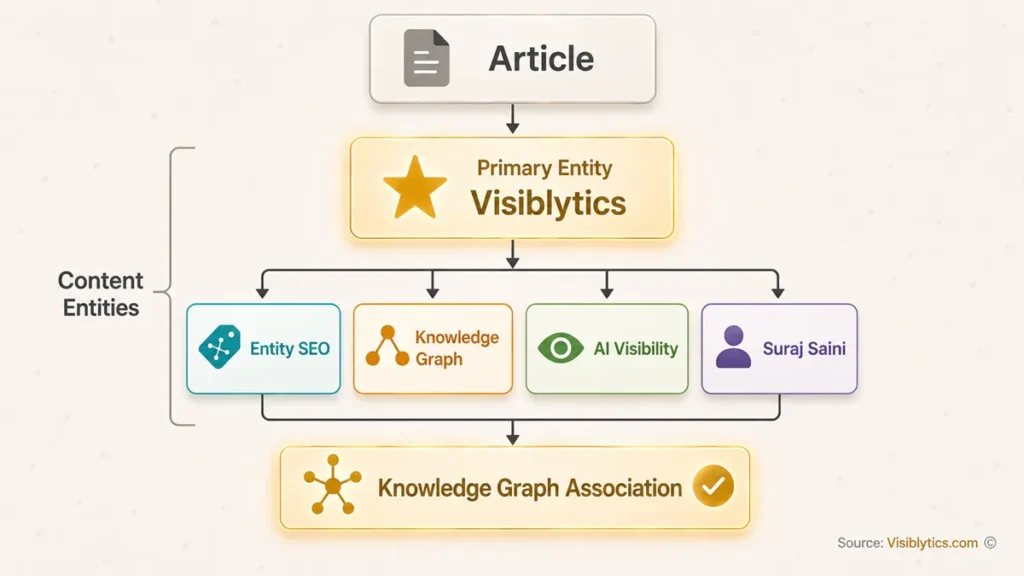
Not every entity in a piece of content has the same salience, and understanding the distinction between primary and secondary salience is essential for writing content that achieves its intended entity association.
Primary entity salience is when an entity is the declared, central subject of the content. The content exists primarily to describe, explain, or inform about that entity. An “About Visiblytics” page, a guide titled “What Is Entity SEO?” where Entity SEO is the primary subject, or a founder profile page where Suraj Saini is the declared subject: these are all examples of primary entity salience.
Primary salience is the strongest entity association signal in content. It is the type of salience that contributes most directly to knowledge graph confidence and to the likelihood that this content will be retrieved and cited when a search engine or AI system needs information about that entity.
Secondary entity salience is when an entity appears in content whose primary subject is something else. A guide to AI Visibility that names ChatGPT, Gemini, and Claude has secondary entity salience for those three entities. A case study about a client that mentions Visiblytics as the agency has secondary entity salience for Visiblytics.
Secondary salience still contributes to entity association, particularly when the co-occurring entities are relevant and the mention is substantive rather than incidental. But it contributes less than primary salience, and a brand that relies only on secondary mentions across other sites without producing high-salience primary content about itself is building a weaker entity signal than one that does both.
The practical implication: your entity homepage, your author pages, and your pillar pages are your primary salience assets. Every piece of content you publish where your entity is the central subject adds to primary salience. Third-party content that mentions you contributes secondary salience. Both matter. Primary salience is the foundation.
Entity Salience and Topical Authority
Entity salience and topical authority are closely connected. Topical authority is the degree to which a search engine or AI system recognizes your entity as a reliable, sustained source of expertise on a specific subject. Salience is one of the mechanisms through which topical authority is built.
When a search engine processes a piece of content about Entity SEO, it identifies the primary entity (the author or publishing organization), the subject entity (Entity SEO as a concept), and the relationship between them (this entity published authoritative content about this topic). High salience content makes that relationship explicit and unambiguous. Low salience content makes it implicit and uncertain.
Topical authority accumulates when a search engine consistently finds high-salience content about a specific topic attributed to a specific entity. Each high-salience piece adds to the association between the publishing entity and the topic. Over time, that association becomes confident enough for the search engine to treat your entity as an authoritative source on that subject.
This is why content clusters are more effective than isolated articles for building topical authority. A cluster of interconnected articles, each with high salience for a specific aspect of Entity SEO, creates a dense, mutually-reinforcing network of entity-topic associations. An isolated article, however well-written, creates a single association that is harder to sustain at high confidence.
The connection between topical clusters and entity authority is also covered in the Entity Authority Signals guide and in the Digital Authority guide.
How to Write High-Salience Content
High entity salience in content is not achieved through keyword repetition. It is achieved through structural clarity and contextual depth. Here is what that looks like in practice.
Declare the entity in the title and opening paragraph. The first place a search engine looks for the primary entity of a piece of content is the title and opening sentences. State the entity clearly and early. An article titled “Entity Salience Explained” with an opening paragraph that immediately identifies entity salience as the subject and defines it has high declared salience from the first line.
Use the entity’s canonical name consistently. Every time you refer to the entity, use its exact canonical name or a clearly established abbreviated form. Referring to Visiblytics as “the platform,” “this tool,” “the company,” and “the service” across 1,500 words dilutes salience because the search engine has to infer that all four references point to the same entity. “Visiblytics” used consistently gives the NER system a clear, repeated, unambiguous signal.
Give the entity substantive contextual coverage. Mention is not coverage. Coverage means dedicating meaningful content to explaining, describing, or analyzing the entity: what it is, what it does, how it works, who is behind it, what it is associated with. The more contextual depth an article provides about an entity, the higher the salience signal that entity receives.
Introduce co-occurring entities that reinforce the association. The entities that appear alongside your primary entity shape its topical context. An article about Visiblytics that also covers Entity SEO, Knowledge Graphs, AI Visibility, and Suraj Saini is building a rich co-occurrence network around the Visiblytics entity. An article about Visiblytics that covers unrelated topics dilutes that network.
Structure headings around the entity and its attributes. H2 and H3 headings that explicitly reference the entity or its core attributes signal structural salience. “How Visiblytics Approaches Entity SEO” as an H2 is a stronger salience signal than “Our Approach” covering the same content.
Avoid pronoun overload. Excessive use of pronouns (“it,” “they,” “this”) without regular entity name repetition reduces NER confidence. A paragraph that refers to Visiblytics exclusively as “it” for six sentences is a weaker salience signal than one that uses “Visiblytics” every two to three sentences. This does not mean mechanical repetition. It means disciplined use of the canonical name throughout.
Link to the entity’s primary pages. Internal links from your content to your entity homepage and your entity’s primary topic pages create structural associations that reinforce content-level salience. A blog article about Entity SEO that links to the Entity SEO pillar page explicitly connects the content to the entity’s authoritative presence on that topic.
Entity Salience Mistakes That Weaken Association
Burying the entity. Spending the first three paragraphs on background context before introducing the primary entity means the first clear entity signal arrives late. Search engines weight early mentions more heavily. Introduce the primary entity in the first sentence or first paragraph.
Over-relying on pronouns. A paragraph where “it” appears six times after one mention of the entity name is ambiguous. NER systems can usually resolve the reference, but ambiguity reduces confidence. Use the canonical name regularly throughout.
Treating all mentions as equal. A heading mention, a first-paragraph mention, and a footnote mention are not equivalent salience signals. Invest in structurally prominent positions for your most important entity references: titles, H2s, opening paragraphs, and conclusions.
Mixing too many primary entities. An article that attempts to be simultaneously about Visiblytics, Entity SEO, Knowledge Graphs, and AI Visibility as equal primary subjects dilutes salience for all four. Pick one primary entity. Let the others appear as supporting context and co-occurrences.
Entity stuffing. Repeating an entity name far beyond what is natural for the content length and subject is not high salience. It is noise. Search engines distinguish between natural, substantive entity coverage and mechanical repetition. Write for contextual depth, not mention count.
Inconsistent naming. Using “Visiblytics,” “visiblytics.com,” “the Visiblytics platform,” and “Visiblytics SEO tool” interchangeably across the same article creates multiple entity candidates for NER to resolve. Canonical name consistency is the simplest, highest-impact salience practice available. The full implications of naming inconsistency are covered in the Entity Consistency guide.
Entity Salience and AI Citation
High entity salience makes it easier for AI retrieval systems to identify content that is primarily about a specific entity, increasing the likelihood that the content is selected when answering entity-focused questions. When an AI system like ChatGPT, Gemini, Claude, or Perplexity retrieves content to inform an answer about a specific entity, it needs to be confident that the content it is retrieving is genuinely about that entity rather than merely referencing it.
A high-salience article about Visiblytics gives a retrieval system a clear, unambiguous signal: this content is a reliable source of information specifically about Visiblytics. A low-salience mention of Visiblytics in a broader industry article gives a weaker signal: this content references Visiblytics but is not primarily about it.
When an AI system is constructing an answer to “what does Visiblytics do?” it is looking for high-salience content where Visiblytics is the primary subject. Content where Visiblytics is a secondary mention is less likely to be selected as the primary source for that specific question, even if the mention is accurate.
This connection between content salience and AI retrieval is part of the broader framework covered in the LLM SEO guide, specifically the section on content extractability and how AI systems select sources for context assembly. The AI Visibility guide covers the full picture of how all these signals combine to determine whether your brand appears in AI-generated answers.
Entity Salience Across Different Content Types
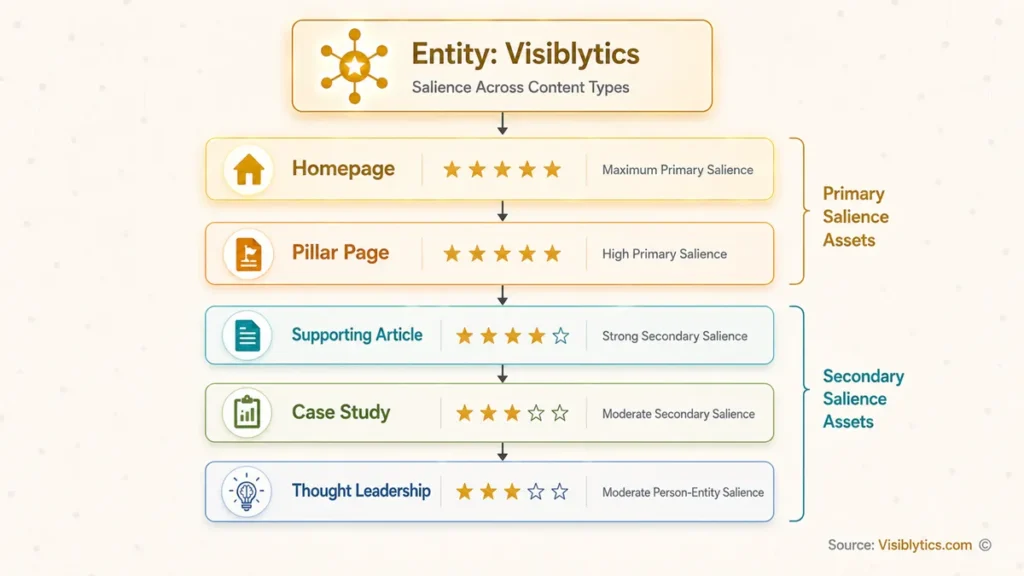
Different content types produce different salience profiles, and understanding which types serve which salience goals is useful for content planning.
Entity homepages and About pages. Maximum primary salience for your organization entity. These pages exist entirely to define and describe your entity. Every element should reinforce who you are, what you do, and what you are associated with. This is covered in depth in the Entity Homepage guide.
Pillar pages and topic guides. High primary salience for a topic entity (Entity SEO, Knowledge Graphs, AI Visibility) with secondary salience for your organization entity as the author. These pages build topical authority by creating a strong association between your organization entity and the topic entity.
Cluster articles. High primary salience for a specific sub-topic entity (entity salience, entity attributes, entity reconciliation) with secondary salience for the parent topic and your organization. Each cluster article adds a specific entity-topic association to your authority network.
Case studies. High primary salience for a client entity and the outcome, with secondary salience for your organization as the agent. Case studies build organizational credibility signals but are not the primary vehicle for topical entity salience.
Thought leadership and opinion pieces. High primary salience for a person entity (the author) and moderate salience for the topic. These build person-entity authority and topical association simultaneously.
Entity Salience Checklist
Before writing:
- Identified the single primary entity this content is about
- Confirmed this content’s salience goal: primary salience for your entity, or secondary salience as a co-occurrence signal
- Canonical name confirmed and will be used consistently throughout
Structure:
- Primary entity named in the title
- Primary entity introduced in the first paragraph
- At least one H2 or H3 references the primary entity or its core attributes
- Primary entity named in the conclusion
Content:
- Canonical name used consistently; pronouns limited after each new section
- Meaningful contextual coverage of the entity, not just mentions
- Co-occurring entities are topically relevant and reinforce the primary association
- No entity stuffing: mention frequency is natural for content length and subject
Technical:
- Article schema implemented with
aboutproperty naming the primary entity - Author attributed to a named person entity with Person schema
- Internal links connect this content to the entity’s primary pages
❓ Frequently Asked Questions
What is entity salience in SEO?
Entity salience is how prominently and centrally an entity features within a piece of content. It is the measure of how confidently a search engine can associate a piece of content with a specific entity based on how central that entity is to the content as a whole. High salience means the entity is the declared, dominant subject. Low salience means the entity is a passing reference within content about something else.
How is entity salience different from keyword density?
Keyword density measures how frequently a specific term appears in content as a percentage of total words. Entity salience measures how centrally and prominently an entity features in content based on position, structural signals, contextual depth, and co-occurring entities. Keyword density is a text-frequency metric. Entity salience is a meaning-centrality metric. High salience is not produced by repeating an entity name frequently. It is produced by making the entity the clear, substantive, structurally prominent subject of the content.
How is entity salience different from attribute salience?
Entity salience (this guide) refers to how prominently an entity features within a piece of content. Attribute salience refers to how frequently and consistently an entity’s properties appear across multiple external sources. Both affect how confidently a knowledge graph stores entity information, but they operate at different levels: entity salience is a content-level signal, attribute salience is a cross-source signal. Attribute salience is covered in the Entity Attributes guide.
Does entity salience affect AI citations?
Yes directly. AI retrieval systems look for content where an entity is the clear, primary subject when constructing answers specifically about that entity. High-salience content is a more reliable retrieval candidate for entity-specific queries than low-salience content that merely references the entity. Writing high-salience content about your entity increases the likelihood that AI systems will select your content as a source when answering questions about your brand.
How do I increase entity salience in existing content?
Audit your existing content for the primary entity of each piece. For articles where the primary entity should be your brand but the entity is buried, undernamed, or replaced with pronouns, update the content to: introduce the entity in the first paragraph, use the canonical name consistently throughout, add the entity to at least one H2 or H3, and deepen the contextual coverage of the entity. Adding Article schema with an about property naming the entity reinforces the association at the structural level.
Can an article have high salience for multiple entities?
An article can have moderate salience for multiple entities, but it is very difficult to sustain high primary salience for more than one entity simultaneously. Content that tries to be equally about two or more primary entities typically achieves medium salience for each rather than high salience for any. The more focused the content on a single primary entity, the stronger the salience signal for that entity. Let additional entities appear as co-occurrences that reinforce context rather than as competing primary subjects.
How does entity salience connect to topical authority?
Topical authority accumulates when a search engine consistently finds high-salience content about a specific topic attributed to a specific entity. Each high-salience piece strengthens the association between your publishing entity and the topic. Over time, that association becomes confident enough for the system to treat your entity as an authoritative source on that subject. A content cluster where each article has high salience for a specific aspect of a topic builds topical authority faster and more durably than isolated articles with diffuse entity focus.
Salience Is What Turns Mentions into Association
Mentioning your entity across the web is not the same as building entity association. A thousand low-salience mentions across unrelated content create a scattered, low-confidence signal. A hundred high-salience pieces of content where your entity is the clear, substantive, structurally prominent subject create a strong, coherent association that search engines and AI systems can use with confidence.
The foundational work that makes high-salience content possible is covered in the Entity SEO guide: defining your entity clearly, establishing its attributes, building its relationships, and maintaining consistency across every surface where it appears. Salience is the content layer that sits on top of that foundation and translates entity clarity into topical authority and AI citation likelihood.