

Entity authority signals are the specific pieces of evidence that tell search engines and AI systems an entity, a person, a brand, a product, or any other “thing” in the real world, is genuine, well defined, and worth trusting. They are different from Domain Authority, which scores a website based on backlinks and link equity. Entity authority works at the level of the entity itself, not the page or the domain it happens to live on. If you have ever wondered why a brand with a thin website still shows up confidently in a knowledge panel or gets cited cleanly by an AI system, entity authority signals are usually the reason.
This article is precise about what it covers before going further, because “authority” gets used loosely in SEO and that looseness causes real confusion. This piece is about the signals that build authority for an entity specifically. It is not about Domain Authority as a metric (there is a dedicated comparison at Digital Authority vs Domain Authority), and it is not about the broader brand-versus-entity authority debate (covered separately at Brand Authority vs Entity Authority). What you will get here is the actual signal set: what builds entity-level trust, how search engines and AI systems read it, and what you can do to strengthen it.
What Are Entity Authority Signals?
Entity authority signals are the consistency, corroboration, and recognition markers that let a system confirm an entity is real, distinct, and credible enough to cite or surface. They are gathered from your own site, from how other sources describe you, and from how often independent sources agree with each other about who you are and what you do. The system isn’t grading your writing quality in isolation here. It’s asking a narrower question: can I trust that this is a real, well understood entity, separate from anything else that shares its name?
This is a meaningfully different question from the one Domain Authority tries to answer. Domain Authority, as a third-party metric, estimates how likely a domain is to rank based largely on its backlink profile. Entity authority doesn’t care what domain you’re on. It cares whether the entity itself, the person, organization, or product, has a coherent, corroborated identity across the web. A brand-new domain can have strong entity authority if the founder has an established public history. A fifteen-year-old domain can have weak entity authority if its entity signals are scattered or inconsistent. A full breakdown of how these two concepts diverge is at Digital Authority vs Domain Authority, since the distinction deserves more room than a section here can give it.
Where Entity Authority Fits Among the Entity Components
If you’ve read the Entity SEO guide, you already know Authority is one of the five core components of entity building, alongside Identification, Attributes, Relationships, and Consistency. That pillar page names the component and explains its place in the bigger picture. This article is the deep dive on that one component specifically. Everything from here on is about what “Authority” actually means in practice and how it gets built.
It’s worth noting this same idea shows up in the Knowledge Panel eligibility framework too, where Authority is one of five dimensions search engines weigh when deciding whether an entity qualifies for a panel. That’s not a coincidence. A knowledge panel is, in part, a visible confirmation that an entity has cleared the authority bar. The signals covered below are largely the same signals feeding both outcomes.
The Core Entity Authority Signal Set
Entity authority is built from six overlapping signal types: corroboration volume, source authority hierarchy, citation pattern, schema and structured data consistency, relationship density, and recognition events. No single one of these does the job alone. Search engines and AI systems weigh them together, and a weakness in one can usually be partially offset by strength in another, though not always.
Corroboration volume is simply how many independent sources describe your entity the same way. If your “About” page says you founded a company in 2019, and Wikidata says 2019, and a press mention from a trade publication also says 2019, that’s three points of agreement. One source claiming something about itself is a statement. Three or more independent sources agreeing is corroboration, and corroboration is what systems actually trust.
Source authority hierarchy matters because not all corroboration counts equally. A mention on a high-trust source like a major news outlet, an academic citation, or a government or institutional database carries more weight than a mention on a low-effort directory listing. Not all corroborating sources contribute equally. In practice, search engines and AI systems appear to place greater confidence in sources that are authoritative, independently maintained, and consistently corroborated by other trusted sources. Rather than treating every mention as equal, they evaluate both the credibility of the source and how well it aligns with other available evidence. Independent knowledge bases sit above that for most general-purpose entities, trusted publications and industry-specific authorities sit near the top, and general directories and low-authority mentions sit at the bottom. None of these are worthless, but they’re not interchangeable either.
Citation pattern is about how an entity gets referenced over time, not just how often. A brand that gets mentioned once in a big launch story and then goes quiet for two years has a different pattern than one that gets steady, smaller mentions across trade press, podcasts, and partner sites month after month. The second pattern reads as an active, ongoing entity. The first reads as a moment, not a presence.
Schema and structured data consistency is the mechanical layer underneath all of this. If your Organization schema lists one founding date and your Person schema for the founder lists a conflicting one, or if your sameAs links point to profiles with different bios, you’re handing the system contradictory data before it even gets to weigh outside corroboration. This is the layer most entirely within your control, and it’s also the one most commonly left half finished.
Relationship density refers to how many of your entity’s relationships (founder, employer, partnership, membership, topical specialization) are documented and machine-readable, not just mentioned in prose. An entity with five well-documented relationships to other recognized entities tends to read as more established than one that exists in isolation, even if the isolated entity has more raw content. This is closely tied to what is covered in Entity Relationships, if you want the schema-level detail.
Recognition events are the things that happen to an entity rather than things the entity says about itself: awards, speaking engagements, press features, inclusion in “best of” or industry lists, and citations by other recognized authorities. These are slower to accumulate than the other signals, but they tend to carry outsized weight because they’re inherently third-party and harder to fabricate.
How Search Engines and AI Systems Measure These Signals
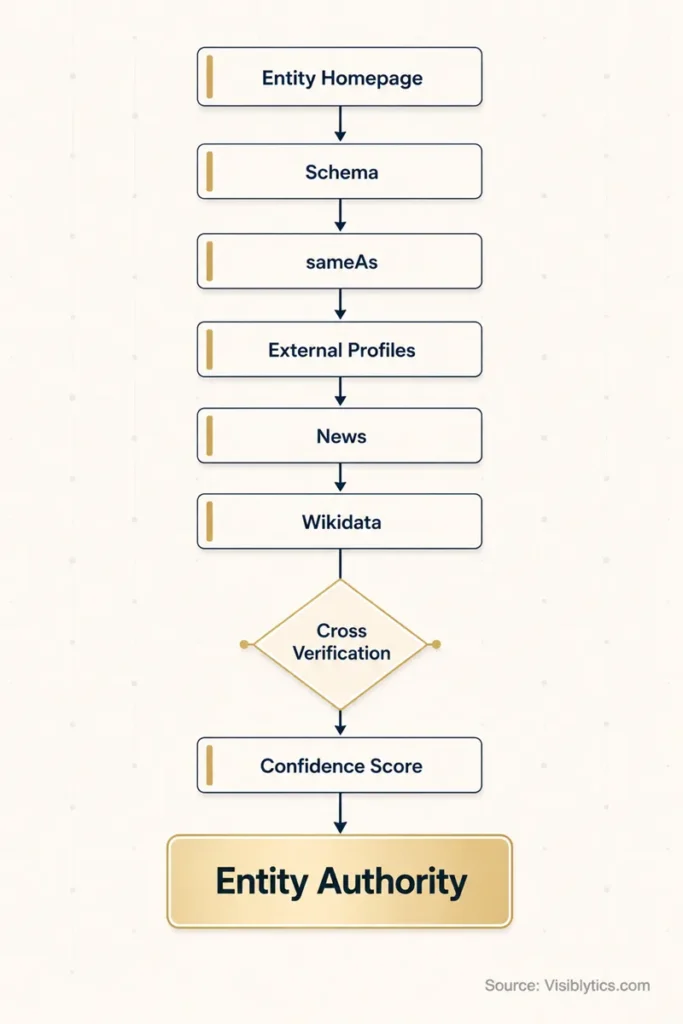
Search engines and AI systems measure entity authority by cross-referencing what an entity claims about itself against what independent sources say, then scoring the degree of agreement and the trust level of the agreeing sources. This is fundamentally a verification process, not a content-quality scan. A well-written page with zero outside corroboration will generally lose to a plainer page backed by consistent, multi-source agreement.
In practice, this happens at two layers. The first is structural: search engines crawl schema markup, sameAs links, and structured profiles to build a baseline record of what an entity claims to be. The second is corroborative: they check that baseline against external mentions, Wikidata entries, news coverage, and other independent sources. Where the two layers agree, confidence goes up. Where they disagree, the system either picks the more authoritative source or treats the entity as ambiguous until the conflict resolves.
Modern AI retrieval systems add another layer to this process. Rather than relying solely on pre-trained knowledge, they can retrieve current information from multiple sources and evaluate those sources before constructing a response. Because many of these systems pull from the live web rather than relying purely on static training data, an entity with strong, current authority signals is more likely to get surfaced and cited correctly in a generated answer. An entity whose authority signals are stale or contradictory is more likely to get skipped, merged with a similarly named entity, or described with outdated information.
Entity Authority vs Brand Authority
Entity authority and brand authority are related but answer different questions: entity authority asks whether a system can verify and trust who you are, while brand authority asks whether your audience perceives you as a leader in your space. The two reinforce each other in practice, since strong audience perception tends to generate the press mentions and citations that feed entity signals, and strong entity signals tend to make brand messaging more consistent and more likely to be repeated accurately. But they’re measured differently and built differently, and the distinction deserves a full comparison of its own at Brand Authority vs Entity Authority.
Building Entity Authority Signals
You build entity authority by auditing what currently exists, fixing the inconsistencies you find, and then systematically increasing corroboration from sources with real standing. This isn’t a one-time project. It’s closer to ongoing maintenance with periodic pushes when something changes, like a rebrand or a new product line.
Start with an audit of your own structured data. Pull up your Organization and Person schema and check that names, founding dates, descriptions, and sameAs links are internally consistent and match what’s on your entity homepage. This is the cheapest fix available and it’s also the one most often skipped, mostly because it’s invisible until something breaks.
Next, audit your external footprint. Search your entity’s name and see what comes back: Wikidata, Wikipedia if applicable, LinkedIn, Crunchbase, industry directories, any press coverage. Note where descriptions conflict, even subtly, and work through fixing them in rough order of source authority. Fix your own entity homepage first, since it’s the anchor everything else gets checked against, then move outward.
After that, focus on growing corroboration deliberately rather than hoping it accumulates. This might mean securing a Wikidata entry if you don’t have one, pursuing press mentions in outlets relevant to your category, contributing guest content to sites with established authority in your space, or simply making sure your team’s individual profiles consistently link back to the organization. None of this needs to happen all at once. Steady, consistent additions tend to outperform a single burst of activity.
Finally, document relationships explicitly wherever they exist. If you’re a founder, make sure founder and worksFor schema properties are in place and consistent across your own site and your profiles elsewhere. If you partner with other recognized entities, make those relationships visible in prose and in markup, not just in passing mentions.
Entity Authority Is Cumulative
No single signal builds entity authority on its own. One press mention is a data point, not a verdict. One podcast appearance, one conference talk, one industry citation, one guest article, one Wikidata edit, each of these is small enough on its own that it would be a mistake to chase any single one expecting a meaningful shift. The system isn’t looking for a standout moment. It’s looking for a pattern.
What actually moves the needle is the accumulation. A press mention by itself tells a system almost nothing definitive. But a press mention, alongside a podcast appearance, alongside a conference credit, alongside an industry citation, alongside a guest article, alongside a clean Wikidata entry, starts to look like something else entirely: a real, active, independently corroborated entity. Each individual signal is weak evidence. Stacked together, they become hard to dismiss.
This is also why entity authority resists shortcuts. There’s no single action that gets an entity “verified” the way a checkmark might suggest. It’s closer to the way credit history works: no one transaction proves trustworthiness, but a long, consistent record of them does. The same logic applies here. A founder who shows up in one trade publication and then disappears for two years has a thinner record than one who appears more modestly but more often, across more independent contexts.
The practical implication is straightforward. Don’t treat any one tactic, a press hit, a podcast booking, a Wikidata fix, as the finish line. Treat it as one entry in a growing ledger. Entity authority isn’t won in a single move. It’s built the way reputations are built anywhere: slowly, through repetition, and through independent sources that keep agreeing with each other over time.
Common Mistakes
Treating schema as the whole job. Structured data tells a system what you claim. It does nothing to corroborate the claim. Sites with immaculate JSON-LD and almost no outside mentions still have weak entity authority, because nothing outside the site agrees with what the site says about itself.
Chasing volume over source quality. Ten low-authority directory listings rarely outweigh one mention from a genuinely trusted source in your category. If you’re choosing where to spend effort, quality of the corroborating source matters more than count.
Letting profiles drift after launch. Entity authority isn’t a setup task. A LinkedIn bio that hasn’t been updated since a rebrand, an old founding date sitting on a directory listing, a sameAs link pointing to a deactivated profile: these small drifts compound over time and start working against you rather than for you.
Confusing brand sentiment with entity authority. A brand can have strong positive sentiment and weak entity authority at the same time, particularly if it’s young or if its public mentions are inconsistent about basic facts. Sentiment is about how people feel. Entity authority is about whether systems can verify who you are.
Building relationships in prose only. Saying “the founder also advises at X” in a blog post is a start, but if that relationship never makes it into schema or into a corroborating mention on X’s own site, it’s doing very little for entity authority. Relationships that only exist in narrative form are much weaker than relationships that show up in structured, cross-referenced data.
Checklist: Strengthening Entity Authority Signals
Internal consistency
- Organization and Person schema match across founding date, name, and description
sameAslinks are current and point to active, accurate profiles- Entity homepage content matches schema claims exactly
External corroboration
- Wikidata entry exists and is accurate, if applicable to your entity type
- At least three independent sources agree on core facts (name, founding date, what you do)
- Recent press or industry mentions exist, not just historical ones
Relationship documentation
- Founder, employer, and partnership relationships are present in schema, not just prose
- Relationships are corroborated from both sides where possible (your site and theirs)
Ongoing maintenance
- A recurring check (quarterly is reasonable) for profile drift across major external sources
- A process for updating entity data immediately after any rebrand, leadership change, or major pivot
❓ Frequently Asked Questions
What is the difference between entity authority and Domain Authority?
Domain Authority is a third-party metric estimating how likely a website is to rank, based mostly on backlink profile. Entity authority measures how well a search engine or AI system can verify and trust a specific entity, independent of which domain that entity happens to be associated with. A new domain can carry strong entity authority if the entity behind it already has an established, corroborated identity elsewhere.
Can a small business build entity authority without a Knowledge Panel?
Yes. A knowledge panel is one visible outcome of strong entity authority, not a requirement for building it. Consistent schema, accurate external profiles, and growing third-party corroboration all strengthen entity authority whether or not a panel ever appears, and that strength still helps with AI citation and search visibility on its own.
Does entity authority replace the need for backlinks?
No. Backlinks remain relevant for traditional ranking signals and for Domain Authority specifically. Entity authority works alongside that, not instead of it. A strong backlink profile and strong entity authority address different parts of how a brand gets evaluated, and most established entities end up needing both.
How long does it take to build meaningful entity authority?
There’s no fixed timeline, since it depends heavily on how much corroboration already exists and how active your category is in press and industry coverage. Fixing internal schema inconsistencies can happen in days. Building genuine third-party corroboration from authoritative sources is typically a matter of months, sometimes longer for entities with no prior public footprint.
Is entity authority more important for AI search than for traditional search?
It plays a role in both, but the cost of weak entity authority shows up more visibly in AI-generated answers, since those systems often need to make a confident choice about which entity to cite or describe. Traditional search can still surface a page even with moderate entity ambiguity. AI systems are more likely to skip an entity entirely or describe it inaccurately if the signals are inconsistent.
Do I need a Wikipedia page to have strong entity authority?
No, though it can help significantly for entities that qualify for one. Many strong entities, particularly smaller businesses and individual professionals, build solid entity authority through Wikidata, consistent external profiles, and genuine industry recognition without ever having a Wikipedia page. Wikipedia carries real weight in the source hierarchy, but it isn’t the only path.
What’s the single highest-leverage fix for weak entity authority?
For most organisations, the highest-leverage improvement is creating a single, authoritative entity homepage and ensuring every structured data property, profile, and external mention consistently reinforces it. Once that foundation is stable, focus on earning independent corroboration from trusted sources.
Where to Go From Here
Entity authority signals are one piece of a larger picture. If you haven’t already, it’s worth reading the Entity SEO pillar guide to see how Authority fits alongside the other four entity components, and the Digital Authority guide for the broader trust and recognition framework this connects to. Dedicated comparisons on Digital Authority vs Domain Authority and Brand Authority vs Entity Authority dig into distinctions this article only had room to touch on briefly.