
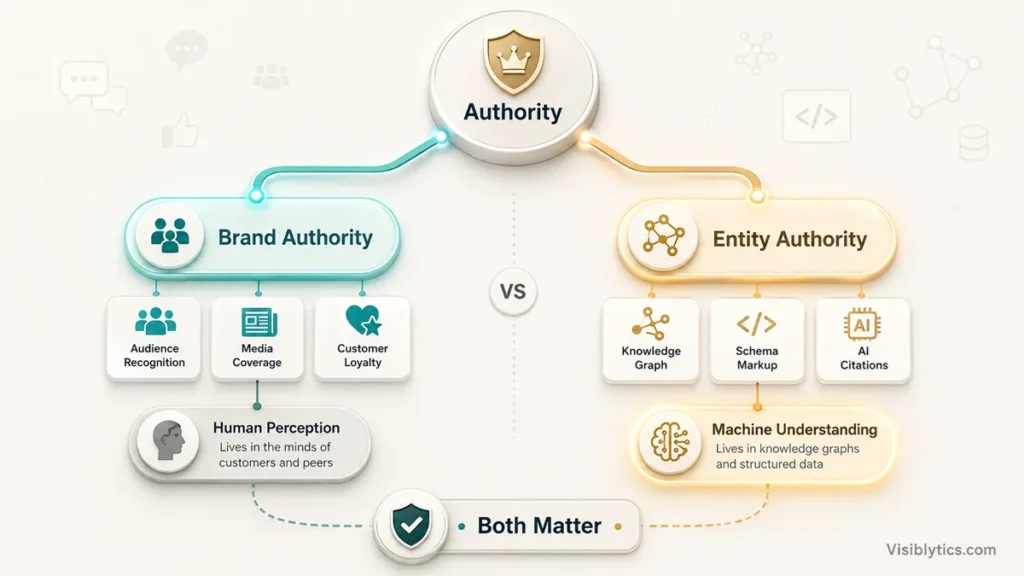
Brand authority and entity authority are related but they answer different questions. Brand authority asks whether your audience perceives you as a credible, recognized leader in your space. Entity authority asks whether search engines and AI systems can verify and trust your entity based on structured, corroborated signals. One lives primarily in human perception. The other lives primarily in machine understanding. Both matter, but they are built differently, measured differently, and produce different outcomes when they are strong or weak.
The practical reason to understand the distinction is that many brands invest heavily in one while neglecting the other, then are surprised when their search and AI visibility does not match their market reputation, or when their AI citations are thin despite being a recognized name in their industry.
What Is Brand Authority?
Brand authority is the degree to which an audience perceives your brand as credible, trustworthy, and influential within a specific market or topic area. It is a human perception metric. It lives in the minds of customers, peers, journalists, and competitors. It is built through consistent presence, quality output, marketing investment, community engagement, and the kind of reputation that accumulates when a brand repeatedly delivers on its promises.
Brand authority is expressed through signals like:
- Unaided brand recall. When someone thinks of a topic or category, does your brand come to mind without prompting?
- Share of voice. What proportion of the conversation in your space involves or references your brand?
- Media coverage. Are journalists and publications covering your brand because it is newsworthy and recognized?
- Community standing. Do peers and competitors reference your brand as a benchmark or point of comparison?
- Customer loyalty and advocacy. Do existing customers recommend your brand unprompted?
- Price premium tolerance. Will customers pay more for your brand than for an equivalent alternative?
Brand authority is traditionally measured through brand surveys, Net Promoter Scores, share of voice tracking, social listening, and competitive analysis. It is a marketing discipline with its own established methodology. Moz, Ahrefs, and Semrush do not produce a brand authority score. Agencies and researchers measure it through qualitative and quantitative brand research.
High brand authority is genuinely valuable. It drives customer acquisition, reduces marketing resistance, supports pricing power, and attracts talent and partnerships. But it is not the same as entity authority, and in the context of search and AI visibility, it does not automatically produce the same outcomes.
What Is Entity Authority?
Entity authority is the degree to which search engines and AI systems can verify your entity as real, correctly identified, and trustworthy based on structured, corroborated signals. It is a machine understanding metric. It lives in knowledge graphs, schema markup, structured external sources, and the pattern of how independent sources describe and reference your entity.
Entity authority is expressed through signals like:
- Entity clarity. Is your entity clearly defined, consistently named, and unambiguously identified across all sources?
- Schema markup. Is your entity’s machine-readable identity structured correctly and consistently?
- Knowledge graph presence. Is your entity represented in Wikidata and other structured knowledge sources?
- External corroboration. Do independent, credible sources verify your entity’s key attributes and relationships?
- Named authorship. Is the content your entity produces attributed to verifiable people with established credentials?
- Knowledge panel presence. Has a search engine built enough confidence in your entity to display a panel for branded searches?
Entity authority is assessed through entity SEO audits, schema validation, knowledge graph checks, and AI citation analysis. The full signal set is covered in the Entity Authority Signals guide. The components that build it are covered in the Entity SEO guide.
The key distinction from brand authority: entity authority does not care whether humans perceive you as credible. It cares whether machines can verify that you are who you claim to be. A brand can have strong human perception and weak machine verification. That gap is increasingly costly as AI systems handle more of how people find information.
The Full Comparison
| Dimension | Brand Authority | Entity Authority |
|---|---|---|
| Primary audience | Humans (customers, peers, media) | Machines (search engines, AI systems) |
| What it measures | Perceived credibility and recognition | Verified machine understanding and trust |
| Built through | Marketing, PR, community, consistent delivery | Schema, entity pages, corroboration, knowledge graphs |
| Measured by | Brand surveys, NPS, share of voice | Entity audits, schema checks, AI citation analysis |
| Lives in | Human perception and memory | Knowledge graphs and structured data |
| Affected by | Marketing investment, brand consistency, product quality | Entity clarity, named authorship, external corroboration |
| Outcome when strong | Customer loyalty, media coverage, pricing power | AI citations, knowledge panels, entity recognition |
| Can it be strong without the other? | Yes | Yes |
| Time to build | Months to years | Months to years |
| How it degrades | Through inconsistent brand experience, bad press | Through inconsistent entity signals, stale schema |
The most important row is “Can it be strong without the other?” The answer is yes in both directions, and understanding how that happens is the most practically useful part of this article.
When Brand Authority Is High but Entity Authority Is Low
This is more common than most brands expect, and it is the pattern that produces the most frustrating AI visibility outcomes.
The scenario: A consultancy has been operating for eight years. They are well-known in their industry. Conference organizers invite their founder to speak. Peers reference their work. Their clients are loyal. By any marketing measure, their brand authority is strong.
But their website has no Organization schema. Their About page is marketing copy with no founding date, no named founders with linked profiles, and no sameAs references to external platforms. Their founder has no author page. Their LinkedIn company profile uses a slightly different version of their company name than their website. They have no Wikidata entry. Their directory listings have outdated information from five years ago.
When someone asks an AI system “who are the leading consultancies in [their topic area]?” the system has strong signals from their marketing-generated mentions, but it cannot verify the entity clearly, cannot attribute the content to a named expert entity, and cannot corroborate the basic facts about the organization from independent structured sources. The AI system may mention them vaguely or not at all, while less well-known competitors with better entity foundations get cited by name.
The brand has human recognition without machine verifiability. That gap is the entity authority deficit.
Why this happens: Brand authority building programs (PR, advertising, social media, event marketing) do not naturally produce entity authority signals. A press mention that uses your brand name but no founding date, no founder name, and no category description is a brand signal but a weak entity corroboration signal. A speaking engagement generates audience recognition but leaves no structured data. Years of excellent marketing can produce strong brand authority with almost no entity authority work done alongside it.
When Entity Authority Is High but Brand Authority Is Low
This scenario is less common but worth understanding, particularly for newer brands and solo practitioners who have done careful entity SEO work from the beginning.
The scenario: A freelance researcher launches a personal brand site. She spends her first three months building a complete entity foundation: a well-structured personal About page with Person schema, a Wikidata entry, consistent profiles across all professional platforms, named authorship on all published content, and a series of original research posts that several credible sites have cited. She has a knowledge panel for her name. AI systems cite her correctly in answers about her research area.
But she has no broad audience recognition. Most people in her field have not heard of her. She has no brand awareness beyond the niche of people who encountered her research. Her “brand authority” by the marketing definition is low.
She has entity authority without broad brand authority. The outcome is that she performs well in AI citations and entity-aware search results for queries in her niche, but she does not have the broader market recognition that would come from brand investment.
How They Reinforce Each Other
Despite being built through different activities and measured differently, brand authority and entity authority have genuine overlapping effects that make building both together more effective than building either alone.
Brand authority generates corroboration for entity authority. When a brand with strong human recognition earns press coverage, those press mentions provide the external corroboration that entity authority systems weight. A brand mentioned by a credible publication generates both a brand signal (more people know about you) and an entity signal (an independent source verifies your existence and attributes).
Entity authority makes brand messaging more consistent. A brand with strong entity authority has consistent, machine-readable descriptions of who it is and what it does. That consistency, enforced through entity maintenance across all platforms, also produces more consistent brand messaging because the attributes that define the entity are the same ones that define the brand.
Named authorship bridges both. An expert author with strong entity authority (Person schema, Wikidata, consistent credentials) who also has brand recognition (featured in major publications, invited to speak, widely followed) is producing signals that feed both systems simultaneously. Each publication appearance is a brand authority signal and an entity corroboration signal.
AI citations reinforce brand authority. When AI systems cite your brand accurately and frequently in answers relevant to your area of expertise, those citations generate brand exposure to audiences who were not previously aware of you. Strong entity authority produces AI citations that in turn build brand awareness.
How They Diverge
The reinforcing effects are real, but so are the divergences. Understanding where they pull in different directions is what prevents the confusion that leads brands to invest in one while expecting it to produce the other.
Brand investment does not automatically produce entity signals. Running an advertising campaign, sponsoring an event, or investing in social media growth produces brand awareness without producing schema markup, Wikidata entries, or named authorship attributions. These are different activities with different outputs.
Entity work does not directly build audience recognition. Implementing Organization schema, creating a Wikidata entry, and building consistent profiles across platforms is valuable entity work that produces zero brand awareness. The people who benefit from your brand need to encounter it in human-readable contexts, not through structured data.
Brand perception can contradict entity signals. A brand that is perceived by its audience as an AI-focused company but has no topical content, no named authorship on AI topics, and no external corroboration of AI expertise in structured sources will have high brand authority for that perception and low entity authority for it. The audience believes one thing; the machines have verified something different.
Famous brands can have weak AI citation performance. This is counterintuitive but real. A large, well-known brand with extensive marketing investment can have weaker AI citation performance than a smaller, less-known competitor if the large brand has poor entity clarity, anonymous content, inconsistent attributes across sources, and no structured knowledge presence. The AI system does not know or care about marketing spend or brand recall surveys.
What AI Systems See
This is where the distinction between brand authority and entity authority has the most direct practical consequence.
When an AI system like ChatGPT, Gemini, Claude, or Perplexity constructs an answer and decides which sources to cite, it does not run a brand perception survey. It does not ask whether the source is well-known in its industry. It evaluates structured signals: is this entity clearly defined, is this content attributed to a verifiable expert, is this source corroborated by independent credible references, does this entity’s stated expertise match what structured knowledge sources say about it?
Brand authority is not directly visible to an AI citation system. What is visible is the evidence that brand authority has generated: press mentions that name the entity clearly, publications that cite the entity’s research, industry references that attribute expertise to the entity. These are the outputs of brand authority that translate into entity corroboration signals.
This is why high-brand-authority organizations that have not done entity work often discover that their AI citation performance does not match their market standing. Their brand authority exists in a form that AI systems cannot easily read. The entity work is what translates brand reputation into machine-readable authority.
Building Both Together
The most efficient approach is to run brand authority and entity authority programs in parallel, designed to reinforce each other rather than operate in separate silos.
When pursuing PR and media coverage, brief journalists with correct, specific entity information: official company name, founding date, founder name and credentials, category description. A press mention that includes these details is both a brand signal and an entity corroboration signal. One that uses only the brand name produces half the value.
When publishing original research, ensure it is attributed to a named author with full Person schema, a Wikidata entry, and consistent credentials across all platforms. Original research that generates brand recognition also generates entity corroboration when it is attributed to a verifiable expert entity.
When building social profiles and community presence, use exactly the same entity name, description, and category across every platform. Brand consistency and entity consistency are the same discipline at this level.
When producing content for brand awareness, ensure every piece has named authorship, Article schema, and a direct link to the author’s entity page. Content that builds audience awareness also builds entity signals when it is structured correctly.
When measuring success, track both types of signals separately. Brand authority metrics: share of voice, media mentions, brand recall surveys where relevant, community standing. Entity authority metrics: knowledge panel presence, Wikidata representation, AI citation frequency and accuracy, named authorship attribution in third-party references.
Common Mistakes
Assuming brand recognition produces entity signals automatically. Being well-known in a market produces human awareness. It does not produce schema markup, Wikidata entries, or named authorship attributions. The entity work has to be done explicitly alongside brand building.
Assuming entity work produces brand awareness. Implementing Person schema and creating a Wikidata entry does nothing for audience recognition. The brand awareness programs (content marketing, PR, events, community) are separate activities with separate outcomes.
Measuring entity authority with brand metrics. Share of voice, social following, and brand recall surveys do not measure entity authority. Using them as proxies leads to a false sense of entity strength.
Neglecting entity work because the brand is already well-known. Large, well-recognized brands are among the most common cases of strong brand authority paired with weak entity authority, precisely because their marketing programs have been running for years while entity SEO was not a priority. The gap between their market recognition and their AI citation performance is often the clearest signal that entity work is overdue.
Running PR programs without entity briefing. Press mentions that do not include the founding date, founder name, or specific category description are weaker entity signals than they could be. A simple entity briefing document, shared with journalists as background, produces better entity corroboration from the same PR activity.
❓ Frequently Asked Questions
What is the main difference between brand authority and entity authority?
Brand authority is perceived credibility in the minds of humans, including customers, peers, and media. Entity authority is verified trustworthiness in the understanding of machines, including search engines and AI systems. Brand authority lives in human memory and perception. Entity authority lives in knowledge graphs, schema markup, and structured external sources. Both are valuable but they are built through different activities and produce different outcomes.
Can a brand have high brand authority and low entity authority?
Yes, and this is common. A brand that has invested heavily in marketing, PR, and community building for years but has not done entity SEO work (no schema, no entity pages, inconsistent external representation, anonymous content) often has strong human recognition and weak machine verifiability. The practical consequence is AI citation performance that does not match the brand’s market standing.
Can a brand have high entity authority and low brand authority?
Yes. A newer brand or individual practitioner who has built a careful entity foundation (complete schema, Wikidata entry, consistent named authorship, original research with external citations) can have strong AI citation performance and knowledge panel presence without broad audience recognition. Entity authority is achievable without widespread brand awareness, particularly in niche topic areas.
Does brand authority help AI citations?
Indirectly. Brand authority itself is not readable by AI citation systems. What is readable are the outputs that brand authority sometimes generates: press mentions that name the entity clearly, publication citations that attribute expertise, industry references that verify credibility. Strong brand authority that has generated these outputs produces entity corroboration signals. Brand authority that exists only in audience perception without generating structured external evidence does not directly help AI citations.
How do I build both at the same time?
The most efficient approach is to design activities that produce both types of signals simultaneously. PR briefed with specific entity information produces brand mentions that also corroborate entity attributes. Original research attributed to a named author entity builds both audience recognition and entity corroboration. Content with Article schema and named authorship builds brand awareness and entity signals together. The key is ensuring that brand-building activities are structured to leave entity signals behind, not just audience impressions.
Which should I prioritize?
That depends on your current gaps. If your brand is well-known but your AI citation performance does not match your reputation, your entity authority is the gap to close. If your entity foundation is strong but you have limited audience recognition, brand authority investment is the more pressing need. For most brands starting from scratch, building both simultaneously from the beginning is more efficient than doing one first and retrofitting the other later.
Two Systems, One Strategy
Brand authority and entity authority are two different systems of trust operating in parallel: one built for human perception, one built for machine understanding. The brands that perform best in search and AI visibility are the ones that recognize the difference and build explicitly for both.
Neither system alone is sufficient. A well-recognized brand that machines cannot verify accurately will underperform in AI citations regardless of its marketing investment. A machine-verifiable entity with no human recognition will struggle to generate the external mentions and citations that raise its entity authority over time.
The practical goal is not to choose between them. It is to design programs that build each deliberately and to structure brand-building activities so they leave machine-readable evidence behind, not just audience impressions.
For the full framework of entity-level authority signals, the Entity Authority Signals guide covers the complete signal set. For the broader Digital Authority framework that connects entity signals to trust and visibility outcomes, the Digital Authority guide covers the complete picture.