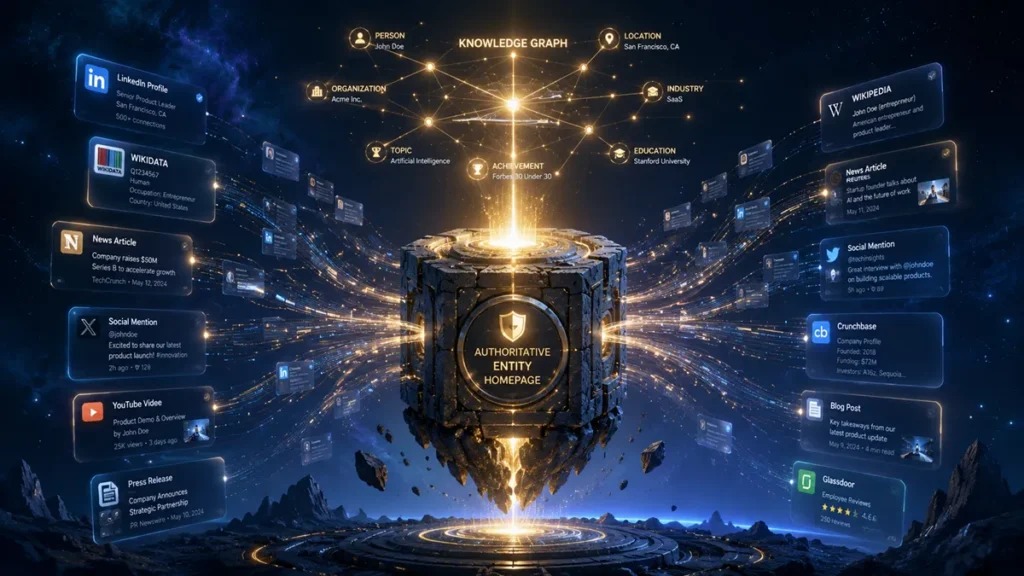
An entity homepage is the single page on your website that Google and other AI systems treat as the authoritative source of factual information about your entity. It is the page where your entity “lives” online. When a search engine or AI system needs to verify who you are, what you do, and how you connect to other entities, this is the page it comes back to first.
I think of it as a source of record. Every fact your entity asserts elsewhere on the web gets reconciled against this one page. The process of how search engines resolve conflicting signals about an entity is covered in depth in the Entity Reconciliation guide. If there are conflicts between what your social profiles say and what your entity homepage says, the entity homepage should serve as the primary source of record that search engines reconcile against alongside other trusted sources. That is exactly why getting it right matters so much.
Entity Homepage: The primary page that acts as the canonical source of information about an entity for search engines and AI systems.
Why Entity Homepages Matter
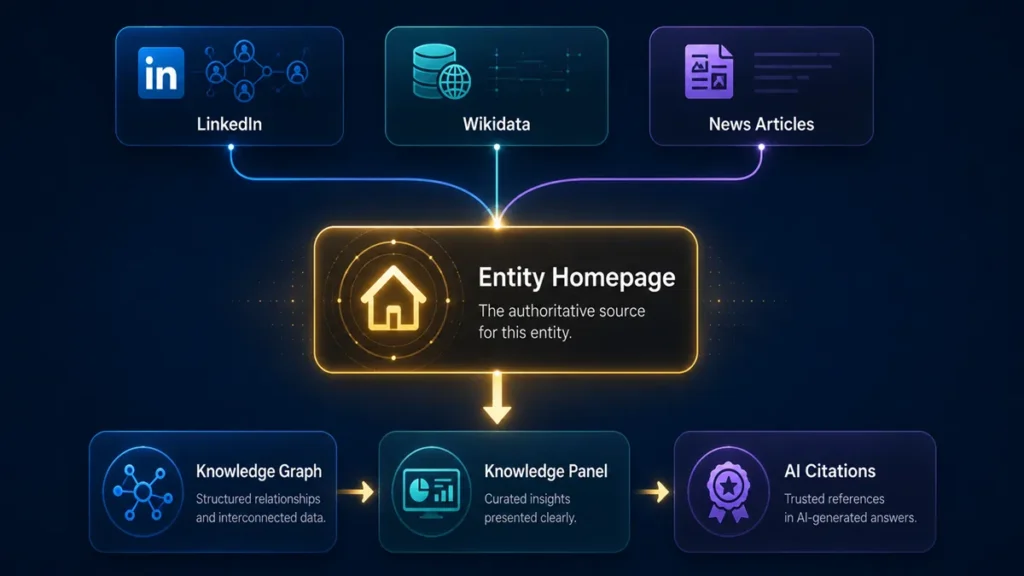
Search engines and AI systems cannot cite sources they cannot identify. The entity homepage solves the identification problem. It gives Google a single, stable reference point for everything it learns about your entity from other sources across the web.
The process is sometimes called reconciliation. When Google finds your brand mentioned on LinkedIn, in a news article, or in a Wikidata entry, it compares that information to your entity homepage to decide what is true. The more clearly and consistently your entity homepage states the facts, the easier that reconciliation process becomes. And the easier it is, the more confidently Google can represent you in search results, Knowledge Panels, and AI-generated answers.
This is not theoretical. I have seen websites with strong backlink profiles and good content get consistently overlooked in AI citations simply because there was no clear entity homepage for the AI to anchor its understanding to. The entity work and the content work are two different things, and most brands only do the content work.
Entity Homepage vs. Homepage
These two things are often confused. Your website homepage and your entity homepage are not necessarily the same page, even though they often end up being the same one.
Your website homepage is designed for visitors. It sells, it introduces, it promotes. It answers the question “why should I care about this brand?” It might mention your services, your headline offer, a testimonial, a newsletter signup. That is marketing content, and it should be there.
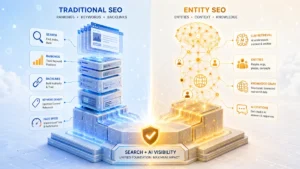
Your entity homepage is designed for machines. It answers a completely different question: “what is this entity, exactly?” It is factual, structured, consistent, and machine-readable. It does not sell. It describes.
The page that works best as an entity homepage is usually the About page, not the main homepage. Here is why. Your main homepage communicates multiple things at once: who you are, what you offer, why you are different, where to go next. For a machine trying to extract a clean, unambiguous entity definition, that is a lot of noise. An About page focused entirely on the entity (the organization, the person, the brand) is a much cleaner signal.
That said, Google often defaults to the homepage as the entity home for established sites, especially when the homepage has been indexed and linked to for years. If that is where Google has already anchored your entity, it is genuinely difficult to move it. The practical advice: if you are building from scratch, build your About page to function as the entity homepage from day one. If Google has already identified your homepage as the entity home, focus on making your homepage do a better job of being one rather than trying to force a migration.
What Goes on an Entity Homepage
The entity homepage answers six things about your entity. These six things should be explicit, factual, and written in plain language before your schema markup makes them machine-readable.
Who you are. State the entity name exactly as you want it recognized everywhere. Not a tagline, not a slogan. The name. The most common mistake here is using a marketing name rather than the legal or trading name. “We help brands grow faster” is not an entity name. “Visiblytics” is. If your registered name and your trading name differ, use the trading name consistently and mention the registered name once for disambiguation.
What type of entity you are. A company. A person. A product. A brand. Search engines classify entities before they describe them. Help them classify yours correctly by stating it directly. The mistake here is omitting the type entirely and assuming Google will infer it. It will try, but the more signals you provide, the more confident the classification. A single line (“Visiblytics is an SEO and search intelligence platform”) does this work cleanly.
What you do. One clear sentence describing the entity’s purpose or function. This is not a value proposition. It is a description. The common mistake is writing this as marketing copy: “We empower brands to unlock their full search potential.” That is noise for a machine. “Visiblytics publishes guides, tools, and research on AI Visibility, Entity SEO, and search intelligence” is a description. Plain, factual, extractable.
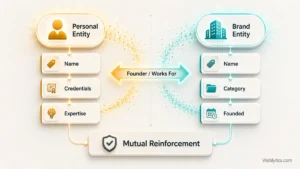
Who is behind it. For a company, name the founder or key people. For a person, state the professional role and organization. These person-to-organization relationships are the building blocks of a knowledge graph, and your entity homepage is where they should be explicitly stated. The mistake here is listing names without context. “Founded by Suraj Saini” with a link to his author page is a relationship the knowledge graph can act on. “Our passionate team” is not.
When you were established. Founding dates, launch dates, or publishing start dates give search engines a timeline that helps disambiguate your entity from others with similar names. This is the element most often left out entirely, usually because it feels unimportant. It is not. Two brands with similar names become immediately distinguishable once one was founded in 2018 and the other in 2024. State the year at minimum, the full date if you have it.
Where you can be found. Links to your social profiles, Wikidata entry, and any other external profiles where your entity has a presence. This is the sameAs layer that confirms to Google that the entity on your website and the entity on LinkedIn are the same thing. The mistake here is linking to profiles that are incomplete, inactive, or inconsistently named. A sameAs link to a LinkedIn profile where your company is named differently from your entity homepage creates a conflict rather than confirming a match. Audit every profile before linking to it.
None of this should read like marketing copy. It should read the way a Wikipedia entry reads. Factual. Direct. Neutral tone.
Building a machine-readable source of truth is the anchor that supports your schema, citations, and Knowledge Panel eligibility. We design and validate complete entity homepages as part of our hands-on Entity SEO services.
Schema Markup on an Entity Homepage
Writing the facts clearly on the page is the first step. Making those facts machine-readable is the second. This is where schema markup comes in.
For an organization entity homepage, the schema type you need is Organization. At a minimum, it should include your name, URL, logo, founding date, founder, and sameAs references pointing to your social profiles and Wikidata entry. Here is what that structure looks like:
{
  "@context": "https://schema.org",
  "@type": "Organization",
  "name": "Visiblytics",
  "url": "https://visiblytics.com",
  "logo": "https://visiblytics.com/wp-content/uploads/2026/07/visiblytics-favicon-512.png",
  "foundingDate": "2026",
  "founder": {
    "@type": "Person",
    "name": "Suraj Saini",
    "url": "https://visiblytics.com/about/suraj-saini/"
  },
  "sameAs": [
    "https://x.com/visiblytics",
    "https://www.linkedin.com/company/visiblytics",
    "https://www.crunchbase.com/organization/visiblytics"
  ]
}
For a person entity homepage (an author page or personal About page), the schema type is Person, with name, URL, job title, employer, and sameAs references.
The sameAs property is the one that does the most work for entity recognition specifically. It is the direct instruction to a search engine: “this entity on my page and this entity on that external platform are the same thing.” Without it, the search engine has to infer the connection. With it, the connection is explicit.
The Schema Markup Generator on this site handles the JSON-LD building without writing code by hand. The Structured Data Testing Tool confirms it is error-free before you publish.
Schema doesn’t create entity understanding by itself. Clear content + Schema + External corroboration = Semantic authority that search engines trust and act upon.
The Difference Between an Entity Homepage and an Entity Page
These two terms get used interchangeably and they should not be.
An entity homepage is the primary source-of-record page for your main entity, your organization or yourself as a person. There is only one per entity.
An entity page is any page that clearly defines and describes an entity. A product page is an entity page for that product. A service page is an entity page for that service. An author bio page is an entity page for that person. A topic cluster pillar page is an entity page for that topic.
Your entity homepage is the most important entity page on your site, but it is not the only one. Every distinct, clearly-described entity on your site has its own entity page. The entity homepage is simply the one that serves as the root anchor for your brand’s identity across the web.
Common Mistakes
Using the homepage as a substitute without optimizing it. Many sites technically have their homepage identified as the entity home, but the homepage is full of calls-to-action, rotating hero images, and marketing copy with no clear entity definition anywhere. Google is working with a very noisy signal. If your homepage is your entity home, make sure it also contains a clean, factual, clearly structured entity section, even if the rest of the page is marketing.
Writing the About page for humans only. A beautifully written story about your brand journey is great for visitors. It is almost useless for entity recognition if it does not also include the structured facts: entity name, type, founding date, people, and sameAs references. The About page can serve both purposes. Write the story if you want to, but make sure the facts are there too, clearly stated, not embedded in narrative.
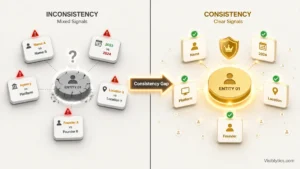
Inconsistent entity naming. If your entity homepage says “Visiblytics” but your LinkedIn says “Visiblytics SEO” and your Twitter says “Visiblytics.com,” you have created a disambiguation problem. Google has to decide which version of your entity is the authoritative one. Every inconsistency is a small delay in entity recognition. Standardize the name and use it exactly everywhere.
No sameAs links. I still see plenty of About pages with Organization schema that includes name, URL, and logo, but no sameAs references at all. Without sameAs, the schema tells Google what your entity is called on your own site. With sameAs, it tells Google that your entity on your site and your entity on four other trusted platforms are all the same thing. The difference in terms of knowledge graph confidence is significant.
Treating the entity homepage as a one-time task. If your organization changes focus, adds a founder, changes its name, or launches a new flagship product, the entity homepage needs to be updated. And every external source that has mentioned your entity needs to reflect the same updated facts. Entity maintenance is ongoing, not a one-time setup.
How the Entity Homepage Feeds Everything Else
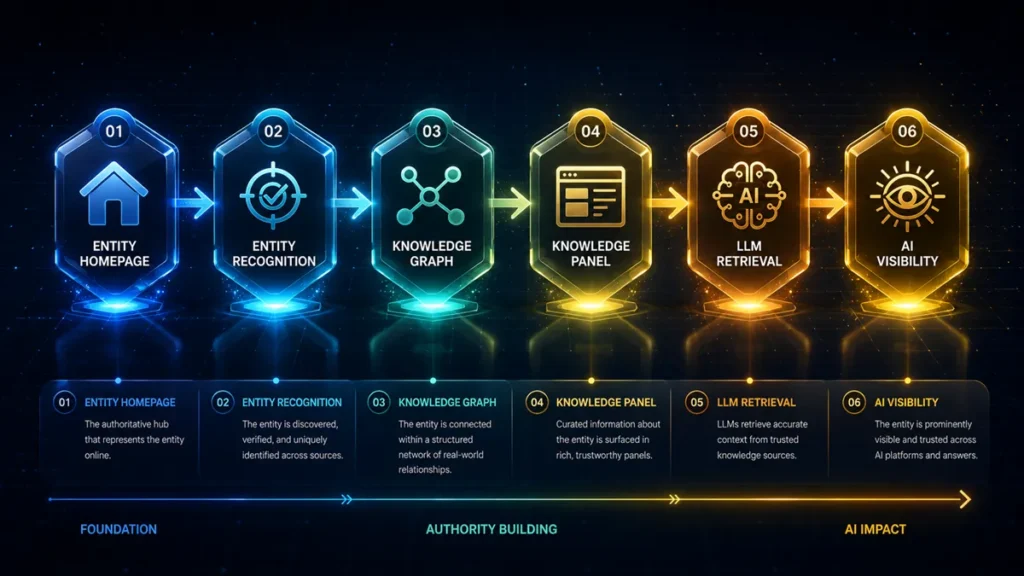
The entity homepage sits at the base of a chain. Everything that follows depends on it.
When Google has a reliable entity homepage to work from, entity recognition becomes cleaner and faster. That makes Knowledge Graph inclusion more likely, because the system has a stable anchor to build relationships from. Knowledge Graph inclusion, in turn, makes Knowledge Panel eligibility more achievable. And all of that together makes AI citation more likely, because AI systems have a verified, well-connected entity to draw from when deciding whether to cite your brand.
Here is what that difference looks like in practice.
Without a strong entity homepage: A consultancy publishes twelve well-researched articles on AI Visibility. The content is genuinely good. The About page is a three-paragraph founder story with no schema, no founding date, and a LinkedIn link that uses a slightly different company name. When an AI system retrieves sources for a query about AI Visibility, it finds the articles but cannot confidently attribute them to a specific, verified entity. The author is named but has no entity page. The company is mentioned but cannot be matched to a knowledge graph entry. The articles get retrieved as content but the brand is not cited as a source. The company exists in the answer but without a name attached to it.
With a strong entity homepage: The same consultancy also has a structured About page that states the exact company name, its founding date, its focus area in one plain sentence, the founder’s name linked to a complete author page, and sameAs references pointing to a LinkedIn profile and Wikidata entry that both use identical naming and descriptions. Organization schema covers all of it in machine-readable form. Now when the same AI system retrieves those twelve articles, it can anchor them to a verified entity, cross-reference that entity against the knowledge graph, confirm the match, and cite the brand by name in its answer.
The content did not change. The entity foundation did. That is what the entity homepage actually does.
This is why the entity homepage is not just an SEO asset. It is an AI Visibility asset. When ChatGPT, Gemini, Claude, or Perplexity encounters your brand in its retrieval process, it is looking for exactly what a good entity homepage provides: a clear, consistent, machine-readable statement of who you are, corroborated by matching signals across the rest of the web.
The full context for why this matters sits in the Entity SEO guide, which covers how entity recognition works from the ground up, and in the Knowledge Graph guide, which explains what happens to your entity after it is recognized.
Entity Homepage Checklist
Before you mark this work done, go through this list.
- Entity name stated exactly and consistently with how it appears everywhere else
- Entity type clearly indicated (organization, person, brand, product)
- One-sentence description of what the entity does, written in factual language
- Key person or founder named explicitly, with a link to their own entity page
- Founding or launch date included
- Organization schema implemented with name, URL, logo, foundingDate, founder, and description
- sameAs references pointing to every active external profile (LinkedIn, Twitter/X, Wikidata, etc.)
- Schema validated and error-free
- Page is crawlable and indexable
- Content uses the exact same entity name as every other source across your web presence
If any of these are missing, the entity homepage is incomplete regardless of how well-written the rest of the page is.
❓ Frequently Asked Questions
Is the entity homepage the same as the About page?
Not always, but the About page is usually the better choice for the entity homepage role. The main homepage is often identified by Google as the entity home by default, especially for older sites. If you are building from scratch, structure your About page to serve this purpose. It is a more focused, entity-specific signal than a marketing homepage.
Can a person have an entity homepage?
Yes. For an individual, the entity homepage is usually a personal domain About page or a professional profile page. It needs to contain the same elements: name, profession, organization affiliation, founding or start date, and sameAs links to external profiles.
Does the entity homepage need to rank in search results?
It needs to be crawlable and indexable, but it does not need to rank for any particular keyword. Its job is not to attract organic traffic. Its job is to give search engines and AI systems a reliable, machine-readable source of record for your entity’s identity.
What happens if I have no entity homepage?
Google will still try to build an entity for you from whatever signals it can find across the web. But without a clear source of record, that entity will be less confident, less accurate, and harder for AI systems to cite reliably. The entity homepage is not mandatory. It is just the most efficient way to give machines a clean starting point.
How often should I update the entity homepage?
Every time your entity changes in a meaningful way. New founder, new focus area, new organization name, new flagship work. Entity information that is stale creates signal conflicts between your own site and external sources that still reflect the old information.