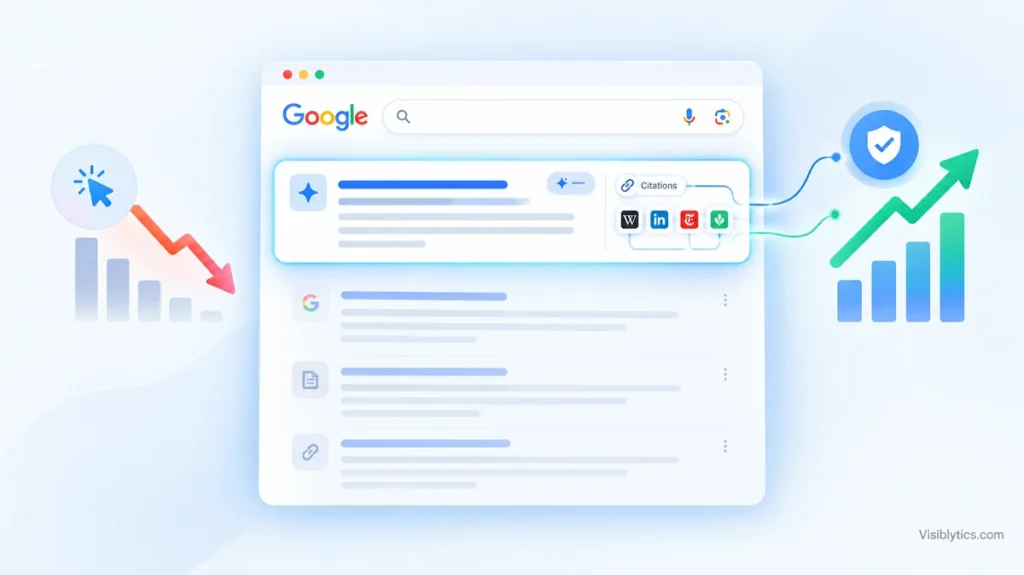
Your Search Console report shows the pattern: impressions on informational queries climbing, clicks flat or falling, average position unchanged. Nothing broke. Google started answering the question above your result, and the click went to the answer instead of the list.
For B2B brands this cuts two ways. The traffic you used to collect from “how to” and “what is the best” queries is shrinking, but the sources named inside the AI Overview are collecting disproportionate attention and trust. Being cited there is now a distinct objective from ranking, with its own formatting rules and its own measurement problem.
This guide covers what earns a citation card, how to structure content so it can be lifted accurately, which schema and entity signals matter and which are overhyped, and how to measure progress when Google gives you no dedicated report.
The AI Overviews Landscape: How Zero-Click Search Has Redefined Organic Traffic
Three shifts matter for planning, and none require speculation about Google’s roadmap.
1. Query coverage skews toward informational and comparison intent. Overviews appear most often on how-to, explanatory, “best for” and troubleshooting queries. Navigational and transactional queries trigger them far less. Your commercial-intent pages are mostly insulated; your top-of-funnel and mid-funnel guides are exposed.
2. Citations come from a wider pool than the top 3. The sources shown in an Overview frequently include pages ranking outside the first position, and sometimes outside page one. A page ranking 6 with a cleaner answer block can be cited over the page ranking 1 with a buried one. This is the opening for brands that cannot out-authority the category leaders.
3. The click economics changed. A cited source earns a link in the Overview, but the user often gets what they need without visiting. Expect lower click-through on cited informational queries and higher quality on the clicks that do arrive. Judge the program on assisted conversions and branded search lift, not raw sessions.
If you also care about being named in conversational assistants, the tactics overlap but are not identical. We cover those separately in our ChatGPT citation guide, so this article stays on Google’s surface.
Eligibility: The Gate Before Any Optimization
Google’s stated position is that no special markup or file is required to be included. A page must be indexed and eligible to be shown with a snippet. Confirm four things before touching content:
- The URL is indexed and returns
200. Confirm in Search Console’s URL Inspection tool. - No
nosnippetdirective in the robots meta tag orX-Robots-Tagheader. A restrictivemax-snippetvalue can also limit what Google may excerpt. - Key answer content renders in the initial HTML or is reliably rendered by Googlebot. Verify in the URL Inspection live test.
- The page isn’t buried in an orphaned or parameter-polluted structure. A quick Screaming Frog crawl will surface orphans and noindex leaks.
One audit we run repeatedly finds legacy max-snippet:0 or nosnippet rules applied sitewide by an SEO plugin years ago. It silently disqualifies the entire blog from snippet-based surfaces.
Content Anatomy of an AI Overview Citation: Formatting, Data Tables, and Direct Answers
The pattern in cited pages is consistent: the question is asked in a heading, the direct answer follows immediately in plain language, and supporting structure (a list, a table, a short worked example) sits beneath it. The model can lift the answer block without needing to interpret surrounding narrative.
Here are the working targets we use when restructuring pages:
| Element | Working target | Why it matters |
|---|---|---|
| Question-shaped H2/H3 | Mirrors the exact query phrasing | Maps your section to the retrieved query |
| Direct answer block | 40 to 60 words, directly under the heading | Self-contained, quotable without context |
| Supporting list | 3 to 7 items, parallel grammar | Extractable as steps or criteria |
| Comparison table | 3 to 6 columns, 4 to 8 rows, header row filled | Gives a structured source for “X vs Y” prompts |
| Named entities | Product, tool and metric names spelled out consistently | Reduces ambiguity in attribution |
| Dates and versions | Stated explicitly (“updated October 2026”) | Freshness is checkable |
The Formatting Blueprint
Use this block pattern for every section you want to be citable. It is plain HTML on purpose, since nothing exotic is needed:
<h2>How long does a Shopify to headless migration take?</h2>

<!-- Direct answer: 40-60 words, no hedging preamble -->
<p>A typical Shopify-to-headless migration takes 10 to 16 weeks for a
store with under 5,000 SKUs. Timeline is driven by theme complexity,
third-party app replacement and redirect mapping, not by catalog size alone.</p>

<!-- Supporting structure -->
<table>
  <thead>
    <tr><th>Store size</th><th>Typical timeline</th><th>Main risk</th></tr>
  </thead>
  <tbody>
    <tr><td>Under 500 SKUs</td><td>8-10 weeks</td><td>App replacement</td></tr>
    <tr><td>500-5,000 SKUs</td><td>10-16 weeks</td><td>Redirect mapping</td></tr>
    <tr><td>5,000+ SKUs</td><td>16-26 weeks</td><td>Search and filtering parity</td></tr>
  </tbody>
</table>

<!-- Context and proof AFTER the answer, not before it -->
<p>In our last four migrations, redirect mapping consumed more time than
front-end development...</p>
Three rules keep this from becoming formulaic filler:
- Answer first, context second. Journalism’s inverted pyramid. If the first 60 words of a section do not stand alone, rewrite them.
- One question per heading. Compound headings (“Pricing, timelines, and risks”) dilute the match to any single query.
- Tables carry data, not decoration. If a table has empty cells or marketing adjectives, it will not be used. Fill every cell with a number, a named item or a yes/no.
For the broader hierarchy of on-page elements, such as title tags, heading structure and internal links, a specialist freelance on-page SEO expert can systematize these patterns across hundreds of URLs. The rest of this guide focuses on the parts specific to AI surfaces.
Information Gain: Why Repeating Competitor Copy Guarantees AI Exclusion
This is the filter most brands fail. If your page says what the existing top ten already say, in the same order, with the same examples, there is no reason for the system to prefer it. The Overview already has that information from sources it trusts more.
Information gain means the page contains something the other candidate sources do not. In practice, that is one of five things:
- Original numbers. Benchmarks from your own client data, support tickets, crawl datasets or surveys. Even a small sample (n=40) is valuable when the method is stated.
- A named framework or decision rule. “Use a 301 when the pages serve the same intent and the old URL has external links; canonicalize when both must stay live.” Specific, applicable, attributable.
- A worked example with real figures. Show the calculation, not just the formula.
- First-hand evidence. Screenshots from Search Console, log excerpts, before-and-after data, with identifying details redacted.
- A clearly stated position. Where the field disagrees, say which side you take and the conditions under which you would switch.
A fast information-gain test: take your draft and the top five ranking pages. List every claim in your draft. Mark each as “also in at least three competitors” or “unique.” If fewer than 20% of your claims are unique, the page is a candidate for exclusion, no matter how well formatted.
This is also why mass-produced AI-written content underperforms for citations. It is trained to produce the consensus answer, which is exactly the answer already available. Use AI for structure and drafting speed if you like, but the unique 20% has to come from your data and your experience.
Schema Markup and Entity Signals That Power Google’s Gemini-Driven Overviews
Be precise about what schema does here. Google has said structured data is not required for inclusion in AI features, and no markup guarantees a citation. What it does is reduce ambiguity: it tells Google who published the page, who wrote it, what the page is about, and how it connects to other entities. That makes your content easier to trust and attribute.
Prioritize these, in order of practical value:
Organizationwith a completesameAsarray on every page template, pointing to your verified LinkedIn, Crunchbase, Wikidata (if you have an entry), and other authoritative profiles.ArticleorBlogPostingwithauthor,datePublished, anddateModified, whereauthorlinks to a realPersonpage with credentials andsameAsprofiles.FAQPageorHowToonly where the visible page genuinely contains that content. Google has sharply limited rich-result display for these types, so do not expect a visual payoff. The structure still helps parsing when it matches the on-page content.Product,SoftwareApplicationorServicemarkup on commercial pages, with accurate pricing, offers and category.
Validate with the Rich Results Test and the Schema Markup Validator, and make sure marked-up content matches visible content exactly. Mismatch between schema and page text is a quality signal in the wrong direction.
Entity consistency matters more than any single markup type. If your company is described three different ways across your site, LinkedIn and Crunchbase, schema will not rescue it. Our entity SEO services page lays out how we reconcile those records.
Measuring AI Overview Impressions: Search Console Signals vs. Third-Party Monitoring
Google Search Console does not report AI Overview visibility as a separate dimension. Impressions and clicks from Overviews are counted within overall Web search performance, which means you have to infer exposure rather than read it directly.
What You Can Do in Search Console
- Filter to question-pattern queries where Overviews are most common. In Performance, add a Query filter with “Custom (regex)” and use:
^(how|what|why|when|which|can|does|is|are|should)\b|\b(vs|versus|best|alternative|alternatives|examples?)\b
- Compare 90-day periods on those queries: impressions up, CTR down, position stable is the signature of Overview exposure on your pages.
- Track branded query growth. Citation visibility often lifts branded search weeks later, even when clicks from the Overview itself are modest.
- Watch assisted conversions in analytics. Users who see you cited and return via brand search or direct are attributed elsewhere.
What Third-Party Monitoring Adds
Semrush and Ahrefs both track whether a keyword triggers an AI Overview and whether your domain is cited in it. Budget roughly $130 to $500 per month for the tool tier that includes this, depending on seat count and tracked keywords. Use it to build a fixed set of 50 to 150 target queries, then review monthly:
| Metric | Definition | Healthy direction |
|---|---|---|
| Overview trigger rate | Share of tracked queries that show an Overview | Context only, not a goal |
| Citation rate | Share of triggering queries where your domain is cited | Up over a 3-month window |
| Citation position | Where your link appears in the card list | Toward earlier positions |
| Branded search volume | Brand query impressions in GSC | Up |
| Assisted conversions | Conversions where organic was an earlier touch | Up |
Treat the numbers as directional. Overviews change by user, location and day, so measure trends over months rather than reacting to a single snapshot.
Future-Proofing Your Organic Strategy with Dual-Engine (Google + AI) Visibility Services
The practical reality for 2026 is that the same pages now serve two systems: the classic ranking system that returns a list, and the answer systems that decide who gets named. Content built for one and ignored for the other leaves value on the table.
A workable operating model looks like this:
- Prioritize the 20 to 40 informational and comparison queries closest to your revenue.
- Restructure the matching pages with the answer-first blueprint above.
- Add information gain: one original data point, framework or worked example per page.
- Align schema and entity records so the publisher and author are unambiguous.
- Measure monthly against a fixed query set, and revisit pages that lose ground.
Most in-house teams can execute steps 1 and 2. Steps 3 through 5 are where specialized help pays back, because they depend on proprietary data, technical implementation and sustained measurement. That is the work our expert AI visibility and GEO optimization services are built around, combining on-page restructuring, entity cleanup and monthly re-baselining so the same asset performs in Google’s list and inside its answers.
If you would rather bring in a strategic LLM SEO and AI search consultant for a scoped engagement than build the capability internally, start with a baseline: your 50 highest-value queries, current citation status, and the specific pages and signals holding each one back. That gives you a prioritized fix list and a number to improve against.
Quick Checklist: Is This Page Built to Be Cited?
- Indexed,
200response, nonosnippetor restrictivemax-snippet - Question-shaped heading matching real query phrasing
- 40 to 60 word direct answer directly under the heading
- At least one list or table with fully populated cells
- At least one original data point, framework or worked example
Organization,ArticleandPersonschema valid and matching visible content- Author page with credentials and
sameAsprofiles - Visible “last updated” date, and the page is actually kept current
- Tracked in a fixed query set and reviewed monthly